
Oct 10, 2026
By Transpire Insight
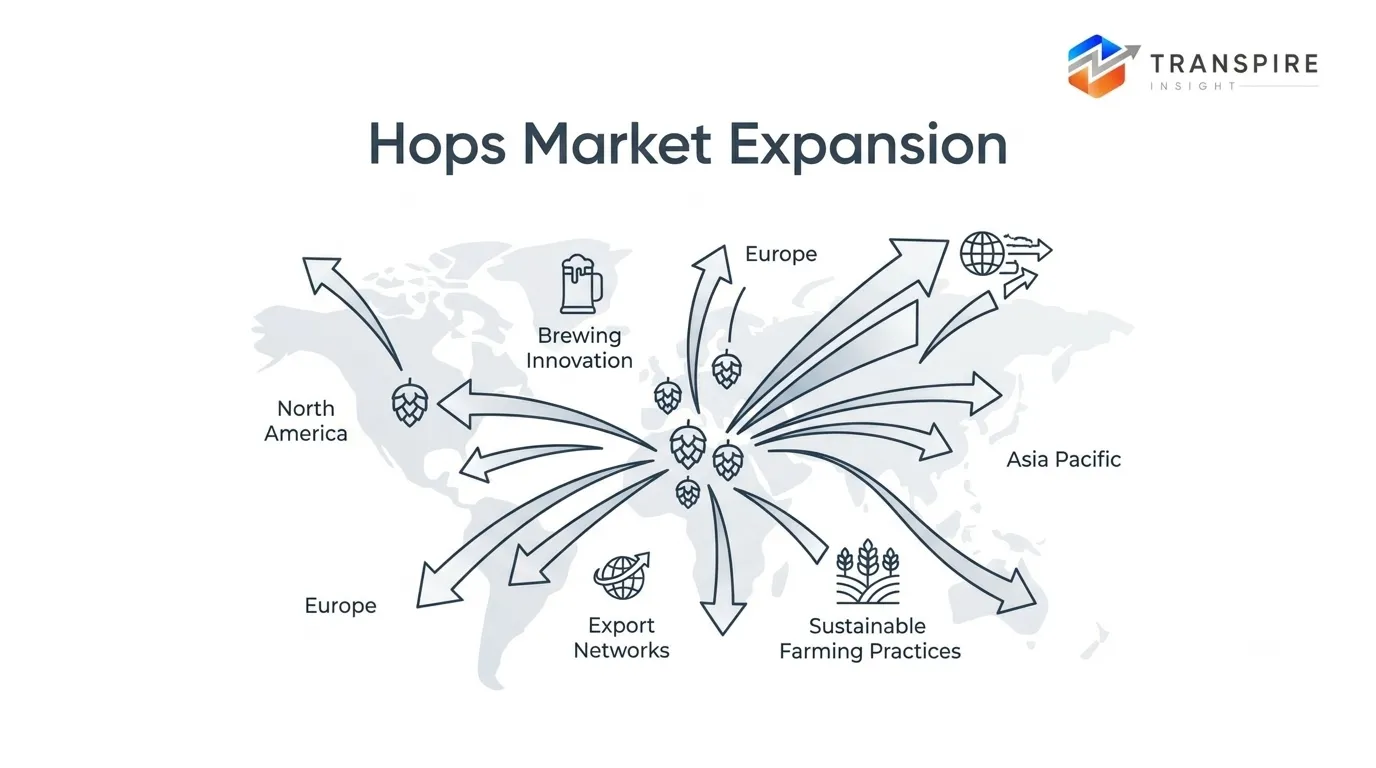
The global Hops Market is undergoing a structural adjustment as growers respond to changing beer demand, acreage reductions, climate pressures, varietal preferences, and increasing interest in specialty aroma hops. While brewing remains the dominant application, hop-derived ingredients are also creating opportunities across food, nutraceutical, pharmaceutical, and cosmetic applications.
Hops Market Overview
Hops are the flowers of Humulus lupulus, primarily used in brewing to contribute bitterness, aroma, flavor, and preservation characteristics.
The commercial market includes:
Beer brewing remains the principal application, although hop derivatives are increasingly being explored in nutraceuticals, pharmaceuticals, cosmetics, food flavoring, and other applications.
Transpire Insights estimates that the global Hops Market generated approximately USD 9.33 billion in 2025, increased to approximately USD 9.89 billion in 2026, and is projected to reach approximately USD 14.90 billion by 2033, representing a CAGR of approximately 6.02% from 2026 to 2033.
Beer brewing remains the dominant application in Transpire's segmentation, accounting for approximately 61% of market revenue.
Latest Global Market Developments
The BarthHaas Report 2025/2026 found that global hop acreage fell approximately 5.5% to 52,660 hectares during crop year 2025.
Global production declined approximately 3.8% to 109,188 metric tonnes, while average alpha-acid content increased modestly from 10.5% to 10.6%.
Germany recorded approximately 18,962 hectares of hop acreage in 2025, although acreage decreased year over year. The United States followed with approximately 17,057 hectares.
BarthHaas reported global beer production of just under 1.9 billion hectolitres in 2025, representing a decline of approximately 1%.
The Brewers Association reported 41,642 acres strung for harvest in 2026, representing only a negligible decrease from 2025. Warm and dry conditions and water management remained important production considerations.
Extreme heat, water availability, disease pressure, and smoke exposure can affect both hop yield and quality.
Craft brewers continue to create demand for varieties with distinctive citrus, tropical, floral, herbal, and resinous characteristics.
Hop pellets, cryogenic products, liquid extracts, and other concentrated formats can improve handling efficiency and allow brewers to target specific flavor and aroma profiles.
Why Hops Matter?
Hops are essential to modern brewing because they contribute several characteristics that shape beer quality and identity.
Their commercial importance extends across:
The industry is increasingly divided between commodity-scale brewing requirements and higher-value specialty varieties.
Key Factors Driving the Hops Market
1. Global Brewing Demand
Breweries remain the core buyers of hops and therefore strongly influence market conditions.
2. Craft Beer
Craft brewers often use distinctive hop varieties and higher hop concentrations, supporting demand for specialty products.
3. Premiumization
Brewers increasingly differentiate products through hop varieties, origin, aroma profiles, and brewing techniques.
4. Hop Extract Technology
Concentrated extracts can improve ingredient efficiency, storage, transportation, and formulation precision.
5. Non-Brewing Applications
Research and commercial development involving hop-derived compounds are creating potential opportunities beyond beer.
Five High-Potential Markets Shaping Global Hops Demand
1. Germany
Germany remains the world's largest hop-growing country, with approximately 18,962 hectares in the 2025 crop year.
The country benefits from a long-established hop-growing ecosystem and the importance of German brewing.
2. United States
The U.S. is one of the world's most important hop producers and a major market for aroma varieties associated with craft brewing.
The 2026 U.S. crop outlook indicated 41,642 acres strung for harvest.
3. China
China provides substantial long-term potential through its large beverage market, brewing industry, agricultural base, and expanding interest in specialty ingredients.
4. United Kingdom
The U.K. has a long brewing heritage and a growing specialty-beer ecosystem, supporting demand for distinctive hop varieties.
5. Australia
Australia is an important specialty-hop market, particularly for distinctive aroma varieties developed for modern craft brewing.
Competitive Landscape
The Hops Market includes agricultural producers, hop merchants, breeding companies, processors, extract manufacturers, and specialized ingredient suppliers.
Top 5 Companies in the Hops Market
BarthHaas is one of the world's major hop specialists, with activities spanning hop breeding, cultivation, processing, trading, and brewing-related ingredients.
Yakima Chief Hops is a major supplier to the brewing industry and is strongly associated with specialty and aroma hop varieties.
Hopsteiner operates across hop growing, processing, breeding, and brewing ingredients, providing broad exposure to the commercial hop supply chain.
John I. Haas is a major hop supplier serving breweries with hop varieties, extracts, and brewing ingredients.
HVG is an important European hop organization involved in marketing and supplying hops to breweries worldwide.
Opportunities for Small Investors
Challenges & Restraints
Climate Volatility
Heat, drought, water shortages, and extreme weather can reduce yields and affect alpha-acid and aroma characteristics.
Acreage Adjustment
Growers are actively adjusting acreage in response to changing market conditions. The 2025 global decline illustrates the scale of this adjustment.
Brewing-Industry Pressure
Global beer production declined by approximately 1% in 2025, creating additional pressure on hop demand.
Production Costs
Labor, irrigation, energy, fertilizer, harvesting, drying, and processing costs affect farm profitability.
Variety Risk
Specialty varieties can command higher prices, but demand can shift rapidly as brewing trends change.
Conclusion
The Hops Market is entering a period characterized by acreage optimization, specialty-variety demand, agricultural risk management, processing innovation, and changing global beer consumption.
The 2025 crop data demonstrate the adjustment underway: global acreage declined to 52,660 hectares, while production decreased to approximately 109,188 metric tonnes.
At the same time, the 2026 U.S. outlook suggests that growers are moving toward greater production discipline, with acreage remaining broadly stable after several years of reductions.
Transpire Insights estimates the global market could increase from USD 9.33 billion in 2025 to approximately USD 14.90 billion by 2033, supported by brewing demand, specialty varieties, extracts, and emerging non-brewing applications.
For growers, processors, ingredient suppliers, breweries, and agricultural-technology companies, future opportunities will increasingly depend on yield efficiency, climate resilience, specialty genetics, processing quality, and differentiated hop products.


Send us a brief description of your challenge and we'll get back to you within 24 hours.

 inquiry@transpireinsight.com
 APAC:+91 7666513636
 Address


