
Aug 17, 2026
By Transpire Insight
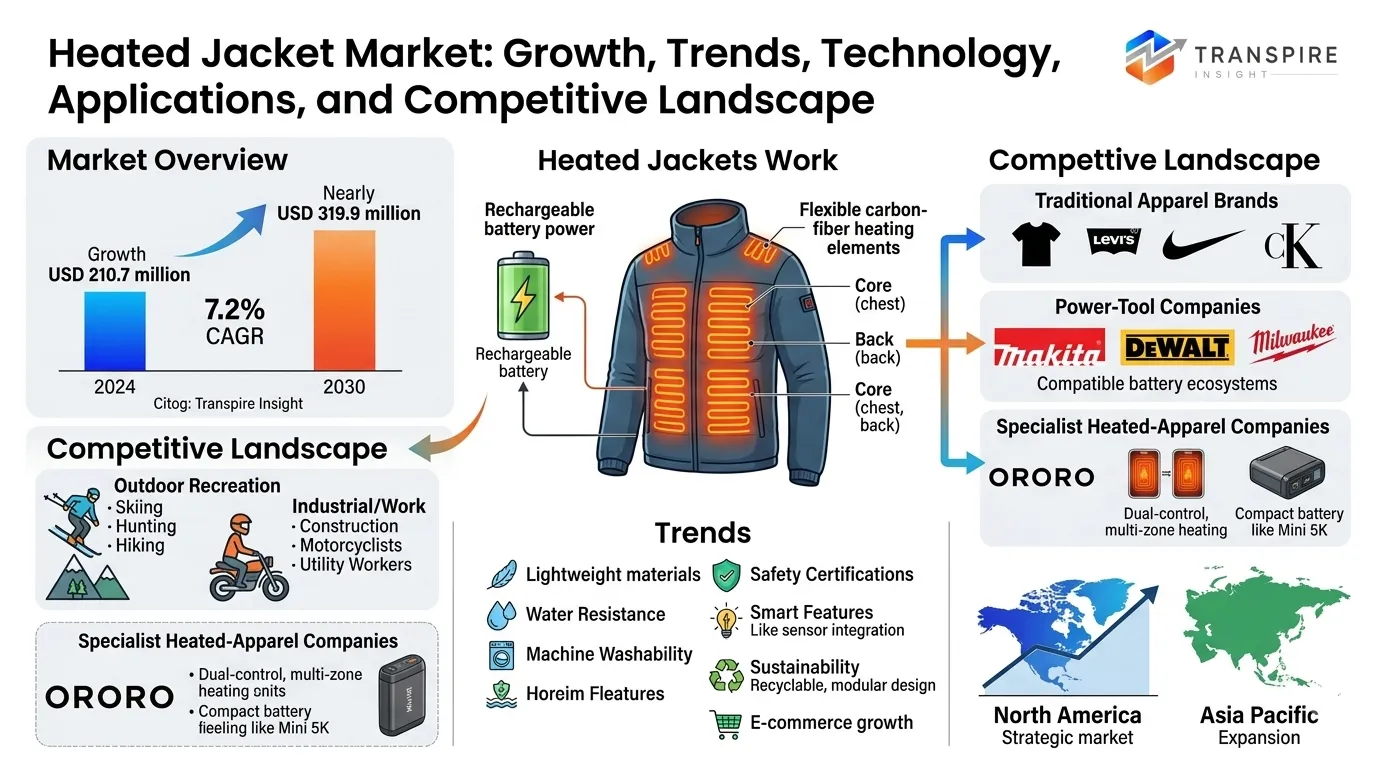
According to Transpire Insight, the global Heated Jacket Market is developing rapidly as consumers and professional users increasingly seek clothing that combines conventional insulation with electrically generated warmth. The market was valued at approximately USD 210.7 million in 2024 and is projected to reach nearly USD 319.9 million by 2030, expanding at a CAGR of approximately 7.2% during 2024–2030. North America remains a major market because of its cold climate, outdoor recreation culture, construction activity, and established demand for technical winter apparel.
Heated jackets are increasingly positioned between traditional winter clothing and wearable technology. Unlike conventional jackets that depend primarily on insulation to retain body heat, heated jackets incorporate electrical heating elements that actively generate warmth. This capability enables users to adjust thermal output according to weather conditions, physical activity, and individual comfort.
The growing popularity of battery-powered apparel is also changing the competitive structure of the winter-clothing industry. Manufacturers are combining lightweight fabrics, carbon-fiber heating elements, rechargeable batteries, digital controls, water-resistant shells, and thermal insulation to create garments designed for both every day and specialized use.
The market therefore extends beyond fashion and seasonal clothing. Heated jackets are increasingly relevant to construction workers, motorcyclists, skiers, hunters, outdoor technicians, warehouse personnel, utility workers, hikers, travelers, and other users exposed to prolonged cold conditions.
How Heated Jackets Work
A heated jacket generally combines a rechargeable battery, conductive heating elements, wiring, control electronics, and an outer garment designed to retain the generated warmth.
The heating elements are usually positioned around areas such as the chest, back, collar, pockets, or arms. When electrical current passes through the conductive material, resistance generates heat that is transferred through the garment toward the wearer.
Modern systems increasingly use carbon-fiber heating elements because they can be incorporated into flexible textile structures without creating the rigidity associated with conventional heating wires.
ORORO's current men's classic heated jacket, for example, incorporates 3 carbon-fiber heating elements across the chest and mid-back and provides 3 adjustable heating levels.
This configuration demonstrates how manufacturers are designing heating systems around the body's core rather than attempting to heat the entire garment uniformly.
The approach has two advantages. First, it can concentrate energy in areas where warmth is most valuable. Second, it can reduce unnecessary power consumption compared with activating a large number of heating elements simultaneously.
Battery Technology Becomes a Core Product Differentiator
The battery is one of the most important components of a heated jacket because it directly influences garment weight, operating duration, heating intensity, and user convenience.
Current consumer products demonstrate the industry's movement toward compact lithium-ion power systems. ORORO's Mini 5K battery provides 4,800 mAh at 7.4 V, equivalent to approximately 35.4 Wh, while weighing approximately 185 grams.
The relatively compact battery architecture allows manufacturers to integrate electrical heating without making the jacket excessively heavy.
Battery charging is also becoming part of the product experience. ORORO states that its battery can be fully charged in approximately 4 hours using a compatible 15-W charging system.
For consumers, the balance between charging time and operating duration is increasingly important. A jacket designed for short outdoor activities may require only a compact battery, while industrial workers spending most of a shift outdoors may prefer larger or interchangeable power sources.
Download the exclusive Heated Jacket Market sample report today to uncover expert insights, emerging trends, and the opportunities defining the future of the industry.
Heating Zones Create More Personalized Thermal Control
Heating-zone configuration is becoming a major differentiating factor across heated jacket products.
Basic models generally concentrate heating around the torso, while premium products increasingly add heating to pockets, arms, collars, and other areas.
ORORO's dual-control heated jacket incorporates 5 separate heating zones, including the left and right pockets, both arms, and the mid-back. It also provides independent controls that allow users to activate different sections of the garment. This development is significant because thermal requirements vary substantially by activity.
A motorcyclist may need additional warmth around the arms and chest because of wind exposure. A construction worker may prioritize the back and torso. A stationary hunter may benefit from concentrated core heating. The ability to customize heat distribution therefore gives manufacturers another way to differentiate products without relying solely on higher battery capacity.
Heated Jackets Are Becoming More Lightweight
Weight is one of the biggest limitations associated with electrically heated clothing.
Traditional battery systems could make heated apparel cumbersome, especially when combined with insulation, waterproof membranes, zippers, pockets, and protective materials. Modern product designs are attempting to reduce this burden through smaller battery packs and thinner heating elements.
The 185-gram battery weight used in ORORO's Mini 5K system illustrates how consumer-oriented heated jackets can incorporate meaningful electrical capacity without requiring a large external power pack. Weight reduction is particularly valuable in hiking, skiing, travel, and motorcycling because excessive garment weight can reduce mobility.
The trend is consequently shifting toward a combination of low-weight power systems, flexible heating components, lightweight insulation, and breathable outer fabrics.
Outdoor Recreation Drives Product Adoption
Outdoor recreation represents one of the most important demand channels for heated jackets. Winter sports participants frequently experience changing thermal conditions during skiing, snowboarding, hiking, camping, and other activities. Physical exertion can generate significant body heat during movement, while inactivity during breaks or lifts can produce rapid cooling. Heated jackets allow users to compensate for these fluctuations without continuously changing layers.
The wider winter-apparel market is also benefiting from increased attention toward technical outerwear. In 2026, ski fashion and performance apparel have increasingly crossed into mainstream fashion, with brands expanding collections that combine technical functionality with lifestyle positioning.
This trend can benefit heated-jacket manufacturers because consumers are becoming more comfortable paying premium prices for clothing that combines performance and design. The opportunity is particularly strong for garments that can transition between outdoor recreation and everyday winter use.
Unlike recreational consumers, these users generally prioritize:
This has encouraged power-tool manufacturers to enter heated apparel.
Makita, for example, has integrated heated clothing into its cordless product ecosystem and has developed heated apparel powered by its established battery platforms. The company also introduced 2 heated base-layer products in the United Kingdom in December 2023, expanding its heated clothing portfolio beyond jackets. This demonstrates how heated apparel can become an extension of the professional cordless-tool ecosystem.
Power-Tool Companies Strengthen the Industrial Segment
The entry of power-tool brands provides a structural advantage because professional users may already own compatible battery systems.
Instead of purchasing a dedicated battery ecosystem exclusively for clothing, users can potentially integrate heated apparel into equipment platforms they already use.
This approach creates cross-selling opportunities while reducing some of the adoption barriers associated with battery-powered clothing.
Companies such as DEWALT, Makita, Bosch, and Milwaukee Tool compete alongside specialist heated-apparel companies, creating a market where apparel engineering and battery technology increasingly overlap.
The competitive landscape is therefore becoming more diverse.
Traditional apparel brands contribute textile expertise and fashion design, while tool manufacturers contribute battery engineering, ruggedness, and professional distribution. Specialist heated-clothing companies occupy the middle ground by combining both technologies into dedicated consumer products.
Proceed to Checkout to purchase the exclusive Heated Jacket Market report and gain instant access to in-depth market intelligence, strategic analysis, and future growth opportunities.
Premium Pricing Reflects Integrated Technology
Heated jackets typically command higher prices than comparable non-heated winter jackets because they include additional electronic components.
ORORO's current classic women's heated jacket is listed at approximately USD 189.99, including its battery package.
Its more advanced dual-control men's jacket is listed at approximately USD 279.99, reflecting the additional heating zones and control architecture.
As production volumes increase and battery components become more efficient, manufacturers may gain opportunities to introduce lower-priced products without sacrificing essential functionality.
At the premium end, however, consumers may continue to pay more for higher heating coverage, advanced materials, stronger weather resistance, and smart controls.
Water Resistance and Washability Improve Practicality
Heated apparel must perform as both clothing and electronic equipment. This creates a difficult design requirement because garments must protect electronic components from moisture while remaining comfortable and washable.
ORORO's current heated-jacket products are marketed as water- and wind-resistant and machine washable, illustrating how manufacturers are working to make electrically heated apparel compatible with normal clothing maintenance. The removable-battery concept is particularly important.
Users need to be able to wash the garment without exposing the battery or charging system to unnecessary moisture.
Manufacturers therefore increasingly separate the power source from the textile heating system while protecting the embedded electrical components through insulation and garment construction.
Electrical safety is a critical factor in the Heated Jacket Market.
Consumers need confidence that the battery, wiring, charging system, and heating elements can operate safely under varying conditions. ORORO states that its battery systems carry 5 major certification markings, including UL, CUL, CE, FCC, and RoHS compliance.
These certifications can provide an important marketing advantage because they communicate that the electronic components have been designed and evaluated according to recognized requirements. For manufacturers, compliance also becomes increasingly important when selling products internationally.
Different regions can impose varying requirements on batteries, electrical systems, electromagnetic compatibility, and product labeling.
Smart Heated Jackets Move Toward Wearable Technology
The next stage of market development is likely to involve greater integration between heated jackets and digital controls.
Current products already provide multiple heating levels and separate heating zones. Future systems can extend this functionality through sensors, mobile applications, automatic temperature adjustment, and predictive battery management.
A smart heated jacket could potentially respond to ambient temperature and wearer activity rather than relying entirely on manual controls.
For example, a garment could reduce heating output when the wearer begins walking and increase it when the person becomes stationary. This type of adaptive thermal management could improve both comfort and battery efficiency.
The development also creates opportunities for software companies, sensor manufacturers, battery-management providers, and wearable-electronics developers to participate in the value chain.
E-Commerce Expands Market Reach
Heated jackets are particularly suitable for online retail because customers can compare technical specifications before purchasing. Traditional winter clothing can often be evaluated primarily through fit, appearance, and material. Heated jackets require consumers to consider additional characteristics such as battery capacity, charging requirements, heating zones, operating duration, temperature controls, and safety certifications.
E-commerce platforms allow manufacturers to communicate these specifications in detail. Direct-to-consumer brands can also use online channels to target specialized customer groups such as motorcycle riders, hunters, outdoor workers, skiers, and winter travelers. This reduces the requirement for extensive physical retail infrastructure and enables smaller manufacturers to reach international consumers.
Customize the exclusive Heated Jacket Market report today to receive tailored insights, country-specific analysis, and business-focused market intelligence.
Sustainability Becomes Increasingly Important
Sustainability is becoming a growing consideration within the heated apparel industry. The integration of electronics introduces additional environmental questions because batteries, wiring, heating components, and conventional textiles must ultimately be managed at the end of the product's life.
Manufacturers can address this challenge through removable batteries, repairable components, recyclable materials, longer warranties, and improved product durability. The objective is to ensure that electronic integration does not shorten the useful life of the garment.
Longer-lasting products can also provide an economic advantage to consumers because the higher initial purchase price can be distributed over a longer period of use. Future products may increasingly emphasize modular construction in which batteries and heating systems can be replaced without discarding the entire jacket.
North America Remains a Strategic Market
North America has developed into one of the strongest markets for heated jackets because of its combination of cold-weather conditions, outdoor recreation, professional workwear, and consumer familiarity with technical apparel.
The region's demand base is diversified. Outdoor consumers purchase heated jackets for skiing, hiking, hunting, camping, and travel, while industrial customers purchase them for construction, utilities, transportation, and other cold-weather occupations.
This diversity reduces dependence on a single application. The market is also supported by the presence of major technology and workwear brands that can distribute heated apparel through established professional channels.
Europe Offers Opportunities Through Winter Tourism and Technical Apparel
European demand is supported by cold-weather markets, winter tourism, outdoor recreation, and strong consumer interest in technical clothing. Alpine markets are particularly attractive because skiing and snow-related tourism create a natural environment for premium thermal products.
Northern European countries also offer opportunities for workwear applications because of extended periods of low temperatures. The European market can therefore support multiple positioning strategies, ranging from premium lifestyle products to rugged industrial garments.
Sustainability requirements may also have a stronger influence on product development in Europe, encouraging manufacturers to explore recyclable textiles, efficient batteries, repair programs, and responsible sourcing.
Asia Pacific Represents a Long-Term Expansion Opportunity
Asia Pacific provides an increasingly diverse opportunity for heated jackets. Japan and South Korea have technology-oriented consumer markets, while China combines large-scale manufacturing capabilities with a growing winter-sports ecosystem.
China's expanding winter recreation industry creates opportunities for technical winter clothing, particularly in regions with established snow and mountain tourism. India represents a more specialized opportunity.
The country's overall climate limits mass-market demand, but northern and high-altitude regions, winter tourism, industrial work, defense-related applications, and outdoor recreation can create targeted opportunities. Manufacturers entering these markets will need to localize products according to climate, price sensitivity, battery preferences, and consumer behavior.
Recent Product Development Strengthens Market Innovation
Product innovation remains central to the market.
In December 2023, Makita UK expanded its heated apparel portfolio with 2 heated base-layer models, the DCX200 and DCX201, designed for professional users and powered through the company's cordless battery platforms.
The significance of this development extends beyond the individual products. It shows that heated clothing is gradually becoming a broader product category rather than a single jacket format. Manufacturers can expand into heated vests, shirts, base layers, hoodies, gloves, socks, and other garments.
This creates opportunities for companies to build complete heated apparel ecosystems in which consumers can select products according to the level of thermal protection required.
Schedule a meeting with our market experts to discuss the exclusive Heated Jacket Market report and identify the best research solution for your organization.
Transpire Insight Experts View
According to Transpire Insight analysis, the Heated Jacket Market is transitioning from a niche winter-wear category toward a broader technology-enabled apparel segment. However, future growth will depend less on simply adding more heating elements and more on improving the overall user experience.
The next generation of products is expected to focus on lighter batteries, faster charging, flexible heating materials, intelligent temperature management, improved washability, stronger weather protection, and modular electronic components.
The current product landscape already demonstrates this evolution. Consumer jackets are incorporating carbon-fiber heating systems, multi-level controls, USB-C charging, removable batteries, and certified electronic components, while professional manufacturers are extending heated apparel across broader cordless-tool ecosystems.
From a competitive perspective, companies that successfully combine thermal performance, battery efficiency, garment comfort, durability, safety, and attractive design are likely to gain a stronger position.


Send us a brief description of your challenge and we'll get back to you within 24 hours.

 inquiry@transpireinsight.com
 APAC:+91 7666513636
 Address


