
Aug 17, 2026
By Transpire Insight
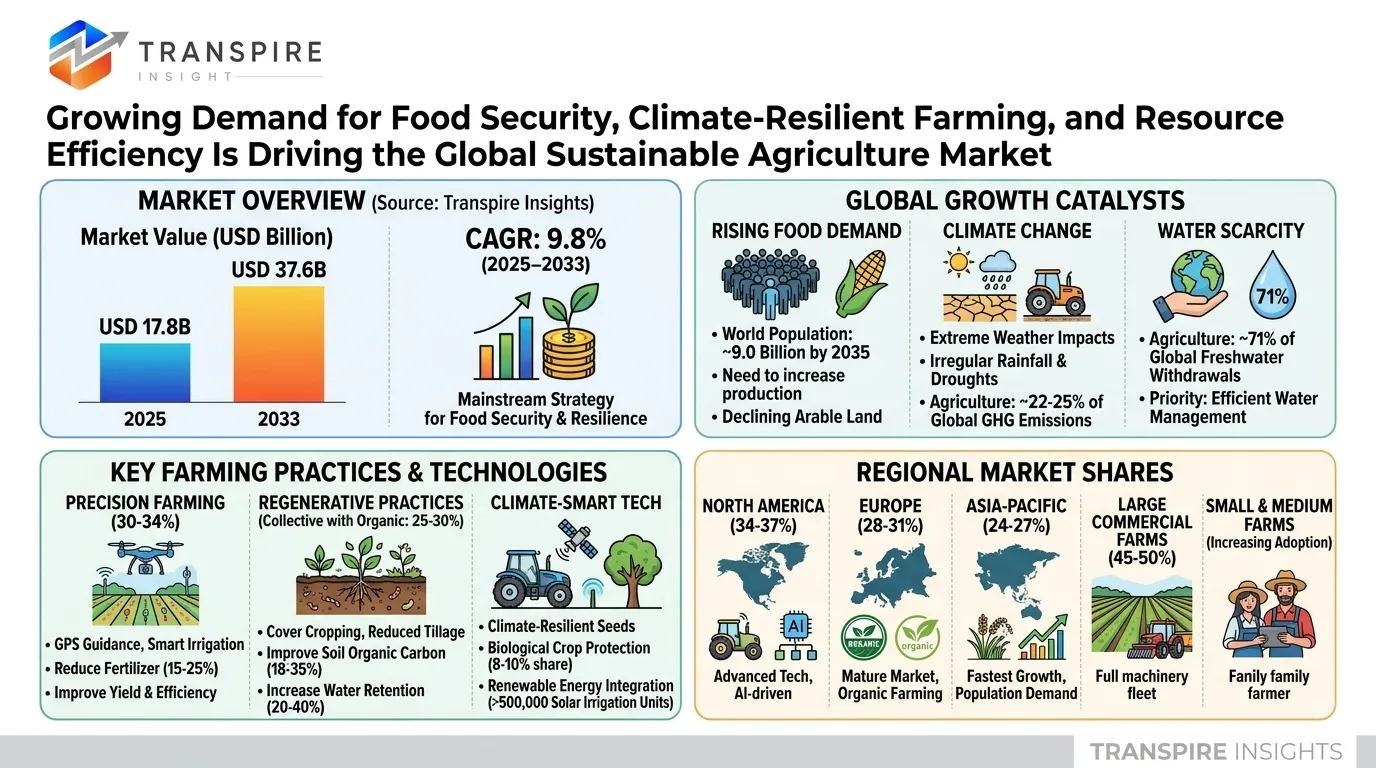
The global Sustainable Agriculture Market is witnessing significant transformation as governments, agribusinesses, food manufacturers, and farmers increasingly adopt environmentally responsible farming practices to address rising food demand while conserving natural resources. Sustainable agriculture integrates modern technologies with ecological farming principles to improve agricultural productivity, maintain soil fertility, reduce greenhouse gas emissions, conserve biodiversity, and optimize the use of water, fertilizers, and energy. According to Transpire Insights, the market is evolving from a niche environmental initiative into a mainstream agricultural strategy that supports long-term food security, climate resilience, and economic sustainability.
According to Transpire Insights, the Global Sustainable Agriculture Market was valued at approximately USD 17.8 billion in 2025 and is projected to reach around USD 37.6 billion by 2033, expanding at a CAGR of approximately 9.8% during the forecast period. Growing investments in precision farming, regenerative agriculture, organic cultivation, biological crop protection, digital farming platforms, and climate-smart agricultural technologies are expected to sustain strong market growth over the next decade.
One of the primary factors driving the market is the increasing global demand for food. The world's population is projected to approach 8.9–9.0 billion by 2035, requiring agricultural production to increase substantially while minimizing environmental degradation. At the same time, the amount of arable land available per person continues to decline due to rapid urbanization, industrial expansion, and land degradation. This situation is encouraging governments and agricultural producers to adopt sustainable farming systems capable of producing higher yields using fewer natural resources.
Climate change has become another major catalyst for market growth. Agriculture accounts for approximately 22–25% of global greenhouse gas emissions when land-use changes are included, while extreme weather events continue affecting crop productivity across major agricultural regions. Rising temperatures, irregular rainfall patterns, prolonged droughts, floods, and soil degradation are encouraging farmers to implement conservation agriculture, precision irrigation, cover cropping, crop rotation, and regenerative farming practices that improve resilience while reducing environmental impact.
Efficient water management is becoming increasingly important within sustainable agriculture. Agriculture consumes nearly 71% of global freshwater withdrawals, making water conservation a critical priority for food production systems. Precision irrigation technologies such as drip irrigation, soil moisture monitoring, automated irrigation controllers, and AI-based water management systems can reduce agricultural water consumption by approximately 30–50% while maintaining or improving crop yields. Increasing water scarcity across Asia, Africa, North America, and Southern Europe is accelerating adoption of these technologies.
Rising Adoption of Precision Farming, Regenerative Practices, and Climate-Smart Technologies Is Strengthening the Global Sustainable Agriculture Market
The Sustainable Agriculture Market is expanding rapidly as agricultural systems worldwide transition from resource-intensive farming toward environmentally responsible, technology-enabled production models. According to Transpire Insights, sustainable agriculture has evolved from an environmental objective into a long-term economic strategy that improves farm productivity while protecting soil health, conserving water resources, reducing greenhouse gas emissions, and strengthening food supply resilience. Growing consumer preference for sustainably produced food, increasing government support, and continuous innovation in digital agriculture are encouraging widespread adoption across both developed and emerging economies.
One of the strongest contributors to market expansion is the adoption of regenerative agriculture. Unlike conventional farming, regenerative practices emphasize restoring soil organic matter, improving biodiversity, minimizing soil disturbance, and enhancing carbon sequestration. Global estimates indicate that nearly 15–19% of agricultural land now incorporates at least one regenerative farming practice such as cover cropping, reduced tillage, rotational grazing, or agroforestry. Long-term field studies suggest these practices can improve soil organic carbon by 18–35% over several years while increasing water retention capacity by nearly 20–40%, making farms more resilient to drought and extreme weather conditions.
Precision agriculture continues transforming farming operations through intelligent resource management. Modern farms increasingly utilize GPS-guided tractors, satellite imagery, multispectral drone mapping, IoT soil sensors, AI-powered crop analytics, and automated irrigation systems. More than 350 million hectares of farmland worldwide are estimated to utilize some form of precision farming technology. Variable-rate application systems alone can reduce fertilizer consumption by 15–25%, decrease fuel usage by approximately 10–15%, and improve nitrogen-use efficiency by nearly 20%, enabling farmers to lower production costs while reducing environmental impacts.
Biological crop protection products are also experiencing strong adoption. Increasing regulatory restrictions on synthetic pesticides and fertilizers have accelerated demand for microbial biofertilizers, biostimulants, biological fungicides, and natural pest management solutions. Biological inputs now account for approximately 8–10% of the global crop protection market, with annual adoption rates increasing steadily as farmers seek safer alternatives that maintain crop productivity while improving soil ecosystems.
Renewable energy integration is becoming another defining characteristic of sustainable farming. Solar-powered irrigation systems, biogas digesters, on-farm wind turbines, and biomass energy facilities help farmers reduce operating expenses while lowering dependence on fossil fuels. Globally, installed solar-powered irrigation systems now exceed 500,000 units, particularly across Asia and Africa, where renewable energy improves irrigation reliability while reducing diesel fuel consumption.
Download the exclusive Sustainable Agriculture Market sample report today to uncover expert insights, emerging trends, and the opportunities defining the future of the industry.
Market Analysis
North America accounts for approximately 34–37% of global market revenue, supported by advanced precision farming technologies, strong mechanization rates, digital agriculture adoption, and significant investment in climate-smart farming initiatives. The United States and Canada continue leading the implementation of AI-driven farm management, autonomous agricultural machinery, and conservation agriculture programs.
Europe represents approximately 28–31% of global demand and remains one of the most mature sustainable agriculture markets. The region benefits from strict environmental regulations, widespread organic farming, regenerative agriculture initiatives, and strong government financial support under sustainable farming policies. Countries including Germany, France, Italy, Spain, and the Netherlands continue investing heavily in resource-efficient agricultural production systems.
Asia-Pacific contributes nearly 24–27% of global market revenue and is expected to record the fastest growth throughout the forecast period. Rapid population growth, increasing food demand, government modernization programs, and expanding adoption of precision irrigation and digital farming technologies are supporting market expansion across China, India, Japan, Australia, and Southeast Asia.
By farming practice, precision agriculture technologies account for approximately 30–34% of overall market value due to increasing adoption of GPS guidance, smart irrigation, crop monitoring, and AI-powered decision-support systems. Organic farming and regenerative agriculture collectively contribute approximately 25–30%, while sustainable livestock management, conservation agriculture, agroforestry, biological crop inputs, and integrated farming systems make up the remaining share.
From an end-user perspective, large commercial farms account for approximately 45–50% of technology adoption because they possess greater investment capacity for advanced equipment and digital platforms. However, small and medium-sized farms are increasingly adopting affordable smart farming solutions through government subsidies, cooperative farming initiatives, and cloud-based agricultural services.
Competitive Landscape
Competition within the Sustainable Agriculture Market is increasingly driven by technological innovation, integrated farming solutions, digital platforms, and biological agricultural products rather than conventional farm equipment alone. Leading companies continue investing in precision agriculture software, autonomous machinery, AI-based crop monitoring, microbial crop inputs, sustainable seed technologies, and carbon farming solutions.
Major participants including Deere & Company, Corteva Agriscience, Bayer AG, Syngenta Group, Trimble Inc., Nutrien Ltd., Yara International ASA, AGCO Corporation, CNH Industrial, and BASF SE collectively generate annual revenues exceeding USD 350 billion, providing substantial financial resources for agricultural innovation, digital transformation, and sustainable product development.
Leading agricultural technology companies are expanding integrated digital farming ecosystems that combine satellite monitoring, weather forecasting, precision spraying, nutrient optimization, machinery automation, and farm management software into unified platforms. These comprehensive solutions improve farm decision-making while reducing operational costs.
Research and development remains one of the industry's strongest competitive advantages. Major agricultural companies generally allocate 4–8% of annual revenue toward R&D activities focused on climate-resilient crop varieties, biological fertilizers, AI-driven analytics, autonomous farm machinery, and precision application technologies. Increasing collaboration between agricultural technology providers, universities, and research institutions is accelerating commercialization of innovative sustainable farming solutions.
Financial Impact
The Sustainable Agriculture Market is generating substantial economic value throughout agricultural supply chains by improving productivity while reducing long-term production costs. Although initial investments in precision farming equipment, smart irrigation, and digital technologies may be significant, farmers frequently recover these investments through improved operational efficiency and higher crop productivity.
Precision nutrient management alone can reduce fertilizer expenditures by 15–25%, while smart irrigation technologies may lower water consumption costs by 30–50% depending on crop type and regional climate conditions. Precision spraying systems further reduce pesticide usage by approximately 20–30%, generating measurable savings while improving environmental performance.
Global public and private investment in sustainable agriculture continues increasing rapidly. Governments, development banks, climate funds, and private investors collectively allocate tens of billions of dollars annually toward climate-smart agriculture, regenerative farming, sustainable irrigation infrastructure, and agricultural digitalization. Financial institutions are also expanding green financing programs that provide preferential loans for farmers adopting environmentally responsible production systems.
Digital Agriculture, Climate Innovation, and Regenerative Farming Are Transforming the Global Sustainable Agriculture Market
The Sustainable Agriculture Market is entering a new phase of development where technological innovation, environmental stewardship, and economic productivity are becoming increasingly interconnected. Traditional farming methods are gradually being replaced by intelligent agricultural systems that optimize resource utilization while maintaining long-term soil fertility and ecosystem health. According to Transpire Insights, sustainable agriculture is no longer limited to reducing environmental impacts; it has become a comprehensive production model integrating artificial intelligence, automation, biotechnology, renewable energy, and precision resource management to improve agricultural resilience and profitability.
One of the most important technological developments is the widespread adoption of Artificial Intelligence (AI) in farming operations. AI-powered platforms analyze weather forecasts, satellite imagery, historical yield data, soil conditions, pest outbreaks, and crop health to assist farmers in making timely management decisions. AI-supported crop monitoring systems can identify disease symptoms with an accuracy exceeding 90–95%, allowing farmers to intervene before significant yield losses occur. Predictive analytics also improve planting schedules, irrigation timing, fertilizer application, and harvesting strategies, contributing to productivity improvements of approximately 10–18% on digitally managed farms.
Satellite-based remote sensing has also become an essential component of sustainable farming. High-resolution multispectral and hyperspectral satellite imagery enables producers to monitor crop growth, vegetation stress, nutrient deficiencies, weed infestations, and irrigation performance over extensive agricultural areas. Global agricultural satellite monitoring now covers hundreds of millions of hectares, allowing farmers to detect field variability early and implement targeted management practices that reduce input costs while improving productivity.
Automation and Smart Machinery Are Improving Farm Efficiency
Agricultural mechanization is evolving rapidly through autonomous machinery, robotics, and intelligent equipment capable of operating with minimal human intervention. Self-driving tractors, robotic harvesters, automated seeders, precision sprayers, and AI-guided cultivation equipment are increasingly replacing conventional manual operations, particularly on large commercial farms facing labor shortages.
Autonomous tractors equipped with GPS navigation and machine vision technologies can operate with positioning accuracy within 2–3 centimeters, enabling highly precise planting, cultivation, and harvesting operations. Precision guidance systems reduce field overlap by approximately 8–12%, lowering fuel consumption, fertilizer use, and soil compaction.
Robotic harvesting technology is expanding across high-value fruit and vegetable production. AI-powered harvesting robots utilize advanced cameras and machine learning algorithms to identify crop maturity while minimizing product damage. Depending on crop type, robotic harvesting systems can improve labor productivity by approximately 25–40%, helping producers address seasonal labor shortages while maintaining product quality.
Drone technology continues gaining importance throughout sustainable agriculture. Agricultural drones equipped with multispectral cameras and spraying systems enable rapid crop monitoring, field mapping, nutrient assessment, and targeted pesticide application. Modern spraying drones can cover 15–30 hectares per hour, while reducing pesticide consumption by approximately 20–30% through precise application techniques.
Proceed to Checkout to purchase the exclusive Sustainable Agriculture Market report and gain instant access to in-depth market intelligence, strategic analysis, and future growth opportunities.
Innovation in Biological Agriculture Is Strengthening Sustainability
Biological agricultural products continue replacing conventional synthetic inputs across multiple farming systems. Biofertilizers, microbial inoculants, seaweed extracts, amino acid formulations, biostimulants, and biological crop protection products improve soil biology while enhancing plant growth and nutrient availability.
Nitrogen-fixing microorganisms have become particularly valuable for reducing dependence on synthetic fertilizers. Biological nitrogen fixation technologies can reduce chemical nitrogen fertilizer requirements by approximately 20–40% in selected crop systems while improving soil microbial activity.
Seed technology remains another area of innovation. Climate-resilient seed varieties capable of tolerating drought, flooding, salinity, and emerging plant diseases are becoming increasingly important as agricultural regions experience changing weather patterns. Advanced breeding technologies continue improving crop productivity while reducing dependence on chemical crop protection products.
Vertical farming and controlled-environment agriculture represent emerging opportunities within sustainable food production. Indoor farming systems utilize LED lighting, hydroponics, aeroponics, automated climate control, and AI-powered environmental monitoring to maximize productivity. These systems typically reduce water consumption by 80–95% compared with conventional open-field farming while producing significantly higher yields per square meter.
Environmental Sustainability Is Becoming a Central Market Driver
Environmental sustainability has become one of the strongest competitive advantages within modern agriculture. Governments, food manufacturers, retailers, and consumers increasingly expect agricultural production systems to reduce emissions while protecting biodiversity and natural ecosystems.
Soil conservation remains a primary objective. Conservation tillage, cover cropping, contour farming, crop rotation, and agroforestry improve soil structure while reducing erosion. Long-term agricultural research indicates that conservation farming practices can lower soil erosion by approximately 50–90% compared with intensive conventional tillage.
Renewable energy integration continues strengthening sustainability across agricultural operations. Solar-powered irrigation systems, biomass power generation, wind turbines, and anaerobic digesters enable farms to produce renewable electricity while reducing fossil fuel dependence. Many commercial farms now generate 20–50% of their own electricity through renewable energy installations, lowering operating expenses and improving long-term energy security.
Water conservation technologies remain equally important. Precision irrigation, rainwater harvesting, recycled wastewater utilization, soil moisture monitoring, and automated irrigation scheduling significantly reduce freshwater withdrawals. Smart irrigation systems typically improve irrigation efficiency by 30–50%, particularly in water-stressed agricultural regions.
Future Technologies Will Shape the Next Generation of Sustainable Agriculture
The future of sustainable agriculture will increasingly depend on intelligent digital ecosystems that integrate artificial intelligence, robotics, biotechnology, renewable energy, and advanced analytics into unified farm management platforms.
Digital Twin technology is beginning to enter agriculture by creating virtual models of farms capable of simulating crop growth, irrigation performance, nutrient cycling, and climate impacts before management decisions are implemented. Early studies suggest Digital Twin systems may improve farm planning efficiency by 15–20% while reducing production risks.
Blockchain technology is strengthening agricultural supply chain transparency by providing secure traceability from farm to consumer. Food companies increasingly utilize blockchain platforms to verify sustainable production practices, organic certification, carbon footprints, and product origin, improving consumer confidence while supporting regulatory compliance.
Artificial intelligence will continue becoming more sophisticated through predictive disease modeling, autonomous farm management, real-time market forecasting, and automated decision-support systems. Combined with satellite monitoring, robotics, and IoT connectivity, AI will enable highly adaptive agricultural systems capable of responding dynamically to changing environmental conditions.
Customize the exclusive Sustainable Agriculture Market report today to receive tailored insights, country-specific analysis, and business-focused market intelligence.
Leading Companies Driving Innovation and Global Competition in the Sustainable Agriculture Market
The Sustainable Agriculture Market is highly competitive and continues to evolve as agricultural technology providers, seed developers, crop protection companies, equipment manufacturers, and digital farming solution providers invest heavily in innovation. Unlike conventional agricultural markets that focus primarily on productivity, sustainable agriculture emphasizes improving yields while conserving natural resources, reducing greenhouse gas emissions, enhancing soil health, and increasing climate resilience. According to Transpire Insights, the top 10 companies collectively influence approximately 55–60% of the global sustainable agriculture technology and solutions market, supported by extensive research capabilities, diversified product portfolios, and strong global distribution networks.
Bayer AG remains one of the world's leading agricultural technology companies through its Crop Science division, offering advanced seeds, biological crop protection products, precision agriculture platforms, and digital farming solutions. During 2025, Bayer generated annual revenue exceeding EUR 46 billion (approximately USD 50 billion), with Crop Science representing one of its largest business segments. The company serves farmers across more than 120 countries through an extensive portfolio of climate-smart agricultural solutions.
Corteva Agriscience is among the largest providers of seeds, crop protection products, biological solutions, and digital farming technologies supporting sustainable agricultural production worldwide. The company reported annual revenue of approximately USD 17–18 billion during 2025 while operating research centers, production facilities, and commercial operations across more than 140 countries. Corteva has significantly expanded investments in biological crop inputs, drought-tolerant seed technologies, microbial solutions, and precision nutrient management systems. The company also collaborates with agricultural organizations to promote regenerative farming practices capable of improving soil health while reducing greenhouse gas emissions.
Deere & Company continues leading the global precision agriculture equipment market through advanced tractors, autonomous machinery, precision planting systems, AI-enabled harvesting equipment, and smart spraying technologies. During FY2025, Deere generated annual revenue exceeding USD 50 billion, making it one of the largest agricultural machinery manufacturers worldwide. The company continues investing in autonomous tractors, machine vision systems, AI-powered precision spraying equipment, and cloud-connected farm management software. Precision application technologies developed by Deere enable farmers to reduce chemical usage by identifying weeds individually rather than treating entire fields, significantly improving sustainability and operational efficiency.
Syngenta Group is one of the world's largest agricultural innovation companies, providing crop protection products, biological solutions, digital agriculture platforms, seeds, and sustainable farming technologies. The company generates annual revenue exceeding USD 30 billion while serving agricultural producers across more than 100 countries. Syngenta continues expanding investments in regenerative agriculture, precision farming platforms, climate-resilient crop varieties, and biological crop protection technologies. The company's sustainability initiatives emphasize improving biodiversity, reducing pesticide intensity, and increasing resource efficiency throughout agricultural supply chains.
Trimble is recognized globally for its advanced precision agriculture technologies, including GPS guidance systems, automated steering, farm management software, drone integration, and geospatial analytics. The company reported annual revenue of approximately USD 3.8–4.0 billion during 2025, with agriculture remaining one of its fastest-growing technology segments. Trimble continues developing AI-powered farm management platforms that integrate satellite imagery, IoT sensors, weather forecasting, yield mapping, and precision irrigation technologies into comprehensive decision-support systems. These solutions improve resource efficiency while enhancing crop productivity and sustainability.
Schedule a meeting with our market experts to discuss the exclusive Sustainable Agriculture Market report and identify the best research solution for your organization.
Conclusion
The global Sustainable Agriculture Market is becoming one of the most strategically important segments within the agricultural economy as governments, producers, and food companies pursue environmentally responsible and economically resilient food production systems. Continuous innovation in precision farming, digital agriculture, biological crop protection, renewable energy integration, autonomous machinery, and carbon farming is transforming agriculture into a highly data-driven and resource-efficient industry.
Future market growth will be supported by rising investments in climate-smart farming, regenerative agriculture, AI-enabled decision-making, advanced irrigation systems, and sustainable agricultural supply chains. These technologies not only improve productivity but also strengthen food security, enhance biodiversity, reduce greenhouse gas emissions, and improve long-term farm profitability.


Send us a brief description of your challenge and we'll get back to you within 24 hours.

 inquiry@transpireinsight.com
 APAC:+91 7666513636
 Address


