
Jul 10, 2026
By Transpire Insight
Description
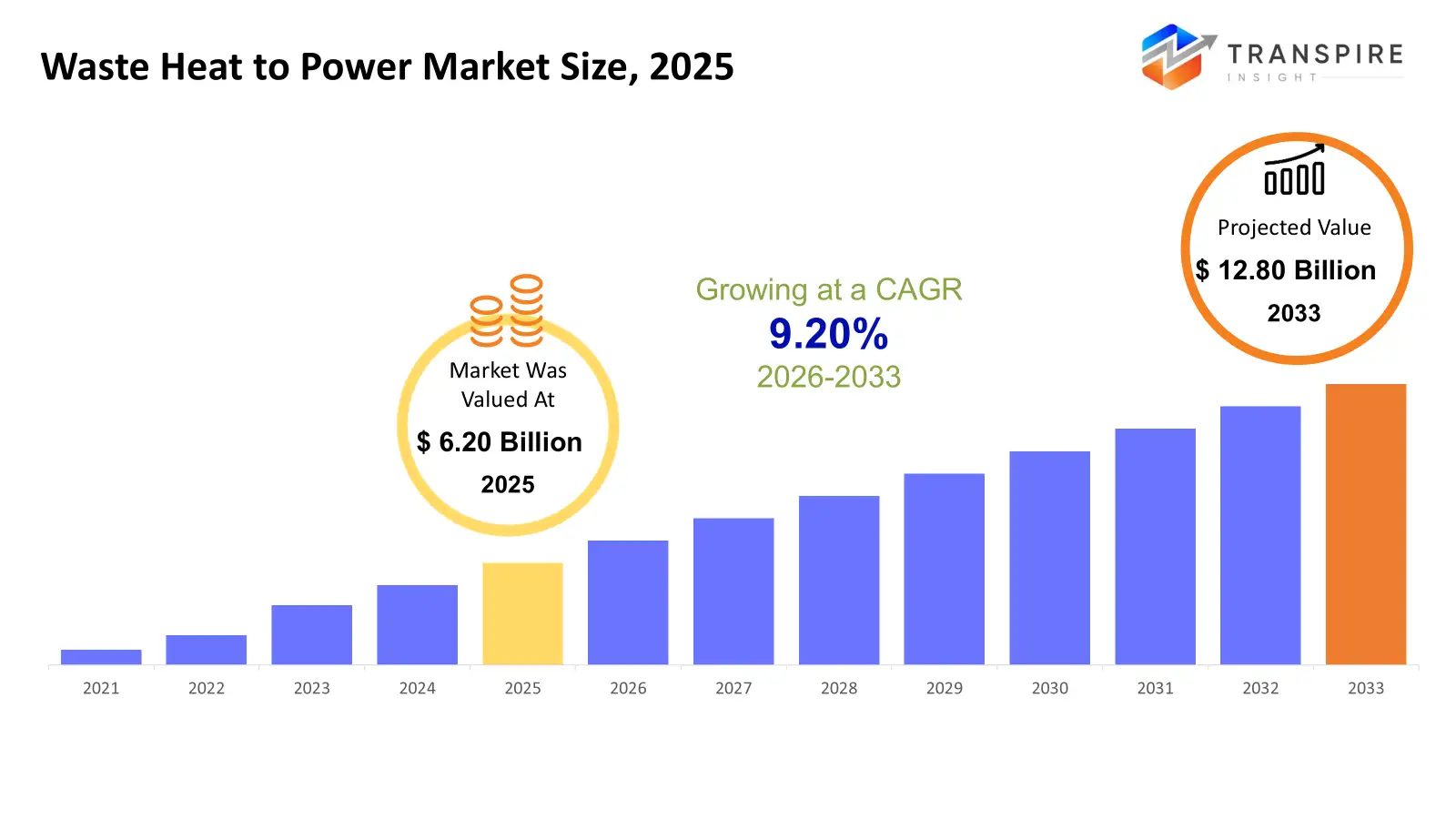
According to a research report published by Transpire Insight, The Global Waste Heat to Power Market Size is projected to grow from USD 37.05 billion in 2026 to USD 80.19 billion by 2035, at a CAGR of 10.19% during the forecast period 2027-2035. The waste heat to power market is primarily driven by escalating global electricity demands, stringent carbon reduction regulations, rising industrial energy costs, and the widespread adoption of efficient Organic Rankine Cycle technologies.
Introduction
The Waste Heat to Power (WHP) market represents a critical pillar of modern industrial energy efficiency, capturing discarded thermal exhaust from energy-intensive processes to generate clean electricity on-site. Utilizing advanced thermodynamic technologies like the Steam Rankine Cycle and Organic Rankine Cycle (ORC), WHP systems minimize resource waste across diverse heavy industries, including petroleum refining, cement production, chemical processing, and metal manufacturing. By converting unutilized heat into emissions-free power, this market significantly lowers operational expenditure, stabilizes energy security, and serves as a vital tool for industries navigating global decarbonization mandates.
Recent Development News
Stay Ahead of Emerging Opportunities with Expert Market Insights by Transpire Insight
Transpire Insight provides comprehensive, data-driven market intelligence to support smarter business decisions. Our research is rooted in comprehensive analysis, authoritative predictions, and industry expertise, enabling organizations to make informed decisions in rapidly evolving markets. In-depth analysis of market segmentation, competitive positioning, regional trends, and emerging investment opportunities in high-growth areas. We blend accuracy with actionable intelligence, empowering companies to uncover new avenues for growth, bolster strategic decision-making, and stay ahead in a dynamic global market.
Download the exclusive Waste Heat to Power Market sample report today to uncover expert insights, emerging trends, and the opportunities defining the future of the industry.
Waste Heat to Power Market Size & Statistics
Regional Growth and Demand Analysis by Transpire Insight:
North America is expected to generate the largest market share during the forecast period in the Waste Heat to Power market. The dominant player in the Waste Heat to Power Market is North America, owing to the availability of leading players in terms of project developers, clean-energy technology suppliers, and robust private-public investments in decarbonizing heavy infrastructure. The United States is currently the biggest producer in the Waste Heat to Power Market, considering factors such as the presence of extensive refining operations, stringent federal emissions boundaries, and major incentives from policies like the Inflation Reduction Act. As of 2026, some of the clean energy companies in the United States have undertaken production activities aimed at manufacturing superior, modular waste heat recovery units that would enhance next-generation industrial power generation.
Asia Pacific is anticipated to grow the fastest during the forecast period in the Waste Heat to Power market. It is expected that the Asia-Pacific region will witness the highest growth rate during the forecast period due to increasing demand for industrial power, growing processing facilities, capital-intensive manufacturing expansions, and massive modernization of national infrastructure grids. China, India, Japan, and South Korea are some of the rapidly growing nations regarding chemical, cement, and steel manufacturing activities that drive the demand for advanced thermal recovery technologies. In 2026, there will be an increase in the facility optimization programs by many processing corporations in China and India. This was done with the aim of ensuring energy-efficient operational structures and utilizing low-grade heat through scalable power configurations.
Top 15 Trends in the Waste Heat to Power Market
Proceed to Checkout to purchase the exclusive Waste Heat to Power Market report and gain instant access to in-depth market intelligence, strategic analysis, and future growth opportunities.
Organic Rankine Cycle technology is increasingly preferred for converting low-to-medium temperature waste heat into usable electricity. Its efficiency and adaptability across diverse industrial processes make it a leading choice for WHP installations.
Industries are increasingly adopting waste heat recovery systems to meet net-zero commitments and reduce carbon emissions. Regulatory pressure and sustainability goals are pushing manufacturers to capture and reuse otherwise wasted thermal energy.
Cement and steel plants are deploying WHP systems to capture heat from kilns and furnaces. This reduces dependence on external electricity grids while improving overall plant-level energy efficiency and operational cost savings.
Policy support, tax credits, and subsidies are accelerating the deployment of waste heat to power projects. These incentives help offset high upfront capital costs, encouraging wider industrial adoption of recovery infrastructure.
Supercritical CO2 cycles are emerging as an alternative to traditional steam-based systems, offering higher thermal efficiency and more compact designs. Growing research and pilot projects are driving commercial interest in this technology.
Data centers are exploring waste heat recovery to offset rising cooling costs and generate supplementary power. Increasing energy consumption and sustainability targets are pushing operators toward integrating WHP solutions into facility design.
Top 25 Companies Leading the Waste Heat to Power Market
Customize the exclusive Waste Heat to Power Market report today to receive tailored insights, country-specific analysis, and business-focused market intelligence.
Top 10 Companies Leading the Waste Heat to Power Market
1. Ormat Technologies
Global pioneer deploying over 3.2 gigawatts of geothermal and recovered energy assets.
Founded: 1965 | HQ: Reno, Nevada, United States.
Why It Ranks: Holds unparalleled dominance in advanced Organic Rankine Cycle technology optimization globally.
Regional Dominance: Strong operational footprint dominating North American and developing geothermal fields.
Product Line: Low-temperature energy converters, custom turbines, and complete turnkey power facilities.
2. Siemens AG
Engineering powerhouse driving digital automation and industrial decarbonization across European markets.
Founded: 1847 | HQ: Munich, Germany.
Why It Ranks: Provides highly efficient steam turbine units coupled with comprehensive power management.
Regional Dominance: Leads technical deployments across primary European and Asian manufacturing hubs.
Product Line: Industrial steam turbines, performance analytics software, and integrated electrical switchgear.
3. ABB Ltd.
Technology leader specializing in electrification, industrial automation, and highly optimized drivetrains.
Founded: 1988 | HQ: Zurich, Switzerland.
Why It Ranks: Engineers' smart electrical control interfaces are essential for stable grid-tied power delivery.
Regional Dominance: Broad market capitalization spanning European, Asian, and American energy sectors.
Product Line: Power converters, digital control networks, generator systems, and microgrid integrations.
4. Mitsubishi Heavy Industries
Engineering giant providing heavy-duty thermal systems to global processing sectors.
Founded: 1884 | HQ: Tokyo, Japan.
Why It Ranks: Innovates mega-scale waste heat boilers and heavy gas-turbine bottoming cycle configurations.
Regional Dominance: Exercises commanding market presence across East Asia and oceanic shipping networks.
Product Line: High-temperature waste heat boilers, exhaust gas turbines, and cogeneration assemblies.
5. MAN Energy Solutions
Global marine and industrial pioneer transforming large-bore engine thermal recovery capabilities.
Founded: 1758 | HQ: Augsburg, Germany.
Why It Ranks: Leads heavy-duty thermodynamic optimization for processing plants and maritime fleet operations.
Regional Dominance: Holds structural dominance across international shipping lines and European heavy industries.
Product Line: Organic Rankine Cycle modules, screw expanders, and industrial heat turbomachinery.
6. Danfoss
Decarbonization champion manufactures highly precise structural components for heavy thermal systems.
Founded: 1933 | HQ: Nordborg, Denmark.
Why It Ranks: Delivers vital high-pressure heat exchangers and energy-dense fluid control components globally.
Regional Dominance: Dominates Western European heating networks and North American commercial infrastructure.
Product Line: Microplate heat exchangers, high-pressure fluid valves, and digital variable-speed drives.
7. Thermax
Leading Indian environmental engineering conglomerate focused on regional decentralized energy generation.
Founded: 1966 | HQ: Pune, India.
Why It Ranks: Provides robust, cost-effective waste heat recovery boilers tailored for emerging economies.
Regional Dominance: Unrivaled structural market penetration within India and Southeast Asian industrial zones.
Product Line: Waste heat recovery boilers, absorption chillers, and custom captive plants.
8. Veolia
Global ecological transformation leader managing extensive hazardous industrial and municipal resources.
Founded: 1853 | HQ: Aubervilliers, France.
Why It Ranks: Integrates circular economy solutions, utilizing secondary industrial heat within complex facilities.
Regional Dominance: Deep institutional presence across European municipal grids and global industrial parks.
Product Line: Energy management outsourcing, structural heat recycling, and district thermal infrastructure.
9. Atlas Copco
An air and gas treatment specialist is expanding thermodynamic efficiency inside compressor systems.
Founded: 1873 | HQ: Nacka, Sweden.
Why It Ranks: Maximizes process energy recovery by capturing heat generated during industrial compression.
Regional Dominance: Globally distributed supply chains spanning major industrial zones in all hemispheres.
Product Line: Energy recovery compressors, expansion turbines, and specialized processing gas machinery.
10. Hitachi Zosen Corporation
Engineering pioneer bridging large-scale environmental waste processing with high-efficiency energy extraction.
Founded: 1881 | HQ: Osaka, Japan.
Why It Ranks: Sets global benchmarks for heavy industrial combustion heat-to-power generation systems.
Regional Dominance: Highly influential vendor across Japanese domestic markets and broader East Asian sectors.
Product Line: Industrial waste combustors, boiler generator components, and precise thermal convertors.
Schedule a meeting with our market experts to discuss the exclusive Waste Heat to Power Market report and identify the best research solution for your organization.
Conclusion
The Waste Heat to Power market stands out as a vital instrument for achieving industrial decarbonization and cost optimization in 2026. Driven by rigid environmental legislation, high global power volatility, and breakthroughs in Organic Rankine Cycle efficiency, the market is set for long-term expansion. While North America drives high-tech implementations, Asia-Pacific remains the demand engine. The collaborative efforts of these top ten players will continue defining manufacturing sustainability, turning wasted thermal energy into localized, secure economic value worldwide.


Send us a brief description of your challenge and we'll get back to you within 24 hours.

 inquiry@transpireinsight.com
 APAC:+91 7666513636
 Address


