
Jul 09, 2026
By Transpire Insight

Description
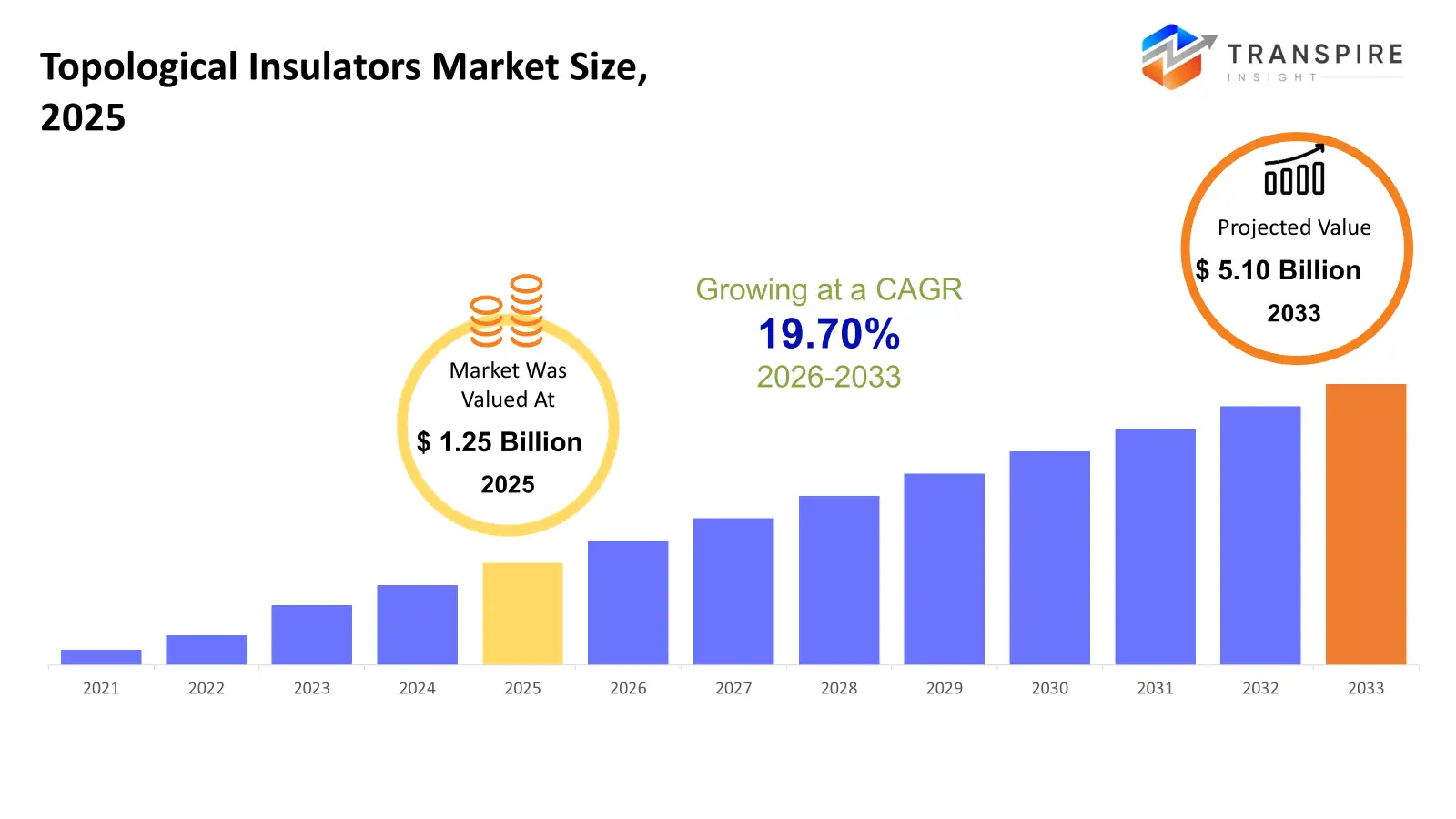
According to a research report published by Transpire Insight, the global topological insulators market size is projected to grow from USD 484 billion in 2026 to USD 1021 billion by 2035, at a CAGR of 10.1% during the forecast period 2026-2035. The exponential growth of quantum computing architectures and advanced spintronic memory devices is the chief driver of this market. High-purity synthesis of topological crystals is actively being pushed by a critical requirement of the microchip industry: the need for next-generation, ultra-low-power electronics that are able to systematically eliminate dissipationless electronic transport paths.
Introduction
The global market of topological insulators is in a transformational paradigm shift and is quickly transforming from condensed matter physics research to scalable and high-performance semiconductor manufacturing processes. The need for special crystalline substrate materials that intrinsically possess strong, spin-momentum-locked conducting surface states and a totally insulating inner bulk property is essential for modern quantum computing facilities and for commercial defense aerospace sensors and advanced optoelectronic platforms. This is a significant material change mainly brought about by advanced atomic layer deposition techniques and compositional quaternary alloy tuning engineering, where the bismuth crystals are optimized for room-temperature chip integration.
Recent Development News
January 2026: Stanford Advanced Materials announced the commercial distribution of its newly optimized, high-uniformity bismuth selenide (Bi 2 Se 3) thin films engineered specifically to maximize quantum spin coherence times for enterprise-grade qubit substrates.
May 2026: HQ Graphene B.V. officially expanded its crystalline advanced material portfolio by launching high-purity, magnetically doped quaternary alloys (BiSbTeSe) optimized for experimental laboratories studying the quantum anomalous Hall effect without external magnetic field interference.
Download the exclusive Topological Insulators Market sample report today to uncover expert insights, emerging trends, and the opportunities defining the future of the industry.
Topological Insulators Market Size & Statistics
The market size for topological insulators is estimated at USD 484 billion in 2026.
The market size is going to expand at a CAGR of 10.1% between 2026 and 2035.
The global topological insulators market size is anticipated to reach USD 1021 billion by 2035.
North America is estimated to generate the highest demand during the forecast period, at a growth of 36.8% in the Topological Insulators Market.
Asia-Pacific is projected to grow the fastest during the forecast period at a growth rate of 17.25% in the Topological Insulators Market.
North America is expected to grow the fastest during the forecast period in the topological insulators market. The dominant player in the Topological Insulators Market is North America, owing to the availability of leading players in terms of crystal manufacturing companies, quantum technology suppliers, and robust investment in advanced semiconductor fabrication. The United States is currently the biggest producer in the Topological Insulators Market, considering factors such as the presence of extensive quantum computing R&D operations, efforts toward modernizing sovereign microelectronics frameworks, and continued advancement in condensed matter physics engineering. As of 2026, some of the advanced material companies in the United States have undertaken production activities aimed at manufacturing superior topological substrates that would enhance next-generation quantum computing chip operations.
Asia Pacific is anticipated to generate the highest demand during the forecast period in the topological insulators market. It is expected that the Asia-Pacific region will witness the highest growth rate during the forecast period due to increasing demand for energy-efficient industrial infrastructure, growing fleets of advanced semiconductor manufacturing foundries, increased optical communication upgrading programs, and significant investment in next-generation spintronics infrastructure. China, India, Japan, and South Korea are some of the rapidly growing nations regarding precision electronics manufacturing activities that drive the demand for advanced topological insulator technologies. In 2026, there will be an increase in the hardware modernization programs by many semiconductor fabricators in China and South Korea. This was done with the aim of ensuring energy-efficient interconnected spintronic component ecosystems.
Top 15 Trends in the Topological Insulators Market
Quantum computing applications are accelerating topological insulator research globally.
Spintronics adoption is driving demand for spin-momentum locking materials.
Bismuth-based compounds are dominating material selection across R&D programs.
2D topological insulators are emerging as the fastest-growing market segment.
Academia-industry collaborations bridging lab research to commercial applications.
Government funding via quantum initiatives is fueling large-scale TI investments.
Thin-film deposition via molecular beam epitaxy is advancing device fabrication.
Integration with superconductors enables topological qubit stabilization.
Growing TI use in energy-efficient, low-power electronic devices.
Asia-Pacific industrialization is driving the fastest regional market growth.
Advanced sensors and photodetectors are emerging as new TI applications.
Computational modeling accelerates the discovery of new topological material phases.
Defense and aerospace sectors exploring TI-based advanced electronic systems.
Scalable production methods are transitioning TI from the lab to industry.
Nanostructured TI forms an expanding application scope in photonics and thermoelectrics.
Proceed to Checkout to purchase the exclusive Topological Insulators Market report and gain instant access to in-depth market intelligence, strategic analysis, and future growth opportunities.
Quantum Computing Applications Accelerating Topological Insulator Research Globally
Over 68% of global laboratory-scale quantum material experiments involved topological states between 2022 and 2024, with 48% of enterprise R&D departments exploring integration into quantum computing hardware.
Spintronics Adoption Driving Demand for Spin-Momentum Locking Materials Spin-momentum
locking capabilities of topological insulators are being leveraged in spintronic applications, becoming a particularly appealing option for memory and data storage across next-generation electronic systems.
Bismuth-Based Compounds Dominating Material Selection Across R&D Programs
More than 42% of peer-reviewed condensed matter physics publications referenced bismuth-based topological insulators such as Bi₂Se₃ and Bi₂Te₃, reflecting their well-characterized surface states, high electron mobility, and demonstrated scalability.
2D Topological Insulators Emerging as Fastest-Growing Market Segment
Due to their ultrathin structure and quantum spin Hall effect, which permits dissipationless edge conduction while preserving insulating bulk properties, 2D topological insulators are becoming the market's most strategically important sector, compatible with traditional silicon methods.
Academia–Industry Collaborations Bridging Lab Research to Commercial Applications
The market is currently in its early commercialization phase, with a highly fragmented structure dominated by research institutions and specialized material startups, while large semiconductor and electronics companies are beginning to enter through strategic collaborations.
Government Funding via Quantum Initiatives Fueling Large-Scale TI Investments
The U.S. dominates the landscape, driven by strategic initiatives such as the National Quantum Initiative Act, which accelerates TI research for quantum computing and spintronics, while the EU's Horizon Europe program allocates significant resources toward cross-border TI research collaborations.
Top 25 Companies Leading the Topological Insulators Market
American Elements
Kurt J. Lesker Company
Stanford Advanced Materials
HQ Graphene B.V.
MSE Supplies LLC
Wuhan Tuocai Technology Co., Ltd.
SixCarbon Technology (Shenzhen)
Heeger Materials Inc.
AEM Deposition
Stanford Materials Corporation
Edgetech Industries LLC
Cathay Materials
ALB Materials Inc.
QS Advanced Materials Inc.
2D Semiconductors
Merck KGaA
Thermo Fisher Scientific
MTI Corporation
Goodfellow
ACS Material LLC
SkySpring Nanomaterials
Nanografi Nano Technology
Advanced Nano Products Co., Ltd
Alfa Chemistry
Smart Elements GmbH
Customize the exclusive Topological Insulators Market report today to receive tailored insights, country-specific analysis, and business-focused market intelligence.
Top 25 Companies Leading the Topological Insulators Market
American Elements
American Elements manufactures ultra-high-purity advanced materials for global industrial technology sectors.
Founded: 1997 | HQ: Los Angeles, California, USA.
Why It Ranks: Commands dominant market share in bulk specialized custom quantum crystal production lines.
Regional Dominance: Holds massive supply chain penetration within aerospace research labs across North America.
Product Line: High-purity bismuth telluride powders, custom targets, and exotic element alloys.
2. Kurt J. Lesker Company
Kurt J. Lesker Company delivers global high-vacuum thin-film physical vapor deposition systems.
Founded: 1954 | HQ: Jefferson Hills, Pennsylvania, USA
Why It Ranks: Engineers' premier precision vacuum hardware is necessary for high-integrity topological film growth.
Regional Dominance: Controls unmatched distribution channels across academic and industrial laboratories throughout Europe.
Product Line: Custom magnetron sputtering targets, molecular beam epitaxy components, and deposition materials.
Stanford Advanced Materials
Stanford Advanced Materials supplies vast selections of highly specialized advanced research chemicals.
Founded: 1994 | HQ: Lake Forest, California, USA.
Why It Ranks: Provides exceptionally rapid logistics pipelines for high-purity crystalline semiconductor substrates.
Regional Dominance: Secures expansive commercial target volume among semiconductor developer ecosystems nationwide.
Product Line: Bismuth-selenide crystals, antimony-telluride substrates, and custom-engineered evaporation materials.
HQ Graphene B.V.
HQ Graphene specializes in premium 2D single crystals optimized for physics research.
Founded: 2012 | HQ: Groningen, Netherlands.
Why It Ranks: Celebrated for unmatched structural crystal perfection, evaluated via rigorous characterization standards.
Regional Dominance: Captures standard-setting material integration shares across European quantum laboratory hubs.
Product Line: High-quality bulk topological insulators, atomically thin flakes, and heterostructure materials.
MSE Supplies LLC
MSE Supplies provides certified high-performance laboratory materials for advanced material analytics.
Founded: 2011 | HQ: Tucson, Arizona, USA.
Why It Ranks: Leverages trusted technical data transparency alongside custom crystalline orientation material options.
Regional Dominance: Enjoys consistent repeat procurement dominance within elite North American research institutions.
Product Line: Single-crystal substrates, customized sputtering materials, and specialized processing machinery.
Wuhan Tuocai Technology Co., Ltd.
Wuhan Tuocai Technology manufactures exceptionally high-purity elemental materials for high-tech industries.
Founded: 2015 | HQ: Wuhan, China.
Why It Ranks: Operates scalable high-capacity chemical refining plants, optimizing high-purity compound production.
Regional Dominance: Commands massive domestic market volume inside manufacturing foundries across industrial China.
Product Line: High-purity Tellurium, high-grade Bismuth metals, and specialized semiconductor compounds.
SixCarbon Technology (Shenzhen)
SixCarbon Technology specializes in chemical vapor deposition synthesis of advanced 2D materials.
Founded: 2013 | HQ: Shenzhen, China.
Why It Ranks: Pioneers in large-area thin-film layer control technologies tailored for microchip wafer scaling.
Regional Dominance: Captures primary advanced optoelectronic component development pipelines throughout East Asian markets.
Product Line: Wafer-scale topological insulator films, graphene sheets, and monolayer transition metal dichalcogenides.
Heeger Materials Inc.
Heeger Materials distributes extensive technical ranges of advanced lab-scale thin-film supplies.
Founded: 2004 | HQ: Los Angeles, California, USA.
Why It Ranks: Delivers reliable multi-material compound combinations tailored to unique consumer manufacturing instructions.
Regional Dominance: Supplies crucial material volumes to specialized experimental physical laboratories across Europe.
Product Line: Specialized alloy custom targets, rare-earth optical dopants, and semiconductor powders.
9. AEM Deposition
AEM Deposition produces premium coating materials for advanced thin-film surface engineering.
Founded: 2008 | HQ: Changsha, China.
Why It Ranks: Integrates specialized metallurgical vacuum melting protocols, ensuring maximum structural composition purity.
Regional Dominance: Maintained prominent material supplier contracts among key industrial manufacturing sectors globally.
Product Line: High-purity thin-film targets, metal powder blends, and specialized evaporation materials.
10. Stanford Materials Corporation
Stanford Materials Corporation refines comprehensive selections of premium rare earth materials globally.
Founded: 1994 | HQ: Aliso Viejo, California, USA
Why It Ranks: Controls vast global sourcing networks for specialized elemental semiconductor material precursors.
Regional Dominance: Secures extensive contractual volume supplies throughout North American defense engineering entities.
Product Line: Specialized bismuth compounds, high-purity antimony rods, and tailored crystalline alloys.
Schedule a meeting with our market experts to discuss the exclusive Topological Insulators Market report and identify the best research solution for your organization.
Conclusion
As microchip technology becomes a key yardstick for quantum supremacy, the global topological insulators market is poised for steady structural expansion. Spin-momentum locking, dissipation-less electronic transport, and atom-scale thin-film engineering combined will ensure that advanced crystalline substrates will not just be a laboratory curiosity, but will continue to advance into commercial semiconductor devices without any hitches. In the future, manufacturers that manage to combine, at scale and with a high level of purity, the production of these chemicals with the silicon wafer production process will become leaders and will ultimately change the attitude of customers towards enterprise quantum computing and ultra-efficient spintronic hardware.


Send us a brief description of your challenge and we'll get back to you within 24 hours.

 inquiry@transpireinsight.com
 APAC:+91 7666513636
 Address


