
Jul 24, 2026
By Transpire Insight
Description
According to a research report published by Transpire Insight, the remote patient monitoring market size is projected to grow from USD 40.29 billion in 2026 to USD 72.13 billion by 2035, at a CAGR of 13.08% during the forecast period 2026-2035. A growing global prevalence of chronic disease conditions and the rapid ageing population are the key drivers in the market's growth. In addition, the healthcare provider climate and changing payment methods for value-based care encourage the adoption of at-home virtual monitoring across the board.
Introduction
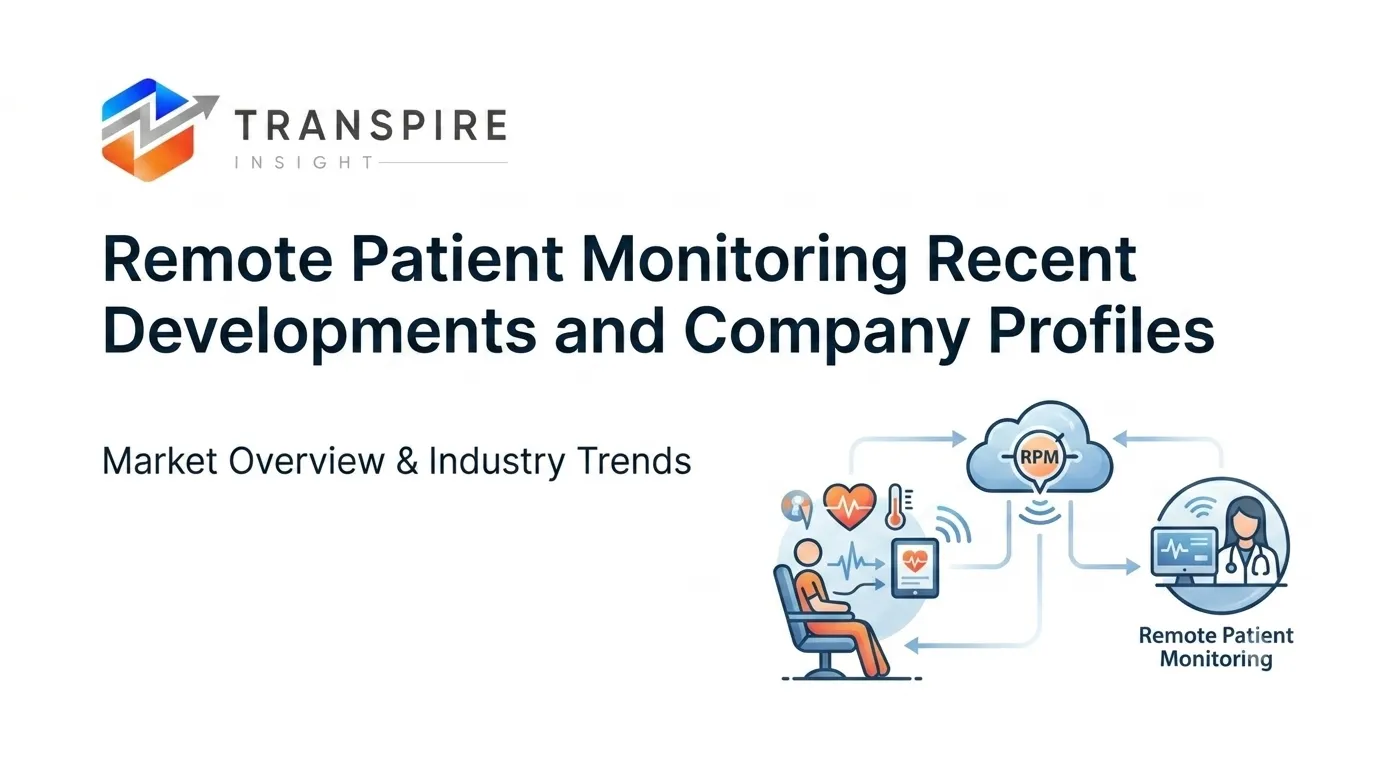
The remote patient monitoring (RPM) market is growing rapidly worldwide. As a result of a monumental move toward a more decentralized care model where medical data is being collected on an ongoing basis from continuous monitoring, RPM relies on a network of interconnected medical devices, cloud-based technology, and artificial intelligence to monitor key health metrics outside of the office walls. These systems move away from the reactive care model at a hospital to the proactive care model at home, offer increased autonomy for the patient, improved health results and significantly lower medical costs, and optimize workflow efficiencies for clinicians.
Recent Development News
Stay Ahead of Emerging Opportunities with Expert Market Insights by Transpire Insight
Transpire Insight provides comprehensive, data-driven market intelligence to support smarter business decisions. Our research is rooted in comprehensive analysis, authoritative predictions, and industry expertise, enabling organizations to make informed decisions in rapidly evolving markets. In-depth analysis of market segmentation, competitive positioning, regional trends, and emerging investment opportunities in high-growth areas. We blend accuracy with actionable intelligence, empowering companies to uncover new avenues for growth, bolster strategic decision-making, and stay ahead in a dynamic global market.
Remote Patient Monitoring Market Size & Statistics
Regional Growth and Demand Analysis by Transpire Insight:
North America is estimated to generate the highest demand during the forecast period, holding a 53.3% market share in 2025 in the remote patient monitoring market. The dominant region in the remote patient monitoring market is North America owing to the region's advanced healthcare infrastructure, sophisticated reimbursement structures, high chronic disease burden, and rapid adoption of hospital-at-home and virtual ward models. The United States is currently the biggest contributor to the North America remote patient monitoring market, with the country's market estimated to reach USD 30.7 billion by 2026, considering factors such as the Centers for Medicare & Medicaid Services (CMS) telehealth flexibility policies, which have contributed significantly to RPM adoption, and CMS-approved hospital-at-home programs that allowed 345 hospitals across 137 health systems to deliver advanced medical care using telehealth. In addition, the Centers for Disease Control and Prevention (CDC) estimates that 6 out of 10 adults in the U.S. have at least one chronic condition, sustaining strong demand for continuous monitoring solutions. As of 2026, companies such as Philips, Medtronic, GE Healthcare, and Abbott continue to expand their digital health portfolios in the region, with Abbott's FreeStyle Libre continuous glucose monitoring system alone being used by 8 million patients globally, supporting the region's leadership in connected diagnostics and chronic disease management.
Asia-Pacific is estimated to generate significant demand during the forecast period in the remote patient monitoring market, growing at a CAGR of 14.39% between 2026 and 2034. Asia-Pacific is expected to grow rapidly during the forecast period due to the increasing digitization of healthcare, a high prevalence of chronic diseases, expanding smartphone and broadband penetration, and government interventions to encourage telehealth adoption across China, India, Japan, and South Korea. China is currently a major hub in the Asia-Pacific remote patient monitoring market, considering factors such as a rising geriatric population, growing national digital health reforms, and the presence of domestic players, including Contec Medical Systems and Lepu Medical Technology. In October 2025, Philips announced a strategic partnership with a leading Chinese telehealth provider to enhance its remote monitoring services in the country. India is also emerging as a key growth center, supported by the government's Ayushman Bharat Digital Mission (ABDM), which has generated more than 73.98 crore ABHA (Ayushman Bharat Health Account) ID numbers as of February 2025, and the Sanjeevani telemedicine platform, through which more than 1,600 doctors connect with over 40,000 patients daily. In Japan, partnerships such as Monidor Oy with Senko Medical are expanding RPM accessibility for elderly care, reflecting the region's broader shift toward scalable, technology-driven, value-based care models.
Top 15 Trends in the Remote Patient Monitoring Market
List of Top 25 Remote Patient Monitoring Companies
1. Koninklijke Philips N.V.
The firm integrates extensive clinical informatics with scalable connected patient monitoring ecosystems.
Founded: 1891 | HQ: Amsterdam, Netherlands.
Why It Ranks: Dominates hospital-to-home enterprise solutions.
Regional Dominance: Strong market leadership across European health systems.
Product Line: IntelliVue monitors, Avalon fetal monitoring, and continuous care software.
2. Medtronic plc
The company provides proactive home care management for complex cardiac implant patients.
Founded: 1949 | HQ: Dublin, Ireland.
Why It Ranks: Unmatched presence in specialized implantable cardiac device telemetry.
Regional Dominance: Highly influential across North American medical providers.
Product Line: CareLink network, Zephyr physiological tracking, and implantable loop monitors.
3. Abbott Laboratories
They revolutionized real-time diabetes data management through continuous interstitial fluid tracking.
Founded: 1888 | HQ: Abbott Park, Illinois, USA.
Why It Ranks: Undisputed world leader in connected consumer-facing glucose tracking.
Regional Dominance: Massive market penetration across the Americas and Europe.
Product Line: FreeStyle Libre systems and integrated digital health reporting platforms.
4. GE HealthCare
The enterprise deploys AI-driven algorithms to accurately predict deteriorating patient vitals.
Founded: 1994 | HQ: Chicago, Illinois, USA.
Why It Ranks: Global provider of high-acuity decentralized wireless monitoring.
Regional Dominance: Extensive diagnostic equipment footprint throughout North America.
Product Line: Portrait Mobile wireless monitoring and Carescape ecosystem solutions.
5. Boston Scientific Corporation
The pioneer focuses on remote diagnostic data for heart failure management.
Founded: 1979 | HQ: Marlborough, Massachusetts, USA.
Why It Ranks: Exceptional integration of clinical diagnostic sensors inside implantable hardware.
Regional Dominance: Deep commercial networks globally with emphasis on Western markets.
Product Line: LATITUDE NXT patient management system and HeartLogic heart failure alerts.
6. Omron Corporation
The manufacturer delivers clinically validated blood pressure monitors with cloud-connected metrics.
Founded: 1933 | HQ: Kyoto, Japan.
Why It Ranks: Foremost consumer provider of home-based cardiovascular hypertension monitoring.
Regional Dominance: Absolute retail and clinical dominance in the Asia-Pacific region.
Product Line: HeartGuide smartwatches and VitalSight remote patient enrollment software.
7. Dexcom, Inc.
The group manufactures highly accurate wearable continuous blood glucose tracking sensors.
Founded: 1999 | HQ: San Diego, California, USA.
Why It Ranks: Key innovator in automated insulin pump communication and interoperability.
Regional Dominance: Rapidly expanding global share with a stronghold in the United States markets.
Product Line: Dexcom G7 systems and Dexcom Clarity data analytics software.
8. Masimo Corporation
The specialist develops advanced signal-extraction technologies for accurate, noninvasive monitoring.
Founded: 1989 | HQ: Irvine, California, USA.
Why It Ranks: Industry gold standard for continuous blood oxygen saturation tracking.
Regional Dominance: Embedded securely across premium hospital systems in developed nations.
Product Line: Radius PPG tetherless sensors and Masimo SafetyNet home platforms.
9. Shenzhen Mindray Bio-Medical Electronics
The corporation manufactures highly cost-effective, structurally durable multiparameter monitoring systems.
Founded: 1991 | HQ: Shenzhen, China.
Why It Ranks: Fastest-growing medical device manufacturer among emerging healthcare systems.
Regional Dominance: Commanding market share in China and expanding into developing nations.
Product Line: BeneVision patient monitors and M-Connect IT telehealth systems.
10. Nihon Kohden Corporation
The firm produces advanced electroencephalography and specialized telemetry monitoring tools.
Founded: 1951 | HQ: Tokyo, Japan.
Why It Ranks: Renowned for long-term telemetry engineering precision and device durability.
Regional Dominance: Primary electronic medical device manufacturer across Japanese clinical sectors.
Product Line: Life Scope telemetry systems and smart bedside data portals.
Conclusion
The remote patient monitoring market is the bedrock of the current healthcare digitization and has transformed the clinical approach from a periodic checkup to a proactive, lifecycle-based monitoring. The industry is set for resilient growth due to the critical demographic changes, the pressing chronic disease challenges, and breakthroughs in the integration of predictive artificial intelligence. Finally, with the digital divide being closed and clinician workflows increasingly digitized by technological systems, remote monitoring will change the value-based care landscape of institutions around the world.


Send us a brief description of your challenge and we'll get back to you within 24 hours.

 inquiry@transpireinsight.com
 APAC:+91 7666513636
 Address


