
Jul 24, 2026
By Transpire Insight
Description
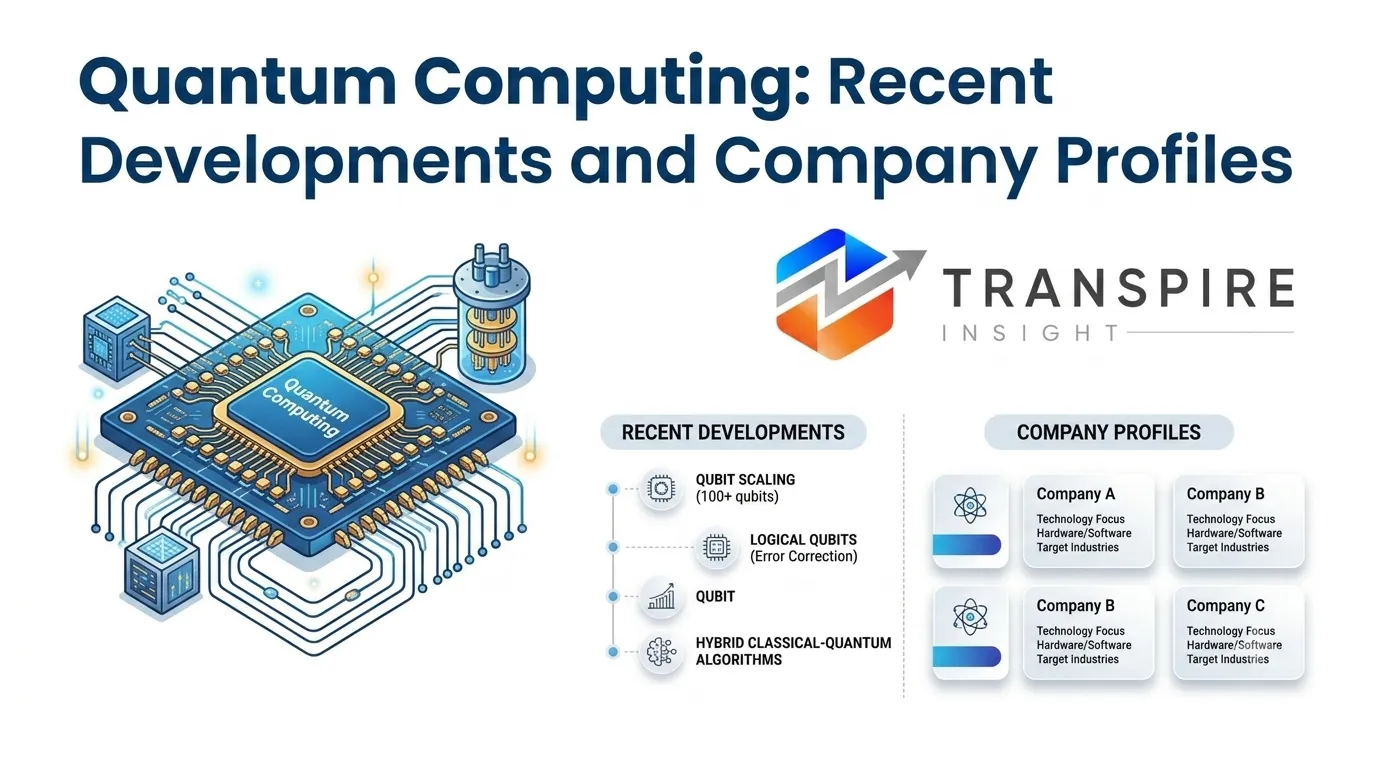
According to a research report published by Transpire Insight, the quantum computing market size is projected to grow from USD 2.82 billion in 2026 to USD 20.13 billion by 2035, at a CAGR of 35.08% during the forecast period 2026-2035. The need for post-quantum cryptography, the cybersecurity needs and requirements, and the vast amounts of government funding fuel the commercialization frenzy. The optimization of complex molecular simulation, machine learning, and global supply chain logistics, urgently needed by industries, must be optimized within sub-nanoseconds.
Introduction
The quantum computing industry has finally entered the commercial realm. The industry is experiencing rapid capital consolidation, full-stack mergers and a clear shift to hybrid classical-quantum computer architectures in 2026. The strides forward in error mitigation and scalable qubit connectivity are fueling pilot initiatives among enterprises in finance, pharmaceuticals, and defense. The quest for quantum supremacy has become an economic and national security race with a multibillion-dollar investment.
Recent Development News
Stay Ahead of Emerging Opportunities with Expert Market Insights by Transpire Insight
Transpire Insight provides comprehensive, data-driven market intelligence to support smarter business decisions. Our research is rooted in comprehensive analysis, authoritative predictions, and industry expertise, enabling organizations to make informed decisions in rapidly evolving markets. In-depth analysis of market segmentation, competitive positioning, regional trends, and emerging investment opportunities in high-growth areas. We blend accuracy with actionable intelligence, empowering companies to uncover new avenues for growth, bolster strategic decision-making, and stay ahead in a dynamic global market.
Quantum Computing Market Size & Statistics
Regional Growth and Demand Analysis by Transpire Insight:
North America is estimated to generate the highest demand during the forecast period, holding a 61% market share in the quantum computing market. The dominant region in the quantum computing market is North America, owing to the region's early technology adoption, a highly competitive vendor landscape, and strong end-user readiness to deploy cloud-based quantum access. The North American market's expansion has been positively impacted by end-users' readiness to develop advanced services and the countries' readiness to adopt cloud computing. As of 2026, companies such as IBM, Google, Microsoft, IonQ, and Rigetti continue to expand their quantum portfolios in the region, with IBM Quantum operating 1,121 physical qubits on its Condor chip and targeting 200 logical qubits by 2029, supporting the region's leadership in commercial-grade hardware and hybrid classical-quantum deployment.
Asia-Pacific is estimated to generate significant demand during the forecast period in the quantum computing market, growing at a CAGR of 25.6% during the forecast period, making it the fastest-growing region globally. The Asia Pacific region is projected to be the fastest-growing market, supported by increasing investments and government initiatives in countries such as China, India, Japan, and South Korea. Regionally, APAC accounts for 47% of global public quantum investment, the largest share of any region, driven by state-backed national strategies. India is also emerging as a key growth center, supported by government-backed education programs. More than 55,000 university students have enrolled in a quantum computing course as part of a broader push to build national capability, and IBM plans to launch its quantum computer in Amaravati, India, by March 2026, alongside India's first quantum computing valley in Andhra Pradesh. In Japan, Fujitsu and RIKEN launched a 256-qubit superconducting quantum computer in April 2025, targeting a 1,000-qubit machine by 2026, reflecting the region's broader shift toward sovereign, hardware-driven quantum capability.
Top 15 Trends in the Quantum Computing Market
1. Post-quantum cryptography adoption
NIST finalized three post-quantum encryption standards in 2024, pushing governments and enterprises toward hybrid quantum-safe encryption before quantum computers can break current cryptography.
2. Quantum-as-a-service growth
Private companies increasingly access quantum computing through cloud providers rather than owning hardware, lowering entry barriers and expanding commercial experimentation across industries and use cases.
3. M&A and consolidation
2025 saw accelerated acquisitions, exemplified by IonQ acquiring Capella Space, Lightsynq, Oxford Ionics, and other firms, signaling market maturation beyond pure research-stage activity.
4. Quantum IPOs and public listings
Six pure-play quantum companies now trade on major exchanges as of March 2026, with more in the pipeline, shifting quantum from a private-market story to public investment.
5. "Harvest now, decrypt later" threat
Adversaries are storing encrypted data today, anticipating future quantum decryption capability, which is forcing organizations managing sensitive long-lived data to migrate cryptography now.
6. Talent shortage constraint
Roughly 75% of quantum job applicants lack the necessary skills, with a workforce shortage projected to exceed 10,000 roles by 2026-27, slowing broader commercialization.
List of Top 25 Companies Leading the Quantum Computing Market
1. IBM
Leading the industry with its scalable, multi-module 360-qubit Nighthawk architecture.
Founded: 1911 | HQ: Armonk, New York, USA.
Why It Ranks: Dictates global benchmarks via its heavily utilized, open-source Qiskit software ecosystem.
Regional Dominance: Aggressively commands the enterprise market across North America and Western Europe.
Recent Development News: Debuted its error-correcting Loon architecture utilizing innovative quantum c-couplers.
2. Google Quantum AI
Pioneered early quantum supremacy milestones utilizing its highly advanced Sycamore superconducting processors.
Founded: 1998 | HQ: Mountain View, California, USA.
Why It Ranks: Sets the gold standard for high-fidelity gates and robust error-correction research.
Regional Dominance: Anchors the Silicon Valley tech corridor while influencing major global academic partnerships.
Recent Development News: Showcased monumental physical-to-logical qubit scale-up ratios for fault-tolerant computing frameworks.
3. Quantinuum
Merged Honeywell Hardware with Cambridge Quantum Software to create a dominant powerhouse.
Founded: 2021 | HQ: Broomfield, Colorado, USA.
Why It Ranks: Achieved the highest-ever valuation for a private quantum firm at $ 10 billion.
Regional Dominance: Commands highly critical trapped-ion hardware deployments across the US and UK.
Recent Development News: Positioned itself for a massive, traditional underwritten IPO in early 2026.
4. PsiQuantum
Focused entirely on building a utility-scale, silicon-photonic quantum computer with error correction.
Founded: 2015 | HQ: Palo Alto, California, USA.
Why It Ranks: Secured a historic $ 1 billion Series E investment led by major global funds.
Regional Dominance: Expanding footprint rapidly into Australia via massive government-backed co-investment initiatives.
Recent Development News: Scaled manufacturing pipelines for proprietary photonic chips using standard semiconductor foundries.
5. IonQ
Trapped-ion pioneer providing native, high-fidelity quantum access across all major cloud providers.
Founded: 2015 | HQ: College Park, Maryland, USA.
Why It Ranks: Executed a massive $2.5-billion acquisition strategy to absorb regional and international platforms.
Regional Dominance: Leverages a strong hold on US federal networks and educational institutions.
Recent Development News: Absorbed Oxford Ionics and Vector Atomic to consolidate its full-stack infrastructure.
6. Rigetti Computing
Builds advanced, scalable multi-chip superconducting quantum processors optimized for hybrid architectures.
Founded: 2013 | HQ: Berkeley, California, USA.
Why It Ranks: Offers an incredibly fast, low-latency Quantum Cloud Services (QCS) co-processing platform.
Regional Dominance: Maintains deep collaborative research loops within the United States defense sector.
Recent Development News: Scaled modular architectures to seamlessly integrate with high-performance classical supercomputing hubs.
7. D-Wave Systems
The undisputed pioneer in commercializing quantum annealing for intense industrial optimization.
Founded: 1999 | HQ: Burnaby, British Columbia, Canada.
Why It Ranks: Deploys real-world commercial applications handling complex global logistics and manufacturing problems.
Regional Dominance: Holds an incredibly firm grip on logistics enterprises throughout North America.
Recent Development News: Finalized a $550-million acquisition of Quantum Circuits to integrate advanced architectures.
8. Intel
Mass-produces silicon spin-qubit chips leveraging its pre-existing, world-class transistor manufacturing lines.
Founded: 1968 | HQ: Santa Clara, California, USA.
Why It Ranks: Uniquely capable of scaling quantum hardware using traditional, high-volume silicon fabrication.
Regional Dominance: Dictates the next-generation quantum hardware supply chain across domestic US facilities.
Recent Development News: Shipped advanced 12-qubit silicon Tunnel Falls chips to global research laboratories.
9. Xanadu
Leading photonic developer behind PennyLane, the premier software open-source library for QML.
Founded: 2016 | HQ: Toronto, Ontario, Canada.
Why It Ranks: Nearing its highly anticipated NASDAQ listing, backed by a $455-million cash position.
Regional Dominance: Operates as the absolute crown jewel of the Canadian quantum ecosystem.
Recent Development News: Achieved significant architectural breakthroughs in fault-tolerant, room-temperature photonic cluster states.
10. IQM Quantum Computers
Europe’s premier startup builds customized, co-designed superconducting quantum computers for supercomputing centers.
Founded: 2018 | HQ: Espoo, Finland.
Why It Ranks: Achieved unicorn status and initiated a major $1.8-billion SPAC merger.
Regional Dominance: Captures the vast majority of continental European government and research tenders.
Recent Development News: Secured vast state funding to scale up processors toward 300 logical qubits.
Conclusion
The quantum computing market is now at its commercial threshold, moving beyond deep tech experiments to enter the market. The technology is no longer science fiction, as massive capital injection, swift full-stack industry consolidation, and incorporation of hybrid classical-quantum systems drive it. Although fully fault-tolerant systems are a long-term objective, near-term utility-scale processors are already changing the ways in which optimization, cryptography, and molecular diagnostics are done, making quantum computing an essential landscape element for tomorrow's world.


Send us a brief description of your challenge and we'll get back to you within 24 hours.

 inquiry@transpireinsight.com
 APAC:+91 7666513636
 Address


