
Jul 29, 2026
By Transpire Insight
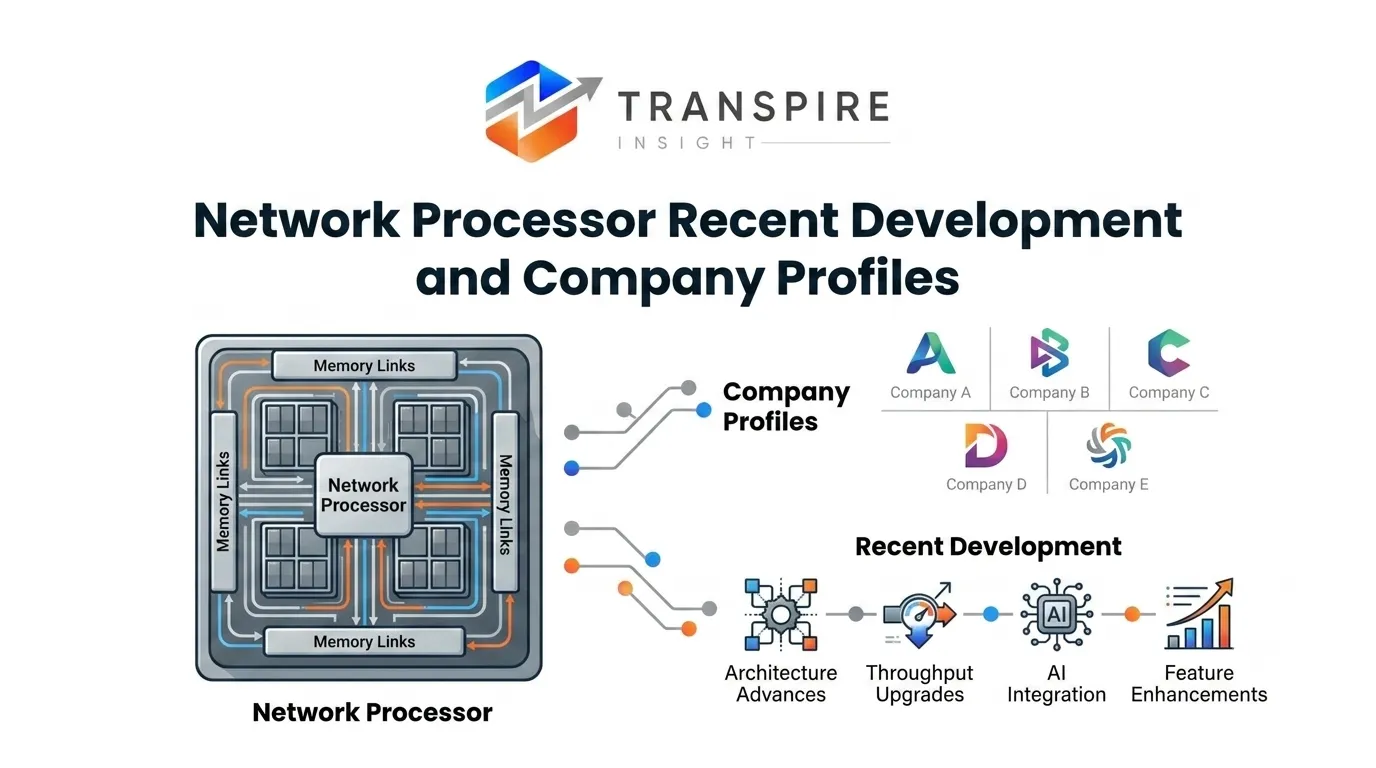
Description
According to a research report published by Transpire Insight, the network processor market size is projected to grow from USD 11.14 billion in 2026 to USD 41.12 billion by 2035, at a CAGR of 17.25% during the forecast period 2026-2035. The network processor market is driven by the network traffic growth in hyperscale data centers, increasing deployment of 5G networks, increasing enterprise AI workloads, and the growing shift towards software-defined networking (SDN). The need for wire speed packet processing and energy efficiency drives chip use around the world.
Introduction
Driven by the ever-growing data-rich cloud ecosystems, high-speed telecom infrastructure, and complex AI pipelines, the global network processor market is undergoing a significant architectural transformation. Network processors are the building blocks of real-time traffic handling, deep packet inspection, and agile data routing. High-performance programmable chips have transformed from a niche networking hardware part into a strategic and critical enterprise asset, as enterprises race to modernize their communication architectures to facilitate ultra-low-latency communication technologies, Wi-Fi 7 standards and hybrid cloud topologies.
Recent Development News
Stay Ahead of Emerging Opportunities with Expert Market Insights by Transpire Insight
Transpire Insight provides comprehensive, data-driven market intelligence to support smarter business decisions. Our research is rooted in comprehensive analysis, authoritative predictions, and industry expertise, enabling organizations to make informed decisions in rapidly evolving markets. In-depth analysis of market segmentation, competitive positioning, regional trends, and emerging investment opportunities in high-growth areas. We blend accuracy with actionable intelligence, empowering companies to uncover new avenues for growth, bolster strategic decision-making, and stay ahead in a dynamic global market.
Network Processor Market Size & Statistics
Regional Growth and Demand Analysis by Transpire Insight:
North America is expected to generate the highest demand during the forecast period in the network processor market. The dominant position of North America in the network processor market is owed to the presence of leading semiconductor companies, network equipment manufacturers, and heavy hyperscale data center investment across the region. North America accounts for the majority of the network processors' market share due to the presence of key semiconductor companies, network equipment manufacturers, and significant investments in hyperscale data centers in the region. Today, the U.S. is the biggest producer in the network processor market, driven by widespread AI data center construction, ramp-up of 5G infrastructure, and continued progress in switch silicon engineering. The U.S.-based chipmakers Broadcom and Marvell have ramped up silicon production of high-bandwidth switches, such as Broadcom's Tomahawk 6 and Marvell's Teralynx T100, to support hyperscaler deployments of AI clusters as of 2025-2026.
Asia-Pacific is anticipated to grow the fastest during the forecast period in the network processor market. High growth is expected in the Asia-Pacific region throughout the forecast period, as the subscriber base for 5G technology is increasing rapidly, the number of hyperscale cloud services is also increasing, the domestic facility for semiconductor manufacturing is also expanding, and there is considerable investment in the telecom network infrastructure. Some of the countries that are rapidly expanding in terms of commercial data center and telecom activity, which is stimulating demand for advanced network processing technologies, include China, Japan, India, and South Korea. The telecom and cloud operators in China and India have launched more modernization programs for their networks in 2025-2026, which will utilize energy-efficient and high-throughput network processors.
Top 15 Trends in the Network Processor Market
AI-optimized Packet Processing Architectures
Vendors are embedding AI-driven traffic classification and inference acceleration directly into packet processing pipelines, enabling network processors to handle security, routing, and analytics workloads simultaneously.
Shift Toward 800G and 1.6T Ethernet Switching
Hyperscalers are upgrading data center fabrics to 800G and emerging 1.6T Ethernet speeds, pushing chipmakers like Broadcom and Marvell to launch higher-bandwidth switch silicon rapidly.
Co-packaged Optics Integration
Co-packaged optics reduce power draw and latency by placing optical engines next to switch silicon, addressing thermal and bandwidth bottlenecks in dense AI training clusters.
Hyperscaler-Driven Demand for Custom ASIC Switch Silicon
Cloud giants increasingly design custom switch ASICs in-house or with semiconductor partners, reducing reliance on merchant silicon while tailoring processors precisely to specific workload requirements.
Expansion of 5G Infrastructure Boosting NPU Deployment
Continued global 5G rollout is driving telecom operators to deploy high-throughput network processors capable of handling network slicing, low-latency routing, and massive machine-type communication traffic.
Growing Adoption of SDN and NFV Architectures
Enterprises and telcos are adopting software-defined networking and network function virtualization, requiring programmable network processors that decouple hardware from control logic for flexible, scalable deployments.
List of Top 25 Companies Leading the Network Processor Market
1. Cisco Systems, Inc.
Deployed over 120,000 advanced network processors globally in enterprise hardware infrastructure.
Founded: 1984 | HQ: San Jose, California, United States.
Why It Ranks: Unmatched proprietary silicon integration inside dominant enterprise core switching equipment.
Regional Dominance: Enjoys massive commercial market share dominance throughout North American enterprise architectures.
Product Line: Silicon One series programmable network architectures powering carrier-class routers.
2. Broadcom Inc.
Delivers high-bandwidth merchant silicon powering modern hyper-scale data center network switching cloth.
Founded: 1961 | HQ: Palo Alto, California, United States.
Why It Ranks: Dictates industry standards through ultra-high-throughput StrataXGS processing pipelines and switches.
Regional Dominance: Holds extensive hardware supply dominance spanning major North American data centers.
Product Line: Jericho and Trident programmable network processors built for hyperscale routing.
3. Marvell Technology, Inc.
Custom infrastructure silicon designs optimized for massive cloud-scale packet processing pipelines.
Founded: 1995 | HQ: Wilmington, Delaware, United States.
Why It Ranks: Leading innovator in heterogeneous chiplet compute architectures and secure infrastructure processors.
Regional Dominance: Deep commercial market penetration across both North American and European hyperscalers.
Product Line: OCTEON data processing units and secure multi-core network hardware processors.
4. Intel Corporation
Combines specialized packet acceleration instruction sets directly inside advanced enterprise processors.
Founded: 1968 | HQ: Santa Clara, California, United States.
Why It Ranks: Integrates high-speed networking optimizations alongside massive general-purpose data center compute nodes.
Regional Dominance: Pervasive server-side processing market share is firmly established across European markets.
Product Line: Intel Xeon Scalable engines featuring robust integrated data streaming accelerators.
5. Advanced Micro Devices, Inc. (AMD)
Adaptive SoC architectures provide flexible, hardware-level inline acceleration for modern telecom stacks.
Founded: 1969 | HQ: Santa Clara, California, United States.
Why It Ranks: Acquired Xilinx to lead the global FPGA-driven programmable networking market.
Regional Dominance: Commands critical design-win share across global telecom infrastructure markets.
Product Line: Versal Adaptive SoCs and Alveo smart network interface accelerator cards.
6. Nvidia Corporation
Spearheads modern AI data center networking via high-performance hardware offload fabrics.
Founded: 1993 | HQ: Santa Clara, California, United States.
Why It Ranks: Re-engineered the networking paradigm by matching high-speed computing with DPUs.
Regional Dominance: Exponentially growing market control inside deep learning compute centers globally.
Product Line: BlueField Data Processing Units optimized for ultra-secure cloud line speeds.
7. Qualcomm Technologies, Inc.
Powers vast edge computing and commercial cellular communication hardware processing nodes.
Founded: 1985 | HQ: San Diego, California, United States.
Why It Ranks: Sets the performance benchmark for wireless and cellular base station processing.
Regional Dominance: Maintains an extensive consumer and industrial hardware footprint across Asian markets.
Product Line: Networking Pro Series platforms engineered for massive multi-gigabit Wi-Fi deployment.
8. NXP Semiconductors N.V.
Embedded processing engines are engineered for highly secure enterprise and vehicle networking infrastructure.
Founded: 1953 | HQ: Eindhoven, Netherlands.
Why It Ranks: Pioneers ruggedized, high-reliability communications processors optimized for edge networking nodes.
Regional Dominance: Commands leading industrial and automotive market share throughout Western Europe.
Product Line: Layerscape multicore communications processors designed for software-defined networking edge devices.
9. Ericsson
Integrates custom network silicon into over 75% of cellular 5G stations.
Founded: 1876 | HQ: Stockholm, Sweden.
Why It Ranks: Dominates global cellular telecommunications engineering via proprietary high-speed radio silicon.
Regional Dominance: Possesses deep telecommunications infrastructure market control across Southeast Asian territories.
Product Line: Ericsson Silicon family custom processors for advanced 5G RAN systems.
10. Huawei Technologies Co., Ltd.
Designs proprietary high-throughput network engines despite enduring strict geopolitical supply restrictions.
Founded: 1987 | HQ: Shenzhen, China.
Why It Ranks: Maintains absolute domestic telecom infrastructure and enterprise networking dominance via Solar silicon.
Regional Dominance: Commands a massive domestic market share across the entire East Asian region.
Product Line: Solar series network processing units integrated inside high-end core routing platforms.
Conclusion
The network processor market has come to a crossroads in evolution, moving quickly from legacy hardware routing architectures to very programmable, AI-optimized, and energy-efficient silicon architectures. The path for the biggest chip makers is highly competitive, with ongoing investments in hyper-scale data centers and 5G and enterprise-grade Wi-Fi 7 deployments across the globe. As the late 2020s begin, vendors that are able to successfully incorporate adaptive, software-defined capabilities along with strong hardware-level security protocols will clearly shape next-generation, high-speed global digital infrastructure.


Send us a brief description of your challenge and we'll get back to you within 24 hours.

 inquiry@transpireinsight.com
 APAC:+91 7666513636
 Address


