
Jul 27, 2026
By Transpire Insight
Description
According to a research report published by Transpire Insight, the missile defense market size is projected to grow from USD 60.38 billion in 2026 to USD 110.17 billion by 2035, at a CAGR of 10.26% during the forecast period 2026-2035. With geopolitical tension on the rise, countries pursuing military modernization are investing significantly in next-generation, integrated, multi-layered air defense systems, and an increasing number of sophisticated hypersonic and drone threats are emerging throughout the world.
Introduction
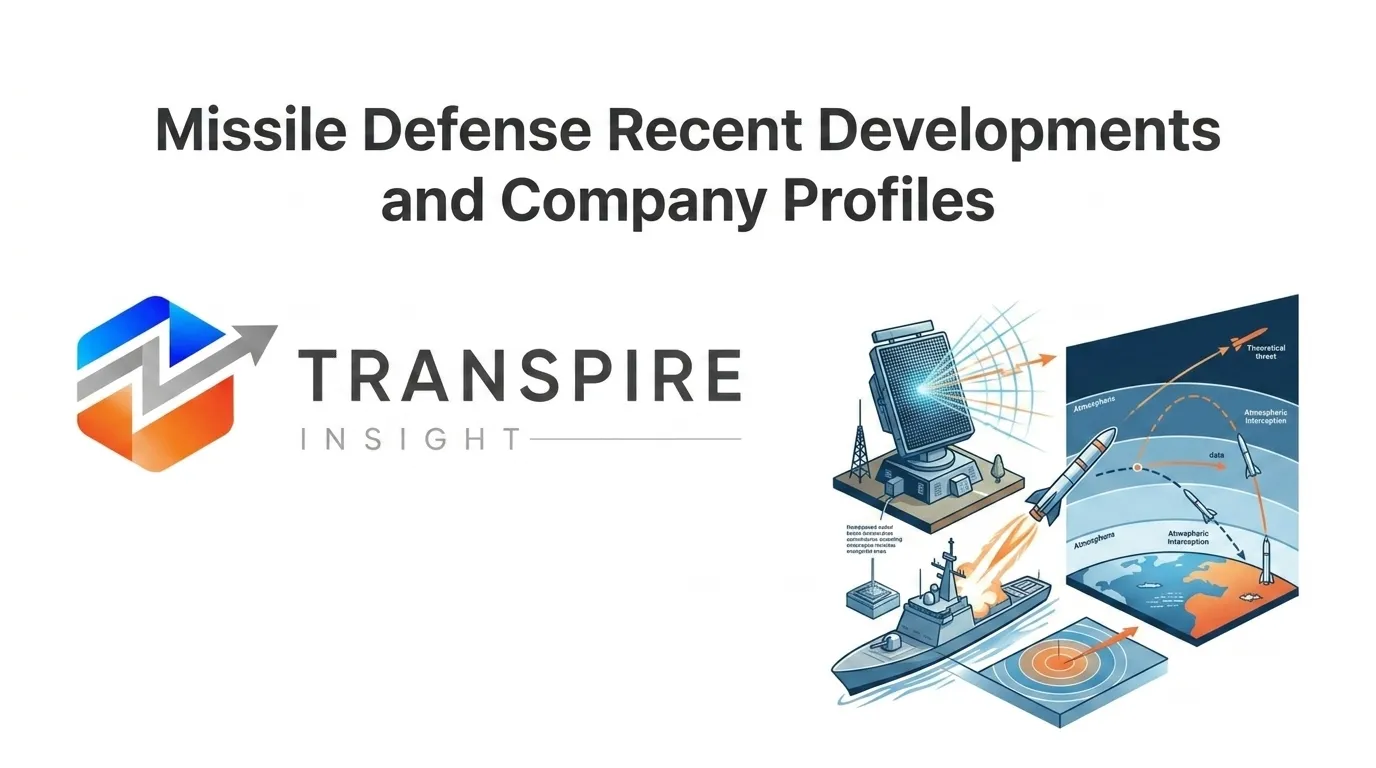
The global missile defense market is growing at a quick pace, with the focus on increasing defense spending to safeguard national territory and vital establishments. The market is experiencing a radical paradigm shift and is anchored in the traditional ballistic interception. In today's evolving threat landscape, including maneuverable hypersonic glide vehicles, stealth cruise missiles, and low-cost drone swarms, highly integrated, multi-layered architectures are needed. Governments around the world are taking steps to upgrade command infrastructure, sensor networks and space-based tracking constellations, with historic investments of capital to ensure they continue to meet the growing needs of their nations.
Recent Development News
Stay Ahead of Emerging Opportunities with Expert Market Insights by Transpire Insight
Transpire Insight provides comprehensive, data-driven market intelligence to support smarter business decisions. Our research is rooted in comprehensive analysis, authoritative predictions, and industry expertise, enabling organizations to make informed decisions in rapidly evolving markets. In-depth analysis of market segmentation, competitive positioning, regional trends, and emerging investment opportunities in high-growth areas. We blend accuracy with actionable intelligence, empowering companies to uncover new avenues for growth, bolster strategic decision-making, and stay ahead in a dynamic global market.
Missile Defense Market Size & Statistics
Regional Growth and Demand Analysis by Transpire Insight
North America's leadership rests on a concentrated industrial base and sustained federal procurement. The US Department of Defense's fiscal 2025 budget request of USD 849.8 billion earmarked USD 33.7 billion specifically for missile defense programs, and that momentum carried into contract awards through 2025 and 2026. In September 2025, Lockheed Martin secured a USD 9.8 billion contract tied to next-generation interceptor and missile defense agency work, reinforcing the region's dominance in system integration and R&D. RTX, Northrop Grumman and Boeing Defense continue to expand space-based early warning and glide-phase intercept capabilities, pushing the US market to an estimated USD 15.77 billion in 2025 at a 6.1% CAGR, while Canada's participation in continental air defense modernization adds incremental regional demand.
Asia-Pacific's growth is being driven by escalating territorial disputes and rapid military modernization across several key economies. Japan's Aegis-equipped destroyer deployments and its next-generation interceptor collaboration with the US highlight the region's strategic weight, with the Japanese market alone worth close to USD 2.22 billion, or about 20.21% of Asia-Pacific revenue, in 2025. India continues to advance indigenous ballistic missile defense layers alongside its Akash and S-400 acquisitions, while South Korea's L-SAM program and China's expanding radar and interceptor networks add further momentum. This combination of rising defense budgets and territorial tension is expected to keep Asia-Pacific expanding at roughly an 8.3% CAGR through the forecast period, making it the fastest-growing region tracked in this market.
Top 15 Trends in the Missile Defense Market
Networked Battle Management
Defense forces are shifting from stand-alone interceptor batteries toward fully networked architectures that fuse radars, sensors, launchers, and command systems into one real-time operational picture.
Hypersonic Interceptors
Growing hypersonic missile threats are directing substantial research funding toward kinetic-kill interceptors and glide-phase defense systems designed to engage extremely fast-moving strategic targets reliably today.
Multi-Year Procurement
Nations are moving from episodic missile purchases to multi-year framework agreements that secure propellant and semiconductor supply chains while lowering unit costs substantially over time.
European Sky Shield
Europe's Sky Shield Initiative is accelerating joint procurement of Patriot, SAMP/T and IRIS-T systems, strengthening interoperability among NATO members facing sustained regional missile threats now.
Gulf Acquisitions
Gulf states are rapidly scaling PAC-3 and comparable long-range interceptor acquisitions, driven by recurring missile and drone exposure rather than long-cycle defense modernization planning alone.
Asia-Pacific Indigenous Programs
India, Japan, and South Korea are expanding indigenous missile defense programs alongside US cooperation, responding to escalating territorial disputes and rapidly modernizing regional military forces.
List of Top 25 Companies Leading the Missile Defense Market
1. Lockheed Martin Corporation
Leading producer of the highly advanced THAAD and PAC-3 interceptor systems.
Founded: 1995 | HQ: Bethesda, Maryland, USA.
Why It Ranks: Dominates global market share through massive, multi-billion-dollar U.S. government defense contracts.
Regional Dominance: Strongest in North America, with expanding deployment throughout allied Middle Eastern nations.
Product Line: THAAD, Patriot PAC-3 MSE, Aegis Combat System, and Next Generation Interceptor.
2. RTX Corporation (Raytheon)
Maker of the combat-proven Patriot missile system and advanced naval SM-3 interceptors.
Founded: 1922 | HQ: Arlington, Virginia, USA.
Why It Ranks: Unrivaled legacy in developing guidance sensors, radars, and hit-to-kill interceptor technologies.
Regional Dominance: Highly influential in North America, Europe, and key East Asian allied states.
Product Line: Patriot (MIM-104), Standard Missile family (SM-3/SM-6), and LTAMDS radar systems.
3. Northrop Grumman Corporation
Premier provider of secure battle management command and control system software.
Founded: 1994 | HQ: Falls Church, Virginia, USA.
Why It Ranks: Crucial integrator of the U.S. Army's integrated air defense network architecture.
Regional Dominance: Heavy operational focus in North America and across NATO-aligned European networks.
Product Line: IBCS (Integrated Battle Command System) and solid-rocket propulsion units for interceptors.
4. The Boeing Company
Prime contractor for the U.S. Ground-based Midcourse Defense homeland interceptor system.
Founded: 1916 | HQ: Arlington, Virginia, USA.
Why It Ranks: Secures pivotal role in safeguarding continental America from long-range ballistic missile attacks.
Regional Dominance: Primarily dominant in North America, protecting vital domestic military installations and territories.
Product Line: Ground-Based Midcourse Defense (GMD) and Arrow system co-development with Israel.
5. MBDA
Europe’s integrated missile champion, a joint venture by Airbus, BAE Systems, and Leonardo.
Founded: 2001 | HQ: Le Plessis-Robinson, France.
Why It Ranks: Spearheads European sovereignty in air defense through advanced domestic cooperative programs.
Regional Dominance: Complete market dominance in Western Europe, with expanding Middle Eastern exports.
Product Line: Aster 15/30, CAMM (Common Anti-Air Modular Missile), and Mistral systems.
6. BAE Systems plc
Builds advanced naval gun systems and specialized sub-assemblies for missile seekers.
Founded: 1999 | HQ: London, United Kingdom.
Why It Ranks: Supplies essential electronic warfare, seeker components, and integration services to allies.
Regional Dominance: Deeply entrenched in the United Kingdom, the European continent, and North America.
Product Line: Electromagnetic railgun research, missile canisters, and advanced digital electronic warfare suites.
7. Thales Group
Pioneer in sovereign military radars, sensors, and global airspace surveillance networks.
Founded: 2000 | HQ: Paris, France.
Why It Ranks: Delivers critical sensor fusion technology required to detect high-speed maneuvering threats.
Regional Dominance: Strong presence across Europe, Asia-Pacific, and highly active in African markets.
Product Line: Ground Master radar series, Crotale NG, and RapidFire air defense systems.
8. Israel Aerospace Industries (IAI)
Co-developer of the world-class Arrow and Barak air and missile systems.
Founded: 1953 | HQ: Lod, Israel.
Why It Ranks: Renowned for rapid combat-testing and pioneering exo-atmospheric ballistic defense systems.
Regional Dominance: Highly dominant in the Middle East, with substantial exports to India.
Product Line: Arrow 2 and Arrow 3 interceptors, Barak MX, and ELM-2080 Green Pine radar.
9. Rafael Advanced Defense Systems
Globally famous creator of the combat-proven, highly successful Iron Dome system.
Founded: 1948 | HQ: Haifa, Israel.
Why It Ranks: Unmatched operational expertise in neutralizing short-range rockets, mortars, and drone swarms.
Regional Dominance: Dominates Israeli national defense, with strategic export agreements in North America.
Product Line: Iron Dome, David’s Sling, and Iron Beam (laser air defense).
10. Almaz-Antey
State-owned Russian giant produces the formidable, widely exported S-400 defense system.
Founded: 2002 | HQ: Moscow, Russia.
Why It Ranks: Engineering powerful, long-range mobile systems capable of tracking multiple targets simultaneously.
Regional Dominance: Dictates the market across Russia, parts of Asia, and Northern Africa.
Product Line: S-300, S-400 Triumf, S-500 Prometheus, and Tor missile systems.
Conclusion
In the end, the missile defense business has evolved from a niche defense issue to an integral part of global strategic security. As countries compete for power and find new technologies, they must evolve to ensure that they have effective deterrent capabilities. In the future, software agility, AI integration and collaborative global partnerships will be key selling points in the market. With defense budgets increasing, the industry leaders need to weigh the complexities of the supply chain while simultaneously having to deploy a layered intercept shield that is responsive.


Send us a brief description of your challenge and we'll get back to you within 24 hours.

 inquiry@transpireinsight.com
 APAC:+91 7666513636
 Address


