
Jul 10, 2026
By Transpire Insight
Description
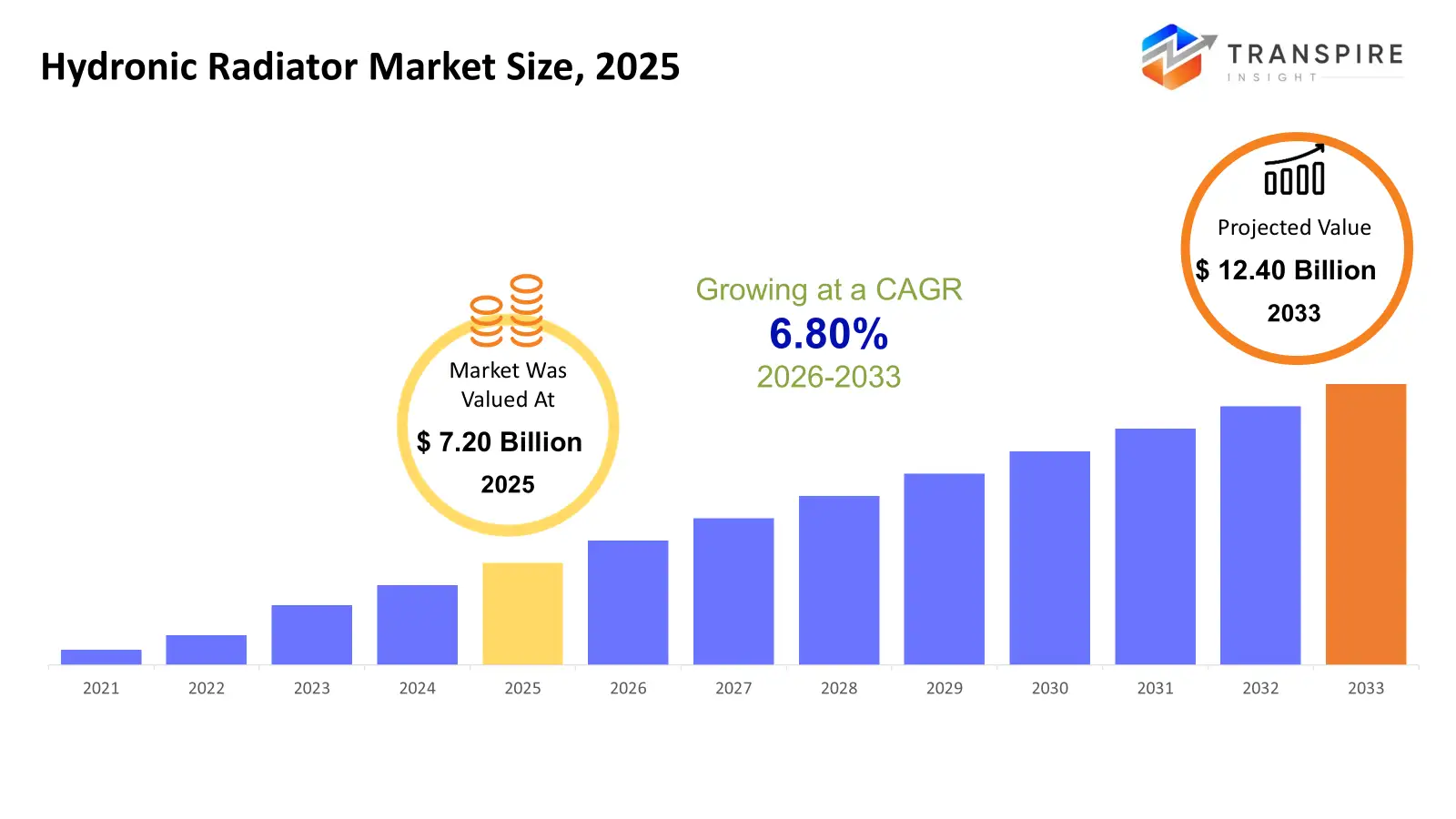
According to a research report published by Transpire Insight, The Global Hydronic Radiator Market Size is projected to Grow from USD 7.20 Billion in 2026 to USD 14.98 Billion by 2035, at a CAGR of 9% during the forecast period 2026-2035. Factors responsible for the market growth include increasing investments in efficient building infrastructure, increasing use of sustainable heating options, strict energy efficiency policies, and increasing activities in renovations. The use of hydronic radiators along with smart thermostats, heat pumps, and low-carbon heaters is playing an important role in the market growth. Moreover, government efforts in encouraging green buildings and decarbonization are expected to contribute to the long-term growth of the global Hydronic Radiator Market.
Introduction
The Hydronic Radiator Market consists of heating systems where heated water or any other fluid is circulated through the radiators for indoor heating. The hydronic radiators are popularly employed in various residential, commercial, and industrial sectors because of the benefits of being energy-efficient, noiseless and compatible with latest heating technology like condensing boilers, heat pumps, etc. These systems are playing an important role in energy efficiency and carbon emission reduction.
Recent Development News,
Stay Ahead of Emerging Opportunities with Expert Market Insights by Transpire Insight
These insights are taken from extensive market research done by Transpire Insight, which is a reputable advisor to some of the world’s leading companies. Based on our research, in-depth analysis of data, forecasting, and industry knowledge, our reports help decision makers uncover business growth possibilities in rapidly changing industries. For those interested in market segments, competitive analysis, geographical analysis, and upcoming market trends, the full report offers incredible insight. With the help of our research, companies will be able to make the right decisions and get a competitive advantage in the shift towards sustainability and profitability.
Download the exclusive Hydronic Radiator Market sample report today to uncover expert insights, emerging trends, and the opportunities defining the future of the industry.
Hydronic Radiator Market Size & Statistics
Regional Growth and Demand Analysis by Transpire Insight:
Europe is the topmost region in terms of Hydronic Radiators Market, holding more than 42% of global market share. This region dominates owing to the extensive use of hydronic heating systems in residential and commercial constructions, strict regulations related to energy efficiency and carbon emission, along with government support for sustainable heating systems. Nations such as Germany, the UK, France, Italy, and Nordic countries feature district heating infrastructure as well as adoption of low-temperature heating systems that can work with heat pumps and condensing boilers. Apart from this, renovations of old buildings to enhance energy performance also help drive market growth.
The Asia-Pacific region is projected to be the fastest-growing regional segment throughout the forecast period owing to factors such as rapid urbanization, increasing constructions of both residential and commercial properties, surging disposable income levels, and investments in energy-efficient infrastructure. China, Japan, South Korea, and Australia are some of the countries that witness increasing adoption of innovative heating systems, driven by the governments' policies promoting the development of green buildings and low-carbon heating systems.
Top 15 Trends in the Hydronic Radiator Market
Proceed to Checkout to purchase the exclusive Hydronic Radiator Market report and gain instant access to in-depth market intelligence, strategic analysis, and future growth opportunities.
1. Growing Adoption of Low-Temperature Hydronic Heating Systems
Transition to efficient buildings is facilitating the use of low temperature hydronic heating systems which perform efficiently even with lower water temperatures while retaining comfortable living conditions. They conserve energy, maximize heating efficiency and make good partners with alternative heating technologies like heat pumps. With the increasing trend of green buildings by the government, the need for low temperature hydronic radiators keeps on rising.
2. Increasing Integration with Heat Pump Technologies
Hydronic radiators are now increasingly engineered to be compatible with the use of air source and ground source heat pumps, which are gaining popularity as an alternative to traditional fossil fuel heating systems. Radiators are being manufactured that have bigger surface areas and greater thermal efficiencies to enable maximum efficiency at lower temperatures.
3. Rising Demand for Energy-Efficient Radiator Designs
The consumers and the property owners require hydronic radiators with a high thermal capacity but with low consumption of energy. The advancements made in terms of materials used, the water flow inside the radiator and the thermal energy transfer have helped the producers manufacture radiators that provide fast heating of spaces at a reduced cost of operation.
4. Expansion of Smart Hydronic Radiators with IoT Connectivity
Increasing use of smart homes and intelligent building management systems has led to increasing need for IoT-based hydronic radiators that come with built-in controls and digital thermostats. The use of smart radiators enables remote monitoring of room temperature and scheduling of heating programs using mobile apps and automation tools.
5. Growing Adoption of Sustainable and Recyclable Radiator Materials
The trend is toward the use of recyclable aluminum, energy-efficient steel, and sustainable manufacturing processes to decrease the negative effects that come along with the manufacturing of hydronic radiators. Sustainable development has become a key competitive advantage, since consumers and the government have been paying more attention to eco-friendly building materials.
6. Increasing Renovation of Residential Heating Infrastructure
Renovation of existing property with more efficient and modern alternatives such as hydronic radiator systems is playing a major part in the growth of the market. Energy efficient upgrades, which are also in compliance with the new regulations on building energy, are being carried out by homeowners. Incentives on energy efficient home renovations and retrofits have accelerated the replacement of old radiators with newer ones.
Top 25 Companies Leading the Hydronic Radiator Market
Customize the exclusive Hydronic Radiator Market report today to receive tailored insights, country-specific analysis, and business-focused market intelligence.
1. Purmo Group
Purmo Group is an organization which provides sustainable solutions for a comfortable indoor climate. This company supplies the markets with heating, cooling and ventilation systems designed for residential and non-residential buildings.
Founded: 1953 | Headquarters: Helsinki, Finland
Why It Ranks: One of the world’s leading hydronic radiator and indoor climate solutions companies.
Regional Dominance: Established presence in Europe, expansion into North America.
Product Line: Hydronic radiators, towel warmers, underfloor heating, convectors and indoor climate solutions.
Recent Development: In 2025, Purmo introduced a new range of low temperature radiators suitable for use with heat pumps.
2. Stelrad Group PLC
Stelrad Group is the maker of steel panel radiators and heating solutions which have been crafted for efficient homes and businesses.
Founded: 1936 | Headquarters: Newcastle upon Tyne, UK
Why It Ranks: Biggest producer of steel panel radiators in Europe.
Regional Dominance: Market leader in the United Kingdom and Europe.
Product Line: Steel panel radiators, designer radiators, towel rails, and low temperature heating solutions.
Recent Development: Stelrad increased its production capacity of high efficiency radiators in 2025.
3. Zehnder Group AG
Zehnder Group offers interior climate products ranging from heating to cooling and ventilation along with the technology for clean air.
Founded: 1895 | Headquarters: Gränichen, Switzerland
Why It Ranks: Top company worldwide for premium interior climate systems.
Regional Dominance: Prominent in all of Europe and increasingly globally.
Product Line: Hydronic radiators, design radiators, ventilation systems, radiant heating and cooling systems.
Recent Development: In 2025, Zehnder launched smart hydronic radiators featuring digital controls.
4. Arbonia AG
Arbonia AG produces building technology equipment that centers around indoor climate, heating, ventilation, and sanitary facilities.
Founded: 1874 | Headquarters: Arbon, Switzerland
Why It Ranks: One of the leading European companies in producing high-quality building technology equipment.
Regional Dominance: Established throughout Europe.
Product Line: Hydronic radiators, convectors, underfloor heating systems, ventilation systems, and indoor climate equipment.
Recent Development: In 2025, Arbonia introduced lightweight hydronic radiators suitable for renewable heating systems.
5. Viessmann Climate Solutions
Viessmann Climate Solutions specializes in sustainable heating, cooling, and renewable energy technology.
Founded: 1917 | Headquarters: Allendorf (Eder), Germany
Why It Ranks: Global pioneer in heating and climate technology.
Regional Dominance: Strong presence in Europe and growing international business operations.
Product Line: Hydronic radiators, boilers, heat pumps, hybrid heating systems, and energy management systems.
Recent Development: In 2025, Viessmann broadened its range of integrated hydronic heating for low-carbon buildings.
6. Vasco Group
Vasco Group is an innovative brand producing designer radiators, ventilations, and underfloor heating systems that prioritize efficient indoor climate management.
Founded: 1975 | Headquarters: Dilsen-Stokkem, Belgium
Why It Ranks: Renowned for its expertise in designing stylish hydronic heaters.
Regional Dominance: A dominant player in Europe.
Product Line: Designer hydronic radiators, towel warmers, underfloor heating, and ventilations.
Recent Development: Vasco has updated its range of smart decorative radiators in 2025.
7. Henrad Radiatoren
Henrad Radiatoren manufactures steel panel radiators and other heating solutions that are meant for efficient energy consumption in homes and businesses.
Founded: 1970 | Headquarters: Herentals, Belgium
Why It Ranks: Established European radiator company.
Regional Dominance: High dominance in Western Europe.
Product Line: Steel panel radiators, compact radiators, designer radiators, and heating accessories.
Recent Development: In 2025, Henrad launched advanced energy-efficient radiator systems.
8. Kermi GmbH
Products offered by Kermi GmbH include heaters and bathroom fixtures, with particular proficiency in hydronic heaters and showers.
Foundes: 1960 | Headquarters: Plattling, Germany
Why It Ranks: Topmost manufacturer of high-end heating systems in Germany.
Regional Dominance: Significant presence in the European market.
Product Line: Hydronic radiators, convectors, underfloor heating systems, and bathroom heaters.
Recent Development: In 2025, Kermi introduced new products into its line of low-temperature radiators.
9. Rettig ICC
The focus of Rettig ICC is indoor climate comfort systems such as hydronic heating and cooling solutions and air distribution systems.
Founded: 1953 | Headquarters: Helsinki, Finland
Why It Ranks: One of the biggest indoor climate solution suppliers in Europe.
Regional Dominance: Well-established across Europe.
Product Line: Panel radiators, designer radiators, convectors, underfloor heating, and indoor climate solutions.
Recent Development: In 2025, Rettig ICC made advancements in its energy-efficient hydronic radiator solutions.
10. Myson
Myson produces heating systems and controllers that ensure better thermal comfort and energy efficiency of buildings.
Founded: 1949 | Headquarter: Derby, United Kingdom
Why It Ranks: Leading producer of hydronic heating solutions.
Regional Dominance: Market leader in the United Kingdom and Europe.
Product Line: Radiators, fan convector, towel heater, underfloor heating, and heating control systems.
Recent Development: In 2025, Myson has enhanced its hydronic heating product range with high-efficiency solutions.
Schedule a meeting with our market experts to discuss the exclusive Hydronic Radiator Market report and identify the best research solution for your organization.
Conclusion
The Global Hydronic Radiator Market is showing stable growth due to the rising demand for energy efficient heating equipment along with the increased number of regulations in building energy codes and the shift towards low carbon and sustainable heating options globally. The increased usage of heat pumps, intelligent thermostats, and smart building management systems increases the performance and efficiency of the hydronic radiator technology. Prominent players such as Purmo Group, Stelrad Group PLC, Zehnder Group AG, Arbonia AG, Viessmann Climate Solutions, Vasco Group, Henrad Radiatoren, Kermi GmbH, Rettig ICC, and Myson focus on innovation and development of their products and technologies along with the development of light weight radiators in order to stay ahead in the market. Due to the increasing investment in green buildings and renovation of the heating systems, the Hydronic Radiator Market will experience stable growth in the coming years.


Send us a brief description of your challenge and we'll get back to you within 24 hours.

 inquiry@transpireinsight.com
 APAC:+91 7666513636
 Address


