
Jul 28, 2026
By Transpire Insight
Description
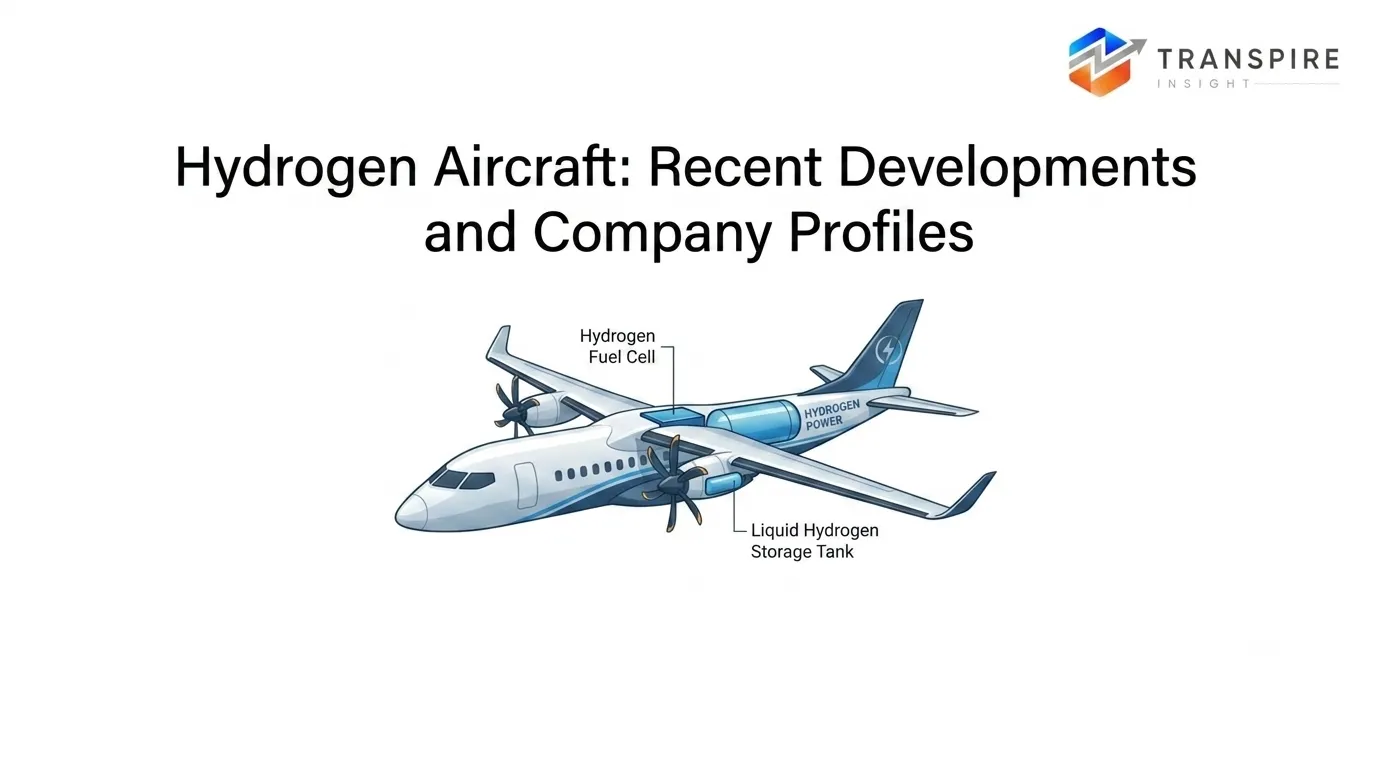
According to a research report published by Transpire Insight, The Global Hydrogen Aircraft Market Size is projected to Grow from USD 730.50 million in 2025 to USD 8,567.80 million by 2035, at a CAGR of 30.9% during the forecast period 2026-2035. The market is fueled by investments in sustainable air travel technologies, global carbon emissions legislation, funding from governments for hydrogen fuel infrastructure, and rapid progress in hydrogen propulsion technologies, fuel cell technologies, cryogenics, and lightweight aerospace materials. Aerospace industry players are working on creating prototypes of hydrogen-powered aircraft in order to achieve zero-emissions flight operations. Additionally, increased cooperation between aircraft manufacturers, hydrogen technology suppliers, airports, and energy firms will speed up commercial adoption of hydrogen aircraft.
Introduction
The Hydrogen Aircraft Market is aimed at exploring aircraft using hydrogen as a means of propulsion by way of hydrogen combustion engine or hydrogen fuel cell technologies. The next generation of aircraft will help cut down carbon footprint, increase energy efficiency and allow for a shift towards sustainability in the aviation industry. Hydrogen aircraft will be instrumental in reaching global net zero aviation goals.
Recent Development News
Stay Ahead of Emerging Opportunities with Expert Market Insights by Transpire Insight
The insights that have been shared through this blog are based on intensive market research carried out by Transpire Insight, an advisor that works with many global organizations. Thanks to the analysis of extensive data, forecasts made by our specialists, and industry intelligence, our reports allow clients to find strategic growth opportunities in dynamically developing industries. For all those who would like to get more detailed information regarding market segmentation, competitive analysis, regional outlooks, and future investment tendencies, there is no doubt that our full report will be of great value.
Hydrogen Aircraft Market Size & Statistics
Regional Growth and Demand Analysis by Transpire Insight:
Europe is the dominant region in the Hydrogen Aircraft Market with a 42% market share of the global market.
The dominance of Europe in the Hydrogen Aircraft Market is due to its fierce determination to realize net-zero aviation emissions, regulatory backing for sustainable aviation, and significant investments from both public and private sectors in hydrogen technologies. The region is inhabited by major aerospace players such as Airbus, Rolls-Royce, Safran, MTU Aero Engines, and GKN Aerospace who are currently developing hydrogen-based aircraft, fuel cell propulsion technology, and cryogenic hydrogen storage technologies. Moreover, projects by the European Union such as clean aviation R&D and hydrogen infrastructure development projects are helping in commercializing these innovations. Europe also enjoys extensive cooperation among aircraft manufacturers, airports, energy producers, and institutions that are carrying out research on hydrogen aviation, thus giving them a competitive advantage in the market.
Fastest growing region: Asia Pacific due to increasing aviation requirements, green hydrogen production investments by governments, fast growth of aerospace manufacturing, and increased research on hydrogen-based aircraft in China, Japan, South Korea, Singapore, and India.
Top 15 Trends in the Hydrogen Aircraft Market
1. Growing Development of Hydrogen Fuel Cell Propulsion Systems
The development of fuel cell systems as an emission-free means of propulsion for replacing traditional jet engines is becoming more popular among airplane builders. Fuel cells help improve energy efficiency, prevent carbon emissions, lower sound levels, meet the requirements of sustainable flying, increase the reliability of propulsion, and help bring new hydrogen planes to market.
2. Expansion of Liquid Hydrogen Storage Technologies
Advanced cryogenic liquid hydrogen fuel storage systems are increasingly being regarded as one of the most important areas of development to make long-distance hydrogen aircraft viable. More efficient fuel storage improves fuel capacity, reduces system weight, increases system safety, provides better thermal insulation, allows greater flight range, and makes hydrogen-powered flights possible.
3. Increasing Investment in Zero-Emission Commercial Aircraft
The big players in aerospace engineering and their respective governments are stepping up efforts towards investments in zero-emissions airplanes. Such investments will foster innovation, enhance research collaborations, aid aircraft certifications, build hydrogen-related infrastructure, lower lifecycle emissions, and drive commercialization.
4. Rising Adoption of Green Hydrogen Production for Aviation
The aviation industry is becoming more and more focused on using green hydrogen that is sourced from renewable energy sources. Using green hydrogen means minimizing carbon footprints, promoting renewable energy, improving clean fuel logistics, increasing environmental sustainability, offering governmental incentives, and ensuring sustainability in hydrogen aviation.
5. Growth of Cryogenic Fuel System Innovations
Modern cryogenic fuel technology is being used to ensure the safe transportation, storage, and distribution of liquid hydrogen aboard aircraft, while sustaining very low operating temperatures. This makes it possible to achieve improved fuel storage, increased reliability of the fuel system, aircraft safety, energy efficiency, optimal use of hydrogen, and larger hydrogen aircraft.
6. Expansion of Sustainable Aviation Infrastructure
Collaboration among airports, energy providers, and aircraft manufacturers is taking place to develop infrastructure needed for hydrogen power. Such growth in infrastructure ensures availability of fuel, support of business activities, preparedness of the airport, mass use of hydrogen, cooperation within the industry, and the switch to sustainable aviation.
Top 25 Companies Leading the Hydrogen Aircraft Market
1. Airbus SE
Airbus SE is a global aerospace manufacturer engaged in the design and production of commercial aircraft, helicopters, defense systems, and next-generation hydrogen-powered aviation technologies.
Founded:1970 | Headquarters: Leiden, Netherlands
Why It Ranks: Global leader in hydrogen aircraft development through its ZEROe program.
Regional Dominance: Strong presence across Europe, North America, Asia-Pacific, the Middle East, and Latin America.
Product Line: Commercial Aircraft, Hydrogen Aircraft Concepts, Military Aircraft, Helicopters, Space Systems, and Aerospace Services.
Recent Development: Expanded development of hydrogen fuel cell propulsion through a joint venture with MTU Aero Engines.
2. ZeroAvia, Inc.
ZeroAvia develops hydrogen-electric propulsion systems for regional and commercial aircraft to enable zero-emission aviation.
Founded:2017 | Headquarters: Hollister, California, USA
Why It Ranks: Pioneer in hydrogen-electric aviation propulsion technology.
Regional Dominance: Strong presence across North America and Europe.
Product Line: Hydrogen-Electric Aircraft Engines, Fuel Cell Powertrains, Aviation Hydrogen Systems, and Aircraft Retrofit Solutions.
Recent Development: Continued certification testing of hydrogen-electric propulsion systems for regional aircraft.
3. Universal Hydrogen Co.
Universal Hydrogen develops hydrogen fuel logistics, storage, and propulsion solutions for commercial aviation.
Founded:2020 | Headquarters: Hawthorne, California, USA
Why It Ranks: Leading innovator in hydrogen fuel delivery and aircraft conversion technologies.
Regional Dominance: Strong presence across North America and Europe.
Product Line: Hydrogen Fuel Capsules, Aircraft Conversion Kits, Fuel Distribution Systems, and Hydrogen Aviation Infrastructure.
Recent Development: Expanded hydrogen logistics and regional aircraft conversion programs.
4. Rolls-Royce Holdings plc
Rolls-Royce designs advanced aircraft engines, propulsion systems, and sustainable aerospace technologies for commercial and defense aviation.
Founded:1906 | Headquarters: London, United Kingdom
Why It Ranks: Leading developer of hydrogen combustion and hydrogen propulsion technologies.
Regional Dominance: Strong presence across Europe, North America, Asia-Pacific, and the Middle East.
Product Line: Aircraft Engines, Hydrogen Engine Technologies, Power Systems, Defense Propulsion, and Aerospace Services.
Recent Development: Expanded hydrogen engine testing programs for future commercial aircraft.
5. Safran S.A.
Safran develops aircraft engines, propulsion systems, avionics, landing gear, and aerospace technologies.
Founded:2005 | Headquarters: Paris, France
Why It Ranks: Key supplier of hydrogen propulsion and aerospace system technologies.
Regional Dominance: Strong presence across Europe, North America, Asia-Pacific, and the Middle East.
Product Line: Aircraft Engines, Hydrogen Propulsion Systems, Landing Gear, Avionics, and Aircraft Interiors.
Recent Development: Increased investment in hydrogen engine and propulsion research.
6. MTU Aero Engines AG
MTU Aero Engines develops commercial and military aircraft engines, maintenance solutions, and sustainable propulsion technologies.
Founded:1934 | Headquarters: Munich, Germany
Why It Ranks: Leading European developer of hydrogen fuel cell propulsion technologies.
Regional Dominance: Strong presence across Europe, North America, and Asia-Pacific.
Product Line: Aircraft Engines, Engine Components, Hydrogen Fuel Cell Systems, and Maintenance Services.
Recent Development: Formed a joint venture with Airbus to develop hydrogen fuel cell aircraft engines.
7. GKN Aerospace
GKN Aerospace manufactures advanced aerostructures, engine systems, electrical wiring, and sustainable aerospace technologies.
Founded:1759 | Headquarters: Redditch, United Kingdom
Why It Ranks: Leading supplier of lightweight aerospace structures supporting hydrogen aircraft.
Regional Dominance: Strong presence across Europe, North America, and Asia-Pacific.
Product Line: Aerostructures, Engine Systems, Electrical Systems, Hydrogen Aircraft Components, and Composite Technologies.
Recent Development: Expanded lightweight composite technologies for hydrogen-powered aircraft.
8. Honeywell Aerospace
Honeywell Aerospace develops advanced avionics, propulsion, navigation, communication, and aircraft management technologies.
Founded:1936 | Headquarters: Phoenix, Arizona, USA
Why It Ranks: Major supplier of avionics and hydrogen aircraft support technologies.
Regional Dominance: Strong presence across North America, Europe, Asia-Pacific, and the Middle East.
Product Line: Avionics, Flight Controls, Navigation Systems, Hydrogen Aircraft Electronics, and Aircraft Connectivity Solutions.
Recent Development: Expanded development of advanced avionics supporting future hydrogen aircraft.
9. GE Aerospace
GE Aerospace develops aircraft engines, aerospace systems, propulsion technologies, and sustainable aviation solutions.
Founded:2024 | Headquarters: Evendale, Ohio, USA
Why It Ranks: Global leader in next-generation aircraft propulsion technologies.
Regional Dominance: Strong presence across North America, Europe, Asia-Pacific, and the Middle East.
Product Line: Aircraft Engines, Hybrid Propulsion Systems, Hydrogen Propulsion Research, Digital Aviation, and Aerospace Components.
Recent Development: Continued investment in hydrogen-compatible aircraft engine technologies.
10. H2FLY GmbH
H2FLY develops hydrogen-electric propulsion systems and fuel cell technologies for zero-emission aviation.
Founded:2015 | Headquarters: Stuttgart, Germany
Why It Ranks: Pioneer in hydrogen-electric aircraft demonstration programs.
Regional Dominance: Strong presence across Europe with expanding global collaborations.
Product Line: Hydrogen Fuel Cell Powertrains, Hydrogen Aircraft Systems, Electric Propulsion Technologies, and Aviation Energy Solutions.
Recent Development: Successfully advanced long-duration hydrogen-powered flight demonstrations supporting commercial aviation applications.
Conclusion
The Hydrogen Aircraft Market can be regarded as one of the most innovative segments of the aerospace sector owing to the increasing trend towards zero-emission and sustainable air transportation all over the globe. With rapid developments in technologies such as hydrogen fuel cell propulsion systems, liquid hydrogen tanks, aerospace materials, hydrogen fueling infrastructure, etc., the market for new generation aircraft is being developed. Major players like Airbus SE, ZeroAvia, Universal Hydrogen, Rolls Royce Holdings, Safran, MTU Aero Engines, GKN Aerospace, Honeywell Aerospace, GE Aerospace, H2FLY GmbH, etc., have been making huge investments in research & development, strategic alliances, and product innovations for the successful commercialization of hydrogen-based air travel. The future looks bright for the Hydrogen Aircraft Market as the decarbonization policies of the governments along with increasing focus of aviation on clean technologies will drive its growth in the long run.


Send us a brief description of your challenge and we'll get back to you within 24 hours.

 inquiry@transpireinsight.com
 APAC:+91 7666513636
 Address


