
Jul 31, 2026
By Transpire Insight
Description
According to a research report published by Transpire Insight, The Global Handling and Lifting Equipment Market Size is projected to Grow from USD 110.6 Million in 2025 to USD 289.9 Million by 2035, at a CAGR of 7.8% during the forecast period 2026-2035. The market is expanding owing to increased industrial automation, development in warehousing and logistics, fast-growing e-commerce sector, growing investments in construction and infrastructure, and the need for efficient material handling solutions. The technological innovations such as electric lifting machinery, autonomous forklifts, internet of things fleet management system, artificial intelligence based predictive maintenance systems, and smart warehouses are also contributing towards the market growth. Moreover, growing strictness in occupational health and safety regulations, rising cost of labor, and demand for energy-efficient lifting machines are anticipated to offer huge growth opportunities during the forecast period.
Introduction
The Handling and Lifting Equipment Market comprises machines and equipment that are utilized to move, hoist, transport, position and store heavy objects effectively and safely. This market consists of cranes, forklifts, hoists, conveyors, aerial work platforms, pallet jacks, stackers, lifting attachments, and automated material handling systems. These products are popularly used in manufacturing, construction, warehouses, logistics, mining, ports, oil and gas, automotive, and ecommerce industries for increasing efficiency and minimizing manual labor.
Recent Development News
Stay Ahead of Emerging Opportunities with Expert Market Insights by Transpire Insight
The insights that have been shared through this blog are based on intensive market research carried out by Transpire Insight, an advisor that works with many global organizations. Thanks to the analysis of extensive data, forecasts made by our specialists, and industry intelligence, our reports allow clients to find strategic growth opportunities in dynamically developing industries. For all those who would like to get more detailed information regarding market segmentation, competitive analysis, regional outlooks, and future investment tendencies, there is no doubt that our full report will be of great value.
Download the exclusive Handling and Lifting Equipment Market sample report today to uncover expert insights, emerging trends, and the opportunities defining the future of the industry.
Handling and Lifting Equipment Market Size & Statistics
Regional Growth and Demand Analysis by Transpire Insight:
The Asia-Pacific accounts for an approximate share of 41% in the Handling and Lifting Equipment Market. Asia-Pacific region is considered dominant in the Handling and Lifting Equipment Market owing to its large-scale industrialization, fast expansion of manufacturing industries, and developments in infrastructure in countries like China, India, Japan, and South Korea. The Asia-Pacific region has the largest automotive industry, electronic industry, construction industry, and heavy machinery industry. There are many companies in this region that manufacture the best automobiles, electronics, and heavy machinery products and hence there is a need for the best and most advanced handling and lifting equipment in order to facilitate the material handling process. Moreover, due to rapid growth of e-commerce operations in the region, there have been many constructions of warehouses and distribution centers. This has increased the demand for forklifts, conveyors, cranes, and automated material handling systems.
Fastest-growing region: North America is expected to be the fastest-growing region during the forecast period due to warehouse automation, increasing adoption of electric and autonomous forklifts, investments in smart logistics infrastructure, labor shortage-driven automation, and growth of e-commerce fulfillment networks.
Top 15 Trends in the Handling and Lifting Equipment Market
Proceed to Checkout to purchase the exclusive Handling and Lifting Equipment Market report and gain instant access to in-depth market intelligence, strategic analysis, and future growth opportunities.
1. Growing Adoption of Electric Material Handling Equipment
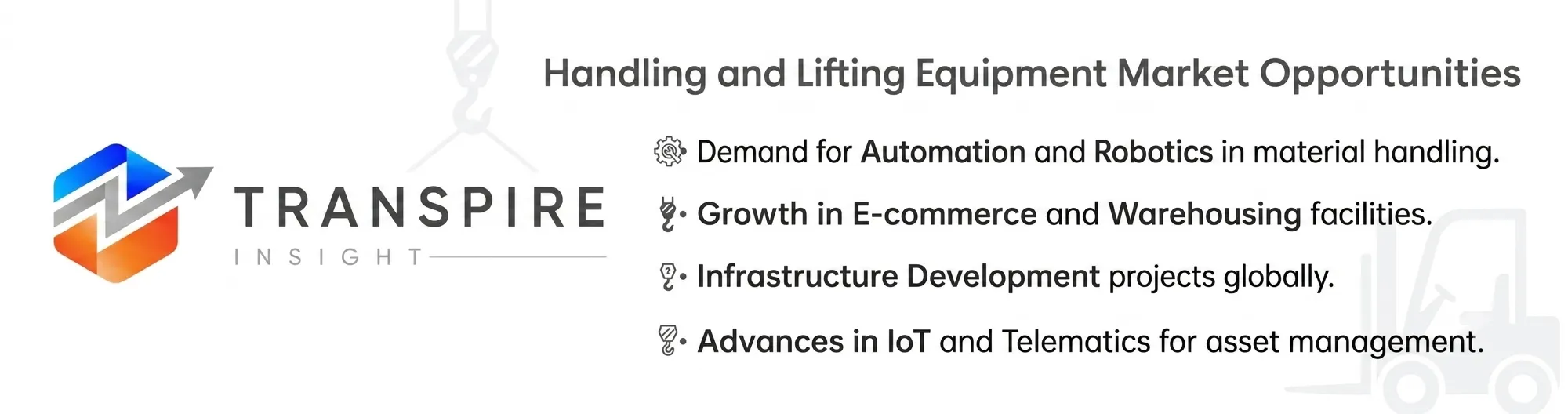
There is a shift towards using electrically driven hoisting equipment instead of diesel/LPG hoisting equipment as industries become environmentally friendly. The reasons for this include reduction in cost of operations, lower emissions of harmful gases, quieter operation, better energy efficiency, regulatory requirements, and increasing electrification of warehouses.
2. Expansion of Warehouse Automation Solutions
The growth of the e-commerce and logistics industry has made it necessary to use automated handling and lifting devices in warehouses. Increased number of orders, quick material handling, less manpower, accurate inventory management, high efficiency in warehouses, and demand for intelligent fulfillment centers have helped boost the market.
3. Increasing Integration of IoT-Enabled Fleet Management
Internet of Things technologies are being embedded by equipment handling and lifting companies to facilitate fleet monitoring and optimization. Factors such as remote equipment tracking, predictive maintenance, asset utilization improvement, reduction in downtime, increased visibility in operations, and performance fleet management are driving its use.
4. Rising Demand for Autonomous Forklifts and AGVs
Forklifts and automated guided vehicles (AGVs) that function on their own are increasingly being used in manufacturing facilities and warehouse environments. These include continuous operations, minimal labor dependence, increased productivity, precise navigational capabilities, safer transportation of materials, and ease of integration with automated warehouses.
5. Development of Smart Crane Monitoring Systems
Modern crane monitoring systems have been developed that make it possible to monitor the performance of cranes in real time and carry out safe lifting processes in construction sites, ports, and industrial plants. The following benefits are some reasons for greater popularity: load monitoring, remote diagnosis, predictive maintenance, operator safety, equipment longevity, and efficiency.
6. Growing Adoption of AI-Based Predictive Maintenance
AI is being employed in material handling machinery to detect potential failures in advance and facilitate efficient maintenance management. The decrease in downtime, reduced cost of maintenance, increase in lifespan of machinery, better maintenance scheduling, greater reliability of operation, and greater productivity are driving the adoption of AI-based maintenance solutions.
Top 25 Companies Leading the Handling and Lifting Equipment Market
Customize the exclusive Handling and Lifting Equipment Market report today to receive tailored insights, country-specific analysis, and business-focused market intelligence.
1. Konecranes Plc
Konecranes Plc is a global manufacturer of lifting equipment and material handling solutions serving industrial, port, and logistics applications.
Founded:1994 | Headquarters: Hyvinkää, Finland
Why It Ranks: Global leader in industrial cranes and intelligent lifting technologies.
Regional Dominance: Strong presence across Europe, North America, and Asia-Pacific.
Product Line: Overhead Cranes, Hoists, Port Cranes, Automated Lifting Systems, and Crane Service Solutions.
Recent Development: Expanded its presence in Japan through a majority stake acquisition in Mitsubishi Electric FA Industrial Products.
2. Cargotec Corporation
Cargotec develops cargo handling equipment and automation solutions for ports, terminals, and logistics industries through brands such as Hiab, Kalmar, and MacGregor.
Founded:2005 | Headquarters: Helsinki, Finland
Why It Ranks: Major supplier of cargo handling and port automation technologies.
Regional Dominance: Strong presence across Europe, Asia-Pacific, and North America.
Product Line: Container Handling Equipment, Terminal Tractors, Loader Cranes, Marine Cargo Handling Systems, and Automation Solutions.
Recent Development: Continued expanding smart and electric cargo handling technologies.
3. Toyota Industries Corporation
Toyota Industries Corporation manufactures material handling equipment, logistics solutions, industrial machinery, and automotive components.
Founded:1926 | Headquarters: Kariya, Aichi, Japan
Why It Ranks: World's leading manufacturer of forklifts and warehouse handling equipment.
Regional Dominance: Strong presence across Asia-Pacific, Europe, and North America.
Product Line: Forklifts, Warehouse Trucks, Automated Guided Vehicles (AGVs), Logistics Automation Systems, and Material Handling Equipment.
Recent Development: Expanded electric forklift and warehouse automation offerings.
4. Jungheinrich AG
Jungheinrich AG provides intralogistics solutions, warehouse automation systems, and material handling equipment worldwide.
Founded:1953 | Headquarters: Hamburg, Germany
Why It Ranks: Leading provider of warehouse automation and electric industrial trucks.
Regional Dominance: Strong presence across Europe and Asia-Pacific.
Product Line: Electric Forklifts, Reach Trucks, Warehouse Management Systems, Automated Storage Solutions, and AGVs.
Recent Development: Increased investment in intelligent warehouse automation technologies.
5. Mitsubishi Logisnext Co., Ltd.
Mitsubishi Logisnext manufactures forklifts, warehouse equipment, and logistics automation systems for industrial applications.
Founded:2017 | Headquarters: Kyoto, Japan
Why It Ranks: Global supplier of advanced material handling and warehouse equipment.
Regional Dominance: Strong presence across Asia-Pacific, Europe, and North America.
Product Line: Forklifts, Reach Trucks, AGVs, Warehouse Equipment, and Logistics Automation Solutions.
Recent Development: Expanded lithium-ion forklift portfolio and smart logistics technologies.
6. Hyster-Yale Materials Handling, Inc.
Hyster-Yale designs and manufactures lift trucks and material handling solutions for industrial and warehouse operations.
Founded:1989 | Headquarters: Cleveland, Ohio, USA
Why It Ranks: Major manufacturer of industrial lift trucks with strong innovation in electrification and automation.
Regional Dominance: Strong presence across North America, Europe, and Asia-Pacific.
Product Line: Forklifts, Container Handlers, Reach Stackers, Electric Lift Trucks, and Warehouse Equipment.
Recent Development: Partnered with NTT DATA to deploy AI-enabled manufacturing solutions.
7. Crown Equipment Corporation
Crown Equipment Corporation manufactures electric forklifts and warehouse material handling equipment.
Founded:1945 | Headquarters: New Bremen, Ohio, USA
Why It Ranks: Global leader in electric lift trucks and warehouse solutions.
Regional Dominance: Strong presence across North America, Europe, and Asia-Pacific.
Product Line: Electric Forklifts, Pallet Trucks, Order Pickers, Reach Trucks, and Warehouse Automation Equipment.
Recent Development: Expanded connected fleet management and warehouse technology solutions.
8. Komatsu Ltd.
Komatsu develops construction, mining, forestry, and industrial equipment including heavy lifting machinery.
Founded:1921 | Headquarters: Tokyo, Japan
Why It Ranks: Leading supplier of heavy-duty lifting and construction equipment.
Regional Dominance: Strong presence across Asia-Pacific, North America, and Europe.
Product Line: Construction Equipment, Cranes, Mining Machinery, Material Handling Equipment, and Industrial Vehicles.
Recent Development: Expanded autonomous and electric heavy equipment technologies.
9. Doosan Bobcat Inc.
Doosan Bobcat manufactures compact construction equipment, material handling machinery, and industrial vehicles.
Founded:1947 | Headquarters: Seoul, South Korea
Why It Ranks: Well-known provider of compact lifting and handling equipment.
Regional Dominance: Strong presence across North America, Europe, and Asia-Pacific.
Product Line: Telehandlers, Compact Loaders, Forklifts, Portable Power Equipment, and Material Handling Solutions.
Recent Development: Expanded electric and compact equipment portfolio.
10. Liebherr Group
Liebherr Group is a multinational manufacturer of construction machinery, cranes, mining equipment, and material handling systems.
Founded:1949 | Headquarters: Bulle, Switzerland
Why It Ranks: Global leader in heavy lifting and crane technologies.
Regional Dominance: Strong presence across Europe, Asia-Pacific, North America, and the Middle East.
Product Line: Tower Cranes, Mobile Cranes, Crawler Cranes, Port Equipment, and Material Handling Systems.
Recent Development: Continued expansion of digital crane control and automation technologies.
Schedule a meeting with our market experts to discuss the exclusive Handling and Lifting Equipment Market report and identify the best research solution for your organization.
Conclusion
The Handling and Lifting Equipment Market is growing at a consistent pace, owing to the rise in industrial manufacturing, warehousing, logistics, construction and e-commerce facilities all over the world. Rising demand for effective material handling, safety, and automation solutions is prompting firms to adopt better lifting technologies. Introduction of electric forklifts, autonomous guided vehicles (AGVs), fleet management systems with IoT capabilities, AI for predictive maintenance and automation in warehouses is revolutionizing the sector, offering improved efficiency levels with reduced energy consumption and costs related to workforce. Major players such as Konecranes Plc, Cargotec Corporation, Toyota Industries Corporation, Jungheinrich AG, Mitsubishi Logisnext Co., Ltd., Hyster-Yale Materials Handling, Inc., Crown Equipment Corporation, Komatsu Ltd., Doosan Bobcat Inc., and Liebherr Group continue to enhance the market via innovations and automation in technologies and geographical expansion strategies. With emphasis on productivity, sustainability and digitization in different industries, the Handling and Lifting Equipment Market is expected to exhibit continuous growth in the long run.


Send us a brief description of your challenge and we'll get back to you within 24 hours.

 inquiry@transpireinsight.com
 APAC:+91 7666513636
 Address


