
Jul 25, 2026
By Transpire Insight
Description
According to a research report published by Transpire Insight, The Global Data Fabric Market Size is projected to Grow from USD 4.5 Billion in 2025 to USD 27.42 Billion by 2035, at a CAGR of 26.3% during the forecast period 2026-2035. The growth factors are attributed to growing enterprise adoption of hybrid/multi-cloud models, increased requirement for real-time data integration, growing popularity of artificial intelligence/analytics, and the need for unified data governance. Technologies such as metadata management powered by artificial intelligence, automation of data discovery, data virtualization, cloud-native technology, integration of edge computing, and intelligent data orchestration are helping increase operational efficiency and decision-making capabilities of organizations. In addition to this, increased investment in digital transformation and data democratization is anticipated to aid the growth of the global Data Fabric market in the future.
Introduction
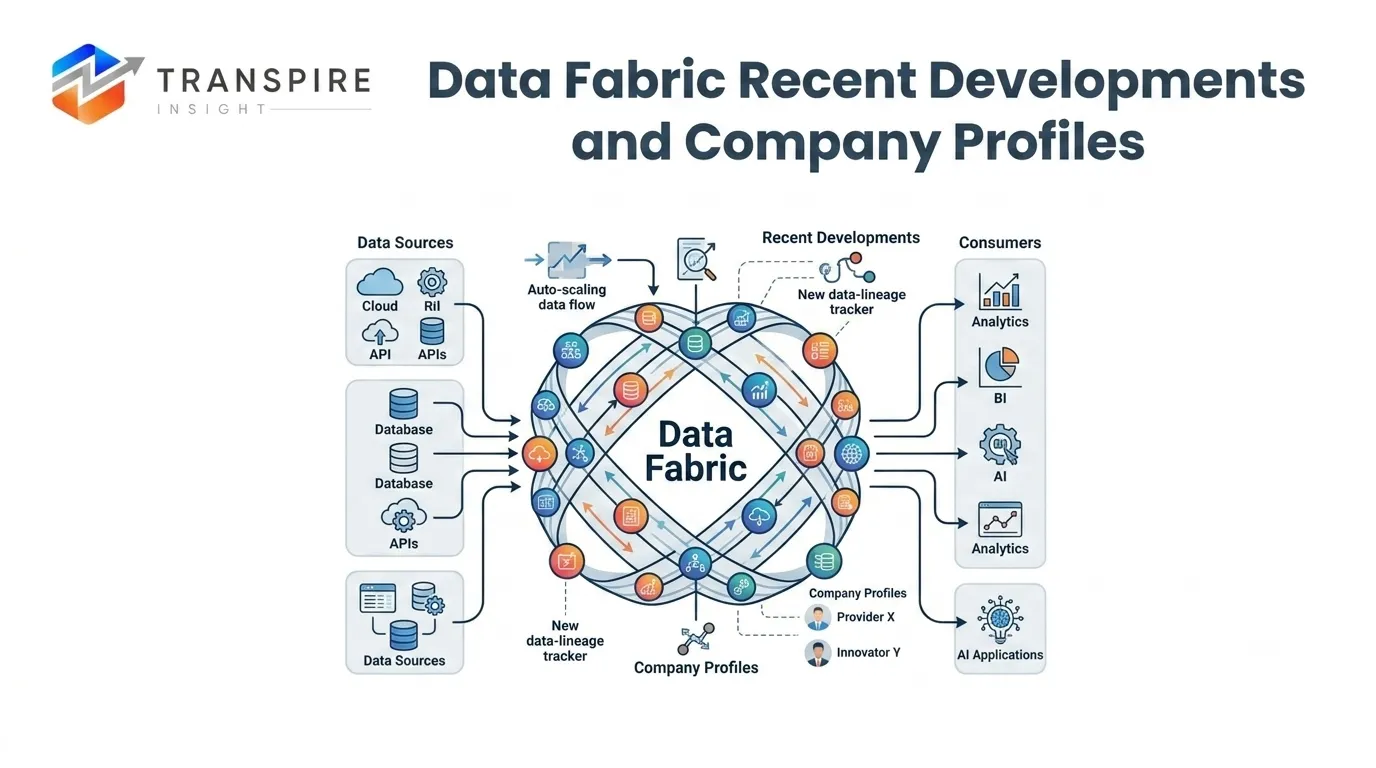
The Data Fabric Market involves technologies and platforms used in creating a data management infrastructure platform, which helps in integrating, accessing, governing, and orchestrating data from different locations such as on-premises, cloud, hybrid, and edge deployments. Data fabric involves the use of artificial intelligence, machine learning, metadata management, automation, and data virtualization to streamline enterprise data management.
Recent Development News
Stay Ahead of Emerging Opportunities with Expert Market Insights by Transpire Insight
The insights that have been shared through this blog are based on intensive market research carried out by Transpire Insight, an advisor that works with many global organizations. Thanks to the analysis of extensive data, forecasts made by our specialists, and industry intelligence, our reports allow clients to find strategic growth opportunities in dynamically developing industries. For all those who would like to get more detailed information regarding market segmentation, competitive analysis, regional outlooks, and future investment tendencies, there is no doubt that our full report will be of great value.
Data Fabric Market Size & Statistics
Regional Growth and Demand Analysis by Transpire Insight:
North America holds the largest market share of about 42% in the Data Fabric Market.
The dominance of North America in the Data Fabric Market is largely attributed to its high presence of cloud service providers, enterprise software companies, and innovators who are driving digital transformation efforts. Businesses from all industries are swiftly turning towards hybrid and multi-cloud environments, artificial intelligence, big data analytics and advanced data governance solutions which are generating a huge demand for data fabrics. The presence of large technology companies including IBM, Microsoft, Oracle, AWS, Google Cloud, Informatica, and Salesforce along with huge investments in enterprise AI, cybersecurity, and cloud-based data management technologies further bolstering the dominance of this region. In addition, strict data governance policies, mature IT infrastructure, and growing real-time analytics adoption are some of the factors responsible for market growth in United States and Canada.
Fastest-growing region: Asia-Pacific, fueled by rapidly growing cloud adoption, accelerated digital transformation, increasing AI implementations, growing data volumes in enterprises, government-led digital projects, and investments in latest data infrastructure in China, India, Japan, South Korea, Singapore, and Australia.
Top 15 Trends in the Data Fabric Market
1. Growing Adoption of AI-Powered Data Management
AI is increasingly becoming an important aspect of the Data Fabric Market by automating aspects such as data discovery, metadata management, data integration, and data quality management within distributed environments. The application of AI will improve operational efficiencies, improve access to data, improve decision-making processes, improve data governance, decrease manual effort, and support intelligent automation.
2. Expansion of Hybrid and Multi-Cloud Data Architectures
Data fabrics are being utilized by businesses for integrating data that is stored in diverse platforms within hybrid/multi-cloud architecture. This practice ensures consistent data, flexible workloads, ease in cloud migrations, simplifies infrastructure, guarantees business continuity, and centralizes enterprise data access.
3. Increasing Integration of Automated Data Governance
Organizations are embedding automated governance functionality into their data fabric solutions in order to comply with regulations and enhance data quality. Benefits associated with automated governance include increased enforcement of policies, increased data security, easier management of compliance, increased visibility into data, cost reduction in governance, and increased trust in enterprise data.
4. Rising Demand for Real-Time Data Integration
A need for real-time access to enterprise data for analytics and artificial intelligence purposes arises. The use of advanced data fabrics helps achieve continuous data integration, reduces processing delays, increases responsiveness of businesses, enhances operational visibility, provides real-time intelligence, and accelerates digital transformation efforts.
5. Growth of Metadata-Driven Data Fabric Platforms
Meta-data driven architecture is assuming increasing significance in helping ease data management within enterprises by offering contextual details on the data held within different systems. Meta-data platforms help to make the data easier to discover, improve integration accuracy, automate processes, boost efficiencies, and increase visibility.
6. Expansion of Data Virtualization Technologies
Through data virtualization, firms can now analyze their data from various locations without having to move or replicate any data. Data virtualization helps in reducing storage requirements, speeding up analytics, making data more accessible, conducting hybrid cloud computing, lowering the cost of the infrastructure, and speeding up decision-making processes for the enterprise.
Top 25 Companies Leading the Data Fabric Market
1. IBM Corporation
IBM is a global technology company specializing in hybrid cloud, artificial intelligence, enterprise software, and advanced data management solutions.
Founded:1911 | Headquarters: Armonk, New York, USA
Why It Ranks: Global leader in enterprise data fabric, hybrid cloud, and AI-powered data integration.
Regional Dominance: Strong presence across North America, Europe, Asia-Pacific, Latin America, and the Middle East.
Product Line: IBM watsonx.data, Cloud Pak for Data, Db2, IBM Storage, DataStage, and hybrid cloud solutions.
Expanded watsonx.data capabilities with AI-powered data fabric enhancements.
2. Microsoft Corporation
Microsoft develops cloud computing, enterprise software, productivity platforms, and AI-powered data management solutions.
Founded:1975 | Headquarters: Redmond, Washington, USA
Why It Ranks: Leading provider of cloud-native data fabric capabilities through Microsoft Fabric and Azure.
Regional Dominance: Strong presence across North America, Europe, Asia-Pacific, Latin America, and the Middle East.
Product Line: Microsoft Fabric, Azure Synapse Analytics, Azure Data Factory, Power BI, Microsoft Purview, and Azure AI.
Recent Development: Expanded Microsoft Fabric with enhanced AI-driven data integration features.
3. Oracle Corporation
Oracle is a multinational technology company delivering cloud infrastructure, databases, enterprise applications, and data management solutions.
Founded:1977 | Headquarters: Austin, Texas, USA
Why It Ranks: Major provider of enterprise cloud databases and integrated data management platforms.
Regional Dominance: Strong presence across North America, Europe, Asia-Pacific, and the Middle East.
Product Line: Oracle Cloud Infrastructure, Autonomous Database, Oracle Analytics Cloud, Oracle Integration Cloud, and Fusion Applications.
Recent Development: Expanded AI-powered capabilities across Oracle Cloud Infrastructure and enterprise databases.
4. SAP SE
SAP develops enterprise software for business operations, analytics, cloud computing, and intelligent data management.
Founded:1972 | Headquarters: Walldorf, Germany
Why It Ranks: Leading enterprise software provider with integrated data fabric capabilities.
Regional Dominance: Strong presence across Europe, North America, Asia-Pacific, and Latin America.
Product Line: SAP Datasphere, SAP HANA Cloud, SAP Business Technology Platform, SAP Analytics Cloud, and SAP Integration Suite.
Recent Development: Expanded SAP Datasphere to strengthen enterprise-wide data integration and governance.
5. Amazon Web Services, Inc.
Amazon Web Services is a global cloud computing provider offering infrastructure, analytics, artificial intelligence, and enterprise data solutions.
Founded:2006 | Headquarters: Seattle, Washington, USA
Why It Ranks: World's leading cloud infrastructure provider supporting modern data fabric deployments.
Regional Dominance: Strong presence across North America, Europe, Asia-Pacific, Latin America, and the Middle East.
Product Line: Amazon S3, AWS Glue, Amazon Redshift, Lake Formation, Amazon EMR, and AWS DataZone.
Recent Development: Expanded AWS DataZone and generative AI capabilities for enterprise data management.
6. Google LLC
Google develops cloud computing, artificial intelligence, analytics, and enterprise data management technologies.
Founded:1998 | Headquarters: Mountain View, California, USA
Why It Ranks: Major provider of cloud-native analytics and intelligent data integration platforms.
Regional Dominance: Strong presence across North America, Europe, and Asia-Pacific.
Product Line: Google Cloud, BigQuery, Dataplex, Vertex AI, Looker, and Cloud Data Fusion.
Recent Development: Enhanced Dataplex and BigQuery with advanced AI-powered data governance features.
7. Informatica Inc.
Informatica provides enterprise cloud data management, integration, governance, and metadata solutions.
Founded:1993 | Headquarters: Redwood City, California, USA
Why It Ranks: Leading provider of AI-powered cloud data management platforms.
Regional Dominance: Strong presence across North America, Europe, and Asia-Pacific.
Product Line: Intelligent Data Management Cloud, Master Data Management, Data Integration, Data Governance, and API Management.
Recent Development: Expanded Intelligent Data Management Cloud with new AI-driven automation capabilities.
8. Denodo Technologies
Denodo develops data virtualization and logical data management software for enterprise data integration.
Founded:1999 | Headquarters: Palo Alto, California, USA
Why It Ranks: Global leader in enterprise data virtualization technology.
Regional Dominance: Strong presence across North America, Europe, and Asia-Pacific.
Product Line: Denodo Platform, Data Virtualization, Logical Data Fabric, Metadata Management, and Data Catalog.
Recent Development: Enhanced logical data fabric platform with improved AI integration capabilities.
9. Talend S.A.
Talend provides cloud-based data integration, quality, governance, and data integrity solutions for enterprises.
Founded:2005 | Headquarters: Suresnes, France
Why It Ranks: Well-recognized provider of enterprise data integration and governance technologies.
Regional Dominance: Strong presence across Europe, North America, and Asia-Pacific.
Product Line: Talend Data Fabric, Data Integration, Data Quality, Data Stewardship, and API Services.
Recent Development: Expanded Talend Data Fabric with enhanced cloud-native integration capabilities.
10. Snowflake Inc.
Snowflake delivers cloud-native data cloud solutions enabling enterprise data storage, analytics, sharing, and AI workloads.
Founded:2012 | Headquarters: Bozeman, Montana, USA
Why It Ranks: Leading cloud data platform supporting modern data fabric architectures.
Regional Dominance: Strong presence across North America, Europe, and Asia-Pacific.
Product Line: Snowflake AI Data Cloud, Data Warehouse, Data Lake, Data Sharing, Snowpark, and Cortex AI.
Recent Development: Expanded AI Data Cloud with new generative AI and enterprise data collaboration capabilities.
Conclusion
Data Fabric Market is witnessing a fast pace in its growth since the increasing adoption of unified architecture of data management for hybrid clouds, AI, analytics, and real-time decisions is on the rise. The need for data integration, automation, metadata management, and data orchestration is driving enterprises to invest in the market from various industry verticals such as BFSI, healthcare, manufacturing, retail, telecommunication, and government. The players like IBM Corporation, Microsoft Corporation, Oracle Corporation, SAP SE, Amazon Web Services, Google LLC, Informatica Inc., Denodo Technologies, Talend S.A., and Snowflake Inc. are continuously innovating with their offerings that include AI-enabled data platform, cloud-native architecture, and data integration for enterprises. With the increasing emphasis on digital transformation, data democratization, regulatory compliance, and AI readiness among others, it is estimated that Data Fabric Market will witness long-term growth globally.


Send us a brief description of your challenge and we'll get back to you within 24 hours.

 inquiry@transpireinsight.com
 APAC:+91 7666513636
 Address


