
Jul 16, 2026
By Transpire Insight
Description
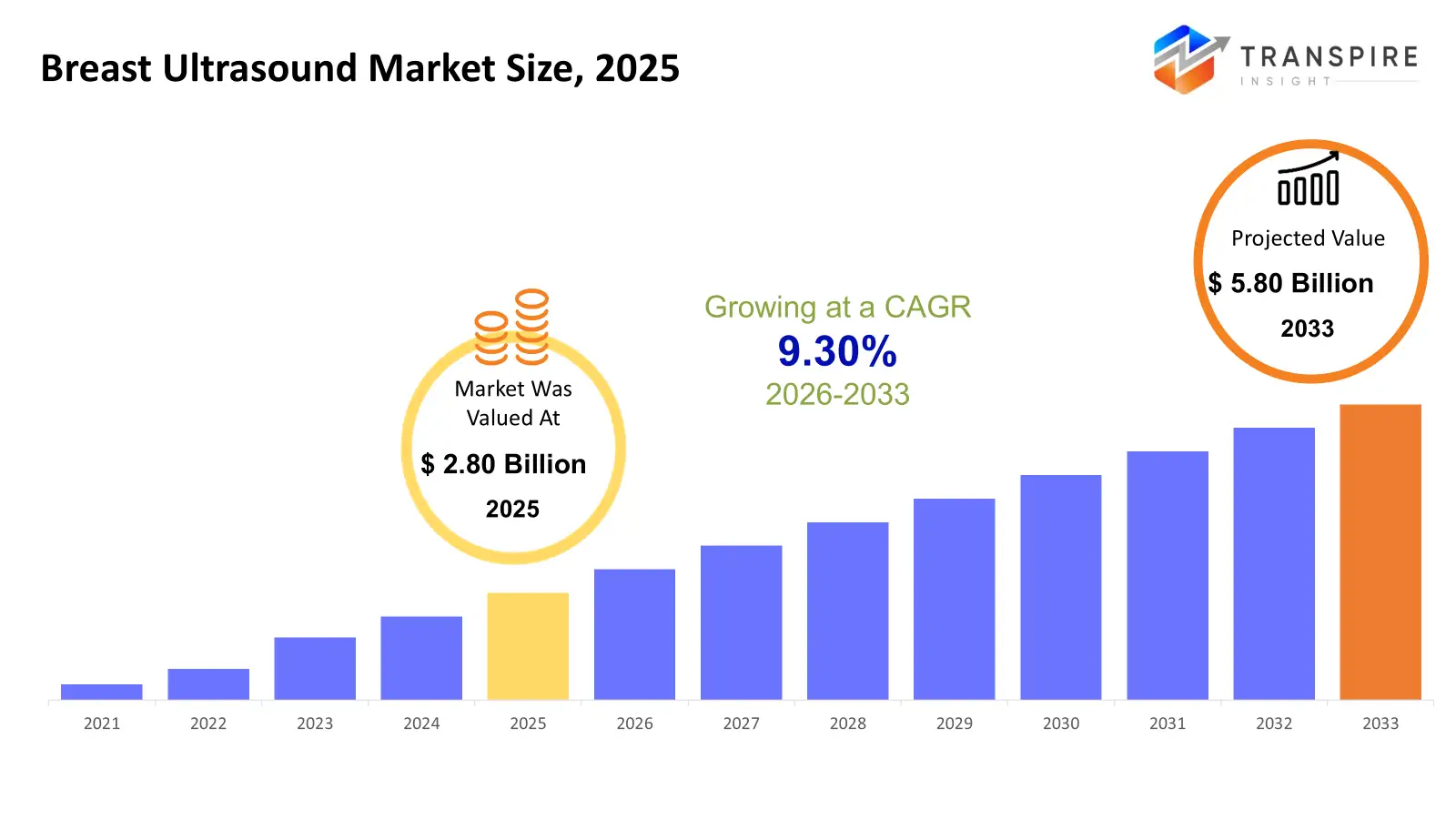
According to a research report published by Transpire Insight, the global breast ultrasound market size is projected to grow from USD 4.10 billion in 2026 to USD 7.80 billion by 2035, at a CAGR of 10.14% during the forecast period 2026-2035. Aggressive dense breast notification laws, coupled with the increasing prevalence of breast cancer around the world, are directly impacting adoption. In addition, continuous innovations in operator-independent Automated Breast Ultrasound Systems (ABUS) eliminate typical manual scanning inconsistencies, driving clinical demand.
Introduction
Breast ultrasound devices are witnesses to the global market's rapid growth, driven by the rising incidence of breast cancer and the increasing emphasis on early screening initiatives. In addition to traditional mammography, which is still a major diagnostic tool, the effectiveness of this imaging method is greatly diminished by the presence of dense breast tissue, in which overlapping structures can obscure any abnormalities. This is why there has been a growing need for advanced ultrasound modalities, especially automated, 3D, and AI-powered platforms, to fill this important clinical need. This change in structure ensures that this will be widely used in advanced medical facilities throughout the world.
Recent Development News
Stay Ahead of Emerging Opportunities with Expert Market Insights by Transpire Insight
Transpire Insight provides comprehensive, data-driven market intelligence to support smarter business decisions. Our research is rooted in comprehensive analysis, authoritative predictions, and industry expertise, enabling organizations to make informed decisions in rapidly evolving markets. In-depth analysis of market segmentation, competitive positioning, regional trends, and emerging investment opportunities in high-growth areas. We blend accuracy with actionable intelligence, empowering companies to uncover new avenues for growth, bolster strategic decision-making, and stay ahead in a dynamic global market.
Download the exclusive Breast Ultrasound Market sample report today to uncover expert insights, emerging trends, and the opportunities defining the future of the industry.
Breast Ultrasound Market Size & Statistics
Regional Growth and Demand Analysis by Transpire Insight:
North America's leadership rests on early and consistent adoption of automated whole-breast imaging, backed by dense-breast notification mandates across most U.S. states and strong reimbursement support from private insurers and Medicare/Medicaid alike. Leading academic cancer centers have folded AI-enhanced reading tools into routine screening pathways, while Canada's provincial health systems continue expanding access to remote and rural populations. Mexico's private hospital networks are also leaning on automated systems to serve medical-tourism patients seeking comprehensive breast-imaging packages. This infrastructure advantage was reinforced in March 2026, when GE HealthCare secured FDA premarket approval for its Invenia ABUS Premium system, an AI-powered platform that cut scan time by 40% and accelerated adoption across U.S. hospital networks.
Asia Pacific's rapid growth is being driven by expanding hospital and diagnostic-lab infrastructure, rising breast cancer awareness campaigns, and government-backed screening initiatives across China, India, and Japan. China's growth is anchored in large-scale hospital procurement and a fast-expanding medical device manufacturing base, while Japan continues to lead in AI-assisted breast ultrasound research. India stands out for extending access into underserved areas. Through 2026, state health departments have deployed automated breast ultrasound (ABU) systems in mobile screening vans, bringing dense-tissue screening to rural populations that previously lacked radiology infrastructure.
Top 15 Trends in the Breast Ultrasound Market
Proceed to Checkout to purchase the exclusive Breast Ultrasound Market report and gain instant access to in-depth market intelligence, strategic analysis, and future growth opportunities.
Top 25 Companies Leading the Breast Ultrasound Market
Customize the exclusive Breast Ultrasound Market report today to receive tailored insights, country-specific analysis, and business-focused market intelligence.
1. Hitachi Ltd.
Advanced Arietta ultrasound platforms introduce high-resolution structural tissue mapping to radiology departments.
Founded: 1910 | HQ: Tokyo, Japan.
Why It Ranks: Pioneers in elastomer tissue evaluation software to reduce painful and unnecessary biopsies.
Regional Dominance: Maintains an immovable leadership position inside expansive Asian hospital networks.
Product Line: Arietta series systems provide incredible high-definition diagnostic imaging for deep tissue.
2. Hologic Inc.
Its cutting-edge SuperSonic and hand-held multi-modality technologies actively revolutionize multi-parametric breast tissue assessment.
Founded: 1985 | HQ: Massachusetts, USA.
Why It Ranks: Remains a premier global authority focused entirely on female wellness technologies.
Regional Dominance: Dictates the market landscape across dense North American screening clinics.
Product Line: SuperSonic MACH systems incorporate premium breast elasticity profiling tools for clinicians.
3. Koninklijke Philips N.V.
Integrated artificial intelligence solutions continuously enhance diagnostic confidence by standardizing complex workflows.
Founded: 1891 | HQ: Amsterdam, Netherlands.
Why It Ranks: Seamlessly integrates smart anatomical quantification software into traditional workflow designs.
Regional Dominance: Captures an expansive market share spanning Western European healthcare infrastructure.
Product Line: EPIQ and Affiniti platforms utilize proprietary software for targeted lesion analysis.
4. Samsung Medison
Premium visual rendering engines offer remarkably vivid spatial clarity for subtle structural variations.
Founded: 1985 | HQ: Seoul, South Korea.
Why It Ranks: Leads deep-learning integration by deploying rapid automated breast lesion classification tools.
Regional Dominance: Rapidly captures high-growth market segments throughout evolving Asia-Pacific territories.
Product Line: RS85 Prestige systems prioritize highly detailed and microscopic tissue structure analysis.
5. Mindray Medical
Cost-effective cart-based platforms significantly democratize localized point-of-care ultrasound applications globally.
Founded: 1991 | HQ: Shenzhen, China.
Why It Ranks: Delivers an exceptional balance between premium diagnostic capabilities and affordable hospital acquisition costs.
Regional Dominance: Holds undisputed structural market control across public Chinese medical networks.
Product Line: The Resona and Consona series bring reliable diagnostic software to standard clinical teams.
6. Fujifilm Holdings
Combining Sonosite point-of-care speed with premium radiology consoles delivers versatile clinical diagnostics.
Founded: 1934 | HQ: Tokyo, Japan.
Why It Ranks: Uniquely merges comprehensive digital mammography systems with specialized high-frequency complementary ultrasounds.
Regional Dominance: Possesses powerful, diversified distribution pipelines running across European and Asian markets.
Product Line: Elixir and Arietta platforms provide comprehensive diagnostic coverage for multi-department setups.
7. Delphinus Medical Technologies
The highly innovative SoftVue platform redefines how dense breast tissue receives routine care.
Founded: 2010 | HQ: Michigan, USA.
Why It Ranks: Patented safe underwater acoustic ring technology scans tissue across 360 degrees.
Regional Dominance: Experiences continuous, rapid installation growth inside modern American imaging facilities.
Product Line: SoftVue 3D tomography delivers compression-free screening options for dense-breasted patients.
8. SonoCiné Inc.
Automated tracking software transforms standard handheld units into precise, operator-independent screening tools.
Founded: 1999 | HQ: Nevada, USA.
Why It Ranks: Invented high-precision robotic probe stabilization to prevent missing hidden internal micro-lesions.
Regional Dominance: Operates extensively within prominent specialized oncology screening facilities across North America.
Product Line: Automated Whole Breast Ultrasound (AWBU) attachments seamlessly optimize pre-existing facility hardware.
9. QT Ultrasound (QT Imaging)
Transmission-based acoustic technologies produce unmatched structural clarity without painful physical compression or radiation.
Founded: 2011 | HQ: California, USA.
Why It Ranks: True speed-of-sound transmission algorithms build distinct, highly comprehensive multi-dimensional tissue maps.
Regional Dominance: Forging extensive commercial partnerships to expand across expanding Middle Eastern markets.
Product Line: QT Breast Scanners offer highly accurate, radiation-free solutions for dense anatomy.
10. SuperSonic Imagine
Proprietary ShearWave elastography measures absolute tissue stiffness in real-time for immediate tumor evaluation.
Founded: 2005 | HQ: Aix-en-Provence, France.
Why It Ranks: Transformed traditional diagnostic workflows by introducing precise, quantitative tissue hardness metrics.
Regional Dominance: Retains strong, highly specialized usage across dedicated academic research clinics worldwide.
Product Line: Aixplorer systems provide highly detailed real-time physiological profiling for oncology specialists.
Schedule a meeting with our market experts to discuss the exclusive Breast Ultrasound Market report and identify the best research solution for your organization.
Conclusion
Overall, breast ultrasound is positioned to play a key role in the much-needed shift in cancer screening. Manual workflows are gradually replaced by automated, AI-assisted and 3D-architectural workflows, as regulatory requirements continue to demand clear and transparent diagnoses even in dense tissue. The partnership of well-known healthcare giants and niche diagnostic trailblazers makes screening tools without radiation, comfortable, and incredibly accurate commonplace throughout the world. This continuous technological development will keep saving lives by early detection, reduce the cost of healthcare, and provide a higher diagnostic accuracy.


Send us a brief description of your challenge and we'll get back to you within 24 hours.

 inquiry@transpireinsight.com
 APAC:+91 7666513636
 Address


