
Jul 11, 2026
By Transpire Insight
Description
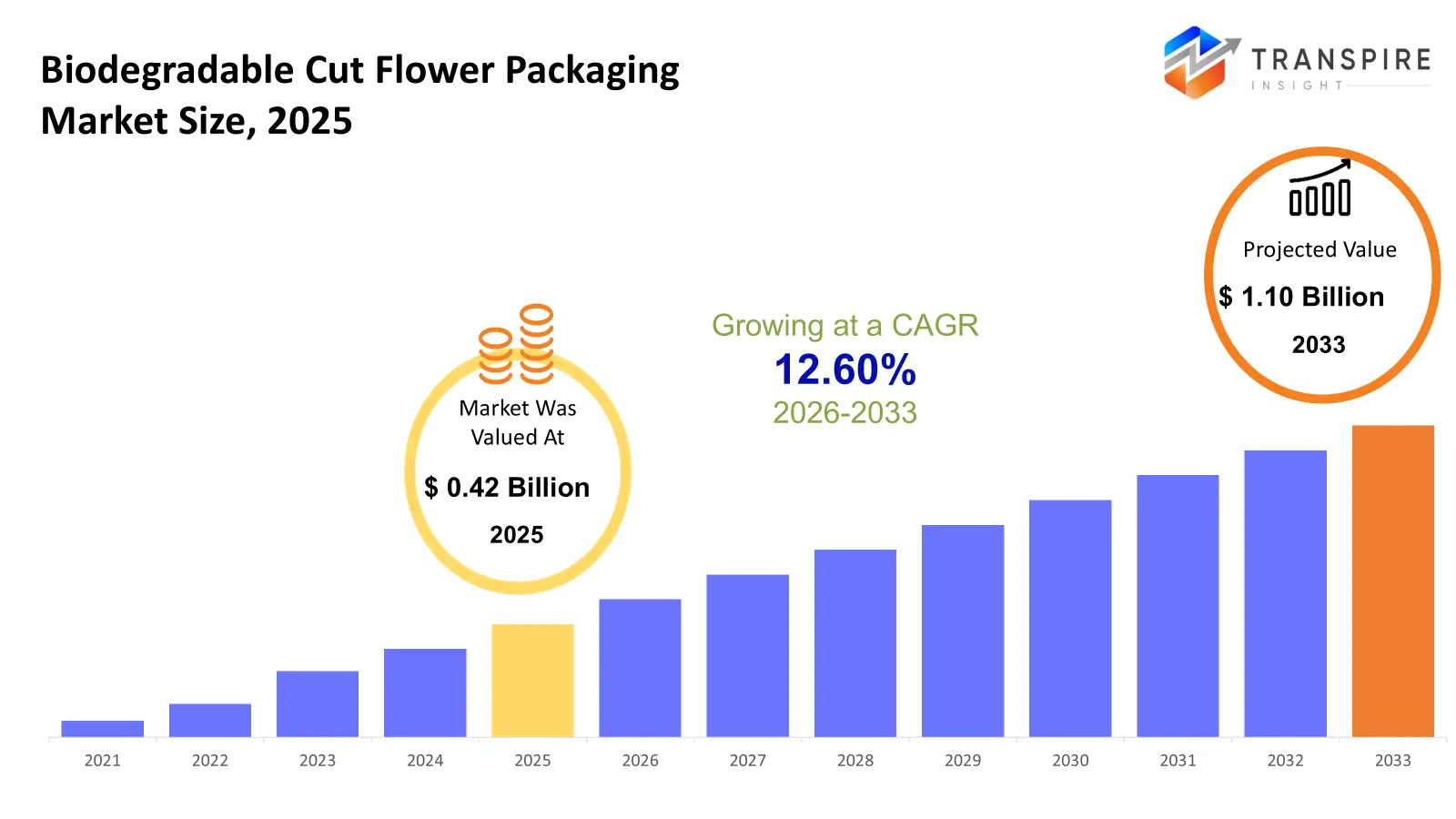
According to a research report published by Transpire Insight, the global biodegradable cut flower packaging market size is projected to grow from USD 4.5 billion in 2026 to USD 7.02 billion by 2035, at a CAGR of 13.60% during the forecast period 2026-2035. Increasing consumer concern for the environment and government initiatives on eliminating single-use plastics encourage the use of eco-friendly, compostable wraps, plant-based cellulose films, and paperboard sleeves to cut down on landfill waste in floriculture value chains around the world.
Introduction
Biodegradable cut flower packaging is witnessing rapid growth in the global market owing to the growing floriculture trade and the drastic growth of e-commerce floral delivery services. Delicate cut flowers need strong moisture management and cushioning to ensure transport vase life. The traditional packaging was mainly plastic sleeves, which are not recyclable, and generate huge amounts of ecological garbage. Thanks to the latest in material science, including anti-fog compostable coatings and bioplastics, today's growers can ensure freshness in their flowers, meet eco-friendly consumer demands, and meet stringent retail sustainability specifications around the globe.
Recent Development News
Stay Ahead of Emerging Opportunities with Expert Market Insights by Transpire Insight
Transpire Insight provides comprehensive, data-driven market intelligence to support smarter business decisions. Our research is rooted in comprehensive analysis, authoritative predictions, and industry expertise, enabling organizations to make informed decisions in rapidly evolving markets. In-depth analysis of market segmentation, competitive positioning, regional trends, and emerging investment opportunities in high-growth areas. We blend accuracy with actionable intelligence, empowering companies to uncover new avenues for growth, bolster strategic decision-making, and stay ahead in a dynamic global market.
Download the exclusive Biodegradable Cut Flower Packaging Market sample report today to uncover expert insights, emerging trends, and the opportunities defining the future of the industry.
Biodegradable Cut Flower Packaging Market Size & Statistics
Regional Growth and Demand Analysis by Transpire Insight:
North America is expected to grow the fastest during the forecast period in the Biodegradable Cut Flower Packaging market. The dominant player in the Biodegradable Cut Flower Packaging Market is Asia-Pacific, owing to the availability of leading players in terms of massive floriculture cultivation areas, raw material bioplastic suppliers, and robust investment in agricultural export infrastructure. The United States is currently the biggest consumer in the North American segment of the Biodegradable Cut Flower Packaging Market, considering factors such as the presence of extensive commercial e-commerce floral delivery operations, efforts toward modernizing retail sustainability mandates, and continued advancement in bio-based materials engineering. As of 2026, some of the packaging companies in the United States have undertaken production activities aimed at manufacturing superior moisture-resistant and compostable shipping boxes that would enhance next-generation retail and direct-to-consumer floral deliveries.
Asia Pacific is anticipated to generate the highest demand during the forecast period in the Biodegradable Cut Flower Packaging market. It is expected that the Asia-Pacific region will witness the highest overall volume and market share during the forecast period due to increasing demand for commercial cut flower transportation, growing fleets of international floral shipments, increased bulk purchasing programs by global florists, and significant investment in agricultural logistics infrastructure. China, India, Japan, and South Korea are some of the rapidly growing nations regarding commercial horticulture activities that drive the demand for advanced eco-friendly packaging technologies. In 2026, there will be an increase in the supply chain modernization programs by many export companies in China and India. This was done with the aim of ensuring energy-efficient and certified home-compostable flower wrapping systems.
Top 15 Trends in the Biodegradable Cut Flower Packaging Market
Proceed to Checkout to purchase the exclusive Biodegradable Cut Flower Packaging Market report and gain instant access to in-depth market intelligence, strategic analysis, and future growth opportunities.
Top 25 Companies Leading the Biodegradable Cut Flower Packaging Market
Customize the exclusive Biodegradable Cut Flower Packaging Market report today to receive tailored insights, country-specific analysis, and business-focused market intelligence.
Top 25 Companies Leading the Biodegradable Cut Flower Packaging Market
1. Smurfit Westrock
Pioneers' high-strength corrugated fiber systems optimize freshness during international cross-border transits.
Founded: 1934 | HQ: Dublin, Ireland
Why It Ranks: Secures premium market positioning through robust global structural packaging manufacturing setups.
Regional Dominance: Enjoys an extensive market share footprint throughout Western European export hubs.
Product Line: 100% paper-based flower shipping boxes, moisture-resistant trays, and ventilation sleeves.
2. Mondi Group
Manufacturers specialize in breathable kraft paper wraps, reducing standard commercial plastic waste.
Founded: 1967 | HQ: London, United Kingdom.
Why It Ranks: Ranks heavily due to the large-scale development of certified sustainable materials.
Regional Dominance: Holds substantial market volume across major European agricultural distribution networks.
Product Line: Eco-friendly flower sleeves, custom kraft wrappers, and biodegradable transport sheets.
3. DS Smith Plc
Engineers custom circular economy packaging, minimizing floral transit carbon emission loops.
Founded: 1940 | HQ: London, United Kingdom.
Why It Ranks: Ranks highly for providing advanced e-commerce delivery boxes built sustainably.
Regional Dominance: Commands a significant distribution presence across North American retail distribution networks.
Product Line: Recyclable direct-to-consumer floral boxes, structural inserts, and protective transport wraps.
4 Stora Enso Oyj
Utilizes premium renewable Northern European wood fiber, minimizing regional plastic usage.
Founded: 1998 | HQ: Helsinki, Finland.
Why It Ranks: Captures top placement through specialized anti-moisture corrugated plant container designs.
Regional Dominance: Maintains an absolutely dominant market footprint across Nordic floriculture sectors.
Product Line: Moisture-resistant Euroboxes, custom flower transit crates, and eco-friendly propagation trays.
5. Amcor plc
Develops highly technical compostable film wraps preserving delicate retail floral freshness.
Founded: 1860 | HQ: Zurich, Switzerland.
Why It Ranks: Ranks for introducing flexible, bio-based barrier solutions into commercial floriculture.
Regional Dominance: Exercises wide market influence throughout active North American agricultural segments.
Product Line: Certified home-compostable cellophane wraps, plant-based clear films, and venting sheets.
6. FloraLife
Combines post-harvest biological flower care products with completely sustainable outer packaging.
Founded: 1938 | HQ: Walterboro, South Carolina, USA.
Why It Ranks: Earns prominent ranking by merging hydration science with eco-friendly shipping materials.
Regional Dominance: Deeply entrenched among North American and Latin American commercial growers.
Product Line: Biodegradable floral transport bags, paper wraps, and eco-conscious hydration packets.
7. Sirane Limited
Innovates compostable absorbent retail pads regulating excessive moisture inside floral wraps.
Founded: 2003 | HQ: Telford, United Kingdom.
Why It Ranks: Excels due to advanced material engineering tackling structural flower decay issues.
Regional Dominance: Growing rapidly within British and continental European retail florist channels.
Product Line: Earthpouch flower sleeves, compostable absorbent mats, and bio-poly protective materials.
8. A*ROO Company
Standardizes mass production of highly aesthetic green-certified decorative floral covers.
Founded: 1968 | HQ: Strongsville, Ohio, USA.
Why It Ranks: Secures its rank via expansive retail distributor supply networks across America.
Regional Dominance: Exceptionally strong positioning among institutional greenhouse growers across the United States.
Product Line: PLA-based clear plant sleeves, paper sheets, and natural fiber wraps.
9. Flamingo Holland Inc.
Delivers specialized horticultural accessories, prioritizing fully compostable structural packaging alternatives.
Founded: 1996 | HQ: Vista, California, USA.
Why It Ranks: Selected for its streamlined import logistics supporting diverse commercial flower markets.
Regional Dominance: Strongly competitive across interconnected Dutch and North American flower auctions.
Product Line: Compostable flower sleeves, recycled paperboard carriers, and natural fiber containers.
10. UFlex Limited
Fabricates high-barrier flexible green films accommodating intensive global commercial shipping.
Founded: 1985 | HQ: Noida, India.
Why It Ranks: Prominent due to cost-effective volume manufacturing of custom-printed wraps.
Regional Dominance: Leading dominant manufacturer serving rapidly expanding South Asian floriculture markets.
Product Line: Biodegradable flower wrapping sleeves, moisture-barrier films, and printed floral paper.
Schedule a meeting with our market experts to discuss the exclusive Biodegradable Cut Flower Packaging Market report and identify the best research solution for your organization.
Conclusion
The global biodegradable cut flower packaging market is at a pivotal moment, with tougher single-use plastic regulations and the explosion of e-commerce delivery channels for cut flowers. With the evolution of material science, the use of certified home-compostable sleeves, moisture-resistant paperboards, and plant-based barrier films has found a balance that satisfies delicate water requirements in floriculture logistics and high environmental standards. In the future, long-term investments in the industry for scalable, circular mono-material structures will continue to be the key to reducing waste in international agricultural value chains by removing waste that ends up in landfills.


Send us a brief description of your challenge and we'll get back to you within 24 hours.

 inquiry@transpireinsight.com
 APAC:+91 7666513636
 Address


