
Jul 27, 2026
By Transpire Insight
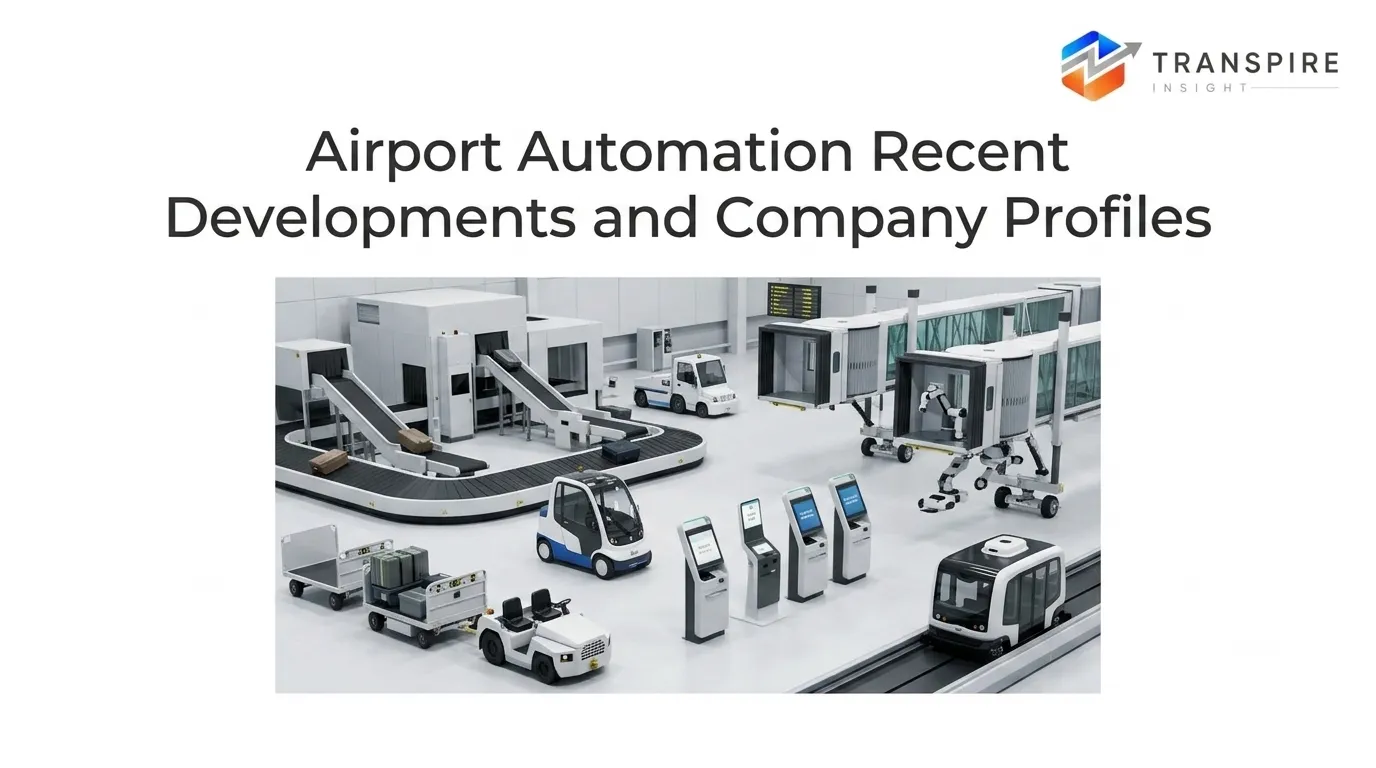
Description
According to a research report published by Transpire Insight, the airport automation market size is projected to grow from USD 60.12 billion in 2026 to USD 93.45 billion by 2035, at a CAGR of 8.06% during the forecast period 2026-2035. The market is primarily propelled by surging global passenger volumes necessitating high throughput without new physical construction. Rapid adoption of contactless biometric solutions and automated baggage systems further accelerates airport digital modernization.
Introduction
The global airport automation market is undergoing a significant evolution, projected to reach over $4.8 billion in 2026. Facing immense pressure to streamline passenger journeys, reduce waiting times, and optimize ground-handling efficiency, airports worldwide are moving away from legacy infrastructure. The integration of artificial intelligence, robotic baggage sorting, and biometric "One ID" systems has transitioned from experimental trials into essential operational deployments. These innovations ensure airports can handle peak traffic smoothly while maintaining stringent security protocols.
Recent Development News
Stay Ahead of Emerging Opportunities with Expert Market Insights by Transpire Insight
Transpire Insight provides comprehensive, data-driven market intelligence to support smarter business decisions. Our research is rooted in comprehensive analysis, authoritative predictions, and industry expertise, enabling organizations to make informed decisions in rapidly evolving markets. In-depth analysis of market segmentation, competitive positioning, regional trends, and emerging investment opportunities in high-growth areas. We blend accuracy with actionable intelligence, empowering companies to uncover new avenues for growth, bolster strategic decision-making, and stay ahead in a dynamic global market.
Airport Automation Market Size & Statistics
Regional Growth and Demand Analysis by Transpire Insight
North America's dominance is anchored by robotics adoption, an established vendor base, and aggressive security-screening modernization. TSA checkpoint upgrades are a clear driver: Smiths Detection secured a USD 96.8 million CT-scanner order, and OSI Systems landed a USD 42 million screening package as part of the agency's ongoing modernization push, while FAA initiatives continue promoting automation adoption across US airports. Daifuku also consolidated its North American footprint, rebranding subsidiaries such as Jervis B. Webb as Daifuku Airport America, signaling deeper regional investment by equipment suppliers.
Asia-Pacific's growth is being pulled by passenger-traffic surges, new airport construction, and government-backed smart-airport programs, particularly in China, India, and Southeast Asia, where automation is built into greenfield terminals from day one rather than retrofitted later. Vendor activity elsewhere reinforces the shift toward integrated, software-driven operations: Amadeus IT Group launched a new passenger-processing platform in February 2025 to streamline check-in and boarding, while Thales was selected by Finland's VTT in July 2025 to supply its TopSky-AstraUTM system for the U-Space Finland drone-traffic pilot, extending automation beyond terminals into airspace management. Europe, the second-largest region at roughly a 30% share, continues leaning on EASA-aligned standards to support similar upgrades at hubs like Heathrow, Frankfurt, and Schiphol.
Top 15 Trends in the Airport Automation Market
Biometric Self-Service Adoption
Airports are deploying biometric identity verification across check-in, bag drop, security, and boarding, cutting processing times and reducing queues while giving passengers seamless, contactless journeys.
AI-Powered Chatbots
AI-powered chatbots and virtual assistants now handle passenger queries, flight updates, and wayfinding around the clock, reducing staffing costs while improving traveler satisfaction across terminals.
Automated Baggage Handling
Modern automated baggage handling and tracking systems speed processing, cut mishandling rates, and give airlines real-time visibility into luggage location, reducing lost-bag claims and costs.
Advanced Security Screening Upgrades
Airports are upgrading to advanced CT-based screening lanes and AI-assisted threat detection, exemplified by TSA's multimillion-dollar Smiths Detection and OSI Systems equipment orders in 2025.
Cloud-Based Airport Operations Platforms
Airports are shifting operations software to cloud platforms, enabling multi-terminal coordination, real-time disruption management, and centralized analytics that scale faster than aging on-premises legacy systems.
Greenfield Airport Construction
New greenfield airport projects are embedding automation from the design stage, integrating biometrics, automated baggage systems, and smart infrastructure to avoid costly brownfield retrofit expenses.
List of Top 25 Companies Leading the Airport Automation Market
1. Collins Aerospace
Introduced next-generation AI-powered self-service check-in kiosks to streamline passenger boarding.
Founded: 2018 | HQ: Charlotte, North Carolina, USA.
Why It Ranks: Unrivaled end-to-end integration of avionics, ground networks, and passenger-terminal systems.
Regional Dominance: Holds highly lucrative, long-term aviation and airport modernization contracts across North America.
Product Line: Self-Service Baggage Drop, Biometric Airside Gates, and Common-Use Passenger Processing Systems.
2. SITA
Announced that their digital technologies successfully cut border processing times significantly.
Founded: 1949 | HQ: Geneva, Switzerland.
Why It Ranks: Dictates international flight data exchange standards and smart-terminal biometrics solutions.
Regional Dominance: Strongly dominates complex, multinational borders and European transit hub automation infrastructure.
Product Line: Smart Path Biometrics, WorldTracer Baggage Management, and Airport Management APIs.
3. Amadeus IT Group
Launched advanced AI-driven passenger flow management systems to reduce congestion.
Founded: 1987 | HQ: Madrid, Spain.
Why It Ranks: Connects airlines and airports with integrated, real-time, cloud-based travel databases.
Regional Dominance: Maintains an extensive market footprint across European and Asia-Pacific travel sectors.
Product Line: Altéa Departure Control, ACUS Cloud Common Use, and Passenger Flow Management.
4. Siemens Logistics
Operates specialized international test centers to pioneer future air-cargo robotics.
Founded: 2013 | HQ: Constance, Germany.
Why It Ranks: Leads the industry in high-speed, mechanical, and software-integrated sorting systems.
Regional Dominance: Commands major airside terminal modernization projects throughout Germany and continental Europe.
Product Line: VarioBelt Conveyors, Baggage 360 Software, and automated tray handling systems.
5. Daifuku Co., Ltd.
Maintains a robust active workforce of over eleven thousand employees worldwide.
Founded: 1937 | HQ: Osaka, Japan.
Why It Ranks: Provides fully automated, self-service baggage handling systems with incredible reliability.
Regional Dominance: Anchors critical airport operations and logistics throughout the Asia-Pacific territory.
Product Line: Self-Bag Drop, Baggage Tray System (Baggeneer), and automated storage systems.
6. Vanderlande Industries
Processes billions of pieces of passenger baggage annually using automated sorting technology.
Founded: 1949 | HQ: Veghel, Netherlands.
Why It Ranks: Pioneers in high-throughput baggage handling systems that drastically reduce transit terminal bottlenecks.
Regional Dominance: Highly influential provider of airport solutions across major North European hubs.
Product Line: Bagflow End-to-End solutions, FLEET autonomous vehicles, and automated loading systems.
7. BEUMER Group
Possesses nearly a century of heavy industrial manufacturing and sorting expertise.
Founded: 1935 | HQ: Beckum, Germany.
Why It Ranks: Masterclass engineering in crisply designed high-speed tilt-tray and tote-based baggage systems.
Regional Dominance: Deeply entrenched across key, large-scale Middle Eastern and North American terminals.
Product Line: CrisBag tote systems, tilt-tray sorters, and long-term operations management services.
8. Thales Group
Delivers real-time collaborative decision-making platforms for dense, busy airport towers.
Founded: 2000 | HQ: Paris, France.
Why It Ranks: Seamlessly bridges airport physical security, digital borders, and airside operational safety.
Regional Dominance: Holds critical, defense-grade aviation infrastructure contracts spanning France and global networks.
Product Line: TopSky air traffic management, BorderEye identity verification, and Gate-to-Gate automation.
9. Honeywell International Inc.
Over one hundred years of engineering expertise across major industrial technologies.
Founded: 1906 | HQ: Charlotte, North Carolina, USA.
Why It Ranks: Integrates mechanical airport assets with automated building management and IoT sensors.
Regional Dominance: Mainstream installation provider for commercial airports throughout North American markets.
Product Line: Honeywell NAVITAS airside integration, smart building controllers, and cyber-secure sensors.
10. ABB Ltd.
Pioneers' high-precision robotic sorting arms are utilized in heavy airport logistics hubs.
Founded: 1988 | HQ: Zürich, Switzerland.
Why It Ranks: Unmatched pedigree in providing sustainable energy automation for modern airport microgrids.
Regional Dominance: Strong industrial presence powering green airport transformations across the European Union.
Product Line: Robotic bag loaders, terminal microgrids, and automated power distribution networks.
Conclusion
Airport automation has evolved from a luxury feature to an operational necessity for modern transit hubs. As passenger demand escalates, the industry must prioritize smart solutions over physical expansion, using AI and biometrics to maximize existing throughput. Industry leaders are efficiently deploying integrated baggage robotics and cloud-based passenger flow software to eliminate bottlenecks. Ultimately, the airports that succeed in 2026 and beyond will be those that embrace seamless, data-driven automation to enhance efficiency, sustainability, and traveler satisfaction.


Send us a brief description of your challenge and we'll get back to you within 24 hours.

 inquiry@transpireinsight.com
 APAC:+91 7666513636
 Address


