
Jul 28, 2026
By Transpire Insight
Description
According to a research report published by Transpire Insight, The Global Additive Manufacturing in Aerospace Market Size is projected to Grow from USD 8.75 Billion in 2025 to USD 49.98 Billion by 2035, at a CAGR of 19.99% during the forecast period 2026-2035. Increasing demands for lightweight aircraft parts, increasing usage of fuel-efficient aircraft, increasing activities related to space explorations, and increased usage of metal AM technology for manufacturing critical aerospace parts are the factors responsible for the market growth. Advances in powder bed fusion, directed energy deposition, binder jetting, artificial intelligence-based design optimizations, digital manufacturing, and advanced aerospace material technologies are revolutionizing aircraft manufacturing and maintenance processes. Moreover, increased investments in modernization of defense systems, commercial aircraft manufacturing, satellites, and sustainable aerospace manufacturing are projected to drive the growth of the global Additive Manufacturing in Aerospace Market in the coming years.
Introduction
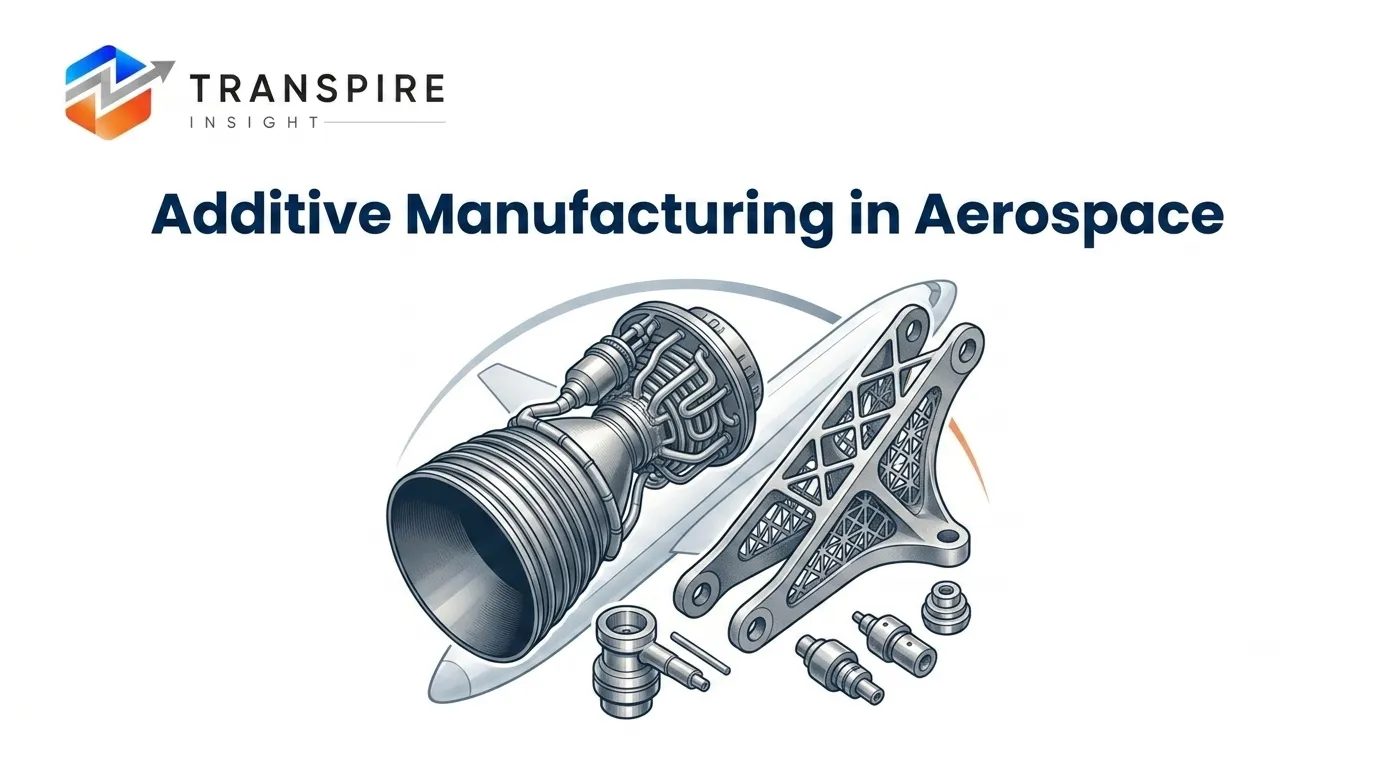
The Additive Manufacturing in Aerospace Market deals with the application of modern 3D printing technology for the production of light-weight, high-performance, and highly complex aerospace parts that can be used in commercial aircraft, military aircraft, space shuttles, satellites, and unmanned aerial vehicles (UAVs). Additive manufacturing helps in achieving rapid prototyping, reduction in material waste, cost reduction in manufacturing, and designing complex parts of the aerospace industry.
Recent Development News
Stay Ahead of Emerging Opportunities with Expert Market Insights by Transpire Insight
The insights that have been shared through this blog are based on intensive market research carried out by Transpire Insight, an advisor that works with many global organizations. Thanks to the analysis of extensive data, forecasts made by our specialists, and industry intelligence, our reports allow clients to find strategic growth opportunities in dynamically developing industries. For all those who would like to get more detailed information regarding market segmentation, competitive analysis, regional outlooks, and future investment tendencies, there is no doubt that our full report will be of great value.
Additive Manufacturing in Aerospace Market Size & Statistics
Regional Growth and Demand Analysis by Transpire Insight:
North America holds the largest regional position in the Additive Manufacturing in Aerospace Market with around 43% of the global market share.
North America dominates the Additive Manufacturing in Aerospace Market owing to its highly evolved aerospace and defense industry, investment in the latest technology, and the presence of large aerospace manufacturers like Boeing, Lockheed Martin, Northrop Grumman, and key additive manufacturers like 3D Systems, Stratasys, and GE Aerospace. This region experiences high R&D activities, wide usage of metal additive manufacturing in producing flight-critical components and receives huge funding from governments in the form of their defense and space programs led by agencies like NASA and the U.S. Department of Defense. In addition, increasing demands for light-weighted aircraft structures, fuel-efficient aircraft, rapid prototyping and spare parts production have further consolidated the dominance of North America in the global market.
Fastest-growing region: Asia-Pacific, because of increasing manufacture of commercial aircraft, investments in local aerospace programs, rising defense modernization efforts, industrialization and increasing use of advanced additive manufacturing technologies in China, India, Japan, South Korea, and Singapore.
Top 15 Trends in the Additive Manufacturing in Aerospace Market
1. Growing Adoption of Metal Additive Manufacturing for Flight-Critical Components
Additive manufacturing using metals is becoming more common among aerospace manufacturers for creating components essential for flying with utmost accuracy, superior mechanical properties, and less complicated production process. This makes for improved structural performance, reduction in weight, conservation of materials, faster production cycle, reduced cost of production, and ability to create highly complicated shapes.
2. Expansion of Lightweight Aerospace Component Production
Aerospace companies are speeding up their efforts to manufacture lighter parts using additive manufacturing technology in order to achieve greater fuel efficiency and increase aircraft performance. Lighter aircraft help in decreasing the weight of the aircraft, lowering fuel usage, carbon emissions, and increasing payload capacities.
3. Increasing Use of Topology Optimization and Generative Design
Optimization technology driven by advanced software in topology optimization and generative design is now facilitating engineers in designing aerospace components that are customized for additive manufacturing. This process helps in creating efficient structures, reducing unnecessary use of materials, increasing durability of the components, cutting down time cycles, and enhancing manufacturing efficiency.
4. Rising Adoption of Additive Manufacturing for Space Applications
Space agencies, along with commercial space launchers, are relying on additive manufacturing for making rocket engines, propulsion systems, spacecrafts, and satellites. Additive manufacturing helps in reducing manufacturing time, offering design freedom, decreasing launch costs, increasing mission reliability, providing rapid prototyping, and enabling the development of next-generation space technology.
5. Growth of On-Demand Aerospace Spare Parts Production
Aviation companies use additive manufacturing in order to manufacture certified spare parts based on the demands of the consumer rather than stockpile physical inventory. This approach lowers the cost of inventory, reduces the supply chain process, decreases downtime for the airplane, increases the availability of spare parts, and allows for digital inventory management.
6. Expansion of Large-Format Industrial 3D Printing
Large-format additive manufacturing technology is gaining greater capabilities to manufacture large-sized structures, tools, molds, and components for aircrafts with greater efficiencies. The benefits of such manufacturing technologies include increased manufacturing flexibility, reduced need for assembly, reduced tooling costs, increased scalability in manufacturing, accelerated development of aircrafts, and large-size components of aerospace vehicles.
Top 25 Companies Leading the Additive Manufacturing in Aerospace Market
1. GE Aerospace
GE Aerospace is a global leader in aircraft engines, aerospace systems, and additive manufacturing technologies for commercial and defense aviation.
Founded:2024(as GE Aerospace following GE's restructuring; GE origins date to 1892) | Headquarters: Evendale, Ohio, USA
Why It Ranks: Pioneer in aerospace metal additive manufacturing for flight-critical engine components.
Regional Dominance: Strong presence across North America, Europe, Asia-Pacific, and the Middle East.
Product Line: Aircraft Engines, Additively Manufactured Fuel Nozzles, Aerospace Components, Propulsion Systems, and Digital Aviation Solutions.
Recent Development: Expanded industrial-scale metal additive manufacturing for next-generation aircraft engine production.
2. Stratasys Ltd.
Stratasys develops industrial 3D printing systems, materials, and software for aerospace, automotive, healthcare, and manufacturing industries.
Founded:1989 | Headquarters: Eden Prairie, Minnesota, USA
Why It Ranks: Global leader in polymer additive manufacturing for aerospace applications.
Regional Dominance: Strong presence across North America, Europe, and Asia-Pacific.
Product Line: FDM Printers, PolyJet Systems, Aerospace Manufacturing Solutions, Industrial Materials, and Additive Manufacturing Software.
Recent Development: Expanded aerospace-certified additive manufacturing materials for aircraft production.
3. 3D Systems Corporation
3D Systems provides industrial 3D printing hardware, software, materials, and digital manufacturing solutions.
Founded:1986 | Headquarters: Rock Hill, South Carolina, USA
Why It Ranks: Pioneer of commercial additive manufacturing technologies.
Regional Dominance: Strong presence across North America, Europe, and Asia-Pacific.
Product Line: Metal 3D Printers, Polymer Printers, Aerospace Manufacturing Systems, Software Platforms, and Printing Materials.
Recent Development: Expanded direct metal printing technologies for aerospace component manufacturing.
4. EOS GmbH
EOS develops industrial metal and polymer additive manufacturing systems for aerospace, automotive, healthcare, and industrial sectors.
Founded:1989 | Headquarters: Krailling, Germany
Why It Ranks: Leading supplier of industrial metal powder bed fusion technologies.
Regional Dominance: Strong presence across Europe, North America, and Asia-Pacific.
Product Line: Metal 3D Printing Systems, Polymer Printing Systems, Industrial Software, and Aerospace Materials.
Recent Development: Expanded production-ready additive manufacturing solutions for aerospace manufacturers.
5. SLM Solutions Group AG
SLM Solutions specializes in industrial metal additive manufacturing technologies for aerospace, automotive, medical, and energy industries.
Founded:2006 | Headquarters: Lübeck, Germany
Why It Ranks: Global leader in selective laser melting technology.
Regional Dominance: Strong presence across Europe, North America, and Asia-Pacific.
Product Line: Metal Powder Bed Fusion Systems, Industrial 3D Printers, Aerospace Production Solutions, and Manufacturing Software.
Recent Development: Increased large-format metal additive manufacturing capabilities for aerospace production.
6. Desktop Metal, Inc.
Desktop Metal develops industrial additive manufacturing technologies focused on mass production using metal, polymer, and ceramic materials.
Founded:2015 | Headquarters: Burlington, Massachusetts, USA
Why It Ranks: Leading innovator in binder jetting technology for industrial manufacturing.
Regional Dominance: Strong presence across North America, Europe, and Asia-Pacific.
Product Line: Binder Jetting Systems, Metal Printing Solutions, Production Printers, and Manufacturing Materials.
Recent Development: Expanded high-volume aerospace manufacturing applications using binder jet technology.
7. Nikon SLM Solutions
Nikon SLM Solutions develops advanced metal additive manufacturing systems for aerospace, defense, medical, and industrial applications.
Founded:2006(as SLM Solutions; acquired by Nikon in 2023) | Headquarters: Lübeck, Germany
Why It Ranks: Leading provider of industrial laser-based metal additive manufacturing.
Regional Dominance: Strong presence across Europe, North America, and Asia-Pacific.
Product Line: Multi-Laser Metal Printers, Industrial Additive Manufacturing Systems, Aerospace Production Solutions, and Software Platforms.
Recent Development: Expanded ultra-large metal additive manufacturing systems for aerospace production.
8. Renishaw plc
Renishaw develops precision measurement systems, additive manufacturing equipment, and industrial metrology solutions.
Founded:1973 | Headquarters: Gloucestershire, United Kingdom
Why It Ranks: Major supplier of precision metal additive manufacturing technologies.
Regional Dominance: Strong presence across Europe, North America, and Asia-Pacific.
Product Line: Metal Additive Manufacturing Systems, Metrology Equipment, Process Monitoring Solutions, and Industrial Software.
Recent Development: Enhanced aerospace-qualified metal additive manufacturing systems.
9. Materialise NV
Materialise provides additive manufacturing software, industrial 3D printing services, and digital manufacturing solutions.
Founded:1990 | Headquarters: Leuven, Belgium
Why It Ranks: Global leader in additive manufacturing software and engineering services.
Regional Dominance: Strong presence across Europe, North America, and Asia-Pacific.
Product Line: Magics Software, Aerospace Engineering Services, Metal Printing Solutions, and Digital Manufacturing Platforms.
Recent Development: Expanded digital manufacturing software supporting aerospace production workflows.
10. The ExOne Company
About Company: The ExOne Company specializes in industrial binder jetting additive manufacturing technologies for metal, sand, and ceramic applications.
Founded:2005 | Headquarters: North Huntingdon, Pennsylvania, USA
Why It Ranks: Pioneer in industrial binder jet additive manufacturing.
Regional Dominance: Strong presence across North America, Europe, and Asia-Pacific.
Product Line: Binder Jet 3D Printers, Metal Printing Systems, Sand Printing Solutions, Industrial Materials, and Manufacturing Software.
Recent Development: Continued expansion of binder jet technology for aerospace tooling and component manufacturing following its integration into Desktop Metal.
Conclusion
The Additive Manufacturing in Aerospace Market is witnessing rapid growth, driven by the growing number of aerospace manufacturers adopting 3D printing technology in order to create lightweight, durable, and complex components at lower production cost and higher design freedom. Rising demand for fuel-efficient aircrafts, need for rapid prototyping and spare part production, and increased focus on space exploration initiatives have further fueled the adoption of additive manufacturing processes based on metals and polymers in the commercial, military, and space segments. Major players like GE Aerospace, Stratasys Ltd., 3D Systems Corporation, EOS GmbH, SLM Solutions Group AG, Desktop Metal, Nikon SLM Solutions, Renishaw plc, Materialise NV, and The ExOne Company have been investing in industrial-grade additive manufacturing solutions and aerospace materials and digital manufacturing technologies in order to bolster their position in the Additive Manufacturing in Aerospace Market.


Send us a brief description of your challenge and we'll get back to you within 24 hours.

 inquiry@transpireinsight.com
 APAC:+91 7666513636
 Address


