logo
☰ Search

Oct 09, 2026

Food Waste Composting Machine Market: Global Growth, Technology, Opportunities, and Competitive Outlook

By Transpire Insight


food-waste-composting-machine-market-global-growth-technology-opportunities-and-competitive-outlook

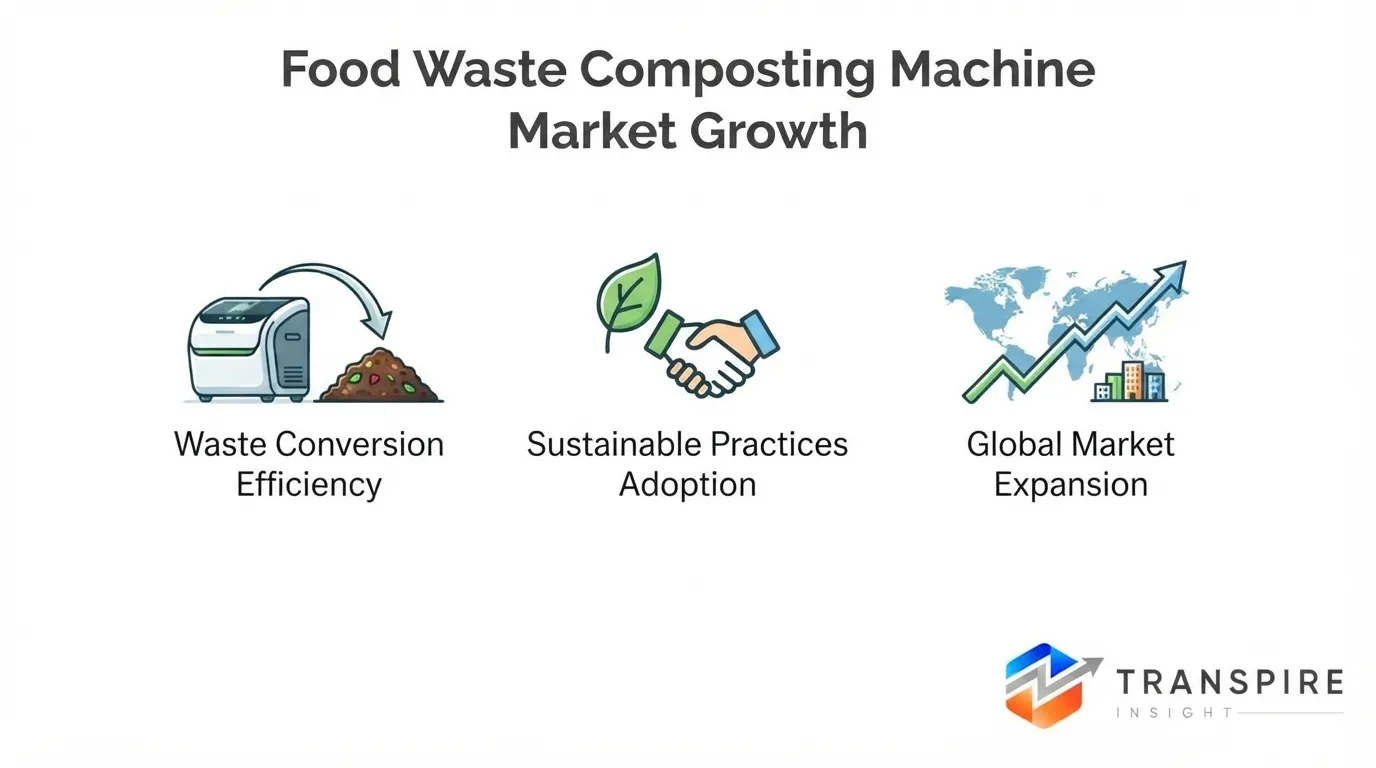
The Food Waste Composting Machine Market is expanding as cities, hospitality businesses, institutions, food processors, and commercial facilities seek practical ways to divert organic waste away from landfills. Automation, odor management, faster processing, IoT monitoring, and decentralized waste treatment are reshaping the equipment category.

Food Waste Composting Machine Market Overview

Food waste composting machines convert organic food waste into compost or a stabilized organic output through controlled biological or mechanical processes.

The market includes in-vessel composters, aerobic composters, automated composting systems, commercial food waste processors, microbial decomposition systems, dewatering-integrated systems, and IoT-enabled composting equipment.

Transpire Insights estimates the global Food Waste Composting Machine Market at approximately USD 1.88 billion in 2025, rising to USD 2.04 billion in 2026 and reaching approximately USD 3.52 billion by 2033, representing an estimated CAGR of 8.11%.

Latest Global Market Developments

  1. High-capacity commercial systems are expanding
    A February 2026 launch in India highlighted a commercial food-waste composting system designed for bulk generators with processing capacity of up to one tonne per hour.
  2. AI is becoming part of food-waste management
    UNEP reported in March 2026 that AI-based food-waste solutions are increasingly being used to reduce food waste and improve operational decision-making.
  3. Food-service businesses are adopting measurement technologies
    The acquisition of Lumitics by Winnow in July 2026 strengthened the combined company's presence in Asia Pacific food-waste technology.
  4. IoT-enabled composting is gaining commercial relevance
    Equipment manufacturers are increasingly integrating sensors and digital controls for temperature, moisture, aeration, cycle time, and system status.
  5. Urban space constraints are supporting decentralized systems
    Compact systems can allow hotels, residential complexes, restaurants, institutions, and commercial facilities to process organic waste closer to where it is generated.
  6. Odor control is becoming a procurement criterion
    Modern equipment increasingly combines controlled aeration, enclosed processing, filtration, and microbial systems to address one of the principal concerns associated with on-site organic waste treatment.
  7. Asia Pacific is becoming a major growth center
    Current industry estimates identify China, India, Japan, and South Korea as important regional markets, with advanced systems particularly relevant in dense urban environments.
  8. Service-based models are emerging
    Leasing, maintenance contracts, managed waste-processing services, and subscription models can reduce the upfront capital requirement for commercial customers.

Download the exclusive Food Waste Composting Machine Market sample report today to explore expert insights, key trends, and emerging opportunities shaping the future of the industry.

Why Do Food Waste Composting Machines Matter?

Food waste represents a major organic-waste stream. UNEP estimates that more than 1 billion tonnes of food are wasted annually, creating both economic and environmental losses.

Composting equipment can help organizations:

  • Reduce landfill dependence
  • Lower organic-waste transportation
  • Process waste at source
  • Improve waste segregation
  • Produce compost or stabilized material
  • Support sustainability reporting
  • Reduce storage time
  • Improve hygiene management

Key Factors Driving the Market

1. Landfill Diversion Policies

Governments are increasingly encouraging or requiring organic-waste diversion.

2. Rising Waste-Disposal Costs

Higher collection, transportation, and landfill costs can improve the economics of decentralized processing.

3. Corporate Sustainability Targets

Foodservice, hospitality, retail, and food-processing companies increasingly track waste diversion as part of sustainability programs.

4. Automation

Automated feeding, mixing, aeration, moisture control, and temperature monitoring reduce manual intervention.

5. Urbanization

Dense urban environments create demand for compact equipment capable of processing organic waste within limited spaces.

Proceed to checkout to purchase the exclusive Food Waste Composting Machine Market report and get instant access to detailed market insights, strategic analysis, and future growth opportunities.

Five High-Potential Markets

1. China

China's waste-sorting policies and large urban population create a substantial addressable market for organic-waste processing equipment.

2. India

India represents an important opportunity because of expanding urban waste volumes, municipal initiatives, hospitality growth, and decentralized waste-processing requirements.

3. Japan

Japan has mature waste-management infrastructure and strong demand for compact, efficient organic-waste processing solutions.

4. South Korea

South Korea has developed a strong food-waste management ecosystem, creating opportunities for automated processing technologies.

5. United States

The U.S. market is supported by commercial sustainability programs, foodservice operators, universities, municipalities, and state-level organic-waste diversion initiatives.

Competitive Landscape

Major participants include equipment manufacturers, waste-management companies, technology developers, and specialized composting-system suppliers.

Customize the exclusive Food Waste Composting Machine Market report to receive insights tailored to your needs, including country-specific analysis and business-focused market intelligence.

Top 5 Companies

  1. Oklin International
    Known for automated food-waste processing and composting systems.
  2. Tidy Planet
    Provides organic-waste management and composting equipment for commercial and institutional applications.
  3. Ridan Composting
    Offers composting equipment aimed at decentralized organic-waste processing.
  4. Food Cycle Science
    Develops food-waste processing equipment designed to reduce waste volume and support decentralized treatment.
  5. BioHiTech Global
    Participates in technology-enabled food-waste processing and organic-waste management.

These companies are among those identified in current industry coverage of the food-waste composting equipment market.

Opportunities for Small Investors

  • Commercial composting equipment distribution
  • Machine servicing
  • IoT monitoring systems
  • Compost-quality testing
  • Organic-waste collection
  • Hospitality waste-management services
  • Equipment leasing
  • Replacement components
  • Waste analytics software

Challenges & Restraints

High equipment costs, inconsistent waste segregation, contamination, maintenance requirements, operator training, limited space, uncertain compost markets, and variations in local regulations can slow adoption.

Schedule a meeting with our market experts to discuss the exclusive Food Waste Composting Machine Market report and find the right research solution for your business.

Conclusion

The Food Waste Composting Machine Market is moving toward automated, decentralized, connected, and commercially managed organic-waste treatment.

Technology improvements are increasingly addressing the traditional problems of odor, labor intensity, processing consistency, and monitoring.

The strongest opportunities are likely to emerge where regulations, disposal economics, and sustainability targets converge.


About the Authors


Chakradhar Khansole Author TI

Chakradhar Khansole

Chakradhar serves as the Research Director at Transpire Insight, bringing over 8 years of experience in technology, innovation, and strategic market intelligence. He specializes in transforming complex market data into actionable business insights that enable organizations to make informed, growth-oriented decisions. Recognized for his strategic vision and analytical expertise, Chakradhar leads high-impact research initiatives, delivering comprehensive market assessments, competitive intelligence, and forward-looking industry analysis.

Kartik Bhong Author TI

Kartik Bhong

Dr. Kartik bhong serves as the Senior Manager at Transpire Insight, bringing over 6+ years of experience in market research, strategic consulting, and business intelligence, complemented by a Ph.D. in Market Research and Strategic Management. With extensive expertise in primary and secondary research, quantitative and qualitative analysis, and industry forecasting, he has successfully led complex, multi-sector research engagements for global clients.

GET IN TOUCH

Ready to discuss your project?

Send us a brief description of your challenge and we'll get back to you within 24 hours.

Quick Response
Within 24 hours
Confidential
Your data is safe
Expert Support
Professional team

We respect your privacy. Information is never shared.