
Aug 17, 2026
By Transpire Insight
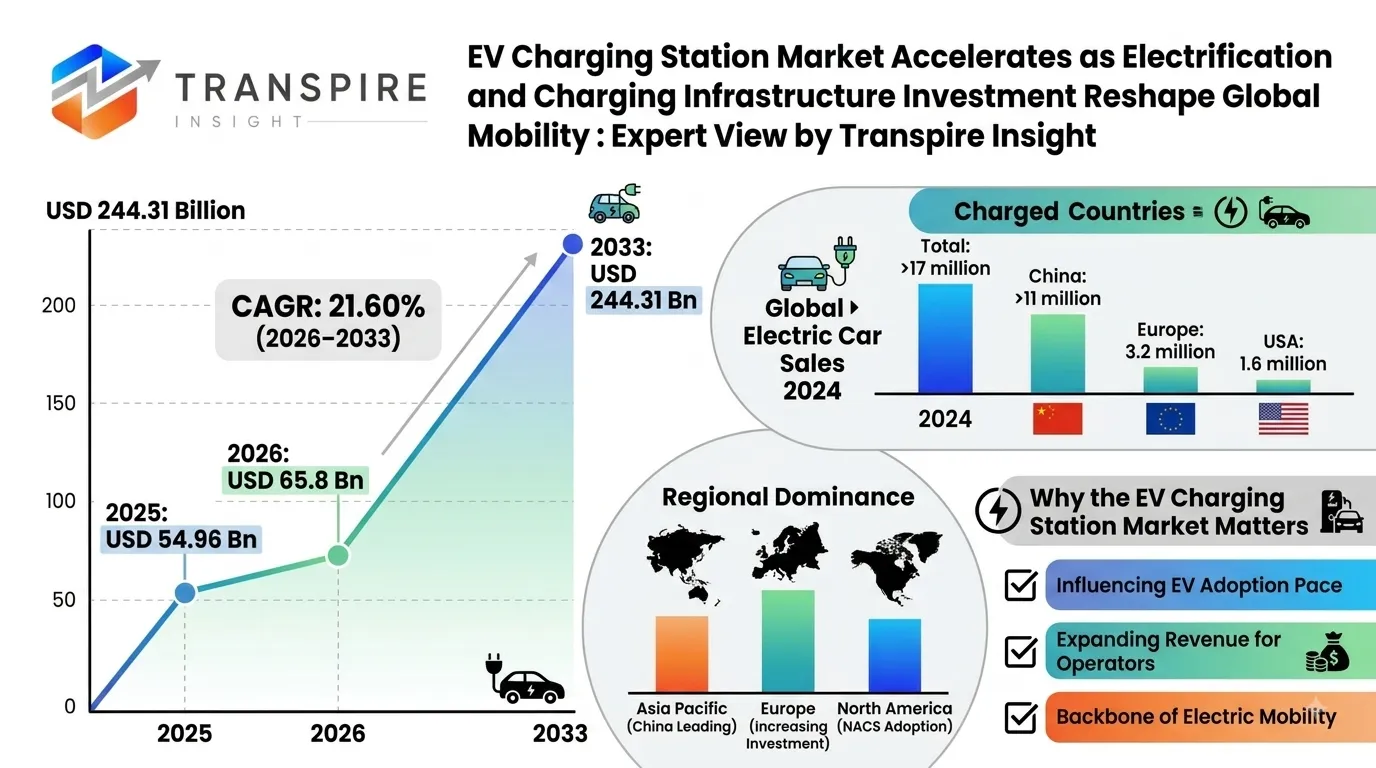
According to Transpire Insight, a detailed research analysis of the global EV charging station market reflects that the industry is entering a major infrastructure-expansion phase as electric vehicle adoption accelerates, governments strengthen zero-emission transportation policies, and automakers expand their electric vehicle portfolios. The global EV Charging Station Market was valued at approximately USD 54.96 billion in 2025 and is projected to reach around USD 65.8 billion in 2026, before expanding to approximately USD 244.31 billion by 2033, representing a CAGR of approximately 21.60% during 2026–2033. Asia Pacific remains the dominant regional market, supported by China's extensive charging network and rapid EV deployment, while Europe and North America continue to expand through public charging investment, highway charging corridors, and fleet electrification.
The transition from internal-combustion vehicles toward battery-electric transportation is creating an infrastructure requirement that extends well beyond vehicle manufacturing. Charging stations have become a fundamental component of the electric mobility ecosystem because EV owners, commercial fleets, public transportation operators, logistics companies, and businesses require reliable access to electricity for vehicle charging.
The charging infrastructure industry is simultaneously evolving across hardware, software, networking, payment systems, energy management, battery storage, and charging-as-a-service models. The market is therefore shifting from the installation of individual charging points toward integrated charging networks capable of managing thousands of connected vehicles and charging assets.
Global EV sales provide the underlying foundation for this expansion. The International Energy Agency reported that global electric car sales exceeded 17 million units in 2024, with sales expected to surpass 20 million units in 2025. China accounted for more than 11 million electric car sales in 2024, while Europe recorded approximately 3.2 million and the United States approximately 1.6 million.
EV Charging Stations Become the Backbone of Electric Mobility
The rapid growth of EV adoption is creating a direct requirement for convenient, reliable, and geographically distributed charging infrastructure.
Unlike conventional refueling, EV charging can occur at homes, workplaces, shopping centers, parking facilities, highways, fleet depots, hotels, restaurants, and dedicated charging hubs. This creates a highly diversified infrastructure market with multiple charging environments and business models.
Level 2 AC chargers remain important for residential and workplace applications because vehicles can remain connected for several hours. DC fast chargers are becoming increasingly important for highways, commercial fleets, urban charging hubs, and other locations where reducing charging time is critical.
Ultra-fast charging is also gaining momentum. Modern DC systems can provide charging power of 150 kW, 250 kW, 350 kW, and in some emerging applications more than 500 kW, depending on vehicle architecture and charger capability.
The underlying infrastructure requirement is substantial. According to the IEA, the number of public charging points globally increased by more than 30% in 2024, reaching approximately 5 million public charging points worldwide.
This expansion demonstrates that EV charging is moving from an early infrastructure category toward a large-scale global utility and mobility service.
Download the exclusive EV Charging Station Market sample report today to uncover expert insights, emerging trends, and the opportunities defining the future of the industry.
Why the EV Charging Station Market Matters
Charging availability is one of the most important factors influencing consumer confidence in electric vehicles.
Potential EV buyers frequently consider charging accessibility, charging speed, station reliability, compatibility, pricing, and geographic coverage before purchasing an electric vehicle. Consequently, charging infrastructure can directly influence the pace of EV adoption.
For urban consumers, home charging can satisfy a significant portion of daily charging requirements. However, households without private parking may depend heavily on public infrastructure.
Commercial fleets create another major opportunity. Delivery vehicles, taxis, buses, ride-hailing fleets, logistics trucks, and corporate vehicles often operate for extended periods and therefore require strategically located charging infrastructure.
Fleet operators are increasingly installing dedicated depot charging systems because predictable charging schedules can reduce operating costs and improve vehicle utilization.
The financial opportunity is also expanding beyond charger sales. Operators can generate revenue through electricity sales, subscription plans, charging memberships, advertising, fleet contracts, parking fees, software services, energy management, and ancillary grid services.
This is transforming charging stations from simple electrical equipment into connected mobility assets.
Competitive Analysis
The EV charging station market includes global automotive suppliers, electrical-equipment manufacturers, charging-network operators, energy companies, technology providers, and specialized charging companies.
Major participants include ABB, Siemens, Schneider Electric, ChargePoint, Tesla, Wallbox, Tritium, Eaton, Delta Electronics, Webasto, EVgo, Blink Charging, Shell, and BP Pulse, among others.
Competition is increasingly based on more than charger hardware. Providers are competing through charging speed, reliability, network density, software capabilities, interoperability, payment integration, remote monitoring, maintenance, energy optimization, and fleet-management functionality.
Hardware manufacturers are also increasingly developing integrated systems combining chargers, power electronics, energy storage, solar generation, and software.
Charging-network operators are pursuing another competitive strategy by expanding station density and improving the user experience through mobile applications, real-time availability information, digital payments, route planning, and loyalty programs.
The market is consequently developing into a multi-layered ecosystem in which hardware, software, energy, and mobility services increasingly overlap.
Financial Impact
This represents an absolute increase of approximately USD 187.27 billion between 2026 and 2033 and highlights the enormous capital requirement associated with global transportation electrification.
Investment is being directed toward public charging networks, highway charging corridors, fleet depots, workplace infrastructure, apartment charging, destination charging, and ultra-fast charging hubs.
The financial opportunity also extends to electrical equipment manufacturers. Charging stations require transformers, switchgear, circuit protection, power converters, cables, connectors, communication equipment, cooling systems, payment hardware, and energy-management systems.
Software is becoming another major source of value. Cloud-based charging platforms can monitor station availability, manage charging sessions, process payments, identify equipment faults, and optimize energy consumption.
The combination of hardware sales and recurring software and service revenue is therefore creating multiple monetization opportunities across the charging value chain.
DC Fast Charging Becomes a Strategic Priority
DC fast charging is becoming one of the most important segments of the EV charging industry because charging speed directly influences the convenience of electric mobility.
AC charging is generally suited to locations where vehicles remain parked for longer periods, while DC charging is designed for applications where charging time needs to be minimized.
Highway charging stations are particularly dependent on DC fast charging because drivers expect relatively short stops during long-distance travel.
Fleet operators also increasingly favor DC charging because faster charging can allow vehicles to return to service more quickly.
The development of higher-voltage EV platforms is supporting this trend. Modern electric vehicles increasingly use 400-volt and 800-volt architectures, with 800-volt systems capable of supporting substantially faster charging under appropriate conditions.
Charging providers are therefore investing in higher-power infrastructure while simultaneously improving thermal management, connector design, power distribution, and charging software.
The challenge is balancing charging speed with grid capacity and infrastructure cost. A large charging hub containing multiple 250-kW or 350-kW chargers can create significant instantaneous electricity demand.
This makes energy management increasingly important.
Proceed to Checkout to purchase the exclusive EV Charging Station Market report and gain instant access to in-depth market intelligence, strategic analysis, and future growth opportunities.
China Dominates Global Charging Infrastructure
China has emerged as the largest EV charging market globally.
The country's rapid EV adoption has been supported by extensive investment in public charging infrastructure, manufacturing capacity, government policy, and urban electrification.
The IEA reported that China accounted for approximately two-thirds of the world's public charging points in 2024, demonstrating the country's dominant position in charging infrastructure.
China's advantage is reinforced by the scale of its domestic EV market. More than 11 million electric cars were sold in China in 2024, representing a significant proportion of global EV demand.
Chinese charging companies are also developing increasingly sophisticated fast-charging systems, including high-power chargers capable of supporting heavy-duty vehicles and passenger cars.
The country's large urban population and rapid deployment of electric buses, taxis, delivery vehicles, and passenger cars create multiple charging-use cases.
China is therefore not only the largest market for EV charging stations but also one of the most important centers for charging technology development.
Europe Expands Through Public and Highway Charging
Europe represents another major EV charging market because of ambitious decarbonization targets, stringent vehicle-emission standards, and increasing EV penetration.
The European Union is developing charging corridors through initiatives designed to improve charging availability along major transport routes.
The EU's Alternative Fuels Infrastructure Regulation requires fast-charging stations to be progressively deployed along major transport corridors. The regulation targets charging pools for cars and vans at intervals of 60 km along key TEN-T corridors, creating a substantial infrastructure requirement.
Europe's charging market is also supported by increasing electric vehicle sales. Approximately 3.2 million electric cars were sold in Europe in 2024, according to the IEA.
Germany, France, the United Kingdom, the Netherlands, Norway, and other European markets are investing in public charging infrastructure while utilities and oil-and-gas companies increasingly enter the charging sector.
The region is also becoming an important market for smart charging because electricity grids are experiencing increasing requirements for demand management and renewable-energy integration.
North America Accelerates Charging Deployment
North America is rapidly expanding its charging infrastructure as electric vehicle adoption increases.
The United States recorded approximately 1.6 million electric car sales in 2024, creating increasing pressure for additional public and highway charging infrastructure.
Federal and state-level programs are supporting charger deployment, while automakers and charging-network operators are investing in fast-charging corridors.
The U.S. National Electric Vehicle Infrastructure program has provided billions of dollars in federal funding for charging infrastructure, while private-sector companies are deploying charging hubs in retail, parking, highway, and fleet locations.
The North American market is also undergoing an important connector transition. Major automakers are increasingly adopting the North American Charging Standard (NACS), now standardized as SAE J3400, creating a broader ecosystem around the connector architecture.
This transition is expected to influence charger compatibility, hardware deployment, fleet infrastructure, and charging-network investment.
Fleet Electrification Creates a High-Value Opportunity
Commercial fleets are expected to become one of the most important growth engines for the EV charging station market.
Fleet vehicles often follow predictable routes and schedules, allowing charging infrastructure to be strategically planned.
Electric buses require depot charging infrastructure, while delivery fleets can use overnight charging combined with daytime opportunity charging.
Heavy-duty trucks create an even larger infrastructure requirement because their batteries are substantially larger than passenger-car batteries.
The Megawatt Charging System (MCS) is being developed to support high-power charging for heavy-duty electric vehicles. Charging power in this emerging standard can reach approximately 1 MW and beyond, substantially exceeding typical passenger-car charging levels.
Fleet charging therefore creates opportunities for high-capacity electrical infrastructure, energy storage, load management, and automated charging systems.
Fleet operators are also increasingly interested in software capable of optimizing charging schedules according to electricity prices, vehicle routes, battery state of charge, and operational requirements.
Charging Infrastructure Integrates with Renewable Energy
The relationship between EV charging and renewable energy is becoming increasingly important.
Electric vehicles can consume substantial quantities of electricity, particularly as charging networks expand. Connecting charging stations with solar generation, battery storage, and smart-grid systems can help manage this demand.
Solar-powered charging stations can partially offset grid electricity consumption, while battery energy storage can reduce peak grid demand and support high-power charging without requiring immediate expansion of grid connections.
Vehicle-to-grid (V2G) technology represents another emerging opportunity. EV batteries can potentially supply electricity back to the grid during periods of high demand, provided compatible vehicles, chargers, software, and regulatory frameworks are available.
This creates the possibility of transforming EVs from passive electricity consumers into flexible energy-storage assets.
The combination of EV charging + renewable energy + battery storage + intelligent energy management could therefore become an important component of future distributed energy systems.
Charging Software Becomes as Important as Hardware
The modern charging station is increasingly a connected digital device.
Charging-network software can monitor station status, manage authentication, process payments, control power delivery, record energy consumption, and provide maintenance alerts.
Open communication protocols are becoming increasingly important because charging operators need to connect chargers from multiple manufacturers to common software platforms.
The Open Charge Point Protocol (OCPP) has become a widely used framework for communication between charging stations and central management systems.
Software can also improve charger utilization. Operators can analyze charging-session data to determine peak demand periods, station profitability, equipment failures, and customer behavior.
Artificial intelligence can further support predictive maintenance by identifying unusual equipment behavior before a charger experiences a complete failure.
This is shifting the industry toward a model in which charging infrastructure becomes an intelligent network rather than a collection of independent electrical devices.
Customize the exclusive EV Charging Station Market report today to receive tailored insights, country-specific analysis, and business-focused market intelligence.
Major Companies Expand Their Charging Ecosystems
Founded In: 2003
Headquarters: Austin, Texas, United States
Tesla has established one of the world's most recognizable fast-charging networks through its Supercharger infrastructure.
The company's charging ecosystem has historically been closely integrated with Tesla vehicles, but adoption of the NACS connector by other automakers has significantly expanded the strategic importance of the network.
Tesla's Supercharger network has also demonstrated the value of combining vehicle technology, charging hardware, software, payment systems, and network management.
The company's charging strategy has therefore influenced the broader industry by demonstrating how an automaker can participate directly in charging infrastructure.
Founded In: 2007
Headquarters: Campbell, California, United States
ChargePoint is a major charging-network and charging-technology provider with a strong presence across North America and Europe.
The company focuses on hardware, charging software, network management, fleet charging, and commercial charging solutions.
Its platform-oriented approach allows businesses, fleet operators, property owners, and other customers to manage charging infrastructure through connected software.
ChargePoint's position illustrates the growing importance of software and network services in addition to physical charger deployment.
Founded In: 1988
Headquarters: Zurich, Switzerland
ABB is a major electrical-equipment and automation company with extensive involvement in EV charging.
The company's charging portfolio includes AC and DC charging systems as well as high-power charging solutions for passenger vehicles, buses, trucks, and commercial fleets.
ABB's expertise in power electronics, automation, electrical infrastructure, and industrial systems provides an advantage as charging networks become increasingly integrated with broader energy-management systems.
The company's involvement in heavy-duty charging also positions it to benefit from the electrification of commercial transportation.
Founded In: 1847
Headquarters: Munich, Germany
Siemens participates in EV charging through charging hardware, software, electrical infrastructure, and energy-management solutions.
Its broader portfolio across industrial automation, buildings, grid infrastructure, and electrification allows the company to approach EV charging as part of a wider energy ecosystem.
This integrated approach is increasingly important as charging stations become connected with buildings, renewable-energy systems, battery storage, and smart grids.
Founded In: 1836
Headquarters: Rueil-Malmaison, France
Schneider Electric provides EV charging solutions alongside electrical distribution, energy management, automation, and building-management technologies.
The company's integrated approach allows charging infrastructure to be connected with building energy systems and broader electricity-management platforms.
This becomes particularly valuable for commercial properties where charging loads can affect overall building electricity consumption.
Market Impact: Charging Infrastructure Becomes a Core Energy Asset
The EV charging station market is changing the structure of both transportation and electricity infrastructure.
As millions of electric vehicles connect to the power grid, charging stations increasingly become points of interaction between mobility and energy systems.
The market affects automotive manufacturing, utilities, electrical equipment, renewable energy, battery storage, real estate, retail, fleet management, telecommunications, software, and financial services.
The industry's long-term success, however, will depend on more than installing chargers. Operators must ensure high availability, convenient payment, transparent pricing, reliable connectivity, sufficient grid capacity, cybersecurity, interoperability, and effective maintenance.
As charging becomes faster and more powerful, the relationship between charging infrastructure and electricity grids will become increasingly important.
Schedule a meeting with our market experts to discuss the exclusive EV Charging Station Market report and identify the best research solution for your organization.
Transpire Insight Experts View
According to Transpire Insight analysis, the EV charging station market is moving from an infrastructure-support category into a central component of the global energy and mobility ecosystem.
The strongest opportunities will emerge at the intersection of fast charging, fleet electrification, charging software, renewable-energy integration, battery storage, smart-grid technology, and automated energy management.
China's approximately two-thirds share of global public charging points in 2024 gives Asia Pacific a significant infrastructure advantage, while Europe and North America are rapidly expanding highway and public charging networks.
Transpire Insight believes that the future competitive landscape will increasingly favor companies capable of combining charging hardware with software, energy services, financing, maintenance, and grid integration.
The next stage of EV charging development will not simply involve installing more stations. It will involve creating intelligent, high-power, interconnected charging ecosystems capable of serving passenger vehicles, commercial fleets, buses, and heavy-duty trucks while simultaneously interacting with increasingly renewable electricity grids.
As global EV sales continue to rise and governments, automakers, utilities, and infrastructure investors accelerate charging deployment, EV charging stations are expected to become one of the most strategically important infrastructure markets within the global transition toward electrified transportation.


Send us a brief description of your challenge and we'll get back to you within 24 hours.

 inquiry@transpireinsight.com
 APAC:+91 7666513636
 Address


