
Oct 10, 2026
By Transpire Insight
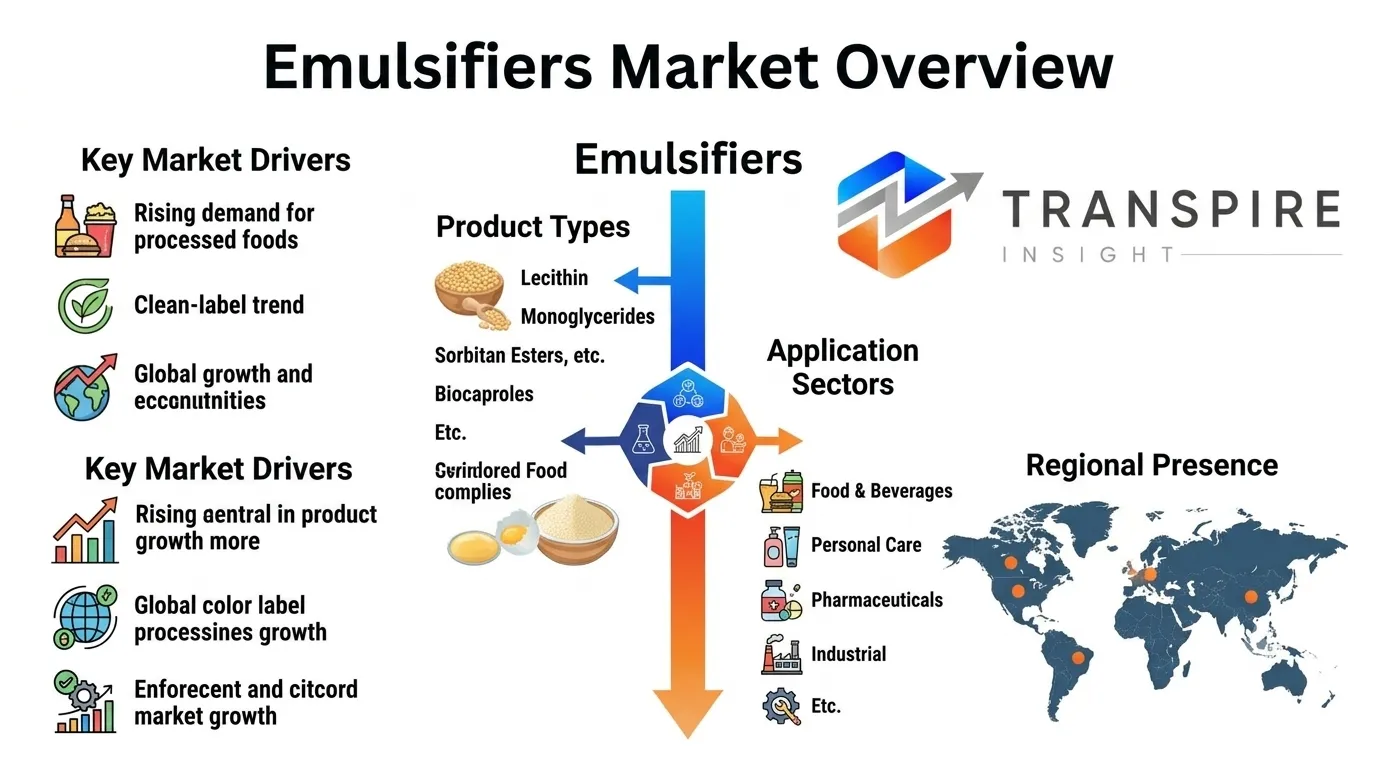
The global Emulsifiers Market is evolving as food manufacturers seek ingredients capable of improving texture, stability, shelf life, consistency, and processing performance. At the same time, regulatory scrutiny, clean-label preferences, reformulation, and demand for plant-derived ingredients are changing how emulsifiers are developed and marketed.
Emulsifiers Market Overview
Emulsifiers are functional ingredients that help stabilize mixtures of ingredients that would otherwise separate, particularly oil and water.
They are widely used across:
Important emulsifier categories include lecithin, mono- and diglycerides, polysorbates, sorbitan esters, stearoyl lactylates, gums, phospholipids, and other functional hydrocolloid systems.
Transpire Insight estimates the global Emulsifiers Market at approximately USD 5.62 billion in 2025, rising to USD 5.91 billion in 2026 and reaching approximately USD 8.42 billion by 2033, representing a CAGR of approximately 5.21%.The market is being influenced by both product-development requirements and changing regulatory frameworks. Current industry analysis identifies formulation adaptability and regulatory compliance as increasingly important for global suppliers.
Latest Global Market Developments
European Commission Regulation (EU) 2026/196 amended permitted uses and specifications for several food additives, including substances used for stabilizing and emulsifying functions.
Global suppliers increasingly need to track changing maximum levels, purity specifications, food categories, and transitional provisions across jurisdictions.
The FDA's 2026 Human Foods Program priorities include stronger oversight of food chemicals and a proposed change concerning GRAS notifications.
Food manufacturers are increasingly exploring recognizable ingredients and plant-derived emulsification systems.
Plant-based dairy alternatives, meat alternatives, and beverages often require carefully selected emulsifier and stabilizer systems to achieve acceptable texture and physical stability.
Emulsifiers can support dough handling, volume, crumb structure, texture, and shelf stability in commercial bakery products.
Suppliers are increasingly developing combinations of emulsifiers, stabilizers, hydrocolloids, and other ingredients tailored to specific applications.
Food manufacturers in Brazil, Saudi Arabia, South Africa, India, and Southeast Asia are expanding localized food production, increasing demand for formulation ingredients.
Why Emulsifiers Matter?
Emulsifiers are small-volume ingredients with a potentially large influence on finished-product performance.
They can help manufacturers achieve:
The commercial value therefore extends beyond the ingredient's direct cost because formulation performance can affect manufacturing efficiency and consumer acceptance.
Key Factors Driving the Market
1. Processed Food Consumption
Growing consumption of packaged and processed foods supports demand for functional food ingredients.
2. Bakery Expansion
Bread, cakes, pastries, and other bakery products remain major applications.
3. Plant-Based Foods
Alternative-protein and dairy-free products often require specialized stabilization systems.
4. Clean-Label Reformulation
Manufacturers are searching for emulsifiers that provide functionality while fitting evolving consumer expectations.
5. Shelf-Life Requirements
Emulsifiers can support product consistency and stability across storage and distribution.
Five High-Potential Markets
1. United States
The U.S. has a large processed-food industry and sophisticated ingredient-supply chain. Regulatory developments are also making food-additive compliance increasingly important.
2. Germany
Germany represents an important European market with strong bakery, dairy, processed-food, and specialty-ingredient industries.
3. China
China offers substantial growth potential because of its large food-processing sector and expanding packaged-food industry.
4. India
India's expanding packaged-food, bakery, dairy, and plant-based-food industries create opportunities for emulsifier suppliers.
5. Brazil
Brazil's large food-processing sector and growing bakery and packaged-food categories make it an important Latin American market.
Competitive Landscape
Top 5 Companies
Opportunities for Small Investors
Challenges & Restraints
The industry faces regulatory changes, raw-material price fluctuations, consumer concerns over food additives, reformulation costs, supply-chain volatility, and the technical challenge of replacing conventional emulsifiers without reducing product quality.
Different regulatory requirements between markets can also increase compliance costs for multinational food manufacturers.
Conclusion
The Emulsifiers Market is evolving alongside the global food industry's transition toward cleaner formulations, plant-based products, longer shelf life, and increasingly sophisticated food processing.
Regulatory developments in Europe and the United States demonstrate that food-ingredient suppliers must increasingly combine formulation performance with rigorous safety documentation and regulatory management.
For ingredient manufacturers, food processors, investors, and specialty-chemical companies, the strongest opportunities are emerging around plant-derived emulsifiers, application-specific blends, clean-label solutions, and technical formulation support.


Send us a brief description of your challenge and we'll get back to you within 24 hours.

 inquiry@transpireinsight.com
 APAC:+91 7666513636
 Address


