
Oct 05, 2026
By Transpire Insight
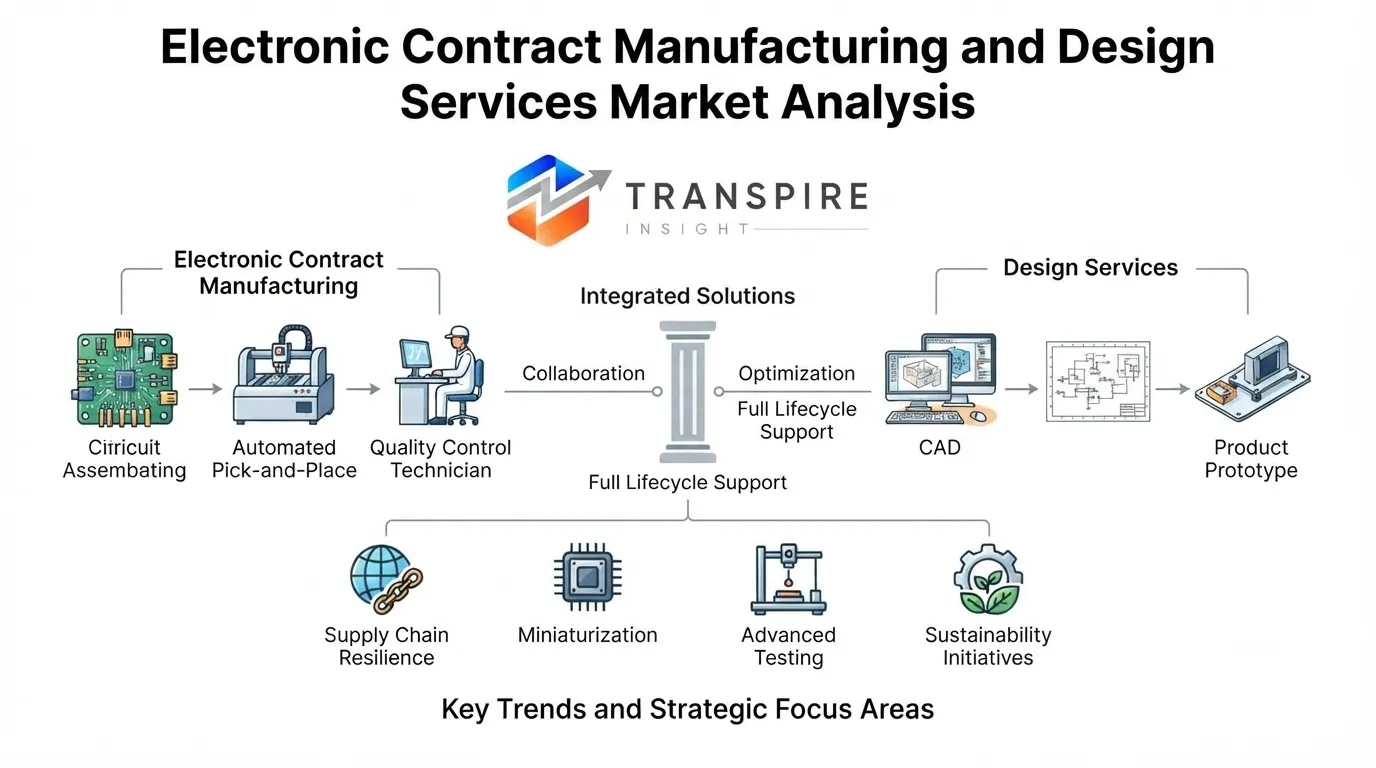
The global Electronic Contract Manufacturing and Design Services Market is entering a period of structural expansion as original equipment manufacturers increasingly rely on specialized partners for electronics design, engineering, prototyping, assembly, testing, manufacturing, and lifecycle support. The combination of rising electronic content, shorter product development cycles, supply-chain diversification, and increasing product complexity is encouraging companies to move beyond traditional manufacturing outsourcing toward integrated design-to-production partnerships.
As connected devices, electric vehicles, industrial automation systems, healthcare electronics, telecommunications infrastructure, and AI-enabled hardware become more sophisticated, contract manufacturers are expanding their capabilities across engineering, advanced assembly, testing, supply-chain management, and product lifecycle services. This shift is creating new opportunities for large global EMS providers as well as specialized engineering and manufacturing companies.
September 2026: The Electronic Contract Manufacturing and Design Services Market is increasingly becoming an important part of the global electronics value chain. Recent market studies place the market in a broad range depending on how electronic design, assembly, manufacturing, testing, logistics, and lifecycle services are defined. Grand View Research estimates the market at approximately USD 649.1 billion in 2025 and USD 703.9 billion in 2026, with the market projected to reach USD 1,361.5 billion by 2033 at a 9.9% CAGR. Another 2026 estimate from 360iResearch places the market at USD 717.6 billion in 2025 and USD 781.1 billion in 2026, reaching approximately USD 1.32 trillion by 2032 at a 9.11% CAGR.
Market Size
For this analysis, the global Electronic Contract Manufacturing and Design Services Market is estimated at approximately USD 704 billion in 2026 and is projected to reach approximately USD 1.36 trillion by 2033, representing a CAGR of around 9.9% during 2026–2033. The estimate is aligned with the latest Grand View Research market assessment, while other published studies report different values because of differences in market definitions and included service categories.
The market encompasses a broad range of activities, including electronic manufacturing services, PCB assembly, electronic design and engineering, prototyping, new product introduction, testing, box-build integration, supply-chain management, repair, logistics, and lifecycle support. The increasing preference for integrated outsourcing is allowing OEMs to concentrate on product innovation while contract manufacturers manage increasingly complex manufacturing processes.
A separate September 2026 assessment from KBV Research estimates the market at approximately USD 687.0 billion in 2026 and forecasts approximately USD 1.31 trillion by 2033 at a 9.6% CAGR. The variation between research estimates highlights the importance of considering the scope of services included when interpreting market-size figures.
The growth trajectory is being supported by increasing electronics content across industries, greater demand for rapid product commercialization, rising capital requirements for advanced production facilities, and the need for specialized engineering capabilities.
Outsourcing Is Becoming a Strategic Manufacturing Model
Electronics outsourcing has evolved considerably from simple component assembly. OEMs increasingly expect contract manufacturing partners to participate throughout the product lifecycle, beginning with product engineering and continuing through prototype development, manufacturing, testing, logistics, repairs, and aftermarket support.
This integrated approach can reduce the need for OEMs to invest independently in every stage of production. Contract manufacturers can provide manufacturing infrastructure, specialized equipment, trained engineering teams, automated production lines, supplier relationships, and testing capabilities.
The development of connected products has further strengthened this trend. Products now frequently combine processors, sensors, communication modules, embedded software, power-management components, displays, wireless connectivity, and increasingly sophisticated control systems. Consequently, manufacturing partners must understand both the physical production process and the engineering requirements of modern electronics.
According to Grand View Research, outsourcing enables OEMs to access manufacturing, design, and supply-chain capabilities while reducing capital investment and allowing them to concentrate on their core competencies.
Electronic Manufacturing Services Remain a Major Revenue Segment
Electronic manufacturing remains one of the largest components of the market. Services can include PCB population, surface-mount technology, through-hole assembly, box-build manufacturing, system integration, functional testing, final assembly, and packaging.
The growing complexity of electronics is increasing the importance of automated inspection and testing. Contract manufacturers are investing in advanced manufacturing execution systems, automated optical inspection, automated testing, robotics, traceability platforms, and data analytics.
KBV Research estimates that electronic manufacturing represented the largest service category in 2025 and could reach approximately USD 554.6 billion by 2033. Electronic assembly is also expected to expand, while electronic design and engineering is projected to record strong growth as OEMs increasingly outsource product-development activities.
Manufacturing providers are therefore moving toward complete product realization rather than competing solely on assembly capacity.
Electronic Design and Engineering Creates New Growth Opportunities
Electronic design and engineering services are becoming increasingly important within the contract manufacturing ecosystem.
Modern providers may support concept development, PCB design, embedded systems, firmware coordination, simulation, design verification, prototype development, design for manufacturability, design for assembly, and engineering validation.
Outsourcing engineering activities can allow smaller and mid-sized companies to gain access to technical expertise without establishing large internal engineering organizations. Larger OEMs can also use external engineering teams to accelerate development or supplement internal capabilities.
KBV Research projects electronic design and engineering to grow at approximately 10.3% annually between 2026 and 2033, reflecting the increasing importance of engineering-intensive outsourcing.
This trend is particularly relevant to medical devices, automotive electronics, industrial control systems, telecommunications equipment, aerospace electronics, and specialized consumer devices.
Automotive Electronics Is Reshaping Contract Manufacturing
Automotive electronics represents one of the most important growth opportunities for electronic contract manufacturing and design services.
The transition toward electric vehicles is increasing the importance of battery-management systems, power electronics, charging systems, vehicle-control modules, connectivity platforms, infotainment systems, advanced driver-assistance systems, sensors, and electronic control units.
Automotive OEMs increasingly require manufacturing partners capable of meeting stringent quality, traceability, reliability, and supply-chain requirements. Contract manufacturers with automotive engineering capabilities can support programs involving high-volume electronics as well as specialized components.
KBV Research identifies automotive as one of the faster-growing industries in the market, with automotive electronics benefiting from electrification, connectivity, ADAS, infotainment, and power-management requirements.
As vehicle architectures become more software-defined and electronically controlled, electronics manufacturing and engineering requirements are expected to expand further.
Healthcare Electronics Demand Supports High-Value Manufacturing
Healthcare is another important application area because medical devices require reliable electronics, controlled manufacturing processes, testing, documentation, and regulatory compliance.
Contract manufacturing providers can support diagnostic equipment, patient-monitoring systems, imaging equipment, laboratory instruments, wearable medical technologies, drug-delivery devices, and other connected healthcare products.
Healthcare electronics often requires higher levels of traceability and quality assurance than conventional consumer products. This creates opportunities for manufacturers with specialized facilities, validated processes, quality systems, and engineering expertise.
The increasing adoption of connected healthcare devices is also creating demand for smaller, more efficient, and increasingly sophisticated electronic assemblies.
IT and Telecommunications Continue to Generate Large Volumes
IT and telecommunications have historically represented major end-use categories for electronics manufacturing services.
Servers, networking equipment, communication infrastructure, computing hardware, storage systems, wireless equipment, and associated components require sophisticated manufacturing and testing capabilities.
KBV Research identifies IT and telecommunications as the leading industry category in its market assessment, with the segment estimated to reach approximately USD 257.9 billion by 2033.
Demand from this sector is being influenced by data-center expansion, cloud computing, high-speed networking, wireless infrastructure, edge computing, and increasing demand for computing capacity.
Industrial Automation Is Expanding the Addressable Market
Industrial manufacturers are increasingly deploying electronics in factories, warehouses, energy systems, robotics, process-control systems, and industrial machinery.
Industry 4.0 initiatives are creating demand for programmable controllers, sensors, industrial gateways, motor controls, machine-vision systems, robotics electronics, human-machine interfaces, and connected monitoring equipment.
Electronic contract manufacturers can provide specialized production capabilities for industrial customers that require a combination of moderate production volumes, complex assemblies, long product lifecycles, and high reliability.
This differs from high-volume consumer electronics manufacturing because industrial products may require extended product support, component lifecycle management, engineering changes, and long-term availability.
AI and Smart Manufacturing Are Changing EMS Operations
Artificial intelligence is increasingly being applied inside electronics manufacturing facilities.
AI-enabled systems can support defect detection, predictive maintenance, production scheduling, quality monitoring, demand forecasting, inventory planning, and process optimization.
Machine-vision systems can inspect electronic assemblies for manufacturing defects, while production analytics can identify deviations in manufacturing processes.
Contract manufacturers are also deploying digital twins and connected manufacturing systems to simulate production processes and improve equipment utilization.
The result is a gradual transition from traditional electronics factories toward digitally connected manufacturing environments in which production data is continuously collected and analyzed.
Supply-Chain Resilience Is Becoming a Competitive Requirement
The electronics industry experienced significant supply-chain disruption during the semiconductor shortage and the broader global logistics challenges of the early 2020s.
These disruptions increased OEM attention toward supplier diversification, regional production, dual sourcing, inventory visibility, and supply-chain risk management.
Current market research indicates that the industry is increasingly moving toward geographically diversified manufacturing networks. Contract manufacturers are expanding capabilities across multiple countries to provide customers with greater flexibility and resilience.
This trend benefits providers that can combine global manufacturing capacity with regional engineering and supply-chain support.
Regional Outlook
Asia Pacific
Asia Pacific represents the largest regional market for electronic contract manufacturing and design services.
Grand View Research estimates that Asia Pacific accounted for approximately 46.2% of global market revenue in 2025.
The region benefits from extensive electronics supply chains, semiconductor ecosystems, component suppliers, manufacturing infrastructure, skilled technical labor, and large electronics production clusters.
China remains a major electronics manufacturing center, while Taiwan, Vietnam, Malaysia, Thailand, South Korea, Japan, and India are also important parts of the regional manufacturing network.
India is receiving increasing attention as electronics manufacturing capacity expands and companies seek additional production locations. Manufacturing diversification is contributing to new opportunities for EMS providers and electronics design companies.
North America
North America remains an important market because of its concentration of technology companies, medical-device manufacturers, aerospace and defense programs, automotive companies, industrial technology firms, and telecommunications businesses.
The region is particularly relevant to high-mix, high-complexity, engineering-intensive electronics manufacturing.
North American customers are also placing greater emphasis on supply-chain resilience, domestic manufacturing capability, cybersecurity, quality systems, and regulatory compliance.
Europe
Europe is supported by automotive electronics, industrial automation, medical technology, aerospace, energy systems, and telecommunications.
The region's established automotive industry creates significant demand for electronics manufacturing related to electric vehicles, charging infrastructure, driver assistance, vehicle connectivity, and power management.
European manufacturers are also increasingly focused on sustainability, product lifecycle management, repairability, recycling, and supply-chain transparency.
Latin America
Latin America is developing as an electronics manufacturing and assembly region, supported by proximity to North American markets, industrialization, consumer-electronics demand, automotive production, and efforts to diversify supply chains.
Mexico is particularly relevant because of its manufacturing links with the U.S. market and its established automotive and electronics industries.
Middle East and Africa
The Middle East and Africa represent emerging opportunities for electronics manufacturing and engineering services.
Investment in telecommunications infrastructure, renewable energy, industrial automation, healthcare technology, defense systems, and digital infrastructure is creating new electronics requirements.
Although the region remains smaller than Asia Pacific, North America, and Europe, localized manufacturing initiatives could gradually increase demand for contract electronics services.
Competitive Landscape
The Electronic Contract Manufacturing and Design Services Market is moderately consolidated, with large global EMS companies competing alongside specialized electronics manufacturers, engineering service providers, and ODMs.
Competition increasingly extends beyond manufacturing capacity. Companies are differentiating through product design, engineering support, supply-chain management, automation, advanced testing, regional manufacturing footprints, quality systems, and lifecycle services.
Grand View Research identifies Benchmark Electronics, Celestica, Compal Electronics, Creating Technologies, Fabrinet, Flex, Hon Hai Precision Industry, Jabil, Plexus, and Venture Corporation among the key companies profiled in the market.
Other important participants identified across current market research include Sanmina, Foxconn Technology Group, Inventec, Kimball Electronics, New Kinpo Group, Delta Group, LACROIX Electronics, and Asteelflash.
Top 10 Companies in Electronic Contract Manufacturing and Design Services Market
1. Flex Ltd.
Flex is one of the world's major electronics manufacturing and design-service providers. The company supports customers across multiple industries through product design, engineering, manufacturing, supply-chain management, and lifecycle services.
Its diversified industry exposure allows it to participate in automotive, healthcare, industrial, communications, and consumer technology programs. Flex's scale and geographically distributed manufacturing capabilities position it as a major participant in the global electronics outsourcing ecosystem.
2. Jabil Inc.
Jabil provides design, manufacturing, supply-chain, and product lifecycle services to technology companies across multiple industries.
Its capabilities extend from product development and prototyping to large-scale manufacturing and supply-chain management. Jabil's broad customer base includes healthcare, automotive, industrial, communications, and consumer-related applications.
3. Hon Hai Precision Industry Co. Ltd. (Foxconn)
Hon Hai, widely known as Foxconn, operates one of the world's largest electronics manufacturing networks.
The company has extensive manufacturing capabilities across consumer electronics, communications, computing, automotive electronics, and other technology categories. Its large-scale production infrastructure and global supplier ecosystem make it an important force in electronics manufacturing.
4. Celestica Inc.
Celestica provides design, manufacturing, supply-chain, and technology services for customers operating in areas such as aerospace and defense, communications, healthcare, industrial technology, and capital equipment.
The company's focus on complex electronics and engineering-intensive applications supports demand for high-reliability manufacturing services.
5. Benchmark Electronics Inc.
Benchmark provides integrated engineering, manufacturing, testing, and supply-chain services.
Its capabilities cover design and engineering, prototype development, manufacturing, testing, and lifecycle support. Benchmark has exposure to markets where quality, reliability, and engineering expertise are particularly important.
6. Sanmina Corporation
Sanmina provides integrated manufacturing services across electronics, mechanical systems, interconnect products, precision machining, and complex assemblies.
The company supports industrial, medical, communications, defense, and semiconductor-related applications. Its ability to combine product design, manufacturing, testing, and specialized component capabilities provides an integrated model for complex electronics programs.
7. Plexus Corporation
Plexus provides product development and electronics manufacturing services for customers in healthcare, aerospace and defense, industrial, and communications markets.
The company's capabilities cover product design, engineering, manufacturing, supply-chain management, and aftermarket support.
Its focus on highly regulated and technically demanding industries gives it an important role in engineering-intensive electronics outsourcing.
8. Venture Corporation Limited
Venture Corporation provides technology services covering product and technology development, manufacturing, and related engineering capabilities.
The company operates across several technology markets and has developed expertise in advanced manufacturing and complex electronics.
Its presence in Asia and international customer base support its participation in the global contract manufacturing ecosystem.
9. Compal Electronics Inc.
Compal Electronics is a major Taiwanese electronics manufacturer involved in notebook computers, displays, mobile products, servers, and other technology products.
Its large-scale manufacturing infrastructure and experience with complex electronics production make it an important participant in the global electronics supply chain.
10. Fabrinet
Fabrinet specializes in advanced manufacturing services for complex optical and electronic products.
The company supports customers requiring precision manufacturing, engineering, assembly, testing, and specialized production capabilities.
Its focus on high-complexity products gives it a differentiated position within the broader electronics manufacturing services industry.
Market Challenges
Despite strong expansion opportunities, the Electronic Contract Manufacturing and Design Services Market faces several challenges.
Supply-chain concentration remains an important concern because electronics production depends on semiconductors, passive components, connectors, displays, batteries, and other specialized inputs.
Component shortages and price volatility can affect manufacturing schedules and customer commitments.
Intellectual-property protection is another major consideration because contract manufacturers may receive access to sensitive product designs, engineering documentation, manufacturing specifications, and proprietary technologies.
Quality and regulatory requirements can also increase manufacturing costs, particularly in medical, aerospace, defense, and automotive applications.
Margin pressure remains significant in high-volume manufacturing, where customers may negotiate aggressively on production costs.
At the same time, rising automation investment, labor costs, energy requirements, and the need for advanced testing equipment can increase capital expenditure for manufacturers.
Future Outlook
The Electronic Contract Manufacturing and Design Services Market is moving toward a broader and more integrated outsourcing model.
Instead of outsourcing only PCB assembly or final manufacturing, OEMs increasingly seek partners capable of supporting product design, engineering, prototyping, component sourcing, production, testing, logistics, repair, and lifecycle management.
The market is expected to benefit from the continued expansion of electronics in vehicles, healthcare devices, industrial automation, telecommunications, energy systems, AI infrastructure, and connected consumer products.
The convergence of electronics manufacturing, engineering services, automation, artificial intelligence, digital manufacturing, and supply-chain management is likely to remain one of the most important structural developments shaping the industry.
Current forecasts consistently indicate strong long-term expansion, although reported market values differ because research firms use different definitions and service boundaries. Grand View Research forecasts the market to reach approximately USD 1.36 trillion by 2033, while KBV Research forecasts approximately USD 1.31 trillion for the same year.
For OEMs, the competitive value of contract manufacturing is increasingly shifting from low-cost production toward engineering capability, speed, quality, resilience, technology integration, and end-to-end lifecycle support.
As electronic content continues to increase across traditional and emerging industries, contract manufacturers that combine design expertise with scalable production and resilient global supply chains are positioned to remain central to the evolution of the global electronics industry.


Send us a brief description of your challenge and we'll get back to you within 24 hours.

 inquiry@transpireinsight.com
 APAC:+91 7666513636
 Address


