
Oct 05, 2026
By Transpire Insight
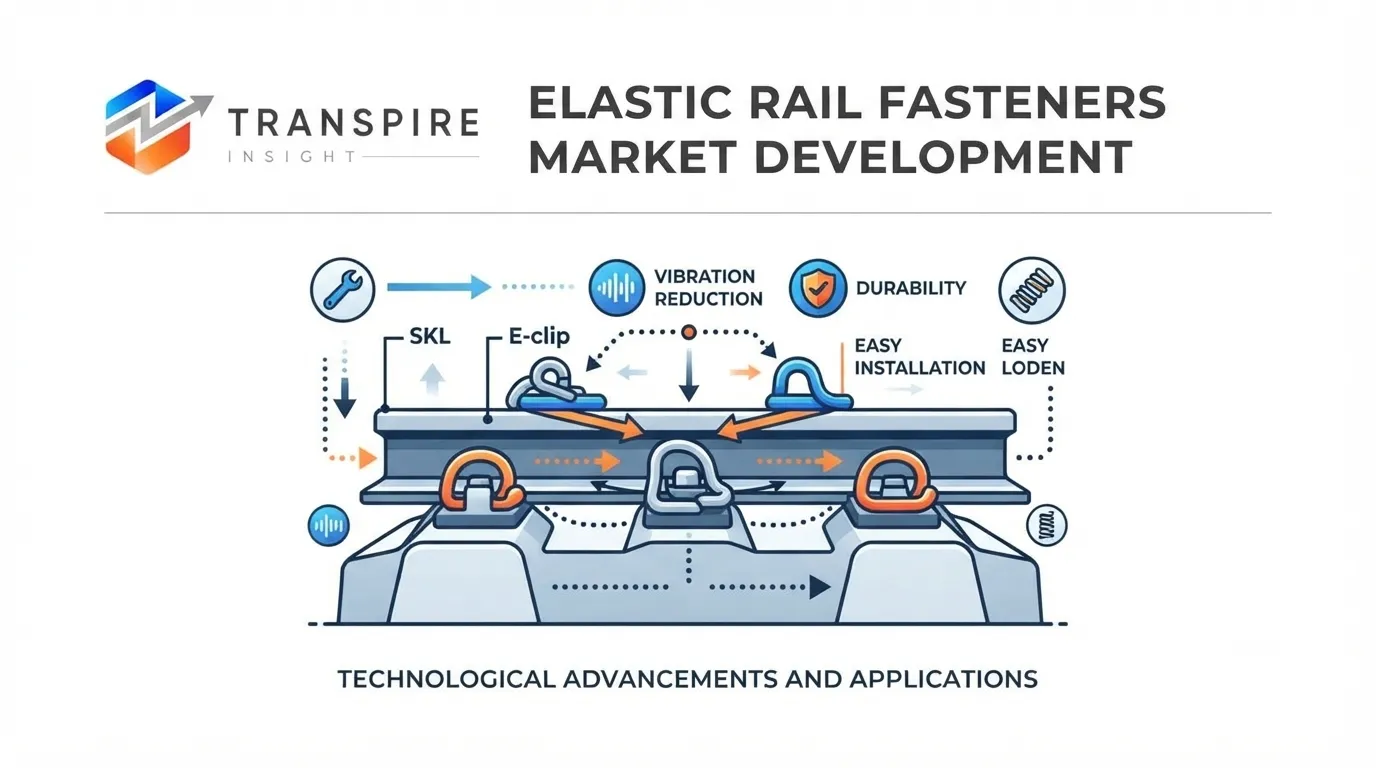
Elastic rail fasteners are becoming an increasingly important component of modern railway infrastructure as governments, infrastructure developers, and railway operators invest in high-speed rail, metro systems, heavy-haul corridors, urban transit, and railway modernization. Designed to secure rails to sleepers while accommodating dynamic loads and controlled movement, elastic fastening systems contribute to track stability, vibration management, durability, and reliable railway operation.
The market is also evolving as railway infrastructure projects demand fastening solutions that can withstand higher axle loads, increased train speeds, demanding environmental conditions, and longer maintenance intervals. Manufacturers are therefore focusing on spring-steel clips, resilient fastening systems, corrosion-resistant materials, vibration-damping components, simplified installation, and solutions compatible with both conventional ballasted and modern ballastless track.
Market Size
The global Elastic Rail Fasteners Market is estimated at approximately USD 2.92 billion in 2025 and is expected to reach approximately USD 4.49 billion by 2035, registering a CAGR of about 4.4% during 2026–2035.
Elastic rail fasteners form an essential part of railway track assemblies. They secure the rail to the sleeper while allowing the fastening system to provide controlled elasticity under repeated wheel loads. Depending on the design, these systems can help maintain rail position, distribute forces, accommodate thermal movement, and reduce the transmission of vibration.
The market includes fastening products manufactured from steel, plastic, rubber, and composite materials. Applications extend across high-speed rail, conventional rail, metro and light rail, heavy-haul freight networks, and other railway infrastructure.
Long railway asset lifecycles make fastener reliability particularly important. Railway operators generally require products capable of maintaining performance under millions of load cycles, temperature fluctuations, moisture, contamination, vibration, and mechanical stress.
Railway Infrastructure Investment Drives Demand
The expansion and modernization of railway infrastructure is one of the principal factors supporting demand for elastic rail fasteners.
Governments across major economies are investing in railway corridors to improve passenger mobility, freight transportation, urban connectivity, and energy-efficient transportation.
New railway construction requires large volumes of fastening components, while existing networks require replacement and maintenance products.
Rail fastening systems are not simply commodity components. Their engineering characteristics influence rail restraint, stiffness, load transfer, vibration behavior, and maintenance requirements.
Pandrol describes fastening systems as components that control stiffness, manage load distribution, and protect track structures throughout their service life. Its systems are used across heavy-haul, mainline, high-speed, metro, and light-rail applications in more than 100 countries.
High-Speed Rail Creates Demand for Advanced Fasteners
High-speed railway development is creating demand for specialized elastic fastening systems.
Higher train speeds increase dynamic interaction between the wheel and rail. As train operating speeds rise, track components must maintain precise geometry and secure rail positioning under repeated dynamic forces.
Elastic fasteners are therefore being developed with carefully controlled stiffness characteristics and fatigue resistance.
High-speed projects also place greater emphasis on vibration, noise, track geometry, installation accuracy, and long-term maintenance.
Fastening systems designed for high-speed applications must often meet demanding railway specifications and qualification requirements.
Pandrol's portfolio includes fastening systems designed for high-speed, heavy-haul, metro, tram, light-rail, and other railway applications. Its product range includes e-Clip, Fastclip, Nabla, SD, and Vanguard systems.
Heavy-Haul Railways Require High Load Resistance
Heavy-haul railway networks transport large quantities of minerals, coal, agricultural commodities, industrial materials, and other bulk goods.
These railways can experience significantly higher axle loads than conventional passenger systems.
Fastening systems used in heavy-haul environments must therefore provide strong rail restraint while maintaining resilience over extended operating periods.
Fatigue resistance, wear resistance, corrosion resistance, and consistent clamping force are important performance considerations.
Heavy-haul railways also operate in challenging environments, including deserts, mining regions, humid areas, and locations with substantial temperature variation.
This creates opportunities for manufacturers that can customize fastening systems according to local track conditions.
Urban Rail and Metro Expansion Supports Market Growth
Metro, light rail, tram, and urban transit projects represent another important demand source.
Urban railway networks are expanding as cities seek alternatives to road transportation and attempt to manage congestion and improve public mobility.
Metro systems also have specific requirements related to vibration and noise because railway lines frequently operate near residential buildings, commercial properties, hospitals, and other sensitive locations.
Elastic fastening systems can be engineered to provide controlled resilience and vibration attenuation.
Pandrol's Vanguard fastening system, for example, is positioned as a resilient rail fastening solution designed to reduce ground-borne noise and vibration.
This makes resilient fastening particularly relevant to underground metro systems, embedded tracks, bridges, viaducts, and other urban applications.
Ballastless Track Creates New Opportunities
Traditional railway tracks commonly use ballast to support sleepers and distribute loads. However, ballastless or slab-track systems are increasingly used in high-speed rail, tunnels, bridges, metro systems, and specialized applications.
Ballastless track requires fastening systems specifically designed for direct or embedded rail applications.
The growth of high-speed rail and urban rail infrastructure is therefore creating opportunities for manufacturers offering fastening solutions compatible with concrete slabs and specialized track structures.
Pandrol states that its fastening portfolio covers ballasted and non-ballasted track, including concrete, timber, composite, steel, precast block, and ballastless slab applications.
Clip Fasteners Remain Important
Clip-based systems are among the most widely recognized elastic fastening technologies.
Spring-steel clips provide rail restraint while maintaining a degree of controlled elasticity.
Modern clip systems are designed to simplify installation, reduce maintenance requirements, and maintain reliable performance under repeated loading.
Pandrol's e-Clip is an established spring-steel clip system, while Fastclip is a threadless fastening solution designed to improve installation efficiency.
The development of threadless systems can be particularly valuable for railway contractors seeking faster installation and reduced component complexity.
Automation Is Improving Fastener Installation
Railway construction is increasingly adopting mechanized and automated installation methods.
Railway projects often involve thousands or millions of fastening components, making installation efficiency an important consideration.
Automated fastening equipment can help reduce manual labor, improve consistency, and accelerate track construction.
Pandrol's fastening portfolio includes Clip Driver equipment designed for automated installation.
The combination of automated installation equipment and pre-assembled fastening systems can reduce installation time and support more predictable construction schedules.
This trend is particularly relevant for large high-speed rail and metro projects where contractors need to install extensive lengths of track within restricted construction windows.
Maintenance and Replacement Create Recurring Demand
New railway construction is not the only source of market growth.
Existing rail networks require regular inspection, maintenance, component replacement, and modernization.
Elastic fasteners can experience fatigue, corrosion, deformation, loss of clamping force, or wear over long operating periods.
Railway operators therefore purchase replacement components as part of routine infrastructure maintenance.
The replacement market can provide relatively stable demand because railway maintenance remains necessary even when new railway construction slows.
This creates opportunities for manufacturers with established product certifications and compatibility with installed fastening systems.
Material Innovation Is Improving Product Performance
Steel remains a critical material for elastic rail fastening systems because of its mechanical strength and fatigue characteristics.
However, other materials are increasingly being used for insulators, rail pads, liners, washers, housings, and other components.
Plastic, rubber, polymer, and composite materials can provide electrical insulation, vibration control, corrosion resistance, and improved component durability.
Material engineering is particularly important for railway systems operating in coastal environments, tropical climates, freezing conditions, and high-humidity regions.
The ability to design fasteners for specific environmental conditions can help manufacturers differentiate their products.
Noise and Vibration Reduction Are Becoming More Important
Noise reduction is increasingly important as railway lines move closer to populated areas.
Railway noise can originate from wheel-rail interaction, track vibration, bridges, tunnels, and other components.
Elastic fastening systems can contribute to controlling vibration transmission between the rail and supporting structure.
Urban rail operators are therefore increasingly interested in fastening solutions that balance rail stability with appropriate resilience.
This creates opportunities for specialized resilient fastening systems, rail pads, under-sleeper pads, and vibration-damping products.
Pandrol's portfolio includes resilient pads and mats designed to control track stiffness and resilience alongside its fastening products.
Railway Electrification Supports Modernization
Railway electrification is expanding in many markets as governments seek efficient alternatives to diesel-powered transportation.
Electrified railways require extensive infrastructure upgrades, including tracks, signaling, substations, overhead equipment, and related components.
While elastic fasteners are not themselves electrification equipment, railway electrification projects often coincide with broader track modernization programs.
Modernized corridors may require new fastening systems capable of meeting updated engineering and operational standards.
This creates additional demand opportunities for manufacturers supplying complete track-system components.
Digital and Smart Fastening Systems Are Emerging
Railway infrastructure is becoming increasingly data-driven.
Condition monitoring technologies can potentially measure track loads, vibration, displacement, temperature, and other parameters.
The integration of sensors into fastening components or nearby track infrastructure could support predictive maintenance.
Instead of replacing fasteners according to fixed schedules, railway operators could increasingly use condition data to identify components requiring inspection or replacement.
Smart fastening technology remains an emerging area, but it aligns with the broader transition toward predictive railway maintenance and digital asset management.
The development of intelligent rail infrastructure is expected to create opportunities for manufacturers that combine mechanical fastening expertise with sensing, monitoring, and digital technologies.
Regional Outlook
Asia Pacific
Asia Pacific is one of the most important regions for railway fastening demand because of extensive railway networks, urbanization, metro construction, high-speed rail development, and infrastructure investment.
China has developed one of the world's largest high-speed rail networks, while India is expanding and modernizing railway infrastructure and metro systems.
Japan and South Korea also have mature railway networks with strong demand for reliable track components.
Market research identifies Asia Pacific as the dominant region for broader rail fastening systems, reflecting the scale of railway construction and modernization across the region.
China also has a substantial domestic manufacturing base for railway fasteners and track components, supporting both domestic projects and international supply.
India represents another significant opportunity because railway modernization, dedicated freight corridors, metro development, electrification, and high-speed rail initiatives are supporting demand for advanced track components.
Europe
Europe has a mature railway infrastructure market supported by high-speed rail, conventional passenger rail, freight transportation, metro systems, and cross-border rail connectivity.
The region has strong technical and regulatory requirements for railway components.
European manufacturers such as Vossloh, Pandrol, Schwihag, and voestalpine Railway Systems have developed specialized fastening solutions for different track configurations.
The replacement and modernization of aging railway infrastructure will remain important sources of demand.
Sustainability is also an important consideration, encouraging manufacturers to develop longer-lasting products and more efficient installation systems.
North America
North America is supported by extensive freight rail networks, commuter rail, passenger rail, and railway maintenance activity.
Heavy-haul freight rail is particularly important in the United States and Canada.
Railway operators require durable fastening systems capable of handling substantial axle loads and long operating distances.
L.B. Foster and Progress Rail are among the established participants serving the North American railway infrastructure market.
The region also has opportunities related to passenger rail modernization and investment in intercity transportation.
Latin America
Latin American markets provide opportunities through mining railways, freight corridors, urban transit, and infrastructure modernization.
Countries with substantial mining and agricultural exports require reliable freight rail systems.
Railway development in major cities is also increasing demand for metro and urban rail infrastructure.
Cost efficiency and durability are particularly important purchasing criteria in these markets.
Middle East and Africa
Railway investment in the Middle East and Africa is creating new opportunities for rail fastening manufacturers.
New passenger railways, freight corridors, mining railways, and urban transit projects require modern track components.
The harsh environmental conditions in parts of these regions increase the importance of corrosion resistance, thermal stability, dust resistance, and long service life.
Specialized fastening systems can therefore provide opportunities in desert, coastal, and heavy-haul applications.
Competitive Landscape
The Elastic Rail Fasteners Market is moderately concentrated among established international railway component manufacturers and specialized regional suppliers.
Competition is based on engineering performance, product certification, durability, installation efficiency, global manufacturing capacity, technical support, and compatibility with different track structures.
Leading participants include Pandrol, Vossloh, L.B. Foster, Schwihag, Progress Rail, voestalpine Railway Systems, Amsted Rail, AGICO Rail, SUYU Railway Material, and other regional manufacturers.
Qualification requirements create an important entry barrier because railway operators and infrastructure developers typically require products to satisfy technical standards and project-specific specifications.
The market is also becoming more competitive in emerging economies where regional manufacturers can provide cost-effective alternatives.
Top 10 Companies in Elastic Rail Fasteners Market
1. Pandrol
Pandrol is one of the most established names in railway fastening technology.
The company offers elastic fastening systems for heavy-haul, conventional rail, high-speed rail, metro, tram, and light-rail applications.
Its product portfolio includes e-Clip, Fastclip, Nabla, SD, Vanguard, special baseplates, rail pads, and other track components. Pandrol states that its fastening systems have been used across railway networks in more than 100 countries.
The company's combination of fastening products, resilient systems, installation equipment, and engineering support gives it a broad position within the rail infrastructure supply chain.
2. Vossloh AG
Vossloh is a major European railway infrastructure company with a strong presence in rail fastening systems.
The company provides fastening solutions for conventional railways, high-speed lines, urban transit, and specialized track applications.
Its products include tension clamps and fastening systems designed for concrete sleepers and different track configurations.
Vossloh competes through engineering expertise, international project experience, and its broader portfolio of rail infrastructure technologies.
3. L.B. Foster Company
L.B. Foster is a U.S.-based infrastructure company with extensive involvement in rail products and track components.
Its rail portfolio includes fastening products and other components used across freight, passenger, transit, and specialized railway applications.
The company has particularly strong relevance in the North American railway market.
Its engineering capabilities and customer-specific solutions allow it to serve both maintenance and new infrastructure requirements.
4. Progress Rail
Progress Rail, a Caterpillar company, provides products and services across the railway industry.
Its portfolio includes track components, rail fastening systems, maintenance solutions, and other railway infrastructure products.
The company's relationship with Caterpillar provides access to extensive industrial resources and a broad global customer network.
Progress Rail serves freight and transit markets and participates in both new construction and railway maintenance activities.
5. Schwihag AG
Schwihag is a Swiss railway technology company specializing in track fastening systems and railway infrastructure components.
Its products are designed for applications requiring precision, durability, and reliable rail restraint.
The company has developed fastening and switch technologies for different railway configurations.
Its specialization in railway infrastructure allows it to compete in technically demanding applications where product performance and engineering customization are important.
6. voestalpine Railway Systems
voestalpine Railway Systems is a major international railway infrastructure supplier with products spanning rails, turnout systems, fastening technologies, and other track solutions.
Its fastening portfolio includes systems for concrete sleepers, heavy-haul railways, urban applications, and other track environments.
The company benefits from the broader capabilities of the voestalpine Group and its expertise in advanced steel and railway technologies.
Its integrated approach supports customers seeking multiple railway infrastructure components from a single supplier.
7. Amsted Rail
Amsted Rail is a major North American railway equipment and component supplier.
The company provides products for freight rail applications and has expertise in wheelsets, braking systems, suspension components, and other railway technologies.
Its involvement in rail fastening and related infrastructure components positions it within the broader railway component supply chain.
Heavy-haul and freight rail demand provide important opportunities for the company.
8. AGICO Rail
AGICO Rail, associated with Anyang General International, is a Chinese supplier of railway track components.
Its portfolio includes rail fastening systems, rail clips, bolts, joints, spikes, and other track products.
The company serves domestic and international railway projects and benefits from China's extensive railway manufacturing ecosystem.
Competitive pricing, manufacturing capacity, and export capabilities support its position in international railway component markets.
9. SUYU Railway Material
SUYU Railway Material is a Chinese manufacturer specializing in railway fastening and track components.
Its product portfolio includes rail clips, spikes, bolts, fastening assemblies, and customized railway components.
The company serves a range of railway applications and exports products to international markets.
Its ability to manufacture multiple fastening configurations allows it to compete in cost-sensitive markets as well as specialized infrastructure projects.
10. Lewis Bolt & Nut Company
Lewis Bolt & Nut Company is a U.S.-based manufacturer serving the railway and industrial fastening markets.
The company specializes in railway fasteners and related products used in demanding infrastructure applications.
Its experience in manufacturing railway fastening components supports applications across freight rail and other railway infrastructure segments.
The company competes through product availability, manufacturing expertise, and specialization in railway fastening requirements.
Market Challenges
The Elastic Rail Fasteners Market faces several challenges despite the long-term expansion of railway infrastructure.
Strict technical standards create qualification barriers for manufacturers. Products must meet railway-specific engineering requirements and may need extensive testing before being approved for major projects.
Raw-material price volatility can affect production costs, particularly for steel-based components.
Railway project delays can also affect demand. Large rail projects frequently involve long planning periods, government approvals, land acquisition, financing, and complex construction schedules.
Maintenance access presents another challenge. Railway operators often have limited maintenance windows, meaning fastening systems must be designed for long service intervals and efficient replacement.
Environmental conditions can also affect performance. Corrosion, extreme temperatures, moisture, dust, and chemical exposure require manufacturers to engineer products for specific operating environments.
Future Outlook
The global Elastic Rail Fasteners Market is expected to experience steady growth as railway infrastructure expands across high-speed, heavy-haul, metro, urban transit, and conventional railway applications.
The projected increase from approximately USD 2.92 billion in 2025 to USD 4.49 billion by 2035 reflects continued demand for reliable track fastening components.
Future product development is likely to focus on longer service life, improved fatigue resistance, corrosion protection, vibration reduction, lightweight materials, faster installation, and reduced maintenance requirements.
Automation will become increasingly important as railway contractors seek to reduce installation time and improve consistency. Pre-assembled fastening systems and automated installation equipment can support large-scale infrastructure construction.
Smart railway infrastructure will create another area of opportunity. The integration of sensors and monitoring technologies could allow operators to monitor track conditions and identify maintenance requirements before failures occur.
Sustainability will also influence future product development. Manufacturers are likely to focus on durable products, recyclable materials, reduced installation requirements, and fastening systems capable of extending infrastructure service life.
Asia Pacific is expected to remain an important center of railway infrastructure investment, while Europe and North America will continue to generate demand through modernization and replacement programs.
The competitive environment will increasingly favor manufacturers that can provide not only individual fasteners but complete fastening solutions combining clips, pads, baseplates, insulation components, installation equipment, engineering support, and lifecycle maintenance services.
As railway operators seek safer, more reliable, quieter, and more cost-efficient infrastructure, elastic rail fasteners will remain a fundamental component of modern track engineering. Their role in maintaining rail stability, managing dynamic forces, controlling vibration, and extending track performance positions the market for continued development alongside the global expansion and modernization of railway transportation.


Send us a brief description of your challenge and we'll get back to you within 24 hours.

 inquiry@transpireinsight.com
 APAC:+91 7666513636
 Address


