
Sep 14, 2026
By Transpire Insight
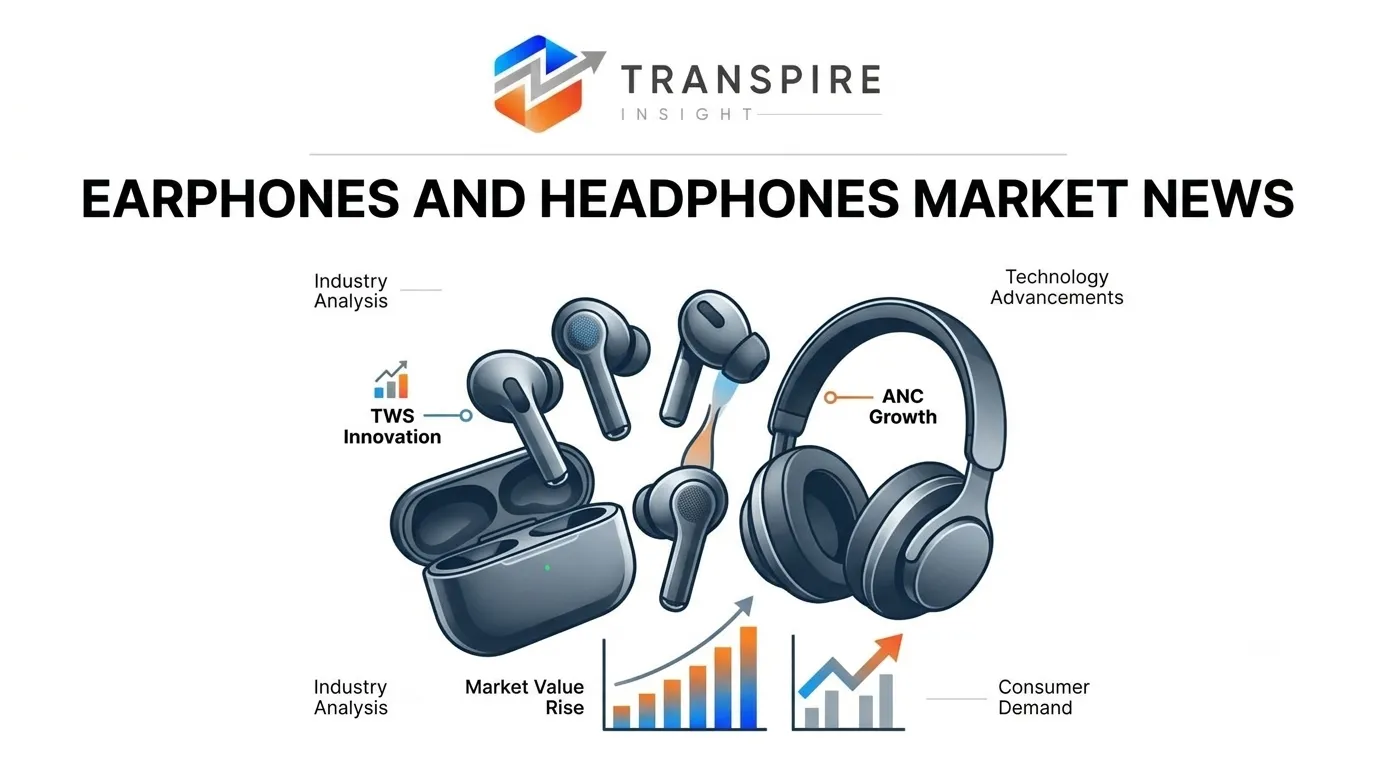
The global earphones and headphones market is entering a new phase as true wireless earbuds, active noise cancellation, spatial audio, artificial intelligence and connected-device integration become increasingly important to consumers. Manufacturers are expanding beyond conventional audio playback by introducing adaptive sound technologies, voice assistants, health-oriented sensing and improved battery performance. Recent product launches and technology developments are also showing a stronger shift toward AI-enabled and open-ear listening experiences, creating new opportunities across entertainment, gaming, fitness, communication and mobile computing.
Earphones and Headphones Market Expands with Growing Demand for Wireless and Connected Audio
The global earphones and headphones market is developing rapidly as consumers increasingly rely on personal audio devices for music, video streaming, gaming, online meetings, communication and everyday mobility. The transition from wired products toward wireless and true wireless devices has become one of the most important structural changes in the industry, while improvements in Bluetooth connectivity, active noise cancellation, battery life and audio processing are expanding the functionality of modern products.
According to Transpire Insights, the global earphones and headphones market is estimated at approximately USD 28.7 billion in 2025 and is expected to reach around USD 32.8 billion in 2026, with the market projected to approach USD 86.9 billion by 2033, representing an estimated CAGR of approximately 14.92% during 2026–2033. Independent market research also indicates strong expansion, although published market estimates vary substantially depending on product and geographic definitions. Grand View Research, for example, projects the global market to reach USD 238.72 billion by 2033 at a 14.5% CAGR, while Mordor Intelligence estimates USD 29.22 billion in 2026 and USD 44.71 billion in 2031.
True Wireless Earbuds Strengthen Their Position in the Audio Market
True wireless stereo products are becoming increasingly important as consumers prioritize portability, convenience and cable-free listening. Compact charging cases, improved battery life, better connectivity and increasingly sophisticated noise-cancellation capabilities have helped transform wireless earbuds from simple accessories into multifunctional personal devices.
Recent market analysis indicates that true wireless products represented the largest connectivity segment, with a 56.17% share in 2026 according to Fortune Business Insights. The broader earphones category also maintained a strong position because of its affordability, portability and compatibility with mobile-first lifestyles.
The continued removal of headphone ports from smartphones and other mobile devices has also encouraged consumers to transition toward Bluetooth-based audio products. As wireless connectivity becomes standard across consumer electronics, earphones and headphones are increasingly functioning as extensions of smartphones, tablets, computers and wearable ecosystems.
Active Noise Cancellation Improves the Premium Audio Experience
Active noise cancellation is becoming one of the most important differentiating features across the premium earphones and headphones market. ANC technologies use microphones and signal processing to identify surrounding noise and generate an opposing signal to reduce unwanted sound.
The technology is particularly valuable for commuters, travelers, remote workers and consumers using audio devices in crowded environments. Improvements in microphones, processors and adaptive algorithms are enabling newer products to respond more dynamically to changes in the surrounding environment.
Recent product developments demonstrate how ANC is moving beyond a fixed on/off function. Google, for example, has introduced an updated Pixel Buds Pro 2 with dynamic ANC designed to respond to changes in earbud fit, alongside Gemini-enabled voice controls.
AI Integration Expands the Role of Personal Audio Devices
Artificial intelligence is increasingly becoming part of the earphones and headphones experience. Voice assistants, real-time translation, adaptive sound processing, personalized audio profiles and context-aware controls are creating new applications beyond conventional music playback.
Modern earbuds can increasingly act as an interface between users and AI assistants. Voice commands can control audio settings, provide information and support communication without requiring users to interact directly with a smartphone.
The development of AI-enabled earphones is also being supported by improvements in onboard processing. Manufacturers are increasingly using dedicated processors and advanced algorithms to analyze environmental sound, optimize speech pickup and personalize audio output.
Recent developments in the market illustrate this transition. Google's updated Pixel Buds Pro 2, for example, are adding Gemini voice functionality and enhanced Live Translation capabilities, demonstrating how AI is becoming integrated into everyday personal audio devices.
Open-Ear Designs Create New Listening Opportunities
Open-ear and open-fit products are emerging as an important alternative to conventional in-ear earbuds. These devices are designed to allow users to hear surrounding sounds while listening to audio, making them attractive for outdoor exercise, commuting and situations where environmental awareness is important.
Recent consumer-audio developments show increasing interest in open-ear products across different price categories. Current market offerings include open-fit and clip-on designs targeted at runners, commuters and users seeking greater awareness of their surroundings.
The growth of this category is creating an additional product segment rather than simply replacing conventional earbuds. Manufacturers are competing through comfort, secure fit, battery endurance, sound leakage management and improved audio quality.
Why do Earphones and Headphones Matter?
Earphones and headphones have become important personal technology products because they provide portable access to music, entertainment, communication and digital services. Their use extends across smartphones, computers, gaming consoles, televisions and other connected devices.
The importance of personal audio is also expanding as remote work, online education, digital entertainment and mobile content consumption remain embedded in everyday consumer behavior. Advanced microphones and noise cancellation further improve the usefulness of headphones for video conferencing and voice communication.
Recent research into real-world personal listening-device behavior found that average logged daily use among a studied group increased from 37 minutes in 2020 to 64 minutes in 2024, highlighting the growing role of ear-worn devices in everyday digital activity. The research also points toward the evolution of ear-worn products into sensing platforms for interaction, health and context-aware applications.
Digital Audio Technologies Support the Next Generation of Headphones
The development of the market is increasingly connected with advances in Bluetooth, high-resolution audio, spatial audio, adaptive sound processing and wireless communication technologies. Manufacturers are attempting to deliver better sound quality while maintaining low latency, long battery life and reliable connectivity.
Spatial audio is becoming increasingly relevant for entertainment and gaming because it can create a more immersive listening environment. At the same time, advanced codecs are being developed to improve wireless audio transmission.
However, the industry continues to face technical challenges in delivering fully scalable lossless high-resolution wireless audio. Industry discussions in 2026 indicate that compatibility, battery consumption, implementation costs and limited perceived benefits remain barriers to widespread adoption of advanced lossless wireless transmission.
This is encouraging manufacturers to balance technical audio improvements with features that consumers can immediately experience, including ANC, comfort, battery life, voice quality and AI functionality.
Key Trends in the Earphones and Headphones Market
True wireless earbuds are becoming increasingly dominant as consumers prioritize compact designs, cable-free convenience and seamless smartphone connectivity. Continued improvements in battery performance, ANC and software-based features are supporting replacement demand.
AI assistants, adaptive sound processing, voice enhancement and translation capabilities are expanding the functionality of personal audio products. Earphones are increasingly becoming interfaces for interacting with AI services rather than simply devices for listening to music.
Open-ear designs are gaining attention among consumers who want to maintain awareness of surrounding sounds during exercise, commuting and outdoor activities. The category is expanding through bone-conduction, air-conduction and clip-on approaches.
ANC is becoming more intelligent as manufacturers improve microphones, processors and algorithms. Newer systems can dynamically adjust noise reduction according to environmental conditions and device fit, creating a more personalized listening experience.
Earphones are increasingly being explored as sensing and computing platforms. Recent research highlights opportunities for ear-worn devices in health monitoring, context awareness, interaction and personalized computing, expanding the long-term addressable market beyond conventional audio applications.
Regional Development
The development of the global earphones and headphones market varies across regions because of differences in consumer spending, smartphone penetration, digital entertainment consumption, local manufacturing capabilities and technology adoption. North America remains a major regional market because of strong demand for premium headphones, wireless earbuds, gaming audio and connected consumer electronics. Mordor Intelligence identifies North America as the largest regional market in its current assessment.
Europe represents another important market, supported by established consumer-electronics industries, strong demand for premium audio equipment and increasing consumer interest in wireless products, noise cancellation and sustainable product design.
Asia Pacific is expected to remain one of the fastest-growing regions because of its large consumer population, high smartphone penetration, expanding middle class and strong electronics manufacturing ecosystem. Mordor Intelligence identifies Asia Pacific as the fastest-growing regional market.
India is becoming particularly important within the regional market. The country's earphones and headphones market generated approximately USD 6.07 billion in revenue in 2025 according to IMARC's current assessment and is projected to reach approximately USD 24.00 billion by 2034, supported by wireless migration, premiumization, local manufacturing and mobile-first consumption patterns.
Challenges & Restraints
Despite strong growth opportunities, the earphones and headphones market faces several challenges. Intense price competition has reduced differentiation in the mass-market wireless segment, while consumers increasingly expect advanced features such as ANC, transparency modes, long battery life and AI functionality even at relatively affordable prices.
Battery performance remains another technical challenge. Advanced ANC, high-resolution audio, onboard processing and continuous connectivity can increase power consumption, requiring manufacturers to improve battery efficiency without significantly increasing product size
Wireless audio quality also faces limitations associated with codecs, bandwidth, device compatibility and power requirements. Industry discussions indicate that fully lossless high-resolution wireless audio remains difficult to deliver at scale because of implementation complexity and battery considerations.
Product durability and electronic waste are additional concerns. Earbuds contain batteries and electronic components that can be difficult to repair or recycle, creating sustainability challenges as replacement cycles become shorter.
Counterfeit products and low-cost imitation devices can also affect established brands by creating consumer confusion and putting downward pressure on pricing.
Competitive Landscape
The global earphones and headphones ecosystem includes companies involved in consumer electronics, wireless audio, acoustic engineering, semiconductors and connected-device platforms. Major participants include Apple, Sony, Samsung, Bose, Sennheiser, JBL, Xiaomi, Skullcandy, Jabra, Audio-Technica and other regional and international brands.
Competition is increasingly based on more than sound quality. Manufacturers are differentiating through ecosystem integration, AI assistants, adaptive ANC, spatial audio, health-related features, battery performance, comfort and industrial design.
The market is also seeing greater competition between global premium brands and regional manufacturers that use local production, aggressive pricing and rapid product cycles to expand their presence in emerging markets.
Apple remains one of the most influential participants in the personal audio industry through its AirPods ecosystem and integration with iPhone, iPad, Mac and other Apple products.
The company's approach combines hardware, software and ecosystem functionality, allowing features such as automatic device switching, spatial audio and voice-assistant integration to become part of the broader Apple experience. This ecosystem-based strategy provides a significant competitive advantage in the premium wireless earphone segment.
Sony is a major participant in both premium wireless headphones and true wireless earbuds, with a strong reputation for noise cancellation, audio processing and high-quality sound.
In August 2026, Sony launched its 1000X THE COLLEXION headphones and WF-1000XM6 earbuds in India as part of the 10th anniversary of its 1000X audio series. The new WF-1000XM6 includes a fourth microphone per earbud and is reported to provide a 25% improvement in noise cancellation compared with its predecessor.
These developments demonstrate the continued importance of ANC and microphone technology in the premium audio market.
Samsung is expanding its position in wireless audio through its Galaxy Buds ecosystem and broader Galaxy-device integration. Its latest audio products increasingly combine high-quality wireless sound with AI assistants and smartphone functionality.
Recent reports also indicate that Samsung is developing a new over-ear wireless headphone, reportedly called the Galaxy H1, which could represent its return to the premium over-ear category. Reported features include Bluetooth connectivity, Samsung's high-quality SSC UHQ codec and integration with Gemini and Bixby.
Although the reported product is expected later, the development highlights the growing importance of AI and ecosystem integration within premium headphones.
Bose remains an important premium audio company with a strong position in noise-cancelling headphones and wireless earbuds. Its competitive strength is closely associated with acoustic engineering, comfort and noise-reduction performance.
The company continues to compete in a market where consumers increasingly expect premium headphones to combine strong ANC with improved sound quality, long battery life and comfortable long-duration use.
Sennheiser occupies an important position in premium and audiophile-oriented personal audio. Its products compete through sound quality, acoustic engineering, wireless performance and advanced connectivity.
The company is also part of the industry's broader discussion around next-generation wireless audio quality. Industry feedback suggests that premium audio companies continue to evaluate lossless high-resolution wireless technologies while balancing battery life, cost and practical consumer benefits.
Market Expert View
As per industry analysis, the next phase of the earphones and headphones market is likely to focus on AI-enabled audio, adaptive listening, health-oriented sensing, open-ear designs and deeper integration with connected-device ecosystems
Recent research indicates that ear-worn devices are evolving from conventional audio playback products into broader sensing and computing platforms. Real-world usage research is already examining their potential for context awareness, health applications and personalized interaction.
At the same time, current product developments show that AI is becoming a practical consumer feature rather than only a future concept. Voice-controlled sound adjustment, translation and adaptive noise cancellation are already appearing in commercial products.
Industry participants are therefore expected to prioritize smaller processors, more efficient batteries, improved microphones, adaptive algorithms and seamless integration with smartphones and other connected devices. The ability to combine audio quality, comfort, intelligence and battery efficiency will remain a key differentiator as competition intensifies.
Conclusion
The global earphones and headphones market is entering a more sophisticated phase as wireless connectivity, true wireless designs, active noise cancellation, artificial intelligence, spatial audio and open-ear technologies become increasingly integrated into personal listening devices. The transition from basic audio accessories toward multifunctional connected devices is creating new opportunities across entertainment, gaming, communication, fitness and mobile computing.
The continued expansion of TWS earbuds, adaptive ANC, AI assistants, open-ear products and advanced audio processing is expected to support market development through the coming years. At the same time, manufacturers will need to address battery limitations, wireless audio-quality challenges, pricing pressure, product durability and sustainability concerns.
Recent developments from major technology and audio companies demonstrate that competition is increasingly centered on intelligent features and ecosystem integration rather than audio performance alone. As consumers seek greater convenience, personalization and situational awareness from their listening devices, earphones and headphones are expected to become an increasingly important category within the global connected-device ecosystem.


Send us a brief description of your challenge and we'll get back to you within 24 hours.

 inquiry@transpireinsight.com
 APAC:+91 7666513636
 Address


