
Oct 09, 2026
By Transpire Insight
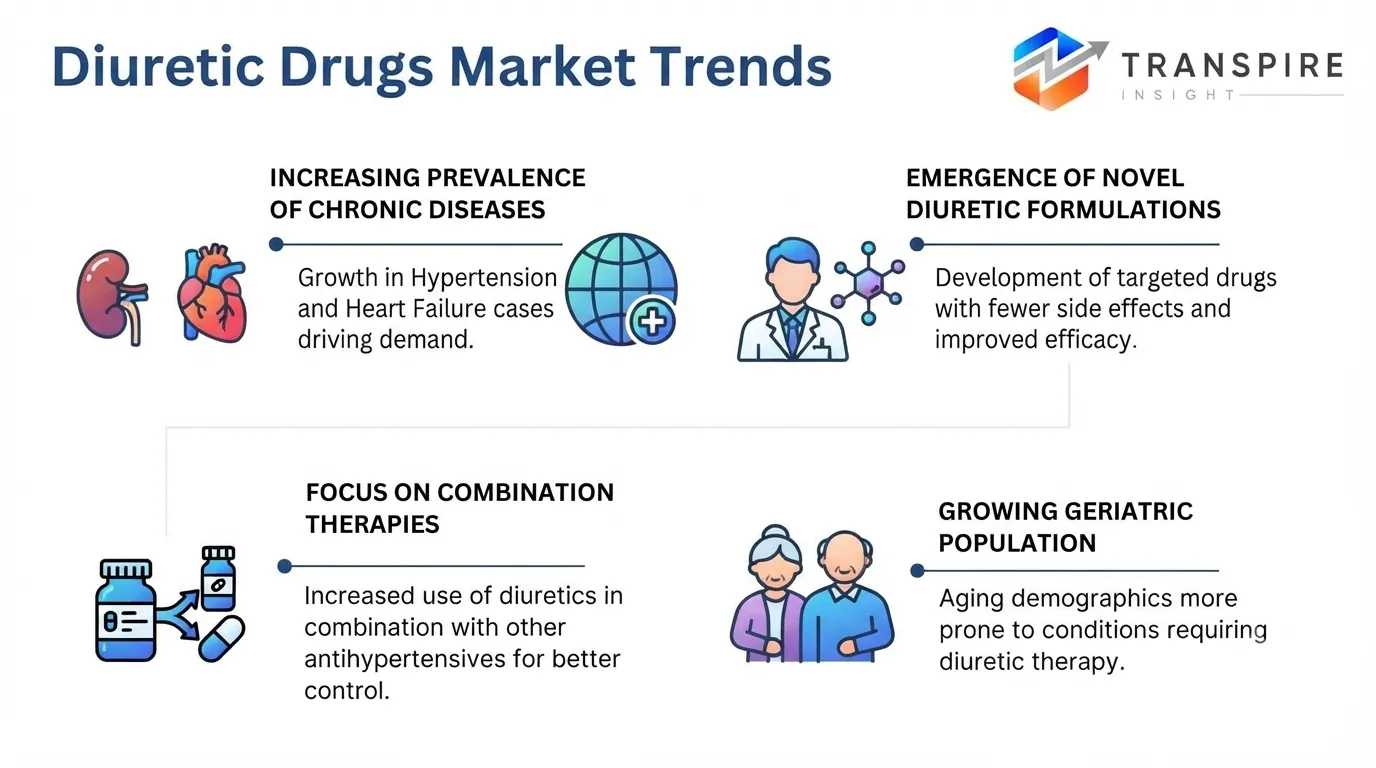
The global Diuretic Drugs Market continues to evolve as cardiovascular, renal, and fluid-retention disorders create sustained demand for therapies that regulate fluid and sodium balance. The market is also experiencing a shift toward more convenient drug-delivery approaches, including wearable infusion systems, nasal formulations, and outpatient treatment options.
Diuretic Drugs Market Overview
The Diuretic Drugs Market covers pharmaceutical products that increase urinary sodium and water excretion and are used across several therapeutic settings, particularly hypertension, heart failure, edema, and selected renal and hepatic conditions.
The principal product categories include loop diuretics, thiazide and thiazide-like diuretics, potassium-sparing diuretics, carbonic anhydrase inhibitors, and combination therapies.
Transpire Insights estimates that the global Diuretic Drugs Market could reach approximately USD 30.35 billion in 2025, increase to around USD 31.95 billion in 2026, and reach nearly USD 45.55 billion by 2033, reflecting an estimated CAGR of approximately 5.20% from 2026 to 2033.
Latest Global Market Developments
Why Do Diuretic Drugs Matter?
Diuretics remain important because fluid accumulation and elevated blood pressure are common clinical problems associated with several cardiovascular and renal disorders.
Their importance extends across:
The commercial opportunity is increasingly influenced not only by the molecule itself but also by administration route, treatment convenience, adherence, outpatient use, and delivery technology.
Key Factors Driving the Diuretic Drugs Market
1. Cardiovascular Disease Burden
The continued prevalence of hypertension and heart failure creates a large underlying treatment population.
2. Aging Population
Older populations have higher healthcare utilization and may require treatment for multiple cardiovascular and renal conditions.
3. Growth in Chronic Disease Management
Long-term disease management increasingly takes place outside hospitals, supporting demand for convenient oral and alternative delivery formats.
4. Drug-Delivery Innovation
Nasal sprays, wearable infusors, and autoinjectors are expanding the possible ways in which established diuretic molecules can be administered.
5. Combination Therapy
Fixed-dose combinations can reduce the number of separate medicines a patient needs to take and remain an important pharmaceutical-development strategy.
Five High-Potential Markets Shaping Global Diuretic Drug Demand
1. United States
The U.S. remains a major pharmaceutical market with substantial demand for cardiovascular and renal therapies. Recent FDA approvals demonstrate continued innovation around diuretic delivery.
2. Germany
Germany provides a large European market supported by advanced healthcare infrastructure, an aging population, and broad pharmaceutical access.
3. China
China offers significant long-term demand potential because of its large population, expanding healthcare system, and growing treatment access.
4. India
India combines a large patient population with expanding pharmaceutical manufacturing and increasing access to chronic-disease treatment.
5. Japan
Japan's aging population and advanced healthcare system support sustained demand for cardiovascular and renal pharmaceutical therapies.
Competitive Landscape
Competition spans multinational pharmaceutical companies, generic-drug manufacturers, specialty pharmaceutical developers, and companies developing novel delivery technologies.
The competitive environment is shaped by:
Top 5 Companies in the Diuretic Drugs Market
Opportunities for Small Investors
Challenges & Restraints
The market faces generic-price pressure, regulatory requirements, competition among established molecules, adverse-effect monitoring requirements, manufacturing-cost fluctuations, and the need for strong clinical differentiation.
Novel delivery systems also face development, reimbursement, physician-adoption, and patient-training barriers.
Conclusion
The Diuretic Drugs Market remains a substantial pharmaceutical category supported by cardiovascular, renal, and chronic-disease treatment requirements.
The most significant structural change is the movement beyond conventional tablets and intravenous administration toward nasal, wearable, and autoinjector-based delivery systems. The 2026 approvals of Enbumyst, Lasix ONYU, and Furoscix ReadyFlow demonstrate this transition.
For pharmaceutical manufacturers, drug-delivery developers, investors, and healthcare distributors, opportunities increasingly exist at the intersection of established molecules and improved treatment convenience.


Send us a brief description of your challenge and we'll get back to you within 24 hours.

 inquiry@transpireinsight.com
 APAC:+91 7666513636
 Address


