
Aug 17, 2026
By Transpire Insight
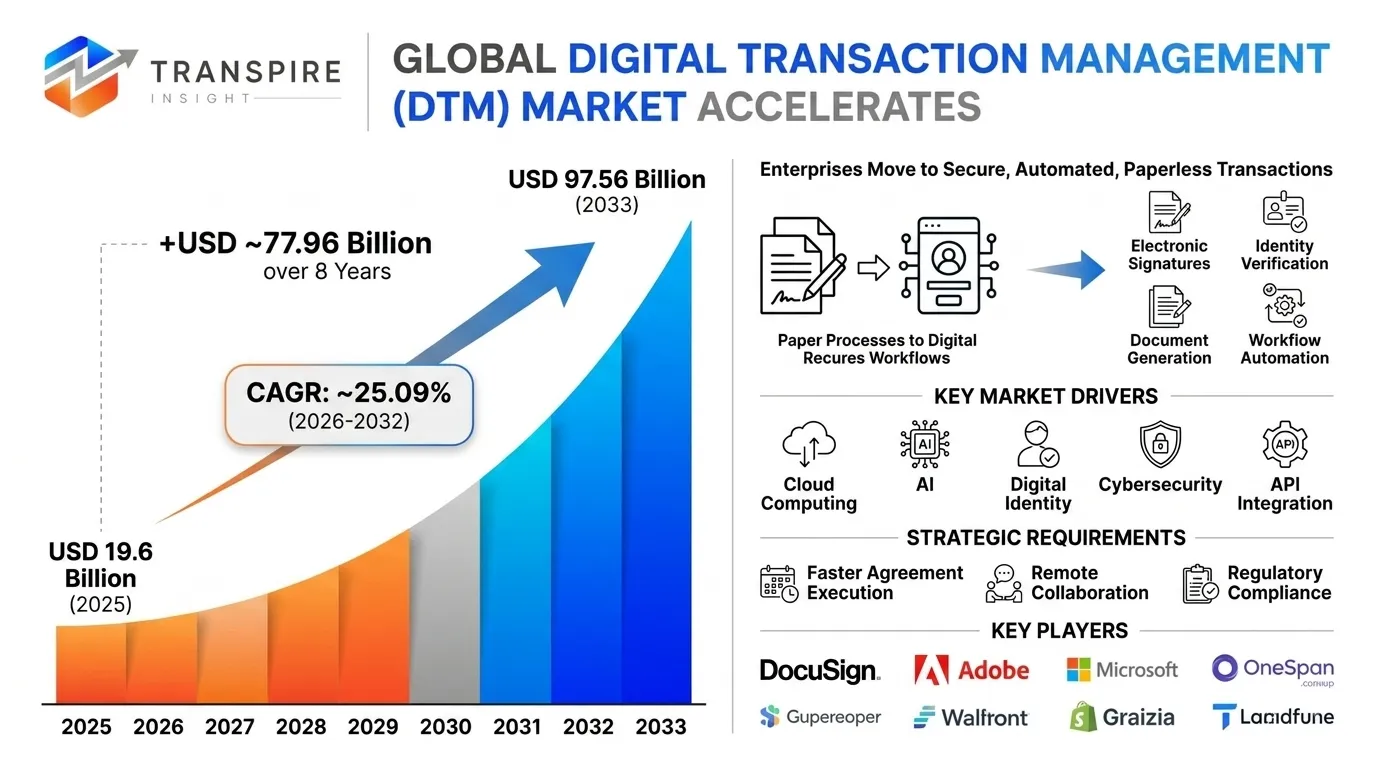
According to Transpire Insight, a detailed research analysis of the global digital transaction management market reflects that enterprises are increasingly replacing paper-intensive transaction processes with secure digital workflows that combine electronic signatures, identity verification, document generation, workflow automation, authentication, and digital record management. The global Digital Transaction Management Market was valued at approximately USD 19.6 billion in 2025 and is projected to reach around USD 24.9 billion in 2026, before expanding to approximately USD 97.56 billion by 2033, representing a CAGR of approximately 25.09% during 2026–2032. The rapid expansion reflects the growing requirement for faster agreement execution, regulatory compliance, auditability, remote collaboration, and digitally connected customer journeys.
The global business environment has entered a phase in which documents are no longer treated as static files but as components of connected digital processes. Contracts, employee forms, loan documents, insurance applications, purchase agreements, healthcare records, government forms, and customer onboarding documents increasingly move through electronically managed workflows.
Digital Transaction Management, commonly referred to as DTM, provides the infrastructure required to create, prepare, authenticate, sign, execute, store, track, and manage these transactions digitally. The technology therefore extends beyond electronic signatures by connecting multiple stages of the transaction lifecycle into a coordinated workflow.
The market is also being reshaped by cloud computing, artificial intelligence, digital identity, cybersecurity, API-based integration, and mobile-first customer experiences. As organizations operate across increasingly distributed workforces and digital channels, the ability to complete transactions without physical paperwork is becoming a strategic requirement rather than simply an administrative convenience.
Digital Transaction Management Bets on the Future of Paperless Business
For decades, business transactions depended on physical documents, manual signatures, postal services, scanning, filing, and repeated data entry. These processes often created delays and made it difficult for organizations to monitor transaction status in real time.
Digital Transaction Management changes this model by allowing documents and agreements to move through electronically controlled workflows. A typical transaction can begin with digital document generation, proceed through identity authentication and electronic signing, and conclude with automated storage, notifications, audit trails, and compliance records.
The shift is particularly important for organizations operating across multiple locations or countries. Digital transactions can reduce dependency on physical offices and allow customers, employees, suppliers, and business partners to complete agreements remotely.
The market's rapid growth illustrates the scale of this transformation. From USD 19.41 billion in 2025, the DTM market is projected to reach USD 92.56 billion by 2032, representing an increase of approximately USD 73.15 billion over seven years.
Cloud deployment is becoming an important part of this transition because organizations can implement transaction-management capabilities without maintaining extensive on-premise infrastructure. Cloud platforms also enable rapid updates, centralized administration, remote access, and integration with other enterprise applications.
Why Digital Transaction Management Matters
Digital Transaction Management is becoming strategically important because organizations increasingly need to complete business processes faster while maintaining security, legal validity, and traceability.
A transaction may involve multiple participants, documents, approval stages, authentication requirements, and compliance controls. Managing each activity manually can increase processing time and introduce opportunities for errors.
DTM platforms bring these activities together. Electronic signatures establish approval, authentication helps confirm identity, document-generation tools standardize information, and workflow automation moves transactions between employees, customers, departments, and external parties.
The technology is particularly valuable in industries with high transaction volumes. Banking, financial services and insurance, healthcare, retail, government, real estate, logistics, and professional services all generate significant quantities of agreements and digitally exchanged documentation.
The economic opportunity is therefore not limited to replacing signatures. Organizations can use DTM to reduce manual processing, shorten approval cycles, improve customer onboarding, increase visibility, and create searchable digital records.
The market's forecast CAGR of 25.09% also demonstrates that transaction management is increasingly becoming an integral part of enterprise digitization rather than a standalone document-management function.
Download the exclusive Digital Transaction Management Market sample report today to uncover expert insights, emerging trends, and the opportunities defining the future of the industry.
Competitive Analysis
The digital transaction management market is highly competitive and includes established software companies, electronic-signature providers, cybersecurity specialists, document-management companies, and workflow-automation platforms.
Key companies operating in the market include DocuSign Inc., Adobe Inc., OneSpan Inc., Entrust Corporation, Wolters Kluwer N.V., Kofax Inc., Nintex, Dropbox Inc., PandaDoc Inc., Ascertia, and eDOC Innovations.
DocuSign has established a strong position around electronic agreements and signatures, while Adobe benefits from its extensive Acrobat and document ecosystem. OneSpan focuses strongly on authentication and secure digital transactions, creating a competitive position in security-sensitive industries.
Competition is increasingly shifting from individual e-signature functionality toward complete agreement and transaction lifecycle management.
Customers are looking for platforms capable of handling document creation, workflow orchestration, identity verification, signing, authentication, storage, analytics, and compliance within a unified environment.
This shift favors companies that can integrate their DTM products with CRM, ERP, HR, financial, procurement, healthcare, and customer-service systems.
Financial Impact
The financial opportunity created by digital transaction management is closely connected to enterprise-wide process automation.
This expansion creates revenue opportunities across software subscriptions, transaction-based pricing, implementation services, integration, identity verification, authentication, workflow automation, and compliance solutions.
For enterprises, the financial value comes from reducing the cost and time associated with manual transactions. A digitally executed agreement can eliminate printing, physical transportation, scanning, manual filing, and repeated data entry.
The effect becomes more significant at high transaction volumes. Banks processing thousands of customer agreements, insurance companies managing large policy portfolios, healthcare organizations onboarding patients, and human-resources departments processing employee documentation can potentially generate substantial efficiency improvements by automating transaction workflows.
The recurring SaaS model is also strengthening the industry's financial profile. Cloud-based DTM providers can generate predictable subscription revenue while continuously expanding their platforms with additional workflow, AI, security, and analytics functionality.
Electronic Signatures Remain at the Core of Digital Transactions
Electronic signatures remain one of the most recognizable components of Digital Transaction Management.
However, modern DTM platforms are expanding beyond basic signature capture. Organizations increasingly require authentication, identity verification, document security, audit trails, automated reminders, access controls, and compliance management.
This development is particularly important for regulated industries. Financial institutions, healthcare organizations, government departments, and large enterprises often need to demonstrate who completed a transaction, when it was completed, which document version was signed, and whether the document was altered afterward.
The DTM market is therefore moving toward transaction environments in which signing is only one stage of a broader controlled process.
Adobe expanded Acrobat Sign in April 2025 to support qualified electronic signatures across all EU member states, aligning with the evolving European electronic-identification and trust-services environment, including eIDAS 2.0.
Such developments demonstrate how regulatory requirements are pushing transaction-management providers toward more sophisticated identity, authentication, and compliance capabilities.
AI Reshapes Transaction Management
Artificial intelligence is becoming an increasingly important technology layer within digital transaction management.
AI can help organizations extract information from documents, classify agreements, identify missing fields, summarize contracts, detect anomalies, recommend workflows, and support automated document processing.
Instead of simply digitizing an existing paper process, AI-enabled DTM platforms can analyze the content moving through the transaction lifecycle.
For example, an AI system could identify important contractual terms, compare clauses against organizational policies, flag unusual provisions, and route documents to the appropriate approval authority.
This can reduce the amount of manual review required for high-volume transactions.
AI is also becoming relevant to customer-facing workflows. Intelligent assistants can guide users through forms, explain transaction requirements, answer process questions, and help determine which documentation is required.
The combination of AI, workflow automation, digital identity, and electronic signatures could therefore transform DTM from a document-processing technology into an intelligent business-process platform.
Proceed to Checkout to purchase the exclusive Digital Transaction Management Market report and gain instant access to in-depth market intelligence, strategic analysis, and future growth opportunities.
Cloud Deployment Accelerates Enterprise Adoption
Cloud-based deployment is becoming increasingly important because organizations want transaction-management platforms that can scale across employees, customers, suppliers, and geographic markets.
Cloud DTM platforms eliminate the need for organizations to maintain extensive transaction-management infrastructure internally. Updates, security controls, integrations, and platform improvements can be managed centrally by the provider.
The model is particularly attractive to small and medium-sized enterprises because cloud subscriptions can reduce the need for significant upfront infrastructure investment.
Large enterprises also benefit from cloud deployment because transaction-management systems can be integrated across multiple business units and geographic regions.
At the same time, regulated organizations may continue to use hybrid or on-premise architectures where data residency, internal security policies, or regulatory requirements influence deployment decisions. Current industry segmentation therefore continues to include cloud, on-premise, and hybrid models.
Security Becomes a Critical Competitive Factor
As more business transactions move online, security has become one of the most important competitive dimensions of the DTM market.
Digital transaction platforms handle sensitive information, including financial data, personal identification, contracts, employee information, healthcare records, and commercially confidential agreements.
A security failure can therefore create financial, legal, and reputational consequences.
Modern platforms increasingly use encryption, multi-factor authentication, identity verification, access controls, tamper-evident audit trails, and centralized security monitoring.
The rise of remote work and distributed enterprise environments has further increased the need for secure transaction systems. Employees may access documents from multiple locations and devices, while customers may complete agreements through mobile applications or web-based interfaces.
This makes identity assurance increasingly important. The industry is consequently moving toward a model in which “who is signing” becomes as important as “what is being signed.”
Major Technology Companies Move Quickly
The competitive environment has recently seen several developments aimed at expanding DTM capabilities.
In June 2024, OneSpan introduced its OneSpan Integration Platform to simplify the integration of e-signature functionality into applications and streamline processes associated with sending, signing, and storing transactions. The development addressed the growing requirement for DTM platforms to connect with broader enterprise software environments.
DocuSign also expanded its transaction capabilities through Notary On-Demand in March 2025, targeting situations in which transactions require notarization and additional assurance beyond standard electronic signatures.
These developments illustrate the industry's movement toward broader transaction ecosystems.
Rather than competing exclusively through signature functionality, providers are increasingly adding identity verification, notarization, workflow automation, compliance, analytics, integrations, and AI-powered capabilities.
Market Impact: Digital Transactions Become a Foundation of Modern Business
The expansion of Digital Transaction Management reflects a broader transformation in how businesses interact with customers, employees, suppliers, and government organizations.
Digital transactions are increasingly becoming embedded within customer journeys. Opening a bank account, purchasing insurance, signing an employment agreement, acquiring property, approving a supplier contract, or completing a healthcare form can all involve multiple digital transaction stages.
The impact therefore extends across financial services, healthcare, retail, government, real estate, manufacturing, logistics, education, telecommunications, and professional services.
The market's projected expansion to approximately USD 92.56 billion by 2032 indicates that DTM is becoming a major component of enterprise digital infrastructure.
The next phase of development is likely to focus on making transactions not only paperless but also intelligent, automated, secure, interoperable, and continuously auditable.
Organizations that successfully connect DTM platforms with their existing enterprise systems can potentially reduce process friction while improving the customer and employee experience.
Customize the exclusive Digital Transaction Management Market report today to receive tailored insights, country-specific analysis, and business-focused market intelligence.
The Key Players Shaping the Digital Transaction Management Market
Founded In: 2003
Headquarters: San Francisco, California, United States
DocuSign is one of the most recognized companies in the digital transaction management industry and has built its position around electronic signatures and digital agreements.
The comany's platform has expanded beyond basic signature functionality toward broader agreement management, workflow automation, identity verification, analytics, and transaction lifecycle capabilities.
DocuSign's established customer base and integration ecosystem provide an important competitive advantage as organizations increasingly consolidate digital agreement processes within unified platforms.
Its Notary On-Demand launch in March 2025 illustrates the company's continued expansion into specialized transaction workflows that require additional verification and trust.
Founded In: 1982
Headquarters: San Jose, California, United States
Adobe maintains a strong position in digital transaction management through Acrobat and Acrobat Sign.
The company's broader document ecosystem provides a significant advantage because organizations can create, edit, convert, review, sign, and manage documents within an interconnected environment.
Adobe has also been strengthening the compliance and identity capabilities of Acrobat Sign. In April 2025, the company expanded support for qualified electronic signatures across EU member states, addressing the requirements of increasingly regulated cross-border digital transactions.
The integration of document intelligence, AI, electronic signatures, and workflow capabilities positions Adobe to compete across a broader portion of the transaction lifecycle.
Founded In: 1991
Headquarters: Montreal, Canada
OneSpan focuses on secure digital transactions, authentication, identity verification, and electronic signatures.
The company has a particularly relevant position in sectors where transaction security and identity assurance are critical, including banking and financial services.
Its technology portfolio addresses the growing requirement for organizations to verify users while maintaining convenient digital transaction experiences.
The launch of the OneSpan Integration Platform in June 2024 demonstrated the company's focus on integrating secure transaction capabilities with third-party applications.
Founded In: 1836
Headquarters: Alphen aan den Rijn, Netherlands
Wolters Kluwer participates in digital transaction management through software and information solutions serving highly regulated professional industries.
The company's exposure to healthcare, finance, legal, tax, compliance, and professional services gives it access to industries where transaction documentation and regulatory controls are particularly important.
Its competitive strength comes from combining specialized industry knowledge with digital workflow and compliance technologies.
As organizations increasingly require transaction platforms that understand sector-specific regulations, vertical expertise can become an important differentiator.
Schedule a meeting with our market experts to discuss the exclusive Digital Transaction Management Market report and identify the best research solution for your organization.
Transpire Insight Experts View
According to Transpire Insight analysis, the Digital Transaction Management market is moving beyond the traditional concept of electronic signatures toward a comprehensive digital infrastructure for business transactions.
The next phase of competition will increasingly be determined by the ability of providers to connect electronic signatures, digital identity, authentication, document intelligence, workflow automation, AI, cybersecurity, compliance, and enterprise integrations within a single transaction environment.
The importance of integration will continue to increase as businesses use hundreds of software applications across sales, finance, human resources, procurement, customer service, and operations. DTM platforms that can connect these systems can become an important orchestration layer between organizations and their customers.
Transpire Insight believes that the long-term opportunity extends beyond eliminating paper. The more significant transformation is the creation of intelligent digital transaction ecosystems in which documents can be generated, verified, analyzed, approved, signed, stored, and monitored with minimal manual intervention.
As artificial intelligence, cloud infrastructure, digital identity, and automated workflows continue to mature, Digital Transaction Management is expected to become an increasingly important foundation of secure, compliant, and efficient enterprise operations.


Send us a brief description of your challenge and we'll get back to you within 24 hours.

 inquiry@transpireinsight.com
 APAC:+91 7666513636
 Address


