
Sep 23, 2026
By Transpire Insight
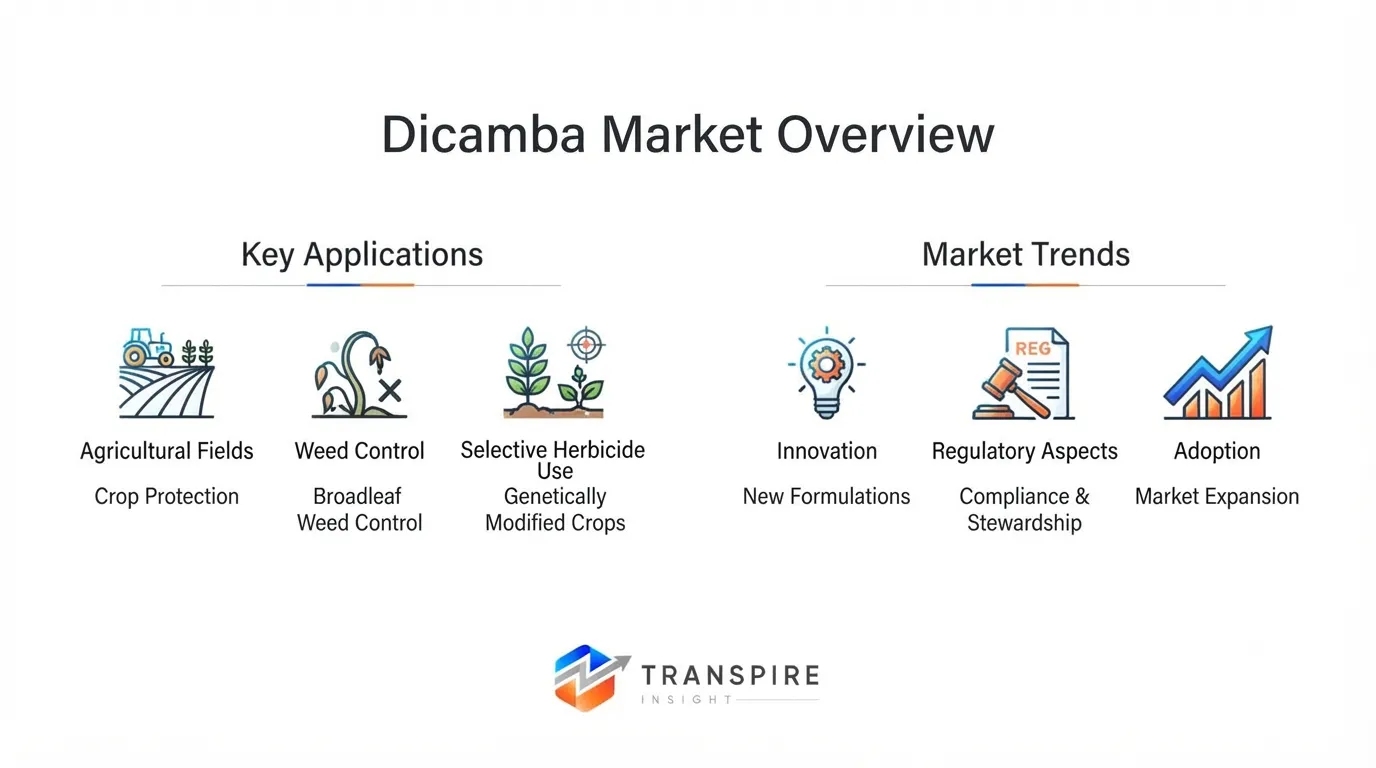
Agricultural producers are facing increasing pressure from difficult-to-control broadleaf weeds, herbicide resistance and the need to maintain crop productivity while improving application efficiency.
Dicamba continues to attract attention because of its effectiveness against a broad range of broadleaf weeds, particularly in soybean, cotton, corn and other crop-production systems.
September 2026: Dicamba is a selective systemic herbicide used to control annual and perennial broadleaf weeds.
It has become an important component of weed-management programs in several major agricultural markets.
Demand is influenced by crop acreage, weed resistance, adoption of herbicide-tolerant crop systems, regulatory conditions and developments in formulation technology.
At the same time, volatility and off-target movement concerns have increased pressure on manufacturers and growers to improve application practices.
Market Size
The global dicamba market was estimated at approximately USD 3.38 billion in 2025 and is projected to reach around USD 5.7 billion by 2035, expanding at a CAGR of approximately 5.4% during 2026–2035.
Current research estimates vary significantly. Some market studies place the market below USD 1 billion because they define it primarily around active-ingredient sales, while other estimates include broader dicamba-based herbicide products and related commercial applications. One current estimate places the market at USD 3.32 billion in 2025 and USD 5.59 billion by 2035.
Weed Resistance Supports Continued Demand
Herbicide resistance is one of the most important factors affecting dicamba demand.
Farmers are increasingly dealing with weed populations that have developed resistance to commonly used herbicides.
Dicamba offers a different mode of action and can be incorporated into integrated weed-management programs.
Its role is particularly important when farmers need to control broadleaf weeds that compete directly with crops for nutrients, water and sunlight.
However, reliance on a single herbicide can increase resistance risk, making rotation and integrated management increasingly important.
Soybean and Cotton Remain Important Crops
Soybean and cotton represent major application areas for dicamba.
Herbicide-tolerant crop systems have supported the adoption of dicamba-based weed-control programs in several markets.
The technology allows growers to manage weeds during crop development while protecting tolerant crop varieties.
North America therefore remains an important market because of its large soybean and cotton acreage.
Low-Volatility Formulations Are Becoming More Important
One of the most important areas of product development is formulation technology.
Concerns surrounding dicamba drift have encouraged manufacturers to develop formulations designed to reduce volatility and improve application control.
This trend is pushing the industry toward better formulation chemistry, improved application windows and more precise spraying systems.
Regulatory developments are likely to remain a major influence on future product adoption.
Precision Agriculture Could Improve Application Efficiency
Precision agriculture is creating opportunities to improve herbicide application.
GPS-guided equipment, variable-rate technology, field mapping and digital farm-management platforms allow growers to apply products more selectively.
The combination of dicamba formulations with precision application could help reduce unnecessary chemical use while maintaining weed-control performance.
Drone-based spraying and advanced field-monitoring systems could also contribute to more targeted applications where permitted by local regulations.
Corn and Other Crops Provide Additional Opportunities
Although soybean and cotton receive significant attention, dicamba can also be used in corn, cereals, pasture and other agricultural applications.
This diversification helps support demand across different crop-production systems.
The actual use pattern varies considerably by country because regulatory approvals, crop registrations and application requirements differ.
North America Maintains a Strong Position
North America remains the largest dicamba market.
Grand View Research estimates that North America represented approximately 48.7% of dicamba revenue in 2023.
The United States is particularly important because of its extensive soybean and cotton cultivation and established crop-protection industry.
However, regulatory decisions continue to affect market dynamics.
Asia Pacific is also an important long-term opportunity as agricultural productivity requirements increase and modern crop-protection products gain adoption.
Regulatory Conditions Remain a Critical Factor
Unlike many industrial chemicals, dicamba demand is strongly influenced by agricultural regulations.
Registration requirements, permitted crops, application timing and restrictions can differ between jurisdictions.
Manufacturers therefore need to balance product performance with regulatory compliance.
The industry is increasingly investing in formulation improvements and stewardship programs designed to support safer and more controlled application.
Competitive Landscape
The market includes large global agricultural chemical companies as well as regional manufacturers.
Bayer and BASF are among the leading participants, while Corteva, Nufarm, Albaugh, ADAMA, Syngenta and other companies maintain important positions.
Bayer has also continued developing its dicamba portfolio, while other manufacturers are investing in crop-protection formulations and precision agriculture technologies.
Top 10 Companies in Dicamba Market
1. Bayer AG
Headquarters: Leverkusen, Germany
Bayer is one of the most prominent participants in the dicamba market through its crop-science portfolio and dicamba-based weed-control systems.
2. BASF
Headquarters: Ludwigshafen, Germany
BASF provides crop-protection products and formulation technologies across global agricultural markets. Its broad portfolio gives it a strong position in weed-management solutions.
3. Corteva Agriscience
Headquarters: Indianapolis, Indiana, USA
Corteva develops crop-protection and seed technologies. Its weed-management portfolio supports growers across major row-crop markets.
4. Nufarm
Headquarters: Melbourne, Australia
Nufarm is a major agricultural chemical company with herbicide products serving farmers across multiple regions.
5. Albaugh
Headquarters: Ankeny, Iowa, USA
Albaugh specializes in crop-protection chemicals and supplies herbicide products to agricultural markets.
Outlook: Could Better Formulations and Precision Application Shape Dicamba's Future?
Dicamba is likely to remain an important weed-management product while the agricultural industry works to address herbicide resistance and improve crop productivity.
The future market will depend heavily on regulatory developments, formulation improvements and adoption of precision agriculture.
Low-volatility products, improved application equipment and integrated weed-management programs could support continued demand.
At the same time, manufacturers will need to demonstrate stronger stewardship and environmental performance.
The next stage of dicamba market development will therefore be defined not simply by volume growth, but by the industry's ability to combine weed-control effectiveness with greater application precision and regulatory compliance.


Send us a brief description of your challenge and we'll get back to you within 24 hours.

 inquiry@transpireinsight.com
 APAC:+91 7666513636
 Address


