
Aug 17, 2026
By Transpire Insight
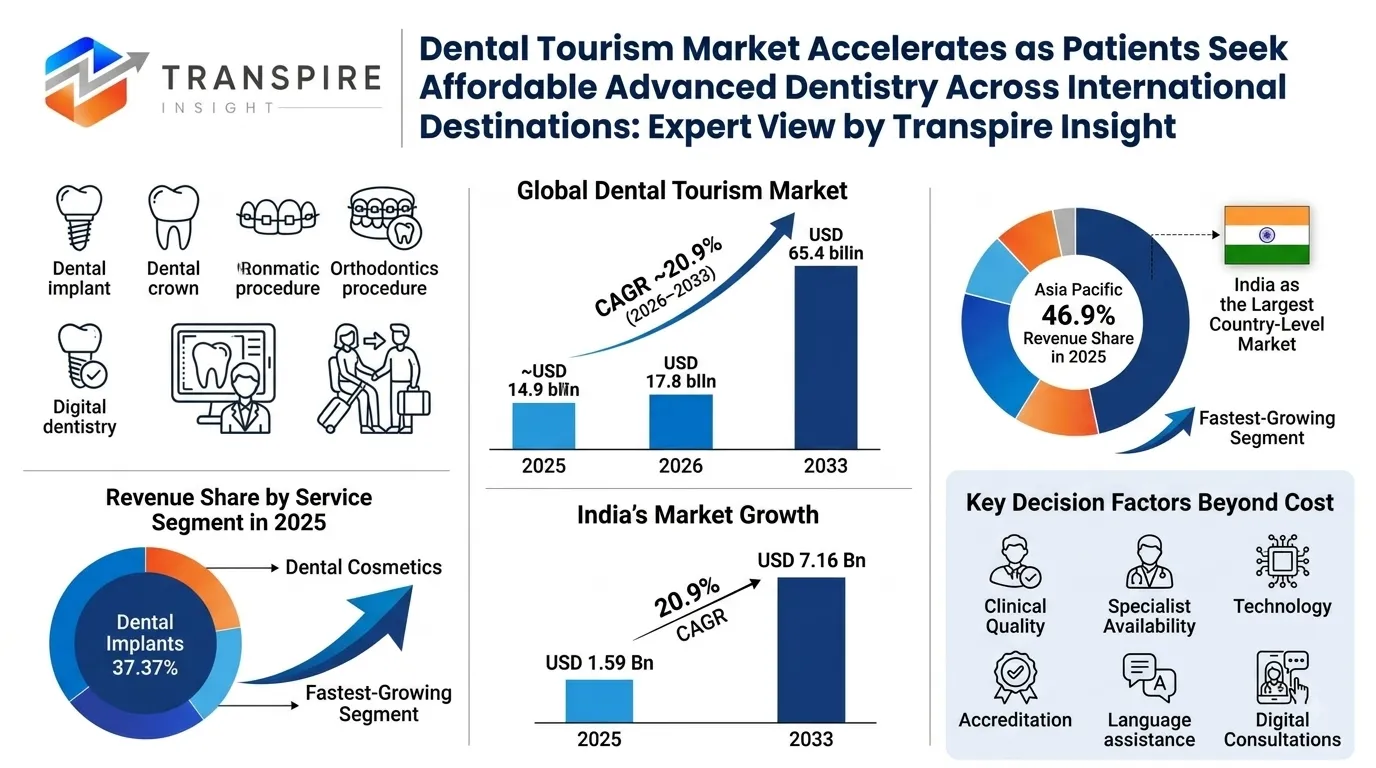
According to Transpire Insight, a detailed research analysis of the global dental tourism market reflects that the industry is entering a high-growth phase as patients increasingly travel internationally to obtain dental implants, orthodontic procedures, cosmetic dentistry, and other specialized treatments at comparatively lower costs. The global dental tourism market was valued at approximately USD 14.9 billion in 2025 and is projected to reach around USD 17.8 billion in 2026, before expanding to approximately USD 65.4 billion by 2033, representing a CAGR of approximately 20.9% during 2026–2033. Asia Pacific dominated the global market with approximately 46.9% revenue share in 2025, while India represented the largest country-level market in the same year.
The global healthcare industry is undergoing a significant transformation as patients increasingly compare treatment costs, clinical expertise, waiting periods, technology availability, and overall patient experience before selecting a dental provider. Dental tourism has developed as a specialized segment within international healthcare travel, connecting dental clinics and hospitals with patients who are willing to cross national borders for treatment.
The industry is no longer driven exclusively by low treatment costs. International patients are increasingly evaluating clinical quality, specialist availability, advanced diagnostic equipment, implant technology, accreditation, treatment timelines, accommodation, transportation, language assistance, and post-treatment support when selecting a destination.
The growing availability of digital consultations is further changing the patient journey. Individuals can increasingly share dental records, diagnostic images, and treatment requirements with overseas clinics before travelling, allowing providers to prepare preliminary treatment plans and cost estimates in advance.
Dental Tourism Bets on the Future of International Dental Care
For decades, patients generally selected dental providers within their local communities. Rising treatment costs, limited availability of specialized procedures, long waiting periods, and increasing international connectivity have gradually changed this behavior.
Dental tourism enables patients to combine healthcare with international travel while potentially reducing the overall cost of expensive procedures. The model is particularly attractive for treatments such as dental implants, crowns, bridges, orthodontics, veneers, and cosmetic procedures, where price differences between developed and emerging healthcare markets can be substantial.
Dental implants represented the largest service segment in 2025, accounting for approximately 37.37% of global dental tourism revenue. Dental cosmetics is expected to record the fastest growth during the forecast period as consumers increasingly seek aesthetic procedures alongside functional dental treatment.
The increasing sophistication of dental technology is also strengthening destination competitiveness. Digital impressions, CAD/CAM systems, 3D imaging, computer-guided implantology, digital smile design, laser dentistry, and advanced prosthetic materials enable international clinics to offer treatments that increasingly resemble those available in high-income markets.
This technological convergence is reducing the traditional perception that patients must choose between affordability and advanced dental care.
Download the exclusive Dental Tourism Market sample report today to uncover expert insights, emerging trends, and the opportunities defining the future of the industry.
Why the Dental Tourism Market Matters
The dental tourism market has become strategically important because dental care is frequently associated with high out-of-pocket expenditure, particularly for elective, restorative, and cosmetic procedures.
Patients from countries with relatively high dental costs can evaluate overseas treatment when the combined cost of treatment, travel, accommodation, and related services remains attractive compared with domestic private-care expenses.
Recent U.S. data illustrates the scale of this behavior. A 2026 report from the CareQuest Institute for Oral Health found that approximately 9.6 million American adults had travelled abroad for dental care, representing roughly 4% of adults in the nationwide survey sample.
The economic impact extends beyond dental clinics. International dental patients generate demand for hotels, airlines, travel agencies, transportation providers, translators, insurance services, medical facilitators, pharmaceutical suppliers, dental laboratories, and hospitality businesses.
This makes dental tourism an interconnected healthcare and tourism ecosystem rather than a standalone dental-service market.
Competitive Analysis
The competitive landscape of dental tourism consists of specialized dental clinics, multispecialty hospitals, dental hospital networks, international patient departments, and healthcare facilitators.
Key companies and healthcare providers identified within the market include Franco-Vietnamese Hospital, Apollo Hospitals Enterprise Ltd., Fortis Healthcare, Clove Dental, Medlife Group, Raffles Medical Group, Oris Dental Centre, and Dubai Dental Hospital, among others.
Competition is increasingly moving beyond treatment price. Dental tourism providers must demonstrate clinical expertise, modern infrastructure, internationally recognized equipment, transparent pricing, convenient scheduling, multilingual communication, and dependable post-treatment support.
The provider structure also remains important. Dental clinics represented approximately 48.76% of the global market in 2025, making them the largest provider segment. Hospitals, however, are expected to be the fastest-growing provider category as international patients increasingly seek comprehensive healthcare environments capable of managing complex cases and multiple specialties.
Large hospital groups have an additional advantage because they can combine dental treatment with diagnostics, surgery, accommodation assistance, international-patient coordination, and other healthcare services.
Financial Impact
The financial implications of dental tourism extend across healthcare providers and the broader travel economy.
India represents an especially significant opportunity. India's dental tourism market generated approximately USD 1.59 billion in revenue in 2025 and is projected to reach approximately USD 7.16 billion by 2033, representing a CAGR of 20.9%. Dental implants represented India's largest service segment in 2025, while dental cosmetics is expected to be its fastest-growing service category.
The financial opportunity also extends to dental equipment manufacturers and implant companies. International patients often require multiple components, including implants, abutments, crowns, prosthetics, imaging, laboratory services, and follow-up care.
Consequently, growth in dental tourism can generate a multiplier effect throughout the dental healthcare supply chain.
Dental Implants Become the Core Growth Engine
Dental implants have become one of the most commercially important procedures within dental tourism because they are relatively expensive in many developed markets and require specialized clinical expertise.
The dental implant segment represented approximately 37.37% of global dental tourism revenue in 2025, making it the largest service category.
The procedure is particularly suited to international treatment models because patients can combine diagnostic assessment, implant placement, prosthetic work, and follow-up visits into planned treatment journeys.
However, implant treatment also creates challenges for dental tourism providers because complex cases may require multiple clinical stages. Bone grafting, sinus augmentation, healing periods, temporary restorations, and final prosthetic placement can extend the treatment timeline.
This has encouraged providers to develop structured international-patient programs that include pre-travel consultations, digital diagnostics, treatment planning, coordinated appointments, accommodation support, and post-treatment communication.
The global dental implant industry is also experiencing strong underlying demand. Straumann reported in 2025 that approximately 220 million people annually could afford implants, while only around 17 million undergo implant treatment, illustrating the large potential gap between affordability and actual treatment adoption.
Proceed to Checkout to purchase the exclusive Dental Tourism Market report and gain instant access to in-depth market intelligence, strategic analysis, and future growth opportunities.
Cosmetic Dentistry Reshapes Patient Demand
Dental tourism is increasingly influenced by the growing overlap between oral healthcare and aesthetic medicine.
Veneers, teeth whitening, smile design, orthodontics, aligners, crowns, and other cosmetic treatments have become important components of international dental travel. Social media and visual platforms have increased awareness of aesthetic dentistry, while improvements in digital smile design allow patients to preview potential outcomes before treatment.
The growth of cosmetic dentistry also changes the demographic profile of dental tourists. Demand is no longer limited to older patients seeking restorative procedures. Younger consumers are increasingly considering orthodontic and cosmetic treatments that can improve appearance and confidence.
Dental cosmetics is identified as the fastest-growing service segment in the global dental tourism market.
This trend is encouraging clinics to invest in digital imaging, CAD/CAM workflows, minimally invasive cosmetic techniques, and personalized treatment planning.
At the same time, the market is becoming more quality-conscious. Patients are increasingly looking beyond attractive treatment packages and evaluating dentist qualifications, materials, laboratory standards, clinical reviews, accreditation, and long-term treatment outcomes.
Asia Pacific Takes the Lead
Asia Pacific has emerged as the leading regional market for dental tourism.
The region accounted for approximately 46.9% of global dental tourism revenue in 2025, supported by strong dental-care infrastructure and the presence of established destinations including India, Thailand, and Malaysia.
India has become particularly important because of its combination of specialist availability, relatively competitive treatment costs, English-language capability, advanced private healthcare infrastructure, and growing international-patient services.
India's dental tourism market is expected to increase from approximately USD 1.59 billion in 2025 to USD 7.16 billion by 2033, representing a 20.9% CAGR.
Thailand and Malaysia also benefit from established medical-tourism ecosystems, while Japan is developing opportunities around technologically advanced dental procedures.
The broader Asia Pacific advantage is supported by a combination of comparatively lower labor costs, increasing healthcare investment, modern private hospitals, international airports, and growing tourism infrastructure.
India Strengthens Its Position as a Dental Tourism Destination
India is increasingly positioned as a major destination for international dental patients.
The country's dental tourism industry benefits from a large pool of dental professionals, expanding private healthcare infrastructure, relatively competitive treatment costs, and growing adoption of advanced dental technologies.
Large healthcare networks and dedicated dental chains are also strengthening the organized-provider segment.
For example, Clove Dental currently reports 715+ clinics across 31+ cities, more than 1,700 dentists, over 30 lakh patients, and more than 55,000 implants across its network.
Large hospital groups are also strengthening India's international healthcare ecosystem. Apollo Hospitals currently reports 75 hospitals, 13,000+ doctors, 520+ clinics, and 2,700+ diagnostic centers, providing a broad infrastructure that can support international healthcare journeys.
These networks can provide international patients with a broader range of services, including diagnostics, specialist consultations, dental procedures, accommodation coordination, and post-treatment support.
Digital Technology Changes the Dental Tourism Journey
Technology is transforming how international patients discover, evaluate, and receive dental care.
Digital consultations can allow patients to communicate with dentists before travelling, share X-rays or scans, discuss treatment options, and receive preliminary cost estimates.
Advanced imaging is also becoming increasingly important. Cone-beam computed tomography, intraoral scanning, digital radiography, and CAD/CAM workflows can improve treatment planning and allow providers to prepare prosthetic components more efficiently.
Artificial intelligence is beginning to add another layer to this transformation by supporting image analysis, treatment planning, patient communication, appointment management, and administrative processes.
The result is a more digitally connected patient journey in which the treatment process can begin before the patient boards an aircraft.
Major Dental Tourism Destinations Compete on More Than Price
Countries such as India, Thailand, Malaysia, Turkey, Hungary, Mexico, and the United Arab Emirates have developed strong positions in different areas of dental tourism.
Turkey, for example, has attracted international patients through competitive pricing and a large private healthcare and cosmetic-treatment ecosystem. The country received approximately 1.8 million healthcare tourists in 2023, generating around USD 3.1 billion in healthcare-tourism revenue, according to reporting on the sector.
Mexico benefits from geographical proximity to the United States, making it particularly attractive to American dental tourists.
Hungary has established a reputation for European dental care, while Thailand and Malaysia benefit from mature medical-tourism infrastructure.
The competitive advantage of destinations is therefore determined by multiple factors: treatment price, clinical reputation, specialist availability, travel accessibility, technology, language support, regulation, hospitality, and patient experience.
Market Impact: Dental Care Becomes an International Service Industry
The expansion of dental tourism is changing the structure of the global dental-services industry.
Dental providers are increasingly competing internationally for patients rather than relying exclusively on local demand. This is encouraging investments in modern clinics, international-patient departments, multilingual websites, digital consultations, treatment packages, and partnerships with hotels and travel operators.
The impact extends across dentistry, medical tourism, hospitality, aviation, travel management, dental laboratories, implant manufacturing, medical devices, healthcare insurance, and digital health platforms.
The market's projected expansion to approximately USD 65.4 billion by 2033 indicates that cross-border dental care is becoming a significant healthcare-services opportunity rather than a niche travel segment.
However, long-term market development will depend on maintaining clinical quality and patient safety. Cost advantages can attract patients initially, but treatment outcomes, transparency, ethical marketing, and reliable follow-up care will determine whether destinations retain international patient trust.
Customize the exclusive Dental Tourism Market report today to receive tailored insights, country-specific analysis, and business-focused market intelligence.
The Key Players Shaping the Dental Tourism Market
Founded In: 1983
Headquarters: Chennai, India
Apollo Hospitals has developed one of India's largest integrated healthcare networks and maintains dedicated international-patient capabilities. Its network currently includes 75 hospitals, more than 13,000 doctors, 520+ clinics, and 2,700+ diagnostic centers, creating a broad infrastructure for international healthcare services.Apollo's international-patient model includes treatment coordination, specialist consultations, travel assistance, accommodation support, airport transfers, and post-treatment services. Its scale allows the group to connect dental services with broader diagnostic and specialist capabilities, an advantage for international patients requiring multidisciplinary treatment.
Founded In: 1996
Headquarters: Gurugram, India
Fortis Healthcare is an integrated healthcare provider operating hospitals, diagnostics, and specialty facilities across India. The company currently reports 36 healthcare facilities across 12 states, more than 6,000 operational beds, 17,900+ healthcare professionals, and 400 diagnostic laboratories. Its large clinical infrastructure supports international healthcare delivery and provides opportunities for patients seeking dental care alongside other medical services.
Founded In: 2011
Headquarters: New Delhi, India
Clove Dental represents the organized dental-clinic model within the Indian market. The company currently reports 715+ clinics across 31+ cities and more than 1,700 dentists. It also reports more than 30 lakh patients, 55,000+ implants, 7,800+ dentures, and 2 lakh crowns across its network. Its large network provides international and domestic patients with access to multiple dental specialties and standardized clinic infrastructure.
Headquarters: Dubai, United Arab Emirates
Dubai Dental Hospital operates as part of Dubai Health and describes itself as the first dedicated dental hospital in Dubai. The hospital provides seven dental specialties under one facility, including endodontics, orthodontics, periodontics, prosthodontics, oral and maxillofacial surgery, and pediatric dentistry. Its dedicated dental-hospital structure supports Dubai's broader ambition to position itself as an international healthcare destination by combining specialized clinical services with the city's established tourism and hospitality infrastructure.
Schedule a meeting with our market experts to discuss the exclusive Dental Tourism Market report and identify the best research solution for your organization.
Transpire Insight Experts View
According to Transpire Insight analysis, the global dental tourism market is moving beyond a simple “low-cost treatment abroad” model toward a more sophisticated international healthcare ecosystem.
The strongest destinations will increasingly compete through a combination of clinical expertise, advanced technology, transparent pricing, treatment coordination, international accreditation, patient experience, and post-treatment continuity.
Asia Pacific's 46.9% revenue share in 2025 gives the region a strong starting position, while India's projected growth from USD 1.59 billion in 2025 to USD 7.16 billion by 2033 demonstrates the potential of emerging healthcare destinations.
Transpire Insight believes that the next phase of competition will be determined less by headline treatment prices and more by the ability of providers to deliver predictable clinical outcomes within a seamless international patient journey.
As digital dentistry, implant technology, cosmetic procedures, AI-assisted diagnostics, and international healthcare coordination continue to advance, dental tourism is expected to become an increasingly important component of the global healthcare-services economy.


Send us a brief description of your challenge and we'll get back to you within 24 hours.

 inquiry@transpireinsight.com
 APAC:+91 7666513636
 Address


