
Oct 13, 2026
By Transpire Insight
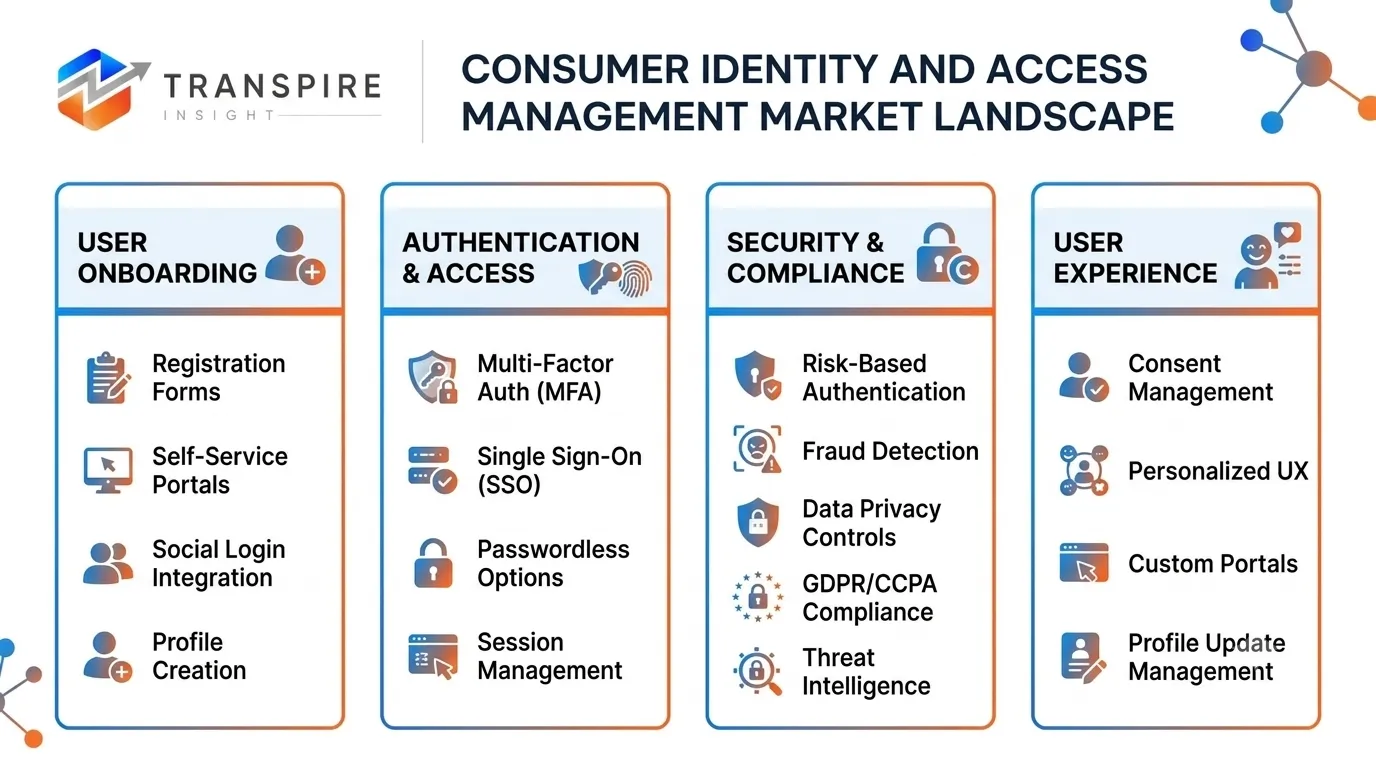
The Consumer Identity and Access Management Market is becoming a critical component of digital customer experience as organizations manage millions of identities across websites, applications, mobile platforms, APIs, connected devices, and emerging AI-agent interactions. Passkeys, identity verification, adaptive authentication, fraud prevention, profile consolidation, and privacy management are reshaping customer identity infrastructure.
Consumer Identity and Access Management Market Overview
Consumer Identity and Access Management (CIAM) refers to technologies that allow businesses to securely manage customer identities while providing convenient access to digital services.
CIAM platforms typically support:
Transpire Insight estimates the global Consumer Identity and Access Management Market at approximately USD 9.72 billion in 2025, increasing to around USD 10.78 billion in 2026 and reaching approximately USD 21.35 billion by 2033, representing an estimated CAGR of 10.27%.
Latest Global Market Developments
Forrester's 2026 CIAM research identifies AI agents as an emerging identity type that CIAM systems increasingly need to manage.
Password replacement through device-bound credentials, password managers, and cloud-synchronized passkeys is becoming increasingly established in consumer identity environments.
Digital businesses increasingly need to distinguish legitimate customers from fraudulent accounts, bots, synthetic identities, and automated attacks.
Companies are attempting to build unified customer profiles across applications, websites, mobile platforms, and channels.
Generative AI can support personalized interactions, automated assistance, and new digital customer journeys, but these systems also require secure identity controls.
Gartner reported that 56% of CISOs increased IAM budgets in 2026 compared with 2025, reflecting the growing strategic importance of identity security.
Businesses must manage consent, customer data, authentication, and privacy requirements across different jurisdictions.
Recent research on enterprise AI access demonstrates that organizations can have formal AI-access policies while still experiencing unauthorized or excessive access, reinforcing the need for real-time identity and authorization controls.
Why Consumer Identity and Access Management Matters?
Digital identity is increasingly part of the customer experience itself.
An effective CIAM platform can help organizations achieve:
The strategic challenge is balancing security with convenience.
Key Factors Driving the Market
1. Digital Customer Growth
More products and services are delivered through digital channels, increasing the number of consumer identities businesses must manage.
2. Cybersecurity Threats
Account takeover, credential theft, bots, and identity fraud are encouraging stronger authentication.
3. Passkey Adoption
Passwordless authentication can reduce dependence on vulnerable password-based access.
4. AI-Based Customer Experiences
AI assistants and agents create new identity and authorization requirements.
5. Privacy Requirements
Organizations increasingly need integrated identity, consent, and customer-data governance.
Five High-Potential Markets
1. United States
The U.S. remains a major CIAM market due to its large digital economy, extensive SaaS ecosystem, financial-services industry, and cybersecurity investment.
2. United Kingdom
The U.K. provides strong opportunities across banking, e-commerce, government services, and digital platforms.
3. Germany
Germany's industrial, financial, and enterprise technology sectors create demand for secure customer-facing digital services.
4. India
India represents an important growth market because of rapid digital-service adoption, large online populations, and increasingly sophisticated identity-security requirements.
5. Japan
Japan offers opportunities across financial services, telecommunications, retail, and digital consumer platforms.
Competitive Landscape
Top 5 Companies
Opportunities for Small Investors
Challenges & Restraints
Complex integration, legacy applications, privacy requirements, customer-experience concerns, cybersecurity threats, identity fraud, and implementation costs can slow adoption.
The rapid emergence of AI agents also creates new authorization challenges because organizations must increasingly distinguish between human customers, applications, automated agents, and autonomous AI systems.
Conclusion
The Consumer Identity and Access Management Market is evolving from conventional login infrastructure into a broader digital trust and customer-interaction platform.
Forrester's 2026 research highlights three particularly important shifts: growing CIAM investment, broader identity verification, and the emergence of AI agents as a new identity type.
Future market opportunities will increasingly center on passkeys, adaptive authentication, AI-agent authorization, identity verification, privacy management, and unified customer profiles.


Send us a brief description of your challenge and we'll get back to you within 24 hours.

 inquiry@transpireinsight.com
 APAC:+91 7666513636
 Address


