
Oct 06, 2026
By Transpire Insight
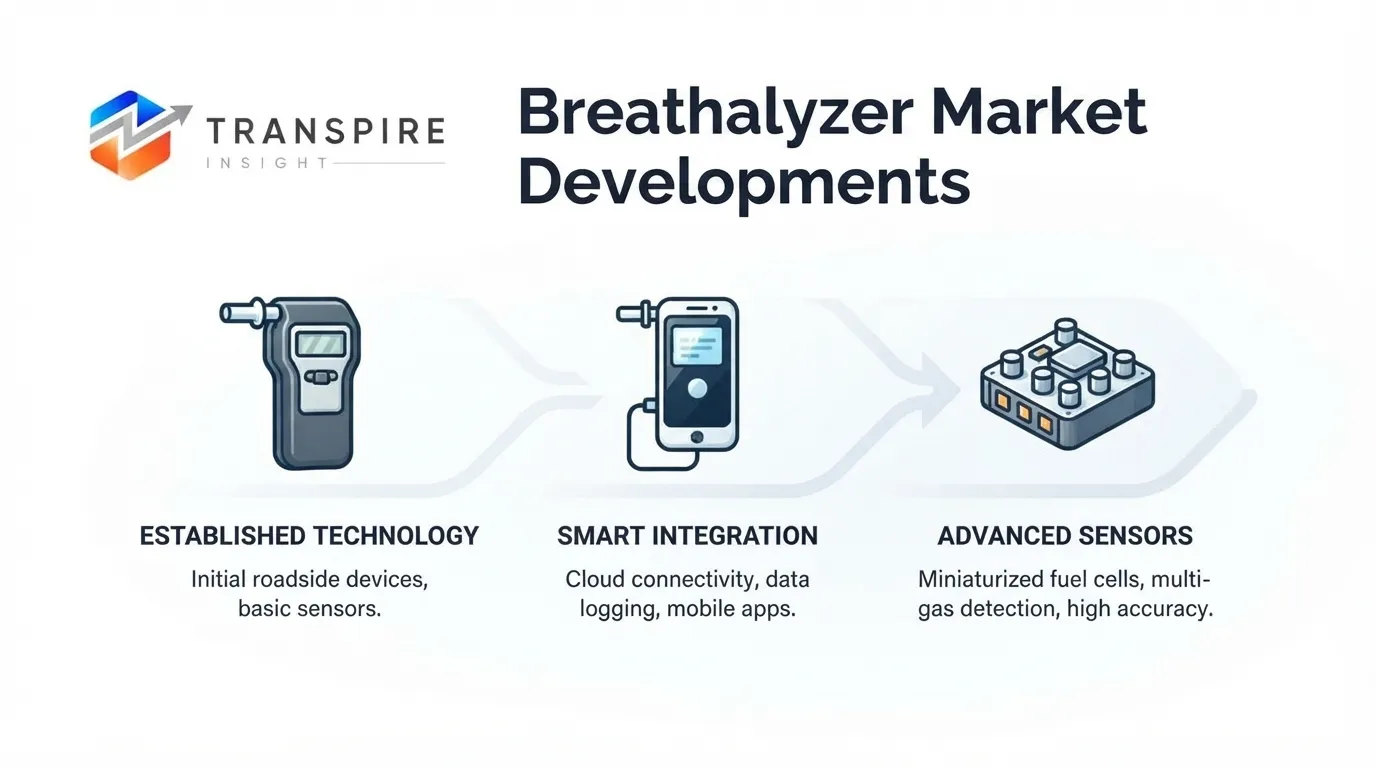
Breathalyzers are becoming increasingly important tools for alcohol screening as governments, law-enforcement agencies, transportation operators, employers, and consumers seek faster and more portable methods of measuring breath alcohol concentration. Modern devices are moving beyond basic handheld testers toward fuel-cell sensors, wireless connectivity, digital data storage, passive screening, smartphone integration, and vehicle-interlock systems.
The evolution of breathalyzer technology is also expanding its role beyond roadside enforcement. Mining, manufacturing, logistics, aviation, construction, healthcare, rehabilitation programs, and commercial transportation are increasingly relevant application areas. As organizations place greater emphasis on workplace safety and compliance, manufacturers are developing devices capable of rapid testing, secure data management, repeated measurements, and integration with broader safety systems.
September 2026: The global Breathalyzer Market is entering a more connected and technology-driven phase as demand grows for portable, reliable, and digitally integrated alcohol-testing systems. Modern breathalyzers can incorporate electrochemical fuel-cell sensors, semiconductor sensors, infrared analysis, Bluetooth connectivity, GPS, internal memory, wireless printing, passive screening, and vehicle-interlock functionality. The market is therefore evolving from conventional standalone testing instruments toward connected alcohol-monitoring ecosystems.
Market Size
According to Transpire Insight, the global Breathalyzer Market was valued at approximately USD 1.77 billion in 2025 and is projected to reach approximately USD 3.55 billion by 2033, expanding at a CAGR of 9.1% from 2026 to 2033. The market includes fuel-cell, semiconductor, infrared, portable, smartphone-connected, and passive breathalyzers used across law enforcement, workplace safety, personal monitoring, healthcare, transportation, and other applications.
The expansion of the market is closely connected with road-safety initiatives, workplace alcohol-testing programs, stricter compliance requirements, increased use of portable testing equipment, and the development of digitally connected devices. Asia Pacific is also becoming an important growth area as governments, transportation organizations, industrial companies, and healthcare institutions expand the use of alcohol-detection technologies.
Road Safety Remains a Major Demand Driver
Road safety is one of the most established applications for breathalyzer technology. Law-enforcement agencies use breath alcohol testing as an initial screening method during roadside operations, while evidential systems can provide more advanced measurements where regulatory requirements permit.
The need for rapid testing has encouraged manufacturers to develop devices that can perform measurements within seconds and store multiple test records. Dräger's professional Alcotest portfolio, for example, includes devices designed for rapid roadside and professional testing, while its Alcotest 5000 can perform high-speed alcohol presence testing without physical contact between the device and the subject.
As road authorities increase enforcement and expand roadside screening, portable breathalyzers remain an important component of traffic-safety programs.
Fuel-Cell Technology Is Strengthening Professional Testing
Fuel-cell breathalyzers represent an important technology category because electrochemical sensors can provide selective alcohol detection and are widely used in professional-grade instruments.
Alcolizer Technology describes fuel-cell technology as a core component of modern breathalyzers and highlights its use in applications requiring accuracy and durability, including law enforcement and workplace safety.
BACtrack also uses electrochemical fuel-cell sensors in its professional and consumer products. Its smartphone-connected models combine fuel-cell sensing with Bluetooth connectivity and mobile applications.
Fuel-cell technology is particularly important where repeated testing, stable performance, and lower susceptibility to certain interfering substances are required.
Semiconductor Sensors Support Affordable Portable Devices
Semiconductor-based breathalyzers provide another important technology segment. These devices can offer compact designs and relatively lower costs, making them relevant to personal-use products and some screening applications.
The lower cost of semiconductor sensors can make portable alcohol testing more accessible, particularly in consumer markets. However, sensor performance, calibration, environmental conditions, and potential cross-sensitivity need to be considered when selecting devices for specific applications.
BACtrack maintains both semiconductor and fuel-cell products across its portfolio, illustrating how different sensor architectures continue to serve different consumer and professional requirements.
The availability of different sensor technologies is helping the market address a broad spectrum of applications rather than relying on a single device architecture.
Infrared Technology Supports Evidential Applications
Infrared analysis is another technology used in advanced breath alcohol testing. Infrared systems can analyze breath samples using optical measurement techniques and are particularly relevant to sophisticated evidential instruments.
Dräger's Alcotest 9510, for example, uses dual sensor technology incorporating infrared and electrochemical sensing and is designed for evidential breath alcohol testing. Dräger states that the system conforms to the international OIML R 126 standard and incorporates functions for detecting mouth alcohol and interfering substances.
The use of multiple sensing technologies in professional instruments demonstrates the industry's emphasis on measurement integrity and traceability for applications where test results may have legal or regulatory consequences.
Portable Breathalyzers Are Expanding Beyond Police Departments
Portability has become a central feature of the Breathalyzer Market. Compact devices allow testing to take place in locations where larger systems would be impractical.
Professional portable breathalyzers are used by police departments, workplaces, industrial operators, transport organizations, correctional facilities, and healthcare programs.
Dräger's Alcotest 6000, for example, is a portable professional device capable of storing up to 500 tests and is designed for rapid breath alcohol measurement.
Lion Laboratories also develops portable professional breath alcohol instruments for law enforcement, industrial environments, healthcare, mining, logistics, manufacturing, and other applications. Its Alcolmeter 900 includes optional wireless connectivity and integrated GPS.
These capabilities are transforming portable breathalyzers into data-enabled safety tools rather than simple measurement devices.
Smartphone-Connected Breathalyzers Are Creating a Consumer Technology Segment
The integration of smartphones is one of the most visible developments in personal breathalyzer technology.
Bluetooth-enabled devices can transfer test results to mobile applications, allowing users to view readings, track historical measurements, and access additional digital functions.
BACtrack's smartphone breathalyzers provide Bluetooth connectivity and compatibility with mobile applications. The company's Mobile Pro uses an electrochemical fuel-cell sensor and can transmit results to iOS and Android devices.
BACtrack also provides a software development kit that allows developers to integrate its breathalyzer technology into applications and digital platforms. The company reports that its smartphone-connected customer base generates more than 50,000 readings each month.
This creates opportunities for breathalyzer technology to become part of broader personal safety and digital-health ecosystems.
Workplace Safety Is Becoming an Important Application
Workplace alcohol testing is increasingly relevant in industries where impairment could create serious safety risks.
Mining, construction, petrochemicals, manufacturing, aviation, shipping, warehousing, and commercial transportation can involve heavy machinery, vehicles, elevated work areas, or hazardous processes. Organizations operating in these environments may use breath alcohol screening as part of broader workplace safety and compliance programs.
Lion Laboratories specifically identifies mining, steelmaking, petrochemical, construction, manufacturing, prisons, warehousing, logistics, shipping, and aviation among the sectors using its breath alcohol screening instruments.
This diversification is increasing the addressable market beyond traditional traffic enforcement.
Alcohol Ignition Interlocks Are Connecting Breathalyzers With Vehicles
Alcohol ignition interlocks represent a specialized but important application of breath alcohol sensing.
These systems require a driver to provide a breath sample before a vehicle can be started. If alcohol above a programmed threshold is detected, the system can prevent vehicle operation.
Alcohol Countermeasure Systems develops ALCOLOCK systems for commercial, automotive, compliance, and monitoring applications. Its ALCOLOCK V3 can be installed in trucks, ships, trains, and heavy machinery and is designed to test breath alcohol before vehicle operation.
The ALCOLOCK L series incorporates dual electrochemical sensing, event logging, and anti-circumvention features.
Such systems demonstrate how breathalyzer technology can evolve from measurement into active safety intervention.
Connected Data and Digital Record-Keeping Are Reshaping Professional Testing
Professional organizations increasingly require more than a single numerical result. They may need timestamps, user identification, GPS information, calibration records, test histories, and secure data transfer.
Manufacturers are therefore incorporating Bluetooth, wireless printing, internal memory, GPS, and software connectivity into professional devices.
Honeywell's AlcoQuant 6020 Plus, for example, includes data storage for up to 9,999 measurements, date and time recording, PC software for statistical analysis and data transfer, and an electrochemical sensor.
This type of functionality can help organizations create more structured alcohol-testing records and integrate breathalyzer results into existing compliance procedures.
Passive Breathalyzers Improve High-Volume Screening
Passive testing is becoming increasingly useful where large numbers of people need to be screened rapidly.
Unlike active testing, passive systems can detect alcohol without requiring the subject to blow directly into a mouthpiece in some configurations. This can improve speed and reduce contact during high-volume screening.
Dräger's Alcotest 5000 is designed for professional alcohol presence detection and can perform up to 12 tests per minute using a contactless funnel.
Lion Laboratories also offers instruments capable of passive and active testing. Its Alcolmeter 600 can be used in roadblock operations and other situations requiring screening of large numbers of people.
These systems can be valuable in transportation hubs, industrial facilities, events, and large-scale law-enforcement operations.
Calibration and Sensor Reliability Remain Critical
Breathalyzers depend heavily on sensor stability and calibration. Professional users need confidence that measurements remain consistent across different environmental conditions and over extended periods.
Temperature, humidity, contamination, mouth alcohol, sensor aging, and improper maintenance can affect measurements. Consequently, calibration and service infrastructure represent important components of the overall market.
Honeywell's E100A ethanol sensor is designed for professional handheld breathalyzers and uses an electrochemical fuel-cell principle. Honeywell states that the sensor is designed for reliable signal quality, durability, low sensor drift, and compliance with international requirements including EN15964 and AS3547.
Honeywell also develops E100C sensors for vehicle-interlock applications and specifies operating conditions designed for demanding automotive environments.
As breathalyzer deployment expands, calibration services and sensor replacement will remain important recurring components of the industry.
Healthcare and Rehabilitation Programs Are Expanding the Addressable Market
Healthcare and rehabilitation programs represent additional application areas for breath alcohol testing.
Hospitals, rehabilitation centers, treatment programs, and healthcare organizations may use alcohol testing as part of specific monitoring or assessment procedures. These applications generally require devices that are easy to operate, hygienic, portable, and capable of maintaining reliable records.
Honeywell identifies occupational safety, roadside testing, and rehabilitation programs among the applications for its AlcoQuant breath alcohol analyzers.
The expansion of healthcare and rehabilitation applications provides an additional pathway for professional breathalyzer adoption.
Regional Outlook
North America
North America represents a major market for breathalyzer technology because of established law-enforcement testing programs, workplace safety requirements, alcohol ignition interlock systems, and consumer demand for portable devices.
The United States and Canada have mature ecosystems covering professional breath alcohol testing, ignition interlocks, personal breathalyzers, and monitoring systems.
The presence of companies such as BACtrack, Lifeloc Technologies, Intoximeters, Abbott, and Alcohol Countermeasure Systems supports the region's broad industry base. Transpire Insight includes the United States, Canada, and Mexico within its North American market coverage.
Consumer smartphone-connected devices are also contributing to the regional market by combining breathalyzer hardware with mobile applications and digital tracking.
Europe
Europe has an established professional breathalyzer industry supported by road-safety programs, industrial testing, transportation safety, and regulatory requirements.
Germany, the United Kingdom, France, Italy, and Spain are important markets. Companies such as Dräger and Lion Laboratories contribute to the region's manufacturing and technology ecosystem.
Dräger's product portfolio includes professional screening devices, evidential breath testers, and personal breathalyzers, demonstrating the breadth of applications across the European market.
European standards such as EN15964 and other national requirements also influence product development and certification.
Asia Pacific
Asia Pacific is becoming an increasingly important growth region for breathalyzer technology because of expanding transportation networks, industrialization, road-safety initiatives, workplace safety programs, and rising adoption of digital testing equipment.
China, Japan, South Korea, India, and Australia represent important markets within the region.
India is particularly significant because of the growing deployment of breath analyzers by government authorities and enterprises. IMARC reported that India's breath analyzer market reached USD 328.3 million in 2025 in its May 2026 assessment.
Australia also has an established breath-testing ecosystem, particularly across road safety and workplace testing, supported by local manufacturers such as Alcolizer and international suppliers.
Latin America
Latin America represents an expanding opportunity as governments and transportation authorities increase road-safety enforcement.
Brazil, Argentina, Mexico, and other markets are potential demand centers for portable breathalyzers used in law enforcement and commercial transportation.
Affordability, calibration infrastructure, local regulatory requirements, and distribution networks remain important factors influencing market adoption.
Middle East & Africa
The Middle East & Africa region is developing opportunities through transportation safety, industrial workplace testing, logistics, mining, and security applications.
The presence of major infrastructure projects and industrial operations creates demand for occupational safety technologies, including alcohol screening.
The market remains diverse, with adoption influenced by local regulations, workplace policies, healthcare infrastructure, and purchasing capacity.
Competitive Landscape
The Breathalyzer Market includes global medical and safety-technology companies, specialized breath alcohol manufacturers, consumer electronics brands, sensor developers, and vehicle-interlock providers.
Competition is increasingly centered on sensor accuracy, measurement speed, calibration intervals, durability, connectivity, data management, portability, and regulatory certification.
Professional products are becoming more connected, while consumer products are becoming smaller and more smartphone-oriented. Meanwhile, ignition interlock systems are extending breath alcohol sensing into vehicle-control applications.
Manufacturers are also developing passive testing systems, wireless data transfer, GPS functionality, digital event logs, and cloud-connected monitoring capabilities.
Top 10 Companies in the Breathalyzer Market
These companies represent different portions of the market, including professional law-enforcement equipment, personal breathalyzers, workplace testing, sensor technology, and alcohol ignition interlock systems. Transpire Insight identifies these companies among the key organizations profiled in its global Breathalyzer Market coverage.
Company Profiles
1. Dräger
Dräger is one of the most established companies in professional breath alcohol testing. Its Alcotest portfolio includes personal, professional, passive, and evidential breath alcohol devices.
The Alcotest 6000 provides rapid professional testing with internal data storage, while the Alcotest 5000 is designed for high-speed contactless alcohol screening.
Dräger also offers evidential systems such as the Alcotest 9510, which combines infrared and electrochemical sensing and is designed for applications requiring court-admissible testing.
2. BACtrack
BACtrack focuses on personal and professional breathalyzers, with a strong emphasis on fuel-cell technology and smartphone connectivity.
Its Mobile Pro uses an electrochemical fuel-cell sensor and Bluetooth communication with mobile devices.
The company also provides a software development kit that allows developers to integrate breathalyzer readings into smartphone applications and digital platforms.
This combination of hardware, mobile software, and connected monitoring positions BACtrack across both consumer and professional applications.
3. Lifeloc Technologies
Lifeloc Technologies specializes in breath alcohol testing equipment for professional applications, particularly law enforcement and corrections.
Its LX9 professional breath alcohol tester incorporates features including Bluetooth printing, GPS, and customizable security functions.
The company's focus on professional testing makes it relevant to agencies and organizations that require portable instruments with additional data and security capabilities.
4. Alcolizer Technology
Alcolizer Technology is an Australian company focused on breath alcohol testing and related safety applications.
The company develops fuel-cell breathalyzers and emphasizes sensor quality, reliability, and durability for professional environments.
Its product focus extends across law enforcement and workplace safety, making the company relevant to both public-sector and industrial testing programs.
5. Intoximeters
Intoximeters is an established participant in the professional breath alcohol testing industry and is recognized for supplying breath alcohol instruments to law-enforcement and related markets.
Its position within the professional testing segment reflects continued demand for evidential and screening systems capable of supporting regulated alcohol testing.
The company is included among the key manufacturers identified in global industry research covering the Breathalyzer Market.
6. Lion Laboratories
Lion Laboratories develops professional breath alcohol analysis equipment for law enforcement, workplace safety, healthcare, mining, manufacturing, logistics, aviation, and other sectors.
Its Alcolmeter 900 provides professional breath alcohol screening with optional wireless and GPS functions and is designed for repeatable measurements.
The company's Alcolmeter 600 supports both active and passive testing, making it suitable for high-volume screening environments.
7. Alcohol Countermeasure Systems
Alcohol Countermeasure Systems develops breath alcohol testing systems, alcohol ignition interlocks, monitoring equipment, and related safety technologies.
Its ALCOLOCK product family includes systems for passenger and commercial vehicles as well as heavy equipment. The ALCOLOCK V3 can be configured for trucks, ships, trains, and other motorized equipment.
ACS also develops remote monitoring solutions for compliance and community supervision programs.
8. Andatech
Andatech participates in the breathalyzer and workplace alcohol-testing market, with products designed for professional and personal testing.
The company's presence is particularly relevant to the Asia Pacific market, where workplace safety and roadside alcohol testing are contributing to demand for portable alcohol detection equipment.
Its market participation illustrates the role of regional manufacturers alongside large global safety-technology companies.
9. Honeywell
Honeywell participates in breath alcohol detection through its sensing and analyzer technologies. Its portfolio includes AlcoQuant handheld analyzers and ethanol fuel-cell sensors.
The AlcoQuant 6020 Plus is designed for roadside testing, occupational safety, and rehabilitation applications and incorporates data-management functions.
Honeywell's E100A sensor is designed for professional handheld breathalyzers, while the E100C is optimized for vehicle-interlock applications.
10. Quest Products
Quest Products participates in the alcohol-testing market with portable breath alcohol testing solutions for professional and screening applications.
The company forms part of the wider competitive landscape alongside specialized breathalyzer manufacturers, sensor developers, law-enforcement technology suppliers, and workplace safety providers. Its presence reflects the market's fragmented structure and the continued availability of specialized suppliers serving specific application requirements.
Key Challenges Facing the Breathalyzer Market
The Breathalyzer Market faces several technical and commercial challenges.
Measurement accuracy remains one of the most important considerations. Professional instruments must be appropriately calibrated and maintained, particularly when used for regulated or evidential purposes.
Sensor aging and environmental conditions can also influence performance. Temperature, humidity, contamination, mouth alcohol, and interfering substances require appropriate device design and operating procedures.
Calibration requirements create recurring maintenance costs for organizations operating large fleets of breathalyzers. Honeywell, for example, specifies calibration intervals for its AlcoQuant equipment, while professional manufacturers provide calibration and service programs.
Consumer devices face an additional challenge because users may misunderstand a breathalyzer reading or treat it as a definitive determination of whether they are legally or safely able to drive. Manufacturers therefore need to communicate device limitations and intended use clearly.
Data security is becoming another consideration as connected breathalyzers transmit alcohol-testing information through smartphones, wireless networks, and organizational databases.
Future Outlook
The future of the Breathalyzer Market is likely to be defined by connectivity, sensor improvements, automation, and integration with larger safety systems.
Fuel-cell sensors are expected to remain important for professional applications, while semiconductor technologies will continue serving cost-sensitive portable devices. Infrared and dual-sensor architectures will remain relevant to high-end evidential systems.
Smartphone connectivity will continue to expand in the personal-use segment, allowing users to store and visualize testing information through mobile applications. Professional devices are likely to increasingly incorporate GPS, wireless communication, secure event logs, digital signatures, and centralized data management.
Workplace safety is another major opportunity. Industries such as mining, construction, manufacturing, logistics, aviation, shipping, and petrochemicals can use alcohol screening as one component of broader occupational safety programs.
Vehicle-integrated alcohol detection represents a further development area. Ignition interlocks are already connecting breath alcohol measurement directly with vehicle operation, while sensor manufacturers are developing components designed for automotive environments.
The market is also likely to see greater use of passive testing for rapid screening and improved hygiene. Contactless or near-contactless technologies can be particularly useful when many individuals must be screened in a short period.
Artificial intelligence and connected analytics could eventually add another layer of functionality by identifying testing patterns, managing compliance records, detecting unusual events, and supporting fleet or workplace safety systems. These applications will depend on appropriate privacy, cybersecurity, regulatory, and data-governance frameworks.
Overall, the Breathalyzer Market is evolving from a standalone alcohol-detection device industry into a broader ecosystem involving sensors, mobile applications, workplace safety systems, vehicle technologies, law-enforcement platforms, and digital monitoring.
Continued investment in fuel-cell sensing, wireless connectivity, passive testing, data security, vehicle integration, and portable professional equipment is expected to support market development through 2033. As alcohol testing becomes increasingly connected with road safety, occupational safety, transportation, and digital monitoring, breathalyzers are likely to remain an important component of modern safety technology.


Send us a brief description of your challenge and we'll get back to you within 24 hours.

 inquiry@transpireinsight.com
 APAC:+91 7666513636
 Address


