
Oct 07, 2026
By Transpire Insight
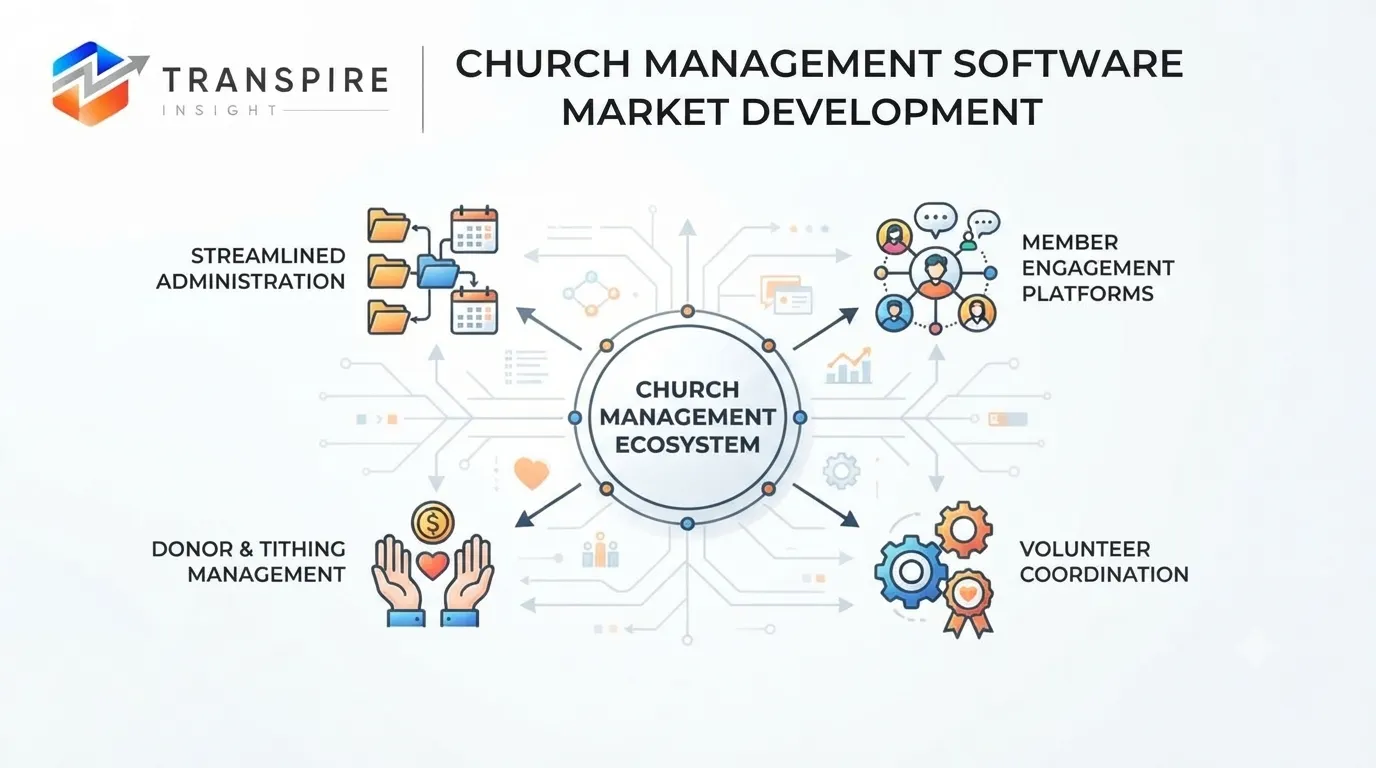
Church Management Software is becoming an increasingly important digital infrastructure for religious organizations seeking to simplify administration, strengthen member engagement, coordinate ministries, and manage financial and operational activities through connected platforms. As churches adopt cloud applications, mobile tools, digital giving, automated communication, and centralized databases, Church Management Software is evolving from a basic membership database into a comprehensive platform for managing day-to-day ministry operations.
The market is also benefiting from the growing need for real-time access to congregation information, volunteer coordination, event registration, child check-in, donation management, communication, reporting, and multi-campus administration. Cloud-based deployment and mobile accessibility are enabling churches of different sizes to replace spreadsheets and disconnected applications with integrated systems that support both staff and congregation members.
Market Size
The Church Management Software Market is expanding as churches and faith-based organizations increasingly move from manual records and disconnected applications toward centralized digital platforms. Modern ChMS solutions combine member databases, attendance records, communication tools, giving management, event registration, volunteer scheduling, reporting, and administrative workflows.
The transition toward cloud software is particularly important because church staff and volunteers increasingly require access to information outside traditional office environments. Cloud deployment allows authorized users to access records from computers, tablets, and smartphones while reducing the need for churches to maintain dedicated local infrastructure.
The market's projected increase from USD 1.45 billion in 2025 to USD 2.74 billion by 2033 reflects continuing investment in digital church administration and engagement technologies.
A major component of this growth is the movement toward all-in-one platforms. Instead of maintaining separate systems for membership, donations, event registration, communications, and volunteer scheduling, churches can increasingly manage these activities through connected software ecosystems.
Planning Center, for example, connects people management with giving, services, groups, registrations, check-ins, communication, and other ministry activities. Similarly, Pushpay describes its ChMS as a centralized platform for member data, ministry workflows, volunteer scheduling, attendance, communication, and engagement.
Growing Adoption of Cloud-Based Church Management Platforms
Cloud deployment is one of the strongest technological trends influencing Church Management Software. Churches increasingly prefer software that can be accessed without maintaining extensive local hardware or complicated IT infrastructure.
Cloud-based ChMS platforms can centralize information while allowing pastors, administrators, ministry leaders, and volunteers to work from different locations. This is particularly relevant for churches operating across multiple campuses or coordinating activities involving large numbers of volunteers.
Technavio identifies rapid acceleration in cloud deployment and mobile terminals as important factors supporting market expansion through 2030. Its research estimates a market opportunity increase of USD 435.1 million during 2025–2030, with an 8.6% CAGR during the forecast period.
Cloud platforms also make software updates, integrations, backups, and system maintenance easier for organizations that do not have dedicated technology departments.
Digital Giving and Donation Management
Digital giving has become an important component of modern church software. Online donations, mobile giving, text-to-give functionality, recurring contributions, contribution reporting, and donor statements are increasingly integrated into ChMS platforms.
Pushpay reports that its platform has processed more than 310 million transactions and has facilitated more than USD 62.9 billion in giving and receiving activity.
ChurchTrac similarly combines online donations and text giving with contribution statements, accounting, budgeting, and reporting.
The integration of financial and membership information can reduce duplicate data entry and help administrators maintain more consistent records. As congregations become more accustomed to digital payment methods, integrated giving functionality is expected to remain a central part of ChMS development.
Member and Congregation Management
Member management remains the foundation of Church Management Software. Modern platforms allow churches to maintain profiles containing contact details, family relationships, group memberships, attendance information, volunteer involvement, communication history, and other relevant organizational data.
The purpose is increasingly moving beyond simple record keeping. Churches can use connected information to understand participation patterns, organize follow-up activities, communicate with specific groups, and coordinate ministry programs.
Planning Center describes its People database as a central point connecting information across its other products, allowing information associated with events, giving, or check-ins to remain connected to individual profiles.
FellowshipOne similarly provides centralized people records, communication, grouping capabilities, visitor assimilation tools, and member self-service features.
Event and Volunteer Management
Events and volunteer coordination represent another major application area. Churches frequently organize worship services, conferences, outreach activities, youth programs, classes, community events, and small-group activities.
Church Management Software helps administrators create events, manage registrations, assign resources, monitor attendance, and communicate changes. Volunteer scheduling features can also automate requests, availability tracking, reminders, and role assignments.
Planning Center provides service planning and volunteer scheduling capabilities, while Subsplash offers volunteer management, scheduling, events, forms, messaging, and other connected functions through its platform.
As churches become more dependent on volunteers to operate multiple programs, automated scheduling and communication can reduce administrative workloads.
Child Check-In and Safety Management
Child check-in has become an important functionality within Church Management Software, particularly for churches with extensive children's ministries.
Digital check-in systems can help staff manage attendance, print identification labels, connect children with family records, and maintain organized records for ministry programs. Rock RMS, for example, provides flexible check-in, secure check-in and check-out, room assignments, customizable labels, and tracking features.
Tithely's Church Management platform also includes check-in and name-tag capabilities as part of its broader ChMS offering.
The integration of check-in with member profiles, events, and attendance data can make these systems more useful than standalone attendance applications.
Mobile Applications and Digital Engagement
Mobile applications are becoming an important extension of Church Management Software. Members increasingly expect to interact with churches through smartphones for giving, event registration, group communication, notifications, schedules, and other activities.
Planning Center's Church Center connects congregation members with church activities including giving, event registration, group communication, prayer requests, and children's check-in.
Subsplash also combines church applications, websites, giving, messaging, events, media, groups, check-in, and church management within its broader platform.
This convergence between administrative software and congregation-facing applications is changing the role of ChMS platforms. Software is increasingly expected to serve both internal church administrators and the people participating in church activities.
Artificial Intelligence and Church Management
Artificial intelligence is emerging as a new development area within Church Management Software. AI can potentially support data analysis, workflow automation, communication preparation, search, reporting, and personalized engagement.
Rock RMS currently describes its platform as AI-powered and provides AI-related capabilities alongside church management, communication, digital publishing, and engagement functions.
Subsplash has also introduced AI-related tools and describes AI-assisted analysis and other AI capabilities within its platform.
The long-term direction of AI in ChMS will depend on data quality, privacy safeguards, user permissions, accuracy, and the ability of church organizations to implement automation responsibly. Rather than replacing core management functions, AI is increasingly being positioned as an additional layer for helping staff interpret information and automate repetitive processes.
Accounting and Financial Administration
Churches have specific accounting requirements related to restricted funds, designated donations, budgets, expenses, payroll, and financial reporting. Consequently, accounting functionality is an important segment of church management platforms.
ACS Technologies provides church accounting, giving, engagement, reporting, and church management solutions through its connected technology ecosystem.
ChurchTrac similarly integrates fund accounting, budgeting, bank synchronization, contribution management, and reporting with broader church management functions.
Integrated accounting reduces the need to transfer information manually between multiple systems and can provide administrators with a more unified view of church operations.
Regional Outlook
North America represents a major market for Church Management Software because of the established presence of specialized church technology providers, large multi-campus organizations, and relatively high adoption of digital giving and cloud platforms. Companies including Planning Center, Pushpay, ACS Technologies, FellowshipOne, Rock RMS, ChurchTrac, and Subsplash have established extensive offerings for churches and ministry organizations.
Europe is also an important market for church software. Technavio identifies Europe as a significant regional contributor to market growth during its forecast period. Adoption is supported by demand for centralized administration, digital communication, online services, and financial management.
Asia-Pacific offers long-term opportunities as religious organizations and nonprofit institutions increasingly adopt cloud platforms and mobile technologies. Growing smartphone use and expanding digital payment ecosystems can support the adoption of mobile-friendly church management solutions.
Latin America and other emerging markets are expected to provide additional opportunities as churches modernize their administrative processes. Affordable SaaS pricing, multilingual interfaces, mobile applications, and simplified implementation can be particularly important for smaller organizations.
Competitive Landscape
The Church Management Software market is characterized by a combination of established specialized software companies, integrated church technology platforms, open-source solutions, and providers focusing on specific church sizes or ministry requirements.
Competition is increasingly centered on platform integration rather than individual features. Providers are adding giving, communication, mobile applications, event management, volunteer scheduling, child check-in, reporting, accounting, and engagement tools to create broader ecosystems.
The market also includes different deployment and pricing approaches. Some platforms focus on modular subscriptions, while others offer broader all-in-one packages. Open-source platforms such as Rock RMS provide another model, allowing organizations and technology partners to customize and extend software according to specific requirements.
Top 10 Companies in Church Management Software Market
Company Profiles
1. Planning Center
Planning Center is a major church software provider offering an interconnected ecosystem for people management, worship planning, giving, groups, registrations, communication, check-ins, and church administration. Its Church Center application provides a congregation-facing mobile experience, while its administrative products connect ministry activities to centralized people records. The company states that the Planning Center is independently structured and not for sale, following the formation of the Ministry Centered Foundation in 2024.
2. Pushpay Holdings Ltd.
Pushpay provides technology covering church management, digital giving, church applications, engagement, and analytics. Its ChMS platform is designed for churches ranging from smaller congregations to large organizations and supports member profiles, attendance, volunteer scheduling, communication, and operational workflows. Pushpay reports more than 14,000 churches using its platform and identifies church management, giving, apps, and engagement as key product areas.
3. ACS Technologies
ACS Technologies has provided church and faith-based technology since 1978. Its portfolio includes church management, accounting, giving, engagement, communications, reporting, and other ministry functions. The company joined the Vanco family in 2025 and states that its solutions serve churches, dioceses, schools, and other faith-based organizations.
4. Tithely
Tithely provides an integrated technology platform covering church management, giving, websites, church applications, communication, and engagement. Its Church Management offering includes people management, groups, events, forms, service planning, directories, messaging, check-in, and reporting. Tithely states that more than 53,000 churches use its broader platform for giving, administration, and engagement.
5. Subsplash
Subsplash provides an integrated platform combining church management with applications, websites, giving, media, events, groups, messaging, volunteer management, and check-in. Its ChMS offering includes unified people profiles, volunteer scheduling, communication, and analytics. Subsplash states that its platform is used by more than 20,000 churches and ministries.
6. FellowshipOne
FellowshipOne offers church management solutions designed for churches ranging from church plants to large multi-campus organizations. Its platform brings together people data, communications, events, tasks, financial information, and reporting. It also provides church accounting, payroll, online giving, and payment capabilities.
7. Rock RMS
Rock RMS is an open-source church management platform covering people management, communication, check-in, metrics, reporting, finance tools, events, workflows, digital publishing, and engagement. Its architecture allows churches and implementation partners to customize functionality according to organizational requirements. Rock reports more than 35.8 million people records managed and more than USD 5 billion in giving processed through its ecosystem.
8. ChurchTrac
ChurchTrac provides an all-in-one platform focused on church administration and ministry operations. Its features include people management, church accounting, worship planning, messaging, volunteer management, events, donations, check-in, websites, applications, attendance, and automation. The company states that more than 14,000 churches use its platform.
9. Faithlife
Faithlife is a technology provider serving churches and ministries with digital tools for Bible study, church management, communication, media, and ministry administration. Its broader ecosystem positions church technology around connected content and ministry workflows, making it a participant in the expanding market for digital church infrastructure.
10. MinistryPlatform
MinistryPlatform is a church management technology platform focused on centralized church data, ministry workflows, people management, communication, and integrations. Its architecture is designed to support organizations with more complex operational requirements and provides a foundation for connecting church information with other ministry applications.
Challenges in the Church Management Software Market
Despite increasing adoption, the market faces several challenges. Cost remains an important consideration for smaller churches with limited technology budgets. Subscription fees, payment-processing costs, implementation expenses, data migration, and training can influence purchasing decisions.
Data migration can also be difficult when churches transition from spreadsheets or legacy systems. Historical membership records, contribution information, attendance data, volunteer schedules, and family relationships may require cleaning before they can be transferred effectively.
Another challenge involves user adoption. Church management systems often serve administrators, pastors, ministry leaders, volunteers, finance teams, and congregation members. A platform can therefore require different interfaces and permission levels for different users.
Data security and privacy are also increasingly important. Church databases can contain personal contact information, children's records, donation information, communication history, and other sensitive organizational data. Providers must therefore maintain appropriate access controls, authentication, backups, and security practices.
Future Outlook
The future of the Church Management Software Market is expected to be shaped by deeper integration, mobile accessibility, cloud deployment, artificial intelligence, automation, digital giving, and data-driven administration.
ChMS platforms are moving beyond basic databases toward comprehensive operating environments for churches. The combination of membership information, events, communication, giving, volunteer management, child check-in, accounting, and mobile applications allows organizations to manage more activities from centralized systems.
AI is likely to become increasingly visible through automated reporting, natural-language search, workflow recommendations, communication assistance, and data analysis. However, adoption will depend on responsible implementation, privacy protection, data accuracy, and clear human oversight.
The market is also likely to see continued consolidation around connected platforms. Churches increasingly want fewer disconnected applications and more unified systems capable of sharing information across administrative and congregation-facing functions.
With the global market projected to reach approximately USD 2.74 billion by 2033, the Church Management Software industry is positioned for continued expansion as religious organizations invest in digital infrastructure, cloud technology, mobile engagement, and operational automation.


Send us a brief description of your challenge and we'll get back to you within 24 hours.

 inquiry@transpireinsight.com
 APAC:+91 7666513636
 Address


