logo
☰ Search

Oct 10, 2026

Automatic Food Waste Processor Market: Global Growth, Smart Appliances, Opportunities, and Competitive Outlook

By Transpire Insight


automatic-food-waste-processor-market-global-growth-smart-appliances-opportunities-and-competitive-outlook

Automatic food waste processors are becoming an increasingly visible category within modern waste-management and kitchen-appliance ecosystems. Drying, grinding, heating, microbial decomposition, odor control, and automated cycle management are enabling households and businesses to reduce the volume and handling burden associated with food scraps.

Automatic Food Waste Processor Market Overview

The Automatic Food Waste Processor Market includes appliances and equipment that automatically reduce, dry, grind, dehydrate, decompose, or otherwise process food waste.

Products range from compact household appliances to commercial systems serving restaurants, hotels, institutional kitchens, supermarkets, and food-processing operations.

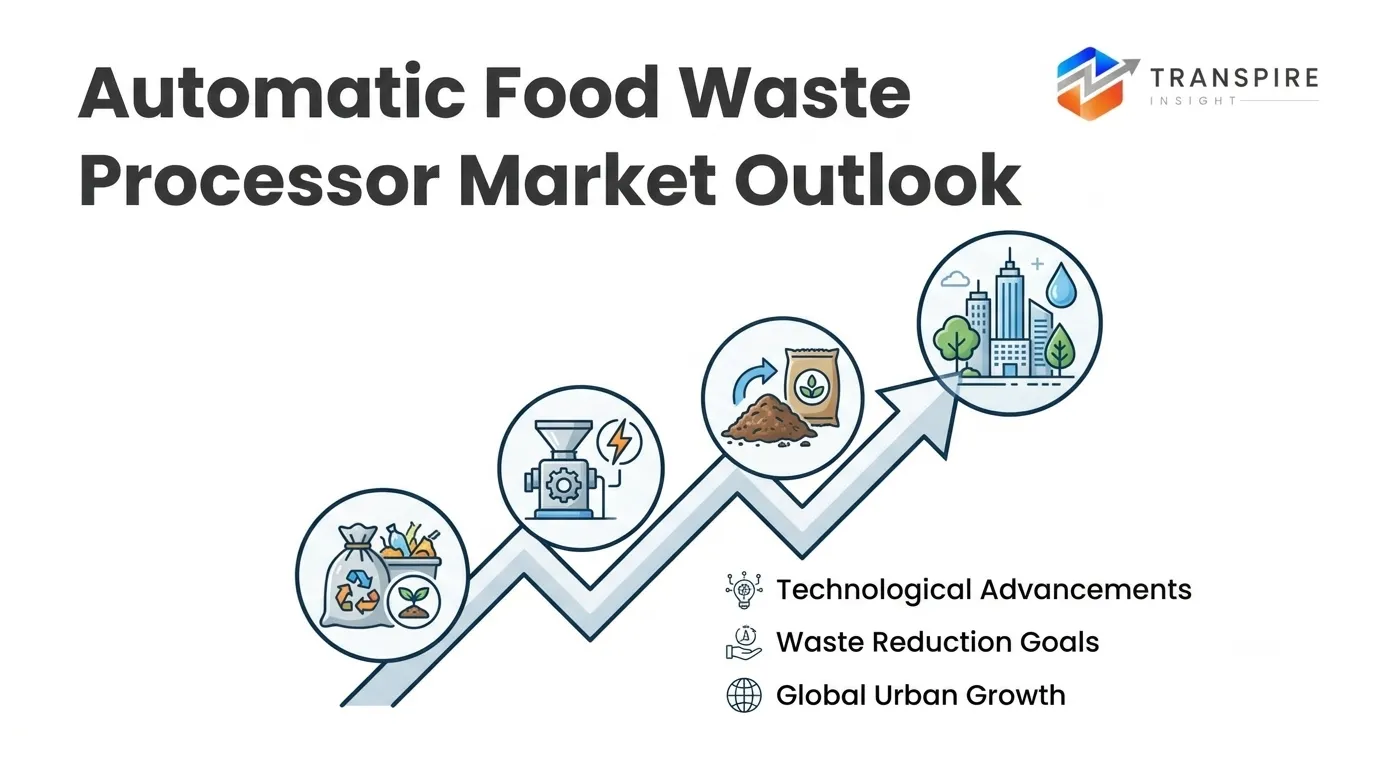
Transpire Insight estimates the global market at approximately USD 3.18 billion in 2025, increasing to USD 3.37 billion in 2026 and reaching approximately USD 4.90 billion by 2033, representing a CAGR of approximately 5.49%.

Market Indicator Transpire Insight Estimate
Market Value (2025) USD 3.18 Billion
Expected Market Value (2026) USD 3.37 Billion
Estimated Market Value (2033) USD 4.90 Billion
Forecast CAGR (2026–2033) 5.49%
Leading Region in 2025 Asia Pacific
Second-largest Region North America
Fastest Growing Region Asia Pacific

The broader food-waste-dispositor category is estimated by one current market assessment at approximately USD 3.41 billion in 2026, demonstrating the scale of the adjacent equipment ecosystem.

Download the exclusive Automatic Food Waste Processor Market sample report today to explore expert Insight, key trends, and emerging opportunities shaping the future of the industry.

Latest Global Market Developments

  1. Korean appliance companies are expanding food-waste processor portfolios
    A May 2026 report described intensified competition among Korean appliance and rental companies, with new product launches and local-government subsidies supporting consumer demand.
  2. Drying and grinding technology is gaining market attention
    Automatic thermal drying and grinding systems are increasingly used because they can substantially reduce the volume of food scraps and simplify subsequent handling.
  3. Microbial processing remains an alternative technology
    Biological decomposition systems continue to compete with thermal and mechanical approaches, particularly where users prioritize organic processing rather than simple volume reduction.
  4. Smart controls are improving user convenience
    Automatic cycle selection, sensors, alerts, and digital controls are becoming more common in higher-end equipment.
  5. Seasonal demand can influence purchasing
    Food scraps can become more difficult to store during warmer months, increasing consumer interest in equipment that reduces odor and waste volume.
  6. Rental models are emerging
    In markets such as South Korea, appliance-rental companies are using subscription models to reduce upfront purchase barriers.
  7. Sustainability is strengthening demand
    Consumers and businesses increasingly seek methods for reducing the environmental and logistical burden associated with food waste.
  8. Commercial foodservice is an important expansion opportunity
    Restaurants, hotels, cafeterias, hospitals, and institutional kitchens generate substantial quantities of organic waste and can benefit from automated processing.

Why Automatic Food Waste Processors Matter?

Automatic processors address several practical problems:

  • Food-waste odor
  • Storage requirements
  • Waste volume
  • Frequent disposal
  • Kitchen hygiene
  • Organic-waste handling
  • Collection frequency
  • Labor requirements

For businesses, the value proposition can extend to reduced waste-handling labor and better measurement of waste volumes.

Proceed to checkout to purchase the exclusive Automatic Food Waste Processor Market report and get instant access to detailed market Insight, strategic analysis, and future growth opportunities.

Key Factors Driving the Market

1. Urban Household Density

Smaller homes and limited outdoor space increase interest in compact indoor waste-processing appliances.

2. Hygiene Concerns

Automated drying, grinding, and enclosed processing can reduce the time food scraps remain in kitchens.

3. Convenience

Consumers increasingly prefer appliances that require limited manual handling.

4. Sustainability Awareness

Food-waste reduction is becoming part of household and corporate sustainability programs.

5. Technology Improvements

Improved motors, heating systems, microbial cartridges, sensors, and control systems are expanding product capabilities.

Five High-Potential Markets

1. South Korea

South Korea has become a highly developed market for food-waste appliances, supported by food-waste policies and a strong home-appliance sector.

2. Japan

Japan's compact urban living environments and established waste-management culture create opportunities for efficient food-waste processors.

3. United States

The U.S. provides a large consumer-appliance market and growing interest in household sustainability technologies.

4. China

China's large urban population and evolving waste-sorting infrastructure create substantial long-term potential.

5. India

India offers opportunities across households, restaurants, hotels, apartment communities, institutions, and commercial kitchens.

Customize the exclusive Automatic Food Waste Processor Market report to receive Insight tailored to your needs, including country-specific analysis and business-focused market intelligence.

Competitive Landscape

Competition includes appliance manufacturers, waste-management technology firms, kitchen-equipment companies, and rental businesses.

Top 5 Companies

  1. Whirlpool Corporation
    Whirlpool's appliance expertise provides a strong platform for residential food-waste technologies.
  2. Emerson
    Emerson participates in technologies related to food processing, appliances, controls, and environmental systems.
  3. Vitamix
    The company's processing expertise provides relevance to food-waste reduction appliances and consumer kitchen equipment.
  4. Oklin International
    Oklin focuses on organic-waste processing and composting technologies, including systems suitable for commercial applications.
  5. Food Cycle Science
    The company develops food-waste processing technology designed to reduce organic-waste volume and simplify disposal.

Opportunities for Small Investors

  • Local appliance distribution
  • Rental and subscription services
  • Replacement filters and components
  • Machine maintenance
  • Commercial kitchen servicing
  • Smart-home integration
  • Food-waste collection partnerships
  • Sustainability consulting

Challenges & Restraints

Consumer awareness, appliance pricing, electricity consumption, maintenance, noise, installation requirements, replacement components, and differences in municipal waste systems can affect adoption.

Schedule a meeting with our market experts to discuss the exclusive Automatic Food Waste Processor Market report and find the right research solution for your business.

Conclusion

The Automatic Food Waste Processor Market is developing at the intersection of home appliances, foodservice equipment, waste management, and sustainability technology.

The South Korean market demonstrates how subsidies, appliance innovation, and rental models can accelerate consumer adoption.

Future products are likely to emphasize lower energy consumption, quieter operation, smaller footprints, smart controls, improved odor management, and greater integration with connected-home systems.

About the Authors


Chakradhar Khansole Author TI

Chakradhar Khansole

Chakradhar serves as the Research Director at Transpire Insight, bringing over 8 years of experience in technology, innovation, and strategic market intelligence. He specializes in transforming complex market data into actionable business insights that enable organizations to make informed, growth-oriented decisions. Recognized for his strategic vision and analytical expertise, Chakradhar leads high-impact research initiatives, delivering comprehensive market assessments, competitive intelligence, and forward-looking industry analysis.

Kartik Bhong Author TI

Kartik Bhong

Dr. Kartik bhong serves as the Senior Manager at Transpire Insight, bringing over 6+ years of experience in market research, strategic consulting, and business intelligence, complemented by a Ph.D. in Market Research and Strategic Management. With extensive expertise in primary and secondary research, quantitative and qualitative analysis, and industry forecasting, he has successfully led complex, multi-sector research engagements for global clients.

GET IN TOUCH

Ready to discuss your project?

Send us a brief description of your challenge and we'll get back to you within 24 hours.

Quick Response
Within 24 hours
Confidential
Your data is safe
Expert Support
Professional team

We respect your privacy. Information is never shared.