
Aug 07, 2026
By Transpire Insight
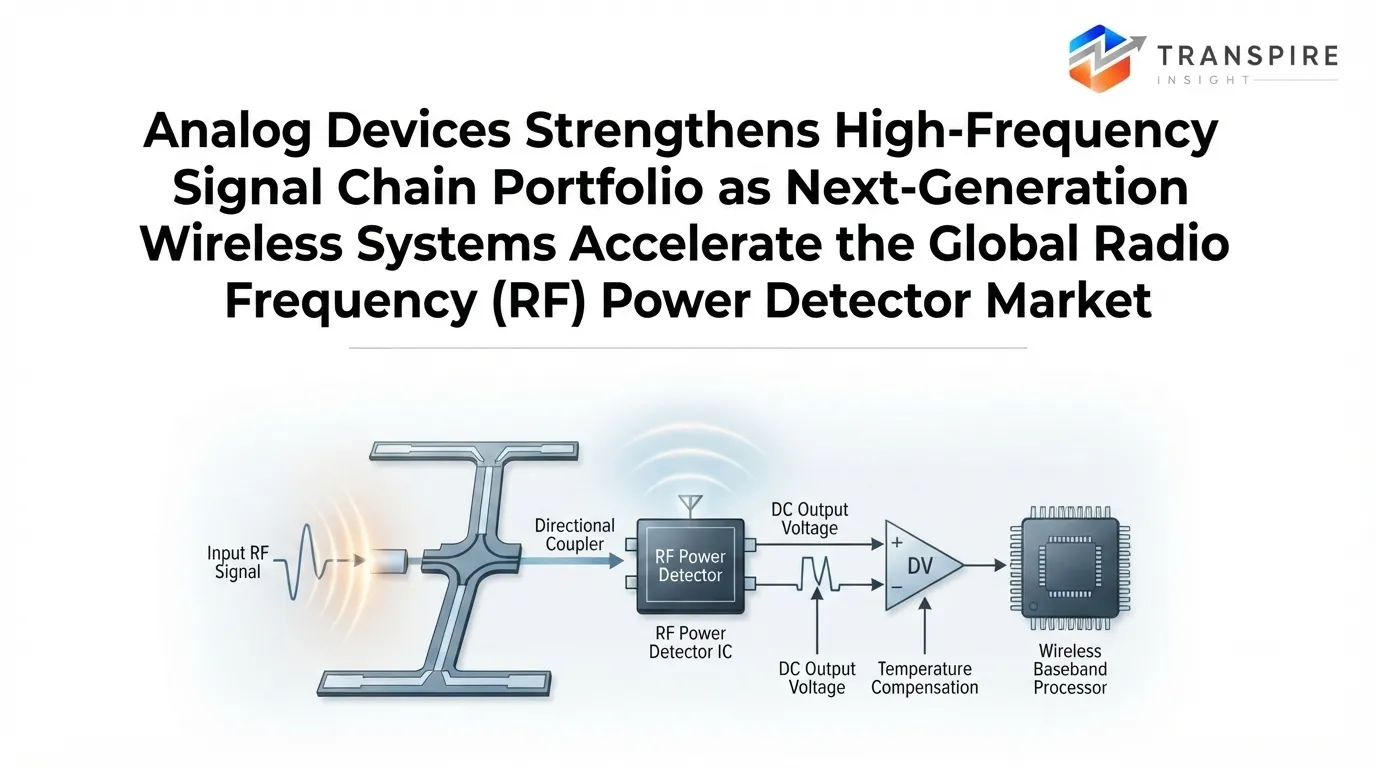
The rapid evolution of wireless communication technologies is reshaping the global Radio Frequency (RF) Power Detector market at an unprecedented pace. During 2025–2026, one of the industry's most significant developments has been the continued expansion of high-frequency semiconductor portfolios by leading analog and mixed-signal manufacturers to support emerging applications in 5G Advanced, early 6G research, satellite communications, aerospace, defense electronics, automotive radar, industrial automation, and high-performance test & measurement systems. Companies including Analog Devices, Texas Instruments, Qorvo, Skyworks Solutions, Infineon Technologies, MACOM, Mini-Circuits, and Renesas Electronics are introducing increasingly sensitive RF signal chain components capable of operating across broader frequency ranges while delivering higher accuracy, lower power consumption, and improved thermal stability.
According to Transpire Insights, the Global Radio Frequency (RF) Power Detector Market was valued at approximately USD 2.18 billion in 2026 and is expected to witness steady expansion throughout the forecast period as wireless infrastructure becomes increasingly sophisticated and high-frequency electronics penetrate virtually every major industry. Unlike previous generations of RF components that primarily supported consumer communication devices, modern RF power detectors are now indispensable across mission-critical applications requiring precise measurement of transmitted and received signal power. Their growing importance extends beyond telecommunications into aerospace, military radar, autonomous vehicles, Internet of Things (IoT), medical electronics, semiconductor manufacturing, and advanced laboratory instrumentation.
One of the most influential technological developments driving market growth is the global transition toward 5G Advanced and the early research phase of 6G wireless communication. Worldwide, telecom operators continue investing billions of dollars in network modernization to accommodate rapidly increasing mobile data traffic. Industry estimates indicate that global mobile data consumption now exceeds 190 exabytes every month, while annual traffic continues growing by more than 20% as video streaming, cloud computing, artificial intelligence, and connected devices generate unprecedented network demand. Supporting these high-capacity wireless networks requires RF front-end architectures capable of maintaining exceptional signal integrity across increasingly complex frequency bands. RF power detectors play a crucial role by continuously monitoring transmission power, optimizing amplifier performance, minimizing signal distortion, and ensuring regulatory compliance across modern wireless infrastructure.
Another major catalyst is the accelerating deployment of millimeter-wave (mmWave) technologies. Unlike conventional sub-6 GHz communication systems, mmWave frequencies extending beyond 24 GHz require significantly greater measurement precision because signal attenuation increases substantially at higher frequencies. This has created strong demand for advanced logarithmic and true-RMS RF power detectors capable of providing accurate power monitoring over extremely wide dynamic ranges. Semiconductor manufacturers are therefore developing highly integrated detector ICs supporting frequencies exceeding 40 GHz, enabling next-generation communication equipment, defense radar systems, satellite terminals, and electronic warfare platforms to achieve greater operational reliability.
The aerospace and defense sector continues to represent one of the market's most technologically demanding application areas. Modern military radar systems, electronic intelligence platforms, secure communication networks, and missile guidance technologies all rely heavily on accurate RF power measurement to maintain operational effectiveness. According to international defense estimates, global military expenditure surpassed USD 2.7 trillion in recent years, with a significant proportion allocated toward advanced electronic systems, radar modernization, and secure communication infrastructure. As governments continue strengthening national defense capabilities, procurement of sophisticated RF components—including high-performance power detectors—is expected to increase steadily across North America, Europe, and Asia-Pacific.
Automotive electronics are creating another important avenue for market expansion. The transition toward Advanced Driver Assistance Systems (ADAS) and autonomous vehicles has accelerated deployment of 77 GHz automotive radar, one of the fastest-growing RF applications worldwide. Industry analysts estimate that modern premium passenger vehicles increasingly incorporate five to ten radar sensors, supporting adaptive cruise control, blind-spot monitoring, collision avoidance, lane-change assistance, and automated parking functions. Accurate RF power detection within these radar modules is essential for ensuring reliable object detection, signal consistency, and system safety under varying environmental conditions.
Industrial automation is also contributing to rising demand for RF power detectors. The rapid adoption of Industrial Internet of Things (IIoT), wireless sensor networks, smart factories, and Industry 4.0 technologies has significantly increased the deployment of wireless communication modules operating across multiple frequency bands. According to manufacturing estimates, more than 30 billion connected IoT devices are expected to be operational worldwide before the end of the decade, creating sustained demand for precision RF measurement technologies that improve wireless reliability while optimizing energy efficiency across connected industrial ecosystems.
Download the exclusive Radio Frequency (RF) Power Detector Market sample report today to uncover expert insights, emerging trends, and the opportunities defining the future of the industry.
Why Next-Generation Wireless Networks Are Redefining RF Power Detection
The transition from conventional wireless communication to intelligent, high-frequency connectivity is fundamentally changing the role of Radio Frequency (RF) Power Detectors across the global electronics industry. In previous generations of communication infrastructure, RF power detectors primarily served as supporting components responsible for measuring transmitted signal strength and ensuring basic amplifier performance. Today, however, they have become integral to highly complex RF front-end architectures that must simultaneously deliver exceptional signal accuracy, energy efficiency, spectral compliance, and real-time adaptive control across increasingly crowded frequency bands.
One of the strongest forces driving this transformation is the global migration toward 5G Advanced and the early commercialization roadmap for 6G technologies. Unlike earlier wireless generations, these networks operate across wider bandwidths, higher frequencies, and significantly denser network architectures. According to international telecommunications estimates, global mobile network traffic now exceeds 190 exabytes per month, while connected cellular IoT devices have surpassed 4 billion worldwide. Industry forecasts further indicate that total IoT deployments could exceed 40 billion connected devices before 2030. This massive increase in wireless connectivity is creating unprecedented demand for RF components capable of maintaining stable signal transmission under highly dynamic operating environments.
The satellite communications sector represents another major catalyst for market expansion. The rapid deployment of Low Earth Orbit (LEO) satellite constellations has significantly increased demand for compact, high-performance RF components capable of operating across Ku-band, Ka-band, and increasingly higher microwave frequencies. Industry estimates suggest that more than 10,000 active satellites are currently orbiting Earth, with thousands of additional communication satellites scheduled for deployment over the next decade. Each satellite communication terminal relies on accurate RF power monitoring to maintain reliable uplink and downlink performance despite continuously changing atmospheric conditions and transmission distances.
Automotive radar is similarly redefining the technical requirements of RF power detectors. Modern Advanced Driver Assistance Systems (ADAS) increasingly rely on 76–81 GHz radar operating with exceptionally high precision to detect surrounding vehicles, pedestrians, cyclists, and road infrastructure. According to automotive industry analyses, over 60% of newly manufactured premium passenger vehicles now incorporate multiple radar modules, while next-generation autonomous platforms may integrate 10–15 radar sensors alongside cameras and LiDAR systems. Maintaining consistent RF output across these radar modules requires highly accurate detector circuits capable of compensating for temperature variations, signal fluctuations, and long-term component aging.
Market Analysis
Growing investments in telecommunications infrastructure, aerospace electronics, semiconductor manufacturing, industrial automation, defense modernization, and connected mobility continue expanding the addressable market for precision RF measurement technologies. While demand from smartphones and consumer electronics remains significant, the strongest long-term opportunities are increasingly emerging from industrial, automotive, satellite, and defense applications where higher operating frequencies require substantially greater measurement accuracy.
North America continues to maintain a leading position within the global market, accounting for approximately 35–38% of total industry revenue. The region benefits from the presence of major semiconductor companies, advanced defense contractors, aerospace manufacturers, and world-leading wireless infrastructure developers. The United States alone invests well over USD 900 billion annually in research and development across public and private sectors, with a significant proportion directed toward semiconductors, telecommunications, defense electronics, and advanced manufacturing. Continued deployment of 5G infrastructure, increasing defense modernization programs, and expanding satellite communication networks are expected to sustain strong regional demand throughout the forecast period.
Europe represents the second-largest regional market, supported by strong automotive manufacturing, industrial automation, aerospace innovation, and semiconductor research. Germany, France, the United Kingdom, Italy, and the Nordic countries continue investing heavily in Industry 4.0 technologies, connected factories, and advanced communication infrastructure. Europe also remains a global leader in automotive radar development, with millions of new vehicles incorporating adaptive cruise control, collision avoidance, and autonomous driving technologies each year. These applications require increasingly sophisticated RF detector solutions capable of maintaining highly stable performance throughout demanding automotive operating conditions.
Asia-Pacific is projected to register the fastest growth over the coming decade. The region accounts for more than 60% of global semiconductor manufacturing capacity, while countries including China, Taiwan, South Korea, Japan, and India continue expanding investments in electronics production, wireless infrastructure, and advanced chip fabrication. China alone operates millions of 5G base stations, making it the world's largest 5G deployment market. Simultaneously, Taiwan and South Korea continue strengthening advanced semiconductor manufacturing capabilities, supporting increasing production of RF integrated circuits for smartphones, communication infrastructure, and industrial electronics.
True RMS RF Power Detectors are witnessing particularly strong growth due to their ability to accurately measure complex digitally modulated waveforms commonly used in modern communication standards such as LTE, 5G NR, Wi-Fi 6, Wi-Fi 7, and satellite communication systems. As digital modulation techniques become increasingly sophisticated, demand for true RMS measurement technologies is expected to accelerate across both commercial and defense applications.
Application analysis indicates that telecommunications continues to represent the dominant end-use segment, accounting for approximately 40–45% of global demand. Continuous investment in wireless base stations, small-cell networks, Open RAN deployments, and fiber-wireless convergence continues driving procurement of RF signal chain components. However, aerospace and defense remain among the fastest-growing applications due to increasing investment in phased-array radar, electronic warfare, satellite communications, and secure tactical communication systems.
Competitive Landscape
Competition within the RF Power Detector market is increasingly determined by technological performance rather than manufacturing scale alone. Semiconductor companies are competing to develop detector integrated circuits capable of operating across wider frequency ranges while delivering lower insertion loss, higher linearity, improved temperature stability, and lower power consumption. As wireless systems migrate toward millimeter-wave frequencies exceeding 40 GHz, innovation in RF detector architecture has become a major competitive differentiator.
Leading manufacturers including Analog Devices, Texas Instruments, Qorvo, Skyworks Solutions, Infineon Technologies, MACOM Technology Solutions, Mini-Circuits, Renesas Electronics, NXP Semiconductors, and Broadcom continue expanding product portfolios through significant investments in RF semiconductor research. Collectively, these organizations generate well above USD 200 billion in annual revenue, enabling sustained investment in advanced analog technologies, gallium nitride (GaN), silicon germanium (SiGe), RF CMOS, and heterogeneous semiconductor integration.
The market is also witnessing increasing collaboration between semiconductor manufacturers and telecommunications equipment providers to optimize RF front-end architectures for emerging wireless standards. Simultaneously, partnerships with automotive manufacturers, defense organizations, and satellite communication companies are accelerating development of specialized RF detector solutions tailored to demanding high-frequency applications.
Financial Impact
The continued expansion of wireless connectivity is expected to generate substantial long-term investment across the RF semiconductor industry. Global telecommunications operators continue allocating hundreds of billions of dollars toward 5G infrastructure expansion, while governments worldwide are increasing funding for semiconductor manufacturing, defense electronics, and digital transformation initiatives. These investments directly stimulate demand for precision RF components throughout the communication signal chain.
Beyond traditional semiconductor manufacturers, sustained market growth is expected to benefit wafer foundries, electronic design automation providers, packaging specialists, RF testing equipment manufacturers, contract electronics manufacturers, and advanced material suppliers. As higher-frequency communication becomes increasingly mainstream, demand for precision RF measurement technologies will continue expanding across virtually every segment of modern electronics.
The Evolution of RF Power Detection: From Signal Monitoring to Intelligent RF System Optimization
The Radio Frequency (RF) Power Detector market is undergoing a profound technological transformation as wireless communication systems evolve from relatively simple transmitter architectures into highly intelligent, software-defined, and AI-assisted radio frequency ecosystems. For decades, RF power detectors primarily served as measurement devices responsible for monitoring transmitted power, protecting amplifiers from excessive output, and ensuring compliance with communication standards. While these functions remain fundamental, the increasing complexity of wireless technologies has significantly expanded their role. Modern RF power detectors now operate as essential components within adaptive RF front-end architectures, continuously supplying real-time feedback that enables dynamic power optimization, beamforming accuracy, interference mitigation, and overall system efficiency.
The transition toward 5G Advanced and early 6G research illustrates this transformation particularly well. Unlike previous cellular generations that relied on relatively narrow frequency allocations and fixed transmission schemes, modern wireless networks simultaneously utilize multiple spectrum bands, carrier aggregation, Massive MIMO antennas, and dynamic beam steering. Industry estimates indicate that a single 5G Massive MIMO base station may incorporate 64, 128, or even 256 antenna elements, each requiring highly accurate RF signal monitoring to maintain consistent transmission performance. Consequently, RF power detectors have evolved from standalone analog components into intelligent sensing elements integrated throughout sophisticated radio architectures.
Artificial intelligence is further redefining RF system optimization. Modern wireless infrastructure increasingly utilizes AI algorithms capable of continuously analyzing network traffic, environmental conditions, signal interference, and amplifier performance. RF power detectors provide one of the most important real-time feedback parameters enabling these algorithms to optimize transmission efficiency without compromising communication quality. Rather than operating at constant power levels, next-generation base stations dynamically adjust output power according to network demand, reducing overall energy consumption while maintaining excellent signal coverage. Studies suggest that AI-assisted radio resource management can improve network energy efficiency by 15–25%, highlighting the growing importance of precision RF measurement technologies.
Satellite communications are experiencing a similar technological evolution. The rapid deployment of Low Earth Orbit (LEO) satellite constellations has fundamentally altered RF system requirements. Unlike traditional geostationary satellites serving relatively stable communication links, LEO satellites move rapidly relative to Earth, requiring continuous beam tracking, adaptive frequency management, and highly accurate power control. Current industry estimates indicate that more than 8,000 operational LEO satellites are actively supporting broadband internet, Earth observation, navigation, and scientific research, with several thousand additional satellites expected to be launched during the coming decade. Maintaining reliable communication across these rapidly changing orbital networks depends heavily on precise RF power detection throughout both satellite payloads and ground station equipment.
Proceed to Checkout to purchase the exclusive Radio Frequency (RF) Power Detector Market report and gain instant access to in-depth market intelligence, strategic analysis, and future growth opportunities.
Why Industry Leaders Are Investing Aggressively in RF Innovation
Competition within the Radio Frequency Power Detector market is becoming increasingly centered on technological sophistication rather than manufacturing scale alone. As wireless frequencies continue moving toward millimeter-wave and sub-terahertz ranges, conventional detector architectures are reaching their practical performance limits. Manufacturers are therefore investing heavily in next-generation semiconductor materials, advanced packaging technologies, heterogeneous integration, and intelligent analog design capable of delivering exceptional accuracy across increasingly challenging operating environments.
Leading semiconductor companies including Analog Devices, Texas Instruments, Qorvo, Skyworks Solutions, Infineon Technologies, MACOM Technology Solutions, NXP Semiconductors, Broadcom, Renesas Electronics, and Mini-Circuits collectively invest well over USD 35 billion annually in research and development. A significant portion of this investment supports high-frequency analog technologies, RF integrated circuits, compound semiconductors, and advanced communication systems designed for future wireless infrastructure. Rather than competing solely through product portfolios, these companies increasingly differentiate themselves through process technology, system integration capabilities, software support, and application-specific design expertise.
Miniaturization has become another major area of competition. Modern smartphones integrate more than 40 RF front-end components, while premium flagship devices may include over 60 RF modules supporting multiple communication standards including 5G, Wi-Fi 7, Bluetooth, GNSS, NFC, and Ultra-Wideband (UWB). Every improvement in detector size, power consumption, and integration directly contributes to enhanced device performance and battery efficiency. Consequently, semiconductor manufacturers continue pursuing highly integrated system-on-chip architectures that combine RF detection, amplification, switching, filtering, and signal processing within compact semiconductor packages.
The automotive industry has similarly emerged as a major innovation driver. Global vehicle manufacturers continue accelerating deployment of radar-based safety systems as governments strengthen vehicle safety regulations and consumers increasingly adopt autonomous driving technologies. Industry estimates suggest that annual automotive radar production could exceed 250 million radar modules before 2032, creating sustained demand for highly reliable RF detector solutions capable of operating across wide temperature ranges while maintaining long-term measurement stability.
Major Semiconductor Companies Continue Expanding High-Frequency Portfolios
The accelerating adoption of advanced wireless technologies has encouraged leading semiconductor manufacturers to significantly broaden their RF product portfolios. Rather than offering standalone analog devices, companies increasingly provide complete RF signal chain solutions that integrate power detectors, amplifiers, mixers, synthesizers, filters, switches, digital calibration, and intelligent control software within unified platforms.
The global semiconductor industry continues investing aggressively in fabrication capacity to support rising demand for high-frequency integrated circuits. Industry estimates indicate that worldwide semiconductor capital expenditure exceeded USD 150 billion annually during recent investment cycles, reflecting unprecedented expansion in advanced wafer fabrication, compound semiconductor manufacturing, and heterogeneous packaging technologies. These investments are strengthening long-term supply resilience while enabling production of increasingly sophisticated RF devices supporting communications beyond 100 GHz.
Market Impact: Precision RF Measurement Becomes the Foundation of Future Wireless Electronics
The continued evolution of wireless communications is transforming RF power detectors from supporting analog components into strategic enabling technologies for the global electronics industry. Virtually every major technological trend including 5G Advanced, future 6G networks, satellite broadband, autonomous transportation, industrial automation, aerospace electronics, defense modernization, smart manufacturing, and connected healthcare depends upon increasingly accurate RF signal measurement and control.
This transformation is creating significant opportunities throughout the semiconductor value chain. Wafer manufacturers, foundries, electronic design automation companies, advanced packaging providers, RF testing equipment manufacturers, communication infrastructure developers, automotive suppliers, and aerospace contractors all benefit from sustained investment in high-frequency electronics. As wireless connectivity continues expanding across every sector of the global economy, demand for precision RF detector technologies is expected to increase steadily.
Customize the exclusive Radio Frequency (RF) Power Detector Market report today to receive tailored insights, country-specific analysis, and business-focused market intelligence.
The Key Players Shaping the Global Radio Frequency (RF) Power Detector Market
The global Radio Frequency (RF) Power Detector market is characterized by intense technological competition, where innovation in analog design, semiconductor fabrication, frequency coverage, power efficiency, and signal accuracy determines market leadership. Unlike conventional semiconductor markets that compete primarily on manufacturing volume, the RF power detector industry demands continuous advancements in high-frequency circuit design capable of supporting increasingly sophisticated wireless communication systems. According to Transpire Insights, the top global semiconductor manufacturers collectively account for approximately 70–75% of the RF power detector market, while numerous specialized analog IC suppliers and RF component manufacturers compete across niche applications including aerospace, defense, medical electronics, laboratory instrumentation, automotive radar, and satellite communications.
Analog Devices remains one of the world's most influential analog semiconductor companies and a global leader in high-performance RF signal chain solutions. The company's RF power detectors are widely utilized across telecommunications infrastructure, aerospace electronics, electronic warfare, industrial instrumentation, medical imaging, and precision laboratory equipment. During fiscal 2025, Analog Devices generated approximately USD 9–10 billion in annual revenue while continuing to allocate nearly 18–20% of revenue toward research and development. The company serves more than 125,000 customers worldwide and offers thousands of analog and mixed-signal products supporting frequencies extending well beyond 40 GHz. Its long-term strategy focuses on intelligent edge computing, advanced analog integration, software-defined instrumentation, and next-generation wireless infrastructure supporting both commercial and defense applications.
Texas Instruments has established one of the industry's largest portfolios of analog semiconductors, supplying RF detection, signal conditioning, power management, and mixed-signal technologies across industrial automation, automotive electronics, communication equipment, and consumer electronics. The company reported approximately USD 15–16 billion in annual revenue during 2025, while maintaining one of the semiconductor industry's strongest manufacturing networks with 15+ wafer fabrication facilities worldwide. Texas Instruments continues investing billions of dollars in expanding 300 mm wafer manufacturing capacity, enabling lower production costs and greater supply chain resilience. The company's RF technologies increasingly support IoT devices, industrial wireless systems, automotive radar, and high-performance communication equipment.
Qorvo specializes in high-frequency RF semiconductor technologies supporting mobile communications, aerospace, defense, Wi-Fi networking, satellite communications, and infrastructure equipment. The company is widely recognized for its expertise in Gallium Arsenide (GaAs) and Gallium Nitride (GaN) technologies that enable high-power and high-frequency wireless applications. Qorvo generated approximately USD 3.8 billion in revenue during fiscal 2025, while continuing to expand investments in 5G infrastructure, satellite communications, defense radar, and automotive connectivity. The company supplies RF front-end components to numerous leading smartphone manufacturers and communication equipment providers while strengthening its presence in high-growth industrial and aerospace markets.
Skyworks Solutions has built a strong international position within RF connectivity by developing integrated analog solutions supporting smartphones, Wi-Fi systems, connected vehicles, industrial IoT, wearable electronics, and smart home devices. Its RF detector technologies contribute to improving transmission efficiency, battery optimization, and signal quality across modern wireless communication systems. The company generated approximately USD 4.2 billion in annual revenue during 2025 while serving customers across more than 30 countries. Skyworks continues expanding research into Wi-Fi 7, private 5G networks, Ultra-Wideband (UWB), and emerging IoT connectivity platforms expected to drive long-term RF semiconductor demand.
Infineon Technologies is one of Europe's largest semiconductor manufacturers, providing RF power devices, analog ICs, automotive electronics, security solutions, and industrial power semiconductors. The company has established a particularly strong position in automotive radar, industrial automation, renewable energy, and secure wireless communication. Infineon reported approximately €15 billion in annual revenue during fiscal 2025 while investing nearly 13% of revenue into research and development activities. The company's RF portfolio continues expanding through innovations in GaN technology, silicon carbide (SiC), automotive radar, and industrial wireless communication systems.
Innovation Continues to Drive Competitive Leadership
The competitive landscape of the RF Power Detector market is increasingly shaped by innovation rather than production scale. Semiconductor manufacturers collectively invest more than USD 45 billion annually in research and development across analog electronics, RF technologies, compound semiconductors, packaging innovation, and advanced manufacturing processes. These investments are enabling detector ICs capable of supporting frequencies approaching 100 GHz, significantly expanding opportunities within future wireless communication systems.
One of the industry's strongest competitive trends is the adoption of advanced semiconductor materials. While conventional silicon continues dominating consumer applications, Gallium Nitride (GaN), Gallium Arsenide (GaAs), and Silicon Germanium (SiGe) are becoming increasingly important for high-frequency communication infrastructure, aerospace electronics, satellite systems, and defense radar because of their superior power density, thermal performance, and frequency response.
Transpire Insights Expert View
According to Transpire Insights, the global Radio Frequency (RF) Power Detector market is entering one of the most strategically important phases in the evolution of the semiconductor industry. For decades, RF power detectors were viewed primarily as supporting analog components responsible for monitoring transmitted signal strength within wireless communication systems. Today, however, they have become indispensable elements of next-generation electronic architectures where precision, energy efficiency, high-frequency performance, and intelligent signal management directly determine overall system capability. As industries transition toward software-defined communication, artificial intelligence, autonomous mobility, satellite internet, and Industry 4.0, RF power detectors are becoming increasingly central to ensuring reliable and efficient wireless operation.
One of the strongest long-term market drivers is the continued expansion of global wireless connectivity. According to international telecommunications estimates, more than 5.8 billion people now use mobile communication services worldwide, while global internet penetration has exceeded 68% of the world's population. Mobile data traffic continues expanding at an annual rate exceeding 20%, fueled by high-definition video streaming, cloud computing, generative AI applications, industrial IoT, connected healthcare, and smart manufacturing. Supporting this exponential growth requires communication infrastructure capable of delivering higher bandwidth, lower latency, and improved spectrum efficiency. RF power detectors enable these networks to continuously optimize amplifier output, monitor transmission quality, and maintain signal integrity across increasingly complex radio frequency environments.
Satellite communications represent another major growth opportunity. The rapid deployment of Low Earth Orbit (LEO) satellite constellations is transforming global broadband accessibility. Industry projections indicate that the number of operational communication satellites could exceed 50,000 over the next decade as companies continue expanding global satellite internet coverage. Every satellite payload, ground station, phased-array antenna, and user terminal depends on precise RF power monitoring to maintain reliable communication links despite rapidly changing transmission conditions. As satellite broadband becomes increasingly integrated into telecommunications infrastructure, demand for high-frequency RF detector technologies is expected to increase substantially.
Artificial intelligence is also reshaping semiconductor development itself. Modern chip design increasingly utilizes machine learning algorithms capable of optimizing analog circuit layouts, predicting manufacturing variability, accelerating design verification, and improving production yields. Industry studies suggest that AI-assisted electronic design automation can reduce certain development cycles by 20–30%, enabling semiconductor manufacturers to introduce increasingly sophisticated RF products while shortening time-to-market. Future RF detector technologies are expected to incorporate embedded intelligence capable of self-calibration, predictive diagnostics, and adaptive power optimization within complex wireless systems.
Sustainability has become increasingly important across the semiconductor industry. Global communication networks already account for a significant share of electricity consumption within digital infrastructure, encouraging equipment manufacturers to prioritize energy-efficient RF architectures. Modern RF detector technologies contribute by enabling dynamic power control, amplifier optimization, and intelligent network management that collectively reduce unnecessary power consumption. Industry assessments indicate that advanced power optimization technologies can lower radio access network energy usage by 15–25%, supporting both operational efficiency and corporate sustainability objectives.
Schedule a meeting with our market experts to discuss the exclusive Radio Frequency (RF) Power Detector Market report and identify the best research solution for your organization.
Conclusion
The global Radio Frequency (RF) Power Detector market is rapidly evolving from a specialized analog semiconductor segment into a foundational technology supporting the next generation of wireless communications and intelligent electronic systems. The accelerating deployment of 5G Advanced, early 6G development, satellite broadband, autonomous transportation, industrial automation, aerospace electronics, defense modernization, and smart connected devices is fundamentally transforming the role of RF power measurement across virtually every high-frequency application.
Rather than functioning solely as signal monitoring components, modern RF power detectors are becoming integral elements of intelligent RF front-end architectures where precision measurement, adaptive power optimization, artificial intelligence, and energy efficiency directly influence system performance. Continuous advances in Gallium Nitride (GaN), Silicon Germanium (SiGe), RF CMOS technologies, advanced packaging, and AI-assisted semiconductor design are expected to further expand product capabilities while enabling operation across increasingly higher frequency bands.


Send us a brief description of your challenge and we'll get back to you within 24 hours.

 inquiry@transpireinsight.com
 APAC:+91 7666513636
 Address


