
Sep 30, 2026
By Transpire Insight
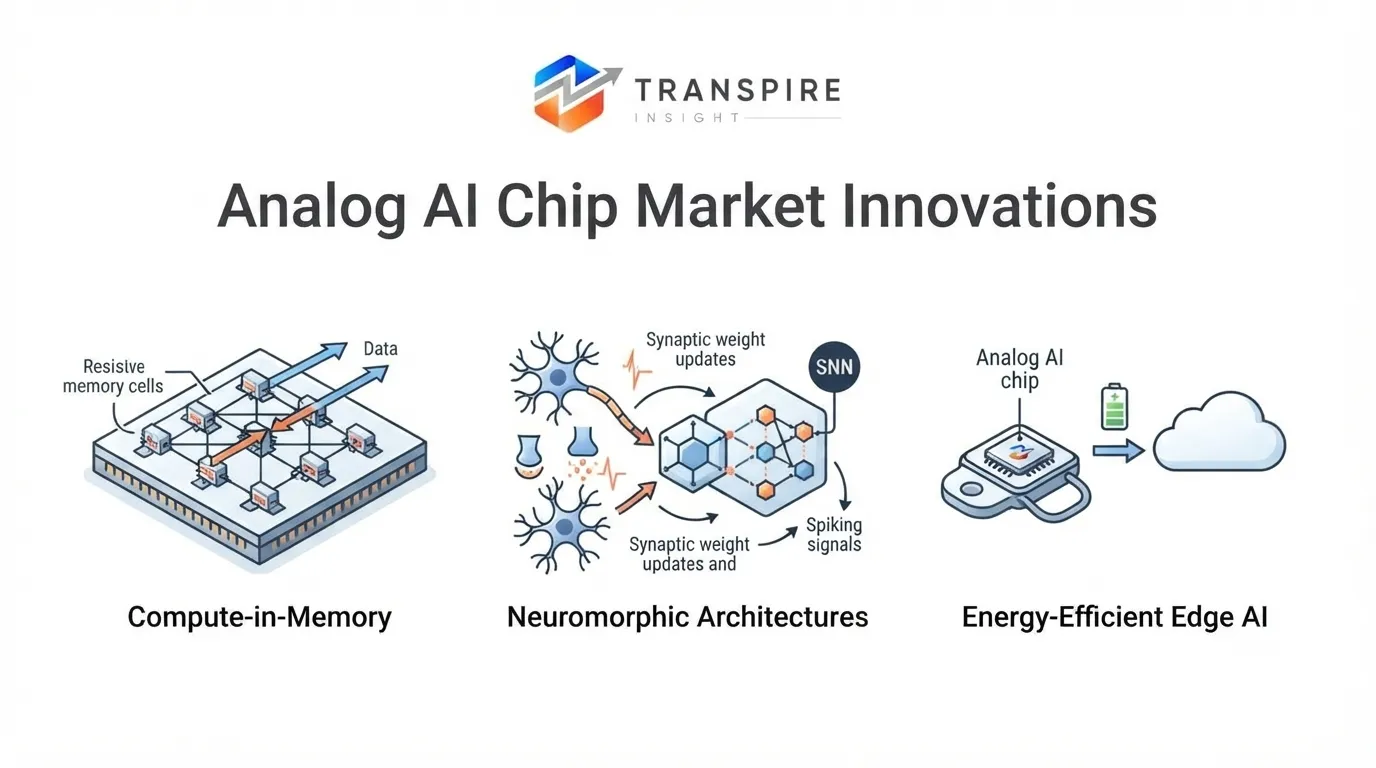
Artificial intelligence is increasingly moving from centralized cloud environments toward devices that must process information locally. This transition is creating opportunities for analog and mixed-signal AI architectures capable of reducing data movement, lowering latency and improving energy efficiency.
Industrial sensors, autonomous systems, robotics, healthcare devices, automotive electronics and intelligent consumer products are creating demand for AI processing closer to the physical environment.
September 2026: Analog AI chips combine principles of analog signal processing with artificial-intelligence computation.
Unlike conventional digital processors that represent information primarily through discrete binary values, analog approaches can process certain computations using continuous electrical signals.
This can reduce some of the energy and latency associated with repeatedly moving data between memory and processing units.
The technology is particularly relevant to edge AI.
Devices such as industrial sensors, cameras, medical instruments and autonomous machines increasingly need to interpret data locally.
Sending all information to a remote cloud server can introduce latency, bandwidth requirements and privacy concerns.
Analog AI architectures offer a potential alternative.
Market Size
The global analog AI chip market was estimated at approximately USD 2.8 billion in 2025 and is projected to reach around USD 11.6 billion by 2033, expanding at a CAGR of approximately 19.5% during 2026–2033.
The market definition varies considerably because some research includes analog AI accelerators, mixed-signal processors and neuromorphic devices, while other studies focus narrowly on analog in-memory computing.
Edge AI Is Driving Demand
The growth of edge AI is one of the most important market drivers.
AI-enabled devices increasingly need to make decisions without relying continuously on cloud infrastructure.
For example, an industrial camera may need to detect a defect immediately.
A robotic system may need to react to an object within milliseconds.
A medical device may need to identify an abnormal signal locally.
In these applications, low latency can be more important than raw computing power.
Analog AI architectures can potentially process certain workloads with significantly lower energy consumption.
Energy Efficiency Is Becoming Critical
AI workloads can require substantial electricity.
As the number of AI-enabled devices increases, energy efficiency becomes increasingly important.
Analog computation can reduce the need for repeated data conversion and movement in selected workloads.
This can improve energy efficiency.
The benefit is particularly attractive for battery-powered systems.
Wearable devices, smart sensors, drones and portable medical equipment cannot always support power-hungry processors.
Low-power AI chips can therefore expand the number of devices capable of running AI locally.
In-Memory Computing Creates Opportunities
One of the major concepts associated with analog AI is in-memory computing.
Traditional architectures frequently move data between memory and processing units.
This movement consumes energy and creates latency.
In-memory architectures perform certain calculations within or near memory arrays.
Analog approaches can represent numerical values through physical characteristics such as voltage or current.
This can enable highly parallel computation.
The technology is attracting interest for neural-network inference and other matrix-intensive workloads.
Sensor Fusion Is an Important Application
AI-enabled systems increasingly need to combine information from multiple sensors.
An autonomous machine may simultaneously process camera, radar, audio, temperature and motion information.
Analog and mixed-signal processors can support efficient sensor processing and fusion.
This makes them particularly relevant to robotics, automotive systems and industrial automation.
The combination of sensing and computing is also becoming increasingly important.
Recent industry activity reinforces this direction. Analog Devices announced an agreement to acquire Alif Semiconductor for approximately USD 1.35 billion, specifically highlighting the combination of sensing, signal processing, power management and on-device AI capabilities.
Automotive Electronics Create Long-Term Demand
Vehicles are becoming increasingly software-defined.
Advanced driver-assistance systems rely on continuous processing of camera, radar and other sensor information.
Local AI processing can reduce response times.
It can also reduce the amount of raw sensor information transmitted to centralized computing systems.
Electric vehicles provide additional opportunities because energy efficiency is a major design consideration.
Future vehicles may incorporate analog AI technologies into sensor interfaces, power systems and intelligent control modules.
Industrial Automation Is Another Key Market
Factories are becoming increasingly intelligent.
Machines can monitor vibration, temperature, pressure and acoustic signals to identify potential failures.
AI can analyze these signals to predict equipment problems.
Processing data locally can reduce communication requirements and allow machines to respond immediately.
This creates opportunities for analog AI chips in predictive maintenance, robotics and machine vision.
Healthcare Devices Need Low-Power Intelligence
Wearable and portable healthcare devices generate continuous streams of physiological information.
Examples include heart-rate, blood-oxygen, motion and other biosignals.
Local AI processing can help identify relevant patterns while reducing the need to transmit all raw information to the cloud.
This can improve privacy and reduce power consumption.
Medical-device manufacturers are therefore exploring increasingly sophisticated low-power processing architectures.
Consumer Electronics Expand the Opportunity
Smartphones, earbuds, cameras and home devices are increasingly incorporating AI.
Consumers expect voice recognition, image enhancement, personalization and intelligent automation.
Edge processing allows these features to operate with lower latency.
The market opportunity therefore extends beyond industrial applications.
However, consumer electronics require extremely competitive costs.
Analog AI chip manufacturers will need to demonstrate clear energy or performance advantages to achieve high-volume adoption.
AI Data Centers Also Influence Architecture Development
Although analog AI is strongly associated with edge computing, its principles can also influence data-center architectures.
AI inference workloads are growing rapidly.
The industry is searching for processors that deliver more computations per watt.
Specialized analog or mixed-signal accelerators could potentially complement conventional GPUs, CPUs and digital AI accelerators.
However, integration challenges remain.
Manufacturing Complexity Remains a Challenge
Analog chips can be sensitive to manufacturing variation, temperature changes and electrical noise.
Digital systems are generally easier to scale through advanced semiconductor manufacturing.
Analog AI developers therefore need sophisticated calibration and error-correction mechanisms.
Manufacturing consistency is particularly important for high-volume commercial applications.
The technology must demonstrate reliable performance across different operating conditions.
Software Ecosystems Will Determine Adoption
Hardware alone is not sufficient.
AI developers require software tools, compilers, model-conversion frameworks and development environments.
The easier it is to deploy existing neural-network models on analog AI hardware, the greater the potential for adoption.
Companies are therefore investing in software ecosystems alongside chip architectures.
This could become a key competitive differentiator.
North America Leads Innovation
North America remains a major center for AI-chip development.
The region combines semiconductor expertise, AI research, cloud companies and venture investment.
The United States is home to major semiconductor and AI companies developing specialized processors.
The region also has strong demand from automotive, defense, healthcare and industrial customers.
Asia Pacific Provides Manufacturing Strength
Asia Pacific is critical to semiconductor manufacturing.
Taiwan, South Korea, China and Japan have extensive semiconductor ecosystems.
The region is also a major market for consumer electronics and automotive electronics.
China is investing heavily in domestic AI-chip development.
Japan and South Korea have strong capabilities in memory, sensors and electronics.
These factors create favorable conditions for analog AI development.
Competitive Landscape
The market is emerging and includes established semiconductor companies, AI accelerators, mixed-signal specialists and startups.
Potential participants include Analog Devices, Texas Instruments, IBM, SynSense, Mythic, BrainChip, Aspinity, Esperanto Technologies, Qualcomm and STMicroelectronics.
Top 10 Companies in Analog AI Chip Market
Headquarters: Wilmington, Massachusetts, USA
Analog Devices has extensive expertise in analog and mixed-signal semiconductor technologies.
Its capabilities in sensing, signal processing and power management create a strong foundation for edge-AI applications.
Its announced Alif Semiconductor acquisition demonstrates its interest in expanding on-device AI capabilities.
Headquarters: Dallas, Texas, USA
Texas Instruments is a major analog and embedded-processing semiconductor company.
Its broad portfolio of microcontrollers, analog components and signal-processing technologies provides exposure to intelligent edge applications.
Headquarters: Armonk, New York, USA
IBM has conducted extensive research into neuromorphic and analog computing architectures.
Its research activities have contributed to the development of AI systems designed to improve energy efficiency.
Headquarters: Zurich, Switzerland
SynSense develops neuromorphic computing technologies designed for ultra-low-power edge AI.
Its processors are targeted at applications requiring continuous sensing and intelligent processing with limited power availability.
Headquarters: Austin, Texas, USA
Mythic develops AI processors based on analog compute concepts.
Its technology focuses on performing AI calculations efficiently while minimizing data movement.
Headquarters: Sydney, Australia
BrainChip specializes in neuromorphic AI technology.
Its Akida platform is designed for low-power edge inference and applications requiring local intelligence.
Headquarters: Boston, Massachusetts, USA
Aspinity develops ultra-low-power analog machine-learning technology.
Its solutions are designed to analyze sensor signals locally and reduce unnecessary data processing.
Headquarters: San Diego, California, USA
Qualcomm develops highly integrated processors for mobile, automotive and edge applications.
Its investment in specialized AI processing and edge computing gives it exposure to low-power AI workloads.
Recent expansion into AI data-center chips also illustrates the company's broader strategy around specialized AI computing.
Headquarters: Geneva, Switzerland
STMicroelectronics provides microcontrollers, sensors, analog components and embedded processors.
Its broad portfolio positions the company to integrate AI processing into industrial, automotive and consumer devices.
Headquarters: Mountain View, California, USA
Esperanto develops specialized AI processors designed to improve energy-efficient computing.
Its technology focuses on efficient AI inference and scalable accelerator architectures.
Outlook: Could Analog AI Become a Critical Layer of Edge Intelligence?
Analog AI remains an emerging technology, but its underlying value proposition is becoming stronger as AI moves closer to physical devices.
The combination of low latency, low power and sensor-level processing is particularly attractive for applications that cannot depend entirely on cloud computing.
Automotive electronics, industrial automation, robotics, healthcare and consumer devices could become important adoption areas.
Challenges remain around accuracy, manufacturing variability, software development and integration.
Nevertheless, the growing demand for efficient AI inference is likely to encourage continued investment.
The long-term opportunity could be substantial if analog AI architectures successfully complement conventional digital processors rather than attempting to replace them entirely.


Send us a brief description of your challenge and we'll get back to you within 24 hours.

 inquiry@transpireinsight.com
 APAC:+91 7666513636
 Address


