
Sep 17, 2026
By Transpire Insight
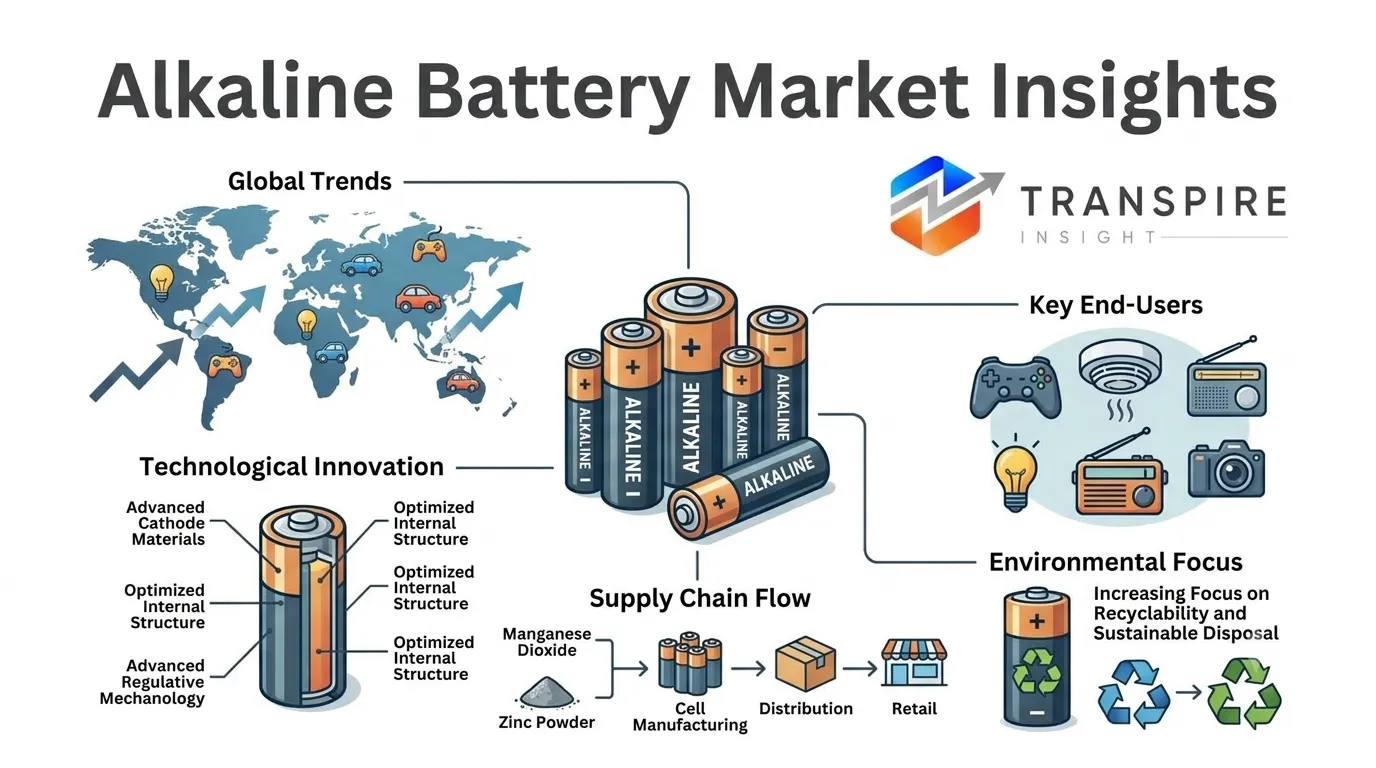
As consumer electronics continue to expand and emerging markets shift from zinc-carbon to alkaline chemistry, battery manufacturers are finding new growth opportunities through premium products, stronger distribution and specialized applications.
The alkaline battery market may look like a mature industry, but demand for portable power remains surprisingly resilient. Remote controls, toys, flashlights, clocks, gaming accessories, wireless keyboards, medical devices, security equipment and other everyday products continue to depend on standardized batteries such as AA, AAA, C, D and 9V.
The bigger opportunity is emerging in markets where consumers are moving from basic zinc-carbon batteries toward longer-lasting alkaline products.
The global alkaline battery market was valued at approximately USD 7.8 billion in 2025 and is projected to reach USD 10.96 billion by 2034, expanding at a CAGR of 3.93%, according to Fortune Business Insights. Global Market Insights estimates a larger USD 9.1 billion market in 2025 and forecasts USD 15.2 billion by 2035 at a 5.3% CAGR.
The difference between these estimates reflects different market definitions, but the underlying trend is consistent. Alkaline batteries remain a multi-billion-dollar global business with steady replacement demand and additional growth from premiumization and developing markets.
Unlike lithium-ion batteries, alkaline batteries are not trying to power electric vehicles, smartphones or large energy-storage systems.
Their opportunity is much simpler.
They are powering the millions of small devices that consumers still want to operate without charging cables.
The Alkaline Battery Market Is Entering a New Growth Phase
For years, alkaline batteries were primarily considered a mature consumer product. The market was driven by replacement purchases, household electronics and established brands.
That model is changing.
The market is increasingly divided between mature economies, where companies compete through premium performance and brand loyalty, and emerging economies, where the bigger opportunity is converting consumers from lower-cost zinc-carbon batteries.
India provides one of the clearest examples.
Panasonic Energy India has previously described India's battery industry as being dominated by zinc-carbon batteries, while alkaline batteries have continued to gain share. The company identified alkaline as an important growth category because its profit contribution is stronger than its volume contribution.
Current market research also points toward strong growth in India. Mordor Intelligence estimates India's alkaline battery market at USD 0.92 billion in 2025, increasing to USD 1.31 billion by 2031 at a 6.12% CAGR. Ken Research uses a much narrower market definition and estimates USD 68 million in 2025, reaching USD 122 million by 2031 at a 10.23% CAGR.
The large difference between the estimates is important.
It shows why alkaline battery market research needs to distinguish between total category value, primary alkaline cells, secondary alkaline products and different distribution channels.
But both datasets point toward the same opportunity: India's alkaline battery category still has substantial room for penetration.
Market Size and Statistics
The global alkaline battery market was valued at approximately USD 7.8 billion in 2025 and is projected to reach USD 10.96 billion by 2034 at a 3.93% CAGR.
Global Market Insights estimates the global market at USD 9.1 billion in 2025 and forecasts it to reach USD 15.2 billion by 2035 at a 5.3% CAGR.
Straits Research estimates the global alkaline battery market at USD 9.8 billion in 2025 and forecasts USD 13.83 billion by 2034 at a 3.9% CAGR.
Mordor Intelligence estimates that primary batteries represented 74.5% of the global alkaline battery market in 2025.
AA batteries represented 43.9% of the global alkaline battery market in 2025 according to Mordor Intelligence, making AA the most important standard size.
Consumer electronics represented approximately 45.6% of global alkaline battery revenue in 2025, while medical devices are projected to be one of the faster-growing application areas.
Asia-Pacific accounted for approximately 38.3% of the global alkaline battery market in 2025 according to Mordor Intelligence.
Global Market Insights estimates that Duracell held more than 18.5% of the global alkaline battery market in 2025, while the five leading companies collectively represented approximately 63.5%.
India's alkaline battery market is estimated at USD 0.92 billion in 2025 by Mordor Intelligence, with a projected 6.12% CAGR through 2031.
AA batteries accounted for 40.35% of India's alkaline battery market in 2025, while 9V batteries are projected to record a 9.62% CAGR through 2031.
Consumer Electronics Continue to Protect Alkaline Battery Demand
The largest source of alkaline battery demand remains everyday consumer electronics.
A household may have several remote controls, toys, clocks, wireless keyboards, computer accessories, flashlights and other devices that depend on replaceable batteries.
The Environmental Protection Agency identifies alkaline and zinc-carbon batteries among common household batteries used in alarm clocks, calculators, flashlights, radios, remote controls and children's toys.
This explains why alkaline batteries have remained relevant even as rechargeable electronics have expanded.
Not every device benefits from an integrated lithium-ion battery.
For a remote control, wall clock or basic toy, a replaceable AA or AAA battery can be cheaper and simpler than adding a rechargeable system, charging circuit and USB connection.
This creates a durable application base for alkaline batteries.
The Zinc-Carbon to Alkaline Shift Is the Bigger Opportunity
The most important growth opportunity in several developing markets is not the creation of new battery demand.
It is chemistry conversion.
Consumers already buying zinc-carbon batteries can move toward alkaline products when they become more concerned about runtime, reliability and leakage protection.
That means manufacturers do not necessarily need consumers to purchase more devices.
They need consumers to purchase a better battery for the devices they already own.
This creates a powerful growth model.
A consumer buying four packs of zinc-carbon batteries every year can become a higher-value customer by switching to premium alkaline products.
The same device generates demand.
The chemistry generates the incremental value.
India is particularly attractive because the country has historically had a much stronger zinc-carbon presence than many developed markets. Panasonic Energy India's annual reporting has described alkaline as a category with an uptrend and highlighted the profitability opportunity associated with increasing penetration.
This makes India fundamentally different from mature North American markets.
North America is largely a replacement and premiumization market.
India can be a replacement, premiumization and chemistry-conversion market at the same time.
AA Batteries Remain the Core Volume Opportunity
AA batteries continue to dominate because they are used across a huge range of devices.
Remote controls, toys, flashlights, wireless keyboards, mice, cameras and many household products use the format.
Mordor Intelligence estimates that AA batteries represented 43.9% of global alkaline battery market share in 2025.
In India, AA batteries represented approximately 40.35% of the alkaline battery market in 2025.
The size of the AA installed base makes it difficult for competing formats to displace it.
AAA batteries are also important because smaller electronics increasingly require compact power sources.
The commercial opportunity for manufacturers is therefore not simply to sell more AA batteries.
It is to increase the value of each AA and AAA purchase through premium positioning, multipacks and higher-performance formulations.
9V Batteries Could Become a High-Value Niche
The 9V battery category is much smaller than AA and AAA, but its growth potential is attractive.
Mordor Intelligence estimates that India's 9V alkaline segment could grow at approximately 9.62% CAGR through 2031. Demand is supported by smoke detectors, medical devices, security sensors and other applications where dependable power matters.
This is a good example of how smaller battery formats can generate stronger growth than the overall market.
Premiumization Is Changing the Battery Business
One of the biggest changes in the alkaline battery industry is the shift from simple commodity competition toward premium performance.
Battery manufacturers increasingly compete through:
If a premium battery provides better performance, consumers can justify paying more.
Panasonic's EVOLTA range is an example of this strategy. The company positions the product around reliable performance and anti-leak characteristics, with Panasonic India stating that its alkaline batteries can be stored for up to 10 years when unused and properly stored.
Premiumization therefore gives established brands an opportunity to protect margins even when unit growth is relatively modest.
Online Retail Is Reshaping Battery Distribution
Battery distribution used to depend heavily on supermarkets, convenience stores, electronics shops and neighborhood retailers.
E-commerce has added another layer.
Consumers can now compare brands, pack sizes and prices before buying.
This is particularly important for batteries because online retailers can encourage larger multipack purchases.
Instead of buying four batteries when a remote control stops working, consumers can purchase 20 or 24 batteries for future use.
That changes the purchase frequency and average transaction value.
It also increases price transparency.
A consumer can compare Duracell, Energizer, Panasonic, Eveready, GP Batteries and private-label alternatives within seconds.
This makes brand differentiation more important.
Manufacturers must convince consumers that a premium battery delivers enough additional value to justify the price difference.
Distribution Remains a Major Competitive Advantage in India
India's battery market is especially dependent on physical distribution because batteries are immediate-need products.
A consumer whose remote control stops working often wants a battery immediately.
This favors brands with broad retail coverage.
Eveready reports a distribution network covering millions of retail outlets and thousands of villages and interior markets, demonstrating the importance of physical availability in India's battery category.
The future distribution model will increasingly combine traditional retail with modern trade, e-commerce and quick commerce.
That combination could help premium alkaline batteries penetrate smaller cities and semi-urban markets.
The companies that can maintain availability while controlling logistics costs will have an important advantage.
How Alkaline Battery Companies Are Fighting for Market Share
Competition in the alkaline battery market is concentrated around brand strength, manufacturing scale, product performance and distribution.
Duracell remains one of the strongest global brands and was estimated by Global Market Insights to hold more than 18.5% of the global market in 2025.
Energizer competes through a broad portfolio covering everyday alkaline batteries and specialized consumer applications.
Panasonic continues to position its alkaline products around reliability and premium performance.
GP Batteries operates at significant manufacturing scale and competes across consumer battery categories.
Eveready remains an important player in India and is expanding its manufacturing capabilities.
The competition is becoming increasingly regional.
Global brands have advantages in technology, marketing and brand recognition.
Regional manufacturers can compete through lower costs, local distribution and price-sensitive product portfolios.
This creates room for multiple business models rather than a single global winner.
Manufacturing Capacity Is Becoming More Important
Manufacturing scale can make a significant difference in a low-cost, high-volume product.
A small reduction in material consumption or manufacturing cost can produce meaningful savings when multiplied across millions or billions of batteries.
This is particularly important because alkaline batteries depend on inputs such as zinc and manganese dioxide.
Supply-chain volatility can therefore affect margins.
Manufacturers with integrated supply chains, large production facilities and strong procurement networks can manage cost pressure more effectively.
India is also becoming more interesting from a manufacturing perspective.
Eveready's expansion of alkaline manufacturing capacity demonstrates that companies see opportunities not only in Indian consumption but also in regional and export markets.
This could gradually reduce dependence on imported finished batteries.
Sustainability Is Becoming More Important
Disposable batteries face increasing pressure from consumers and regulators because they create a recurring waste stream.
The European Union is strengthening battery collection, recycling and material-recovery requirements under its Batteries Regulation.
The European Commission also introduced updated waste classifications in 2025 that specifically cover alkaline battery waste among battery-related waste categories.
This means battery manufacturers increasingly need to consider the full product lifecycle.
Production is only one part of the business.
Collection, recycling, material recovery and consumer awareness are becoming increasingly important.
For manufacturers, this can increase compliance costs.
But it can also create opportunities for companies that develop better collection networks and recycling partnerships.
Rechargeable Batteries Are the Biggest Long-Term Threat
The biggest structural challenge for alkaline batteries comes from rechargeable technologies.
Consumers are increasingly familiar with lithium-ion rechargeable products.
Wireless headphones, portable speakers, gaming accessories, cameras, power tools and other products increasingly use integrated rechargeable batteries.
This reduces the addressable market for disposable cells.
However, the threat is not universal.
Rechargeable batteries require charging infrastructure.
Alkaline batteries offer immediate replacement.
For low-drain devices, emergency equipment, toys, clocks, remote controls and certain professional applications, replaceable batteries remain practical.
The market is therefore unlikely to disappear.
Instead, it is likely to become more concentrated around applications where disposable batteries continue to provide a strong combination of price, convenience and reliability.
India Could Become a Key Growth Market
India may represent one of the most attractive opportunities for alkaline battery manufacturers over the next decade.
Mordor Intelligence estimates India's alkaline battery market at USD 0.92 billion in 2025 and projects it to reach USD 1.31 billion by 2031 at a 6.12% CAGR.
The market is supported by rising consumer-electronics penetration, growing organized retail, e-commerce expansion and the gradual shift away from zinc-carbon batteries.
Consumer electronics accounted for 52.65% of India's alkaline battery market in 2025 according to Mordor Intelligence.
The market is also becoming more specialized.
Medical devices, security systems and other professional applications can create higher-value demand because reliability is more important than the lowest possible battery price.
This creates a two-level opportunity in India.
The first is mass-market conversion from zinc-carbon to alkaline.
The second is premium growth in applications where performance and reliability are critical.
Top 5 Markets Benefiting From the Alkaline Battery Opportunity
Consumer electronics remain the largest opportunity for alkaline battery companies.
Remote controls, wireless accessories, toys, clocks, keyboards and other products continue to create recurring demand.
Mordor Intelligence estimates consumer electronics represented 45.6% of global alkaline battery revenue in 2025.
The opportunity is particularly strong for AA and AAA batteries because these formats serve a huge installed device base.
Toys remain a resilient application because many products continue to use replaceable batteries.
Gaming accessories also create demand for higher-performance cells.
Parents and gamers are more likely to prioritize runtime and reliability than the lowest battery price.
This creates opportunities for premium alkaline products.
Medical and security applications can generate higher-value battery demand.
Devices such as glucose meters, security sensors, alarms and emergency equipment can require dependable replaceable power.
Mordor Intelligence expects medical devices to be among the faster-growing application segments globally.
These applications can also support premium pricing because battery failure can have a greater cost than the battery itself.
Flashlights remain a traditional alkaline application.
Although LED technology has improved energy efficiency, it has also expanded the number of affordable portable lighting products available to consumers.
Demand remains particularly relevant in emerging markets and for emergency-use products.
Manufacturers can benefit by offering long-life AA, AAA, C and D batteries designed for portable lighting.
Emerging markets represent the largest long-term chemistry-conversion opportunity.
Consumers who currently purchase zinc-carbon batteries can gradually move toward alkaline products as incomes rise and performance expectations increase.
India is the strongest example, but similar opportunities exist across Southeast Asia, Latin America, the Middle East and Africa.
The key advantage is that manufacturers are not dependent entirely on creating new battery demand.
They can increase the value of existing demand by changing the chemistry purchased.
The Future of the Alkaline Battery Market
The alkaline battery market is unlikely to experience the explosive growth associated with electric vehicles or lithium-ion energy storage.
Its opportunities are different.
It is a large, established market capable of generating steady growth through millions of recurring purchases.
The next phase will be shaped by four major developments.
First, emerging markets will continue shifting from zinc-carbon toward alkaline chemistry.
Second, premium brands will focus on performance, shelf life and leakage protection to defend pricing.
Third, specialized applications such as medical equipment, security systems and sensors will create higher-value demand.
Fourth, rechargeable technologies and sustainability requirements will force alkaline manufacturers to become more selective about where disposable batteries remain economically attractive.
The companies that understand these changes will have an advantage.
The winning strategy will not be to convince consumers that alkaline batteries are technologically superior to every rechargeable alternative.
It will be to identify the applications where alkaline batteries remain the most convenient, reliable and economical choice.
For India in particular, the opportunity is even broader.
The country combines a large consumer base, increasing electronics penetration, growing organized retail and a continuing transition from zinc-carbon toward alkaline chemistry.
That gives battery manufacturers an unusual combination of volume opportunity and premiumization potential.
The alkaline battery industry may therefore be mature, but it is far from finished.
Its next growth cycle will come from better products, better distribution and better penetration—not simply from selling more batteries.


Send us a brief description of your challenge and we'll get back to you within 24 hours.

 inquiry@transpireinsight.com
 APAC:+91 7666513636
 Address


