
Oct 03, 2026
By Transpire Insight
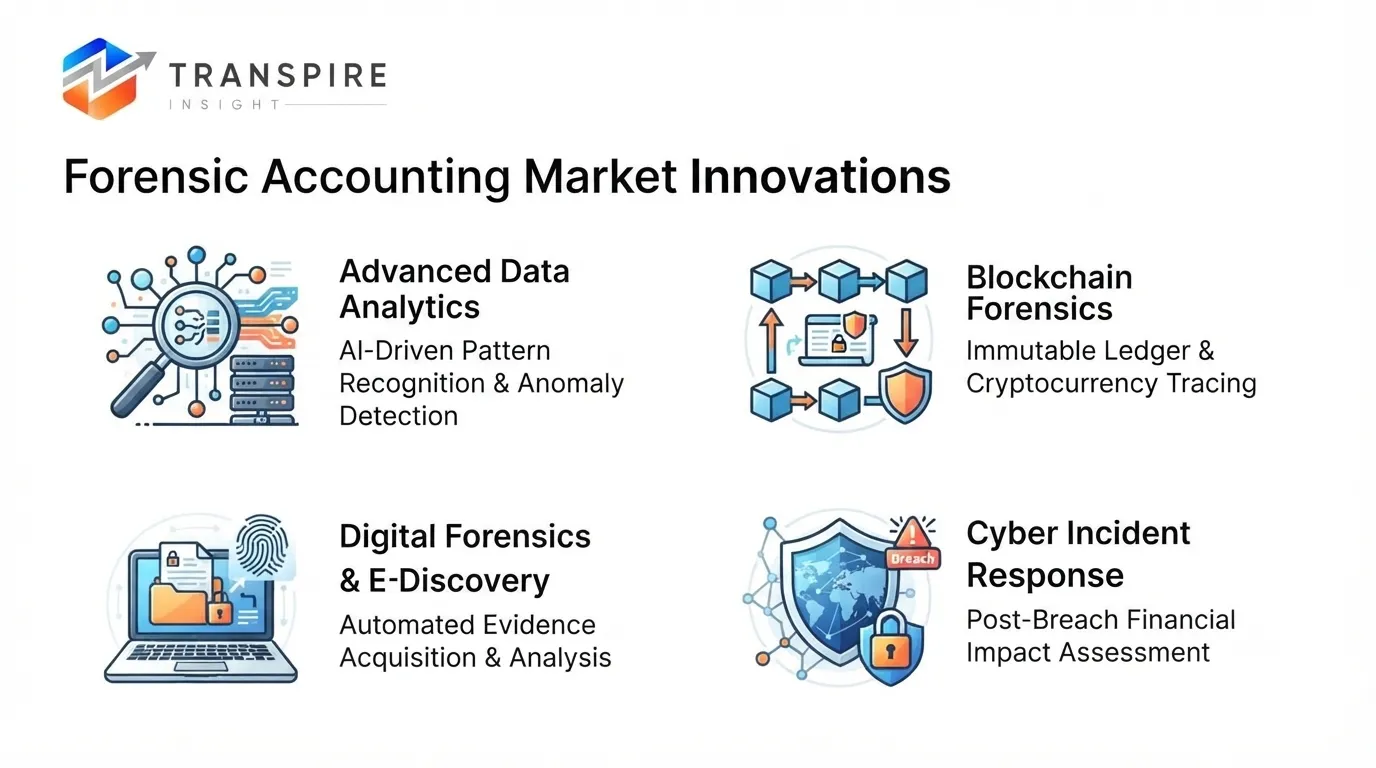
Forensic accounting is becoming an increasingly important component of modern financial governance as organizations face more sophisticated fraud schemes, complex transactions, regulatory scrutiny and growing volumes of digital financial information. Companies are moving beyond traditional audits toward specialized investigations capable of tracing transactions, identifying anomalies, quantifying losses and supporting legal proceedings.
The integration of artificial intelligence, data analytics, digital forensics and cloud technologies is transforming the way forensic accountants investigate financial irregularities. As businesses become more digitally connected, demand for technology-enabled forensic accounting is expected to expand across financial institutions, corporations, governments, insurance companies and legal organizations.
September 2026: Forensic accounting combines accounting, auditing, investigation and analytical techniques to examine financial information for potential fraud, misconduct, disputes or other irregularities. Unlike conventional financial accounting, forensic accounting is often performed with the possibility that findings may be used in litigation, regulatory proceedings, arbitration or internal investigations.
Modern forensic accounting increasingly involves large-scale transaction analysis, electronic evidence review, asset tracing, financial modeling and data visualization. The growing complexity of digital payments, cloud systems, cross-border transactions and online business models has expanded the volume of information that investigators must analyze.
Organizations are also becoming more proactive. Instead of waiting for financial misconduct to occur, companies are increasingly using forensic techniques for fraud-risk assessments, transaction due diligence, compliance monitoring and internal-control evaluation.
Market Size
The global Forensic Accounting Market was estimated at approximately USD 7.4 billion in 2025 and is projected to reach around USD 13.8 billion by 2032, expanding at an estimated CAGR of 9.3% during 2026–2032.
Recent market studies produce somewhat different values because some definitions include forensic accounting services only, while others also incorporate software, digital-forensic tools and technology-enabled investigation solutions. Fortune Business Insight estimates the market at USD 7.71 billion in 2025 and projects USD 14.19 billion by 2034 at a 7.02% CAGR, while 360iResearch estimates USD 7.09 billion in 2025 and USD 13.51 billion by 2032 at a 9.63% CAGR.
The market is supported by increasing financial fraud risks, regulatory requirements, complex corporate transactions, litigation activity and the digitization of financial records.
North America currently represents the largest regional market, while Asia Pacific is expected to record strong growth as businesses digitize and regulatory frameworks develop. Mordor Intelligence estimates North America held approximately 40.25% of market revenue in 2025 and projects Asia Pacific to grow at approximately 10.05% annually through 2031.
Rising Financial Fraud Is Increasing Demand
Financial fraud remains one of the strongest demand drivers for forensic accounting.
Fraud can involve false financial statements, asset misappropriation, corruption, procurement irregularities, expense manipulation, revenue recognition problems and increasingly sophisticated cyber-enabled schemes.
Traditional audit procedures are designed primarily to provide reasonable assurance rather than investigate every transaction for misconduct.
Forensic accounting takes a different approach.
Investigators can examine transaction patterns, relationships between entities, unusual payments and inconsistencies between financial records and operational information.
This allows companies to identify potential misconduct and determine its financial impact.
Digital Payments Are Creating New Investigation Challenges
The expansion of digital payments has changed the financial crime environment.
Transactions can move rapidly across payment platforms, banks, digital wallets and international jurisdictions.
KPMG's 2026 forensic research highlights how digital payments, mobile platforms, cloud services, stolen identities and artificial intelligence are contributing to increasingly technology-driven fraud ecosystems.
Forensic accountants therefore increasingly need technology skills alongside conventional accounting expertise.
Investigations can involve enormous datasets rather than a small number of physical documents.
This is encouraging demand for automated data-analysis tools and digital forensic platforms.
Artificial Intelligence Is Reshaping Forensic Investigations
AI is becoming one of the most significant technological trends in forensic accounting.
Machine-learning systems can examine large volumes of financial information and identify unusual relationships or patterns.
For example, algorithms can flag transactions involving unusual vendors, abnormal payment timing, duplicate invoices or unexpected changes in financial behavior.
AI can also help investigators prioritize information for further examination.
This does not eliminate the need for human forensic professionals.
Instead, technology can reduce the time spent on repetitive data processing and allow investigators to focus on interpretation, interviews, evidence assessment and professional judgment.
Recent developments at major professional-services firms show increasing use of AI and advanced analytics in investigations. EY, for example, describes AI-enabled forensic analytics as part of its technology-enabled forensic and integrity services.
Fraud Investigation Represents a Core Application
Fraud investigation is one of the largest applications within the market.
Mordor Intelligence estimates that fraud detection and investigation accounted for approximately 38.05% of the forensic accounting market in 2025.
Investigations may begin following whistleblower reports, suspicious transactions, regulatory inquiries, internal-control failures or allegations of misconduct.
Forensic accountants examine financial records and supporting evidence to establish what happened and quantify the resulting financial impact.
Litigation Support Creates Sustained Demand
Forensic accounting is widely used in commercial disputes.
Businesses may require specialists to calculate damages, reconstruct financial records, analyze lost profits, value businesses or investigate disputed transactions.
Forensic accountants can also serve as expert witnesses.
This makes litigation support an important component of the industry.
The service is relevant to shareholder disputes, contract disagreements, intellectual-property cases, insurance claims, bankruptcy matters and other financial conflicts.
Corporate Governance Is Strengthening Market Demand
Companies are increasingly expected to demonstrate stronger internal controls.
Boards, investors, regulators and stakeholders want greater visibility into financial risks.
Forensic accounting can support these objectives by identifying weaknesses in financial processes and evaluating potential exposure to fraud.
Preventive forensic services are therefore gaining importance alongside reactive investigations.
Organizations may conduct forensic reviews before major transactions, after acquisitions or when entering high-risk markets.
Mergers and Acquisitions Create Forensic Opportunities
M&A transactions can create substantial financial and compliance risks.
Companies need to understand whether acquisition targets have undisclosed liabilities, questionable transactions or compliance problems.
Transaction forensics can examine financial information and identify potential risks before or after a deal.
EY, for example, describes transaction forensics as a service for identifying financial, operational and reputational risks in M&A transactions, including anti-corruption due diligence and related investigations.
As global M&A activity becomes increasingly complex, forensic due diligence can become an important component of transaction risk management.
Cybercrime Is Expanding the Scope of Forensic Accounting
Cybercrime and financial crime are increasingly interconnected.
A cyberattack can result in unauthorized payments, stolen identities, manipulated financial records or fraudulent transactions.
Investigators may therefore need to combine accounting analysis with digital forensics.
The integration of accounting and technology expertise is becoming particularly important for banks, fintech companies, e-commerce platforms and multinational corporations.
BFSI Remains a Major End User
Banking, financial services and insurance represent one of the largest end-user groups.
Mordor Intelligence estimates BFSI accounted for approximately 41.12% of forensic accounting revenue in 2025.
Financial institutions handle enormous transaction volumes and operate under extensive regulatory requirements.
Banks may require forensic services for fraud investigations, money-laundering reviews, regulatory matters, employee misconduct and complex financial disputes.
Insurance companies also use forensic accounting to investigate suspicious claims and quantify financial losses.
Government and Public-Sector Demand Is Growing
Government agencies use forensic accounting to investigate financial misconduct, procurement irregularities, tax-related issues and misuse of public funds.
Increasing emphasis on transparency and accountability is creating opportunities for specialized forensic professionals.
Government organizations can also use forensic analytics to analyze large procurement and payment datasets.
SMEs Represent an Emerging Opportunity
Large enterprises currently account for a substantial portion of the market.
However, small and medium-sized businesses are increasingly recognizing the financial impact of fraud.
Mordor Intelligence estimates large enterprises represented about 63.05% of market revenue in 2025, while SMEs are expected to grow faster through 2031.
Cloud-based forensic tools could make specialized capabilities more accessible to smaller organizations.
Cloud Deployment Is Expanding
Cloud technology is changing forensic accounting software.
Cloud-based platforms allow investigation teams to access data from multiple locations and collaborate across jurisdictions.
They can also reduce infrastructure requirements.
For multinational investigations, centralized cloud platforms can help teams manage information across different offices.
However, data privacy, cybersecurity and evidence-management requirements remain important considerations.
Data Analytics Is Becoming Essential
The amount of financial data available to organizations continues to grow.
Manual review becomes increasingly inefficient when investigators need to analyze millions of transactions.
Data analytics allows forensic teams to search for patterns and relationships.
Visualization tools can make complex financial relationships easier to understand.
This is particularly useful when presenting findings to executives, regulators, lawyers or courts.
North America Leads the Market
North America remains the largest regional market.
Fortune Business Insight estimates that North America accounted for approximately 38% of global forensic accounting revenue in 2025.
The United States has a mature ecosystem of professional-services firms, litigation practices, financial institutions and forensic technology providers.
High levels of corporate activity and regulatory oversight also support demand.
Europe Maintains Strong Demand
Europe represents another major market.
The region has extensive financial regulation and a large concentration of multinational companies.
Cross-border transactions create additional requirements for financial investigations.
Forensic accounting is also used extensively in disputes, regulatory proceedings, compliance programs and transaction due diligence.
Asia Pacific Offers Strong Growth Potential
Asia Pacific is expected to be among the fastest-growing regional markets.
Rapid digitization of financial services, expanding corporate activity and increasing regulatory sophistication are creating demand.
Countries including China, India, Japan, Singapore, Australia and South Korea are developing increasingly sophisticated financial ecosystems.
India represents an especially important opportunity because digital payments, financial technology and corporate digitization have expanded rapidly.
Recent Indian market research also identifies increasing financial fraud, regulatory scrutiny and digital financial reporting as drivers of forensic accounting demand.
Middle East and Africa Present Emerging Opportunities
The Middle East and Africa represent smaller markets but provide opportunities related to infrastructure investment, financial transparency, corporate governance and regulatory development.
Large infrastructure projects and cross-border investments can generate demand for financial investigation and dispute-support services.
As regulatory frameworks mature, organizations are expected to increase investment in fraud prevention and forensic capabilities.
Competitive Landscape
The forensic accounting market includes global professional-services networks, specialized consulting firms, financial investigation specialists and forensic technology providers.
The competitive environment includes Deloitte, PwC, KPMG, EY, FTI Consulting, Kroll, Alvarez & Marsal, AlixPartners, Grant Thornton and BDO.
Industry research identifies these organizations among the principal participants in the global forensic accounting competitive landscape.
Technology capabilities are becoming increasingly important to competition. Providers are investing in AI, analytics, eDiscovery, digital investigations and automated transaction analysis.
Top 10 Companies in Forensic Accounting Market
1. Deloitte
Headquarters: London, United Kingdom
Deloitte is a major professional-services organization with extensive forensic, financial-crime and investigative capabilities.
Its forensic activities cover areas including fraud investigations, regulatory matters, financial analysis, disputes and technology-enabled investigations.
Deloitte's scale allows it to combine accounting expertise with data analytics, technology and industry knowledge.
The company is also participating in the broader transition toward AI-assisted financial analysis and investigation.
2. PwC
Headquarters: London, United Kingdom
PwC provides investigations and forensic services across fraud, financial crime, disputes, regulatory matters and compliance.
Its forensic teams work with corporate clients and legal professionals on complex financial investigations.
PwC also emphasizes technology-enabled investigations and data analytics.
The company's global network allows it to support cross-border matters involving multiple jurisdictions.
3. EY
Headquarters: London, United Kingdom
EY operates a substantial Forensic & Integrity Services practice.
Its capabilities include forensic accounting, fraud investigations, regulatory support, transaction forensics, disputes, digital investigations and compliance.
EY reports that its international forensic and technology organization includes more than 4,000 professionals, reflecting the scale of its global forensic capabilities.
The company is also integrating AI, analytics and technology into forensic investigations.
4. KPMG
Headquarters: Amstelveen, Netherlands
KPMG provides forensic services covering fraud prevention, investigations, financial crime, regulatory compliance, disputes and forensic technology.
Its forensic practice combines accounting, technology, economics and investigative capabilities.
KPMG also highlights AI and analytics-driven investigation approaches for analyzing complex datasets and identifying potential fraud patterns.
The company's growing focus on technology reflects the increasing digitization of financial crime.
5. FTI Consulting
Headquarters: Washington, D.C., USA
FTI Consulting is a specialist consulting firm with substantial expertise in forensic investigations, disputes and financial analysis.
Its services support litigation, arbitration, corporate investigations and complex financial matters.
The company's specialist positioning allows it to compete in high-value disputes where detailed financial analysis and expert testimony are required.
6. Kroll
Headquarters: New York, USA
Kroll provides risk, investigations, compliance, valuation and financial advisory services.
Its forensic capabilities support corporate investigations, financial crime matters, asset tracing and disputes.
The company's broader risk-management platform allows forensic work to be integrated with corporate intelligence and investigative services.
7. Alvarez & Marsal
Headquarters: New York, USA
Alvarez & Marsal provides disputes, investigations, financial-crime and forensic technology services.
Its specialists perform financial and economic analysis for complex disputes, including damages analysis, forensic accounting, valuation and expert testimony.
The company also provides financial-crime compliance and investigation services.
Its combination of restructuring, investigations and advisory capabilities provides exposure to complex corporate situations.
8. AlixPartners
Headquarters: New York, USA
AlixPartners provides business advisory and consulting services, including investigations, disputes and financial analysis.
Its forensic capabilities are particularly relevant to complex corporate situations involving financial misconduct, restructuring and litigation.
The company serves clients across multiple industries and can combine financial analysis with broader business advisory expertise.
9. Grant Thornton
Headquarters: Chicago, USA
Grant Thornton is a global professional-services organization providing audit, tax and advisory services.
Its forensic and investigative capabilities support fraud examinations, disputes, financial analysis and risk management.
The company serves both large organizations and mid-market businesses, providing opportunities in the growing SME and middle-market forensic segment.
10. BDO
Headquarters: Zaventem, Belgium
BDO is a global professional-services network offering audit, tax and advisory services.
Its forensic accounting capabilities cover financial investigations, disputes, fraud-related matters and risk advisory.
The company's international network allows it to support cross-border investigations while also serving regional and mid-sized organizations.
Outlook: Could AI Transform Forensic Accounting From Reactive Investigation to Continuous Financial Intelligence?
The forensic accounting industry is entering a technology-driven phase.
Traditional forensic accounting will remain important because financial investigations require professional judgment, evidence interpretation and an understanding of legal and accounting principles.
However, the scale of available data is changing the profession.
Future investigations are likely to involve increasingly automated transaction analysis.
AI systems could continuously examine financial data and identify unusual behavior before it develops into a major financial loss.
This could shift organizations from reactive investigations toward continuous financial-risk monitoring.
Cloud platforms will further support this transition by allowing organizations to centralize financial information and investigative workflows.
Another important trend will be the convergence of forensic accounting and digital forensics.
Financial misconduct increasingly leaves electronic evidence across cloud applications, messaging systems, payment platforms and enterprise databases.
Investigators therefore need capabilities extending beyond traditional accounting records.
Cybersecurity and financial crime will become increasingly interconnected.
The development of digital payments and real-time financial systems will also create new investigative challenges. KPMG's 2026 analysis describes fraud as increasingly digital, organized and cross-border, highlighting the need for intelligence-led forensic models.
At the same time, AI adoption will create new governance requirements.
Organizations cannot simply rely on automated systems to determine whether a transaction is fraudulent.
Investigators must validate findings, understand false positives and maintain defensible evidence trails.
Data privacy will also remain a major consideration, particularly for multinational investigations involving sensitive employee, customer and financial information.
Forensic accounting firms that combine accounting expertise with AI, data science, cybersecurity, digital forensics and legal knowledge will be positioned to address increasingly complex investigations.
The long-term market opportunity extends beyond detecting fraud after it occurs.
Companies increasingly want to understand where their financial processes are vulnerable, how risks can be prevented and how quickly potential misconduct can be identified.
As a result, forensic accounting is gradually evolving from a specialized investigative function into a broader component of enterprise risk management.
The market's next stage is likely to be characterized by AI-assisted investigation, continuous transaction monitoring, digital evidence management, predictive analytics, regulatory intelligence and technology-enabled litigation support.
With financial transactions becoming more digital and increasingly global, forensic accounting will remain an important mechanism for strengthening transparency, accountability and financial integrity across the corporate economy.


Send us a brief description of your challenge and we'll get back to you within 24 hours.

 inquiry@transpireinsight.com
 APAC:+91 7666513636
 Address


