
Oct 06, 2026
By Transpire Insight
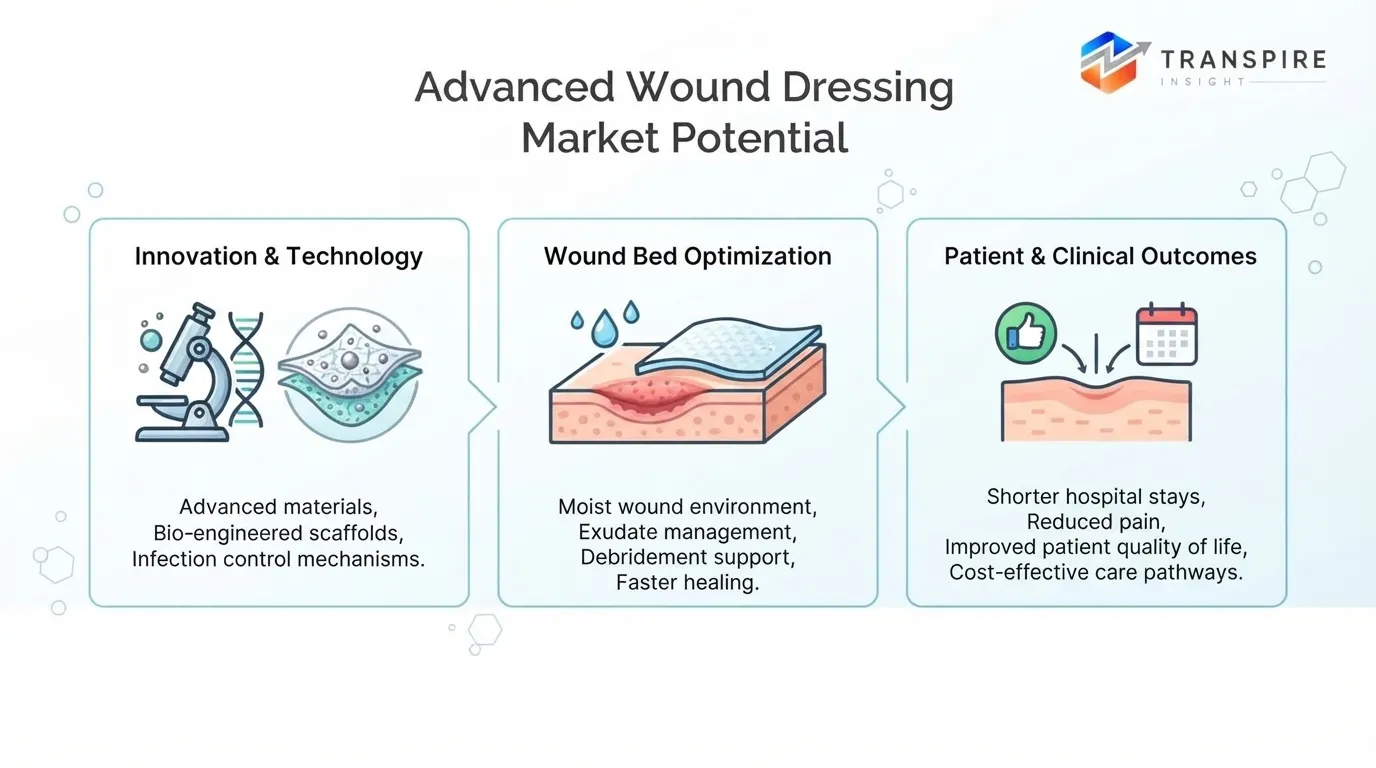
Advanced wound dressings are becoming increasingly important as healthcare systems manage a growing burden of chronic wounds, surgical wounds, burns, diabetic ulcers, pressure injuries, and traumatic wounds. Unlike conventional gauze-based products that primarily provide basic protection, advanced dressings are designed to manage moisture, absorb exudate, support wound-bed conditions, protect surrounding skin, and in some cases provide antimicrobial or biologically active functions.
The transition toward patient-centered wound management is creating opportunities for foam, hydrocolloid, alginate, hydrogel, hydrofiber, collagen, silicone, antimicrobial, and composite dressings. Manufacturers are also developing products that can remain in place for longer periods, reduce unnecessary dressing changes, improve comfort, and support wound management across hospitals, specialty clinics, home healthcare, and outpatient settings.
September 2026: The global Advanced Wound Dressing Market is moving through a period of steady technological development as healthcare providers increasingly seek products capable of addressing the different stages and characteristics of wound healing. Advanced dressings are being used across chronic and acute wound management, with manufacturers focusing on exudate control, moisture balance, infection management, skin protection, conformability, and patient comfort. The market is also benefiting from the expansion of home healthcare and the growing need for wound-care solutions that can be used outside traditional hospital environments.
Market Size
According to Transpire Insight, the global Advanced Wound Dressing Market was valued at approximately USD 8.45 billion in 2025 and is projected to reach approximately USD 12.19 billion by 2033, expanding at a CAGR of 4.71% from 2026 to 2033. The market covers foam, hydrocolloid, alginate, antimicrobial, hydrogel, film, composite, and other advanced dressing technologies used for surgical wounds, burns, diabetic ulcers, pressure ulcers, trauma injuries, and chronic wounds.
The market's expansion reflects the growing emphasis on wound-bed management rather than simple wound coverage. Advanced dressings can be designed to absorb excess fluid, maintain an appropriate moisture environment, protect fragile skin, reduce leakage, and support the clinical management of complex wounds.
Chronic Wounds Are Increasing the Need for Advanced Dressing Technologies
Chronic wounds represent one of the most important demand areas for advanced wound dressings. Diabetic foot ulcers, pressure ulcers, venous leg ulcers, and other wounds that fail to progress normally through healing can require prolonged treatment and repeated clinical assessment.
Medline describes chronic wounds as wounds that fail to progress through normal healing phases in an orderly and timely manner, with diabetic and pressure ulcers among important examples.
As populations age and the prevalence of chronic diseases increases, healthcare providers are facing a greater need for wound-management products that can handle exudate, protect tissue, and remain effective over longer treatment periods.
This is encouraging manufacturers to develop increasingly specialized dressing formats rather than relying on one standard product for every wound.
Diabetic Foot Ulcers Are Creating Sustained Demand
Diabetes is a major factor contributing to the long-term need for wound-care products. Patients with diabetes can develop foot ulcers that require careful monitoring and multidisciplinary treatment.
Advanced dressings are increasingly incorporated into comprehensive wound-management protocols where moisture balance, exudate control, infection management, pressure reduction, and protection of surrounding tissue are important considerations.
The demand generated by diabetic foot ulcers is particularly relevant in countries experiencing increasing diabetes prevalence and expanding healthcare access. India, for example, is expected to see its advanced wound dressing market reach approximately USD 419.7 million by 2033, with a 6.6% CAGR from 2026 to 2033 according to Grand View Research.
Foam Dressings Remain a Major Product Category
Foam dressings are widely used because they can provide cushioning while absorbing wound exudate. Their flexibility makes them suitable for wounds located on different areas of the body, while silicone contact layers can reduce adhesion-related trauma during dressing changes.
Smith+Nephew's ALLEVYN portfolio illustrates the continuing development of foam technology. Its dressings use hydrocellular foam structures for exudate management, with certain versions incorporating silicone contact layers and conformable designs.
Mölnlycke's Mepilex range similarly combines absorbent foam with Safetac soft silicone technology. The company states that Mepilex is designed to absorb exudate, maintain a moist wound environment, and minimize trauma during removal.
The continued development of foam dressings demonstrates how the category is moving beyond simple absorption toward comfort, retention, conformability, and skin protection.
Hydrofiber Technology Is Advancing Exudate Management
Hydrofiber technology is another important development within advanced wound care. These dressings are designed to absorb wound fluid and transform into a cohesive gel.
ConvaTec's Hydrofiber technology uses sodium carboxymethylcellulose fibers that absorb and retain fluid by forming a gel. The company describes the technology as supporting moisture balance while helping lock in exudate.
The AQUACEL family has expanded the application of Hydrofiber technology into multiple dressing formats, including foam, surgical, burn, and antimicrobial products.
The ability to combine fluid management with wound-bed conformity is supporting demand for advanced fiber-based dressings in wounds with moderate to heavy exudate.
Antimicrobial Dressings Address Infection-Management Requirements
Wound infection is a significant concern in chronic and acute wound management. This has encouraged manufacturers to develop dressings incorporating antimicrobial materials such as silver and other antimicrobial technologies.
Silver-based dressings are designed for specific clinical situations where microbial management is required. However, antimicrobial products are generally selected according to wound characteristics and clinical judgment rather than being universally appropriate for every wound.
Mölnlycke's Mepilex Border Ag incorporates silver sulfate within a multilayer foam dressing and is designed to provide antimicrobial activity alongside exudate management.
ConvaTec also offers AQUACEL Ag products that combine ionic silver with Hydrofiber technology.
This combination of antimicrobial functionality and fluid management represents an important direction in advanced wound dressing development.
Silicone Dressings Are Improving Patient Comfort
Traditional adhesive materials can cause discomfort or damage fragile skin when dressings are removed repeatedly. Silicone contact layers have therefore become an important area of innovation.
Soft silicone technology can provide secure contact while reducing the degree of adhesion to the wound surface and surrounding skin.
Mölnlycke's Safetac technology is used across several Mepilex products and is specifically designed to minimize trauma during dressing removal.
Smith+Nephew has also developed silicone-based ALLEVYN products intended to combine absorption with comfortable application and removal.
The increasing importance of patient comfort is particularly relevant for chronic wounds because patients may require repeated dressing changes over extended periods.
Collagen-Based Dressings Are Expanding the Biomaterial Segment
Collagen is being incorporated into wound-care products because of its role as a structural protein in human tissue. Collagen-based products are designed for specific wound-management applications and can form part of a broader approach to supporting tissue repair.
HARTMANN's advanced wound-care portfolio includes collagen matrix products alongside hydrocolloid, hydrogel, foam, and alginate dressings.
Medline also offers collagen products as part of its advanced wound-care portfolio, alongside silver, foam, alginate, hydrogel, hydrocolloid, and superabsorbent products.
This diversification indicates that the advanced dressing market is becoming increasingly material-driven, with manufacturers developing products around particular wound characteristics.
Alginate Dressings Remain Important for Exuding Wounds
Alginate dressings are typically derived from seaweed-based materials and are valued for their fluid-management capabilities.
ConvaTec classifies alginate as a seaweed-derived dressing containing sodium and/or calcium ions, while HARTMANN's portfolio includes calcium alginate and silver-containing alginate products.
Alginate technology is therefore likely to remain an important part of the advanced wound dressing landscape, particularly where absorption and wound-bed management are required.
Home Healthcare Is Changing Dressing Requirements
The movement of healthcare from hospitals toward outpatient and home settings is creating new requirements for advanced wound dressings.
Home-based wound management can reduce the need for frequent hospital visits, but products need to be easy to apply, secure, comfortable, and capable of managing exudate between clinical assessments.
Medline offers advanced wound dressing products through both hospital and home-care channels, including foam, hydrocolloid, alginate, hydrogel, collagen, silver, and superabsorbent products.
As home healthcare expands, manufacturers are likely to focus increasingly on intuitive application, longer wear times, secure fixation, and clear visual indicators that help caregivers determine when dressing changes may be required.
Negative Pressure Wound Therapy Is Complementing Advanced Dressings
Although the Advanced Wound Dressing Market focuses primarily on dressing products, modern wound management increasingly integrates dressings with advanced therapy systems.
Negative pressure wound therapy uses controlled negative pressure to help manage wound fluid and support the wound environment. Solventum's V.A.C. therapy portfolio includes specialized dressings designed for different wound geometries and incorporates technology that monitors negative pressure at the wound site.
Mölnlycke also offers Avance Solo, a portable single-use negative pressure wound therapy system, demonstrating how dressing manufacturers are increasingly expanding toward therapy-based solutions.
The integration of dressings with therapy systems could create additional opportunities for companies that can offer complete wound-management portfolios.
Smart and Digital Wound Care Is Emerging
Digitalization is becoming increasingly relevant to wound management. Healthcare providers need reliable ways to document wound dimensions, monitor healing progress, track dressing changes, and identify changes that may require intervention.
Digital wound measurement and monitoring tools can potentially support more consistent clinical documentation and remote care.
Mölnlycke has identified digital solutions and AI as areas that can contribute to connected wound-care systems involving healthcare providers, patients, and healthcare organizations.
The combination of advanced dressings with digital monitoring could eventually create more integrated wound-management platforms.
Regional Outlook
North America
North America represents a major market for advanced wound dressings, supported by established healthcare infrastructure, advanced medical-device manufacturing, high utilization of specialized wound-care products, and significant demand associated with chronic wounds.
Transpire Insight identifies the United States, Canada, and Mexico within the North American market scope.
The United States remains particularly important because of its extensive hospital network, specialty wound-care services, home healthcare infrastructure, and established reimbursement environment.
The presence of major companies such as Solventum, Smith+Nephew, Medline, Cardinal Health, and other wound-care providers further strengthens the region's commercial ecosystem.
Europe
Europe has a mature wound-care market supported by established healthcare systems, aging populations, specialized clinical services, and strong medical-device manufacturing capabilities.
Countries including Germany, the United Kingdom, France, Italy, Spain, and Nordic markets represent important demand centers.
European companies such as Mölnlycke, Coloplast, HARTMANN, B. Braun, ConvaTec, and Urgo contribute significantly to product development and distribution.
The region is also increasingly focused on reducing healthcare costs through better prevention, fewer unnecessary dressing changes, and improved management of chronic wounds.
Asia Pacific
Asia Pacific represents an important long-term growth region because of its large population, increasing healthcare expenditure, rising diabetes burden, expanding hospital infrastructure, and growing access to specialized medical products.
China, Japan, South Korea, India, and Australia are among the important markets included in the Transpire Insight regional scope.
India is particularly notable for its developing advanced wound dressing market. Grand View Research estimates that India's market will grow from USD 252.3 million in 2025 to USD 419.7 million by 2033.
Increasing awareness of advanced wound-management methods and the expansion of private healthcare facilities are likely to support adoption across the region.
Latin America
Latin America is developing opportunities through improvements in hospital infrastructure, increased awareness of advanced wound treatment, and the growing prevalence of chronic diseases.
Brazil and Argentina represent important markets, while Mexico's proximity to the North American healthcare ecosystem provides additional commercial opportunities.
Cost remains a major consideration in the region, making affordability and product availability important factors for broader adoption.
Middle East & Africa
The Middle East & Africa market is gradually expanding as healthcare infrastructure improves and countries increase investment in specialized medical services.
Saudi Arabia, the United Arab Emirates, and South Africa are among the important markets covered within the global industry landscape.
Premium private hospitals and medical centers are potential early adopters of sophisticated wound-care products, while broader market development will depend on affordability, reimbursement, healthcare professional training, and distribution infrastructure.
Competitive Landscape
The Advanced Wound Dressing Market is highly diversified, with companies competing across product performance, clinical evidence, material science, product portfolios, geographic reach, and healthcare-provider relationships.
Manufacturers are expanding beyond individual dressing products toward broader wound-management ecosystems that may include dressings, compression therapy, cleansing products, negative pressure therapy, skin substitutes, digital tools, and clinical support.
Innovation is increasingly focused on combining multiple functions into a single dressing. Examples include antimicrobial and absorbent technologies, silicone contact layers, superabsorbent cores, collagen matrices, and hydrofiber structures.
Top 10 Companies in the Advanced Wound Dressing Market
Company Profiles
1. Solventum
Solventum is a major healthcare technology company with a broad wound-care portfolio. Its advanced wound-care activities include dressings, negative pressure wound therapy, compression solutions, and other wound-management products.
Its V.A.C. therapy portfolio includes specialized dressings and negative pressure systems designed for acute and chronic wound management.
The company's combination of advanced dressings and therapy-based solutions gives it exposure to multiple stages of wound management.
2. Smith+Nephew
Smith+Nephew is a major medical technology company with an established advanced wound-management business.
Its ALLEVYN portfolio includes foam dressings designed for exudate management, conformability, moisture management, and protection. Certain products incorporate silicone contact technologies and specialized structures for different wound types.
The company also offers products for surgical wounds, pressure injuries, chronic wounds, and other wound-care applications.
3. Mölnlycke Health Care
Mölnlycke has a strong focus on wound care and surgical products. Its portfolio includes Mepilex foam dressings, Exufiber fiber dressings, antimicrobial dressings, negative pressure wound therapy, wound cleansing products, and pressure-ulcer prevention solutions.
The Mepilex family uses Safetac soft silicone technology, while other products address exudate management and antimicrobial requirements.
4. ConvaTec Group
ConvaTec is a significant participant in advanced wound care, particularly through its AQUACEL Hydrofiber technology.
The company's Hydrofiber technology is designed to absorb wound fluid and transform into a gel, supporting fluid retention and moisture management.
Its AQUACEL portfolio includes foam, surgical, burn, and silver-containing antimicrobial dressings, allowing the company to address multiple wound-management requirements.
5. Coloplast
Coloplast provides advanced wound dressings across different stages of wound healing. The company has also expanded into biologic wound-care solutions through its acquisition of Kerecis, whose products use fish-skin technology for soft-tissue regeneration and management of difficult-to-heal wounds.
This combination of conventional advanced dressings and biologic technologies gives Coloplast exposure to multiple areas of wound management.
6. B. Braun
Its wound-care portfolio includes products supporting wound treatment and management in clinical settings. The company participates in the broader advanced wound-care ecosystem alongside other medical technologies.
7. Medline Industries
Medline has developed a broad advanced wound-care portfolio covering foam, alginate, collagen, hydrocolloid, hydrogel, silver, superabsorbent, compression, skin protection, and wound-cleansing products.
Its Optifoam, Opticell, Puracol, Exuderm, and other product families demonstrate the company's broad approach to wound management.
Medline's presence across hospitals, clinics, and home healthcare also supports its position across multiple care settings.
8. Integra LifeSciences
Integra LifeSciences participates in advanced wound management through products designed for tissue repair and wound-care applications.
Its portfolio includes technologies associated with wound healing, tissue regeneration, and biologically based treatment approaches.
The company is particularly relevant to the segment where advanced wound dressings overlap with tissue-engineered and regenerative wound-care technologies.
9. Urgo Medical
Urgo Medical specializes in wound-care products and services, with a focus on chronic wounds and advanced wound-management solutions.
The company develops products designed around specific wound characteristics, including infection, exudate, healing environment, and patient comfort.
Its specialization in wound care allows it to compete through clinical expertise and application-specific technologies.
10. PAUL HARTMANN
PAUL HARTMANN has a long-established presence in wound management and offers a diversified range of advanced wound dressings.
Its current portfolio includes hydrocolloids, hydrogels, foams, collagen products, alginates, and silver-containing products.
The company's broad material portfolio allows it to address different wound characteristics while supporting healthcare providers across various stages of wound treatment.
Key Challenges Facing the Advanced Wound Dressing Market
Despite continued expansion, advanced wound dressings face several challenges.
The first is cost. Advanced products can be considerably more expensive than conventional gauze and basic dressings. This can restrict adoption in healthcare systems with limited reimbursement or constrained medical budgets.
Clinical selection is another challenge. No single dressing is appropriate for every wound. Healthcare providers need to consider wound depth, exudate level, infection status, tissue condition, location, surrounding skin, and the patient's overall condition.
Training and product familiarity can also influence adoption. As manufacturers introduce increasingly specialized materials and multilayer products, healthcare professionals require appropriate education to select and apply them correctly.
Regulatory requirements can increase development costs and lengthen commercialization timelines, particularly for products incorporating antimicrobial agents, biologically derived materials, or advanced therapeutic technologies.
Sustainability is becoming another consideration. Manufacturers must balance sterile packaging requirements, product performance, single-use medical-device standards, and environmental objectives.
Future Outlook
The future of the Advanced Wound Dressing Market is expected to be shaped by the convergence of material science, clinical wound management, digital healthcare, and patient-centered product design.
Future dressings are likely to become more specialized rather than simply more absorbent. Products may increasingly incorporate multiple functions, such as moisture control, exudate retention, antimicrobial activity, conformability, skin protection, and visual indicators.
The development of smart wound dressings could represent another important direction. Sensors and digital technologies may eventually help monitor parameters such as wound moisture, temperature, pH, or infection-related changes, allowing clinicians to obtain more information without repeatedly removing the dressing.
Regenerative medicine is also expected to influence the market. Collagen matrices, biologically derived materials, skin substitutes, and tissue-regeneration technologies are gradually expanding the definition of advanced wound care.
At the same time, home healthcare will remain an important area of development. Products that are easier to apply, comfortable to wear, capable of longer wear periods, and compatible with remote clinical monitoring can help support decentralized wound management.
The Advanced Wound Dressing Market is therefore moving from simple wound protection toward increasingly sophisticated wound-management solutions. Continued investment in biomaterials, antimicrobial technologies, exudate management, silicone interfaces, digital monitoring, and regenerative medicine will shape the industry's next stage.
With healthcare providers increasingly focused on efficient chronic-wound management and patient comfort, advanced dressings are expected to remain an important component of modern wound-care strategies through 2033.


Send us a brief description of your challenge and we'll get back to you within 24 hours.

 inquiry@transpireinsight.com
 APAC:+91 7666513636
 Address


