
Sep 23, 2026
By Transpire Insight
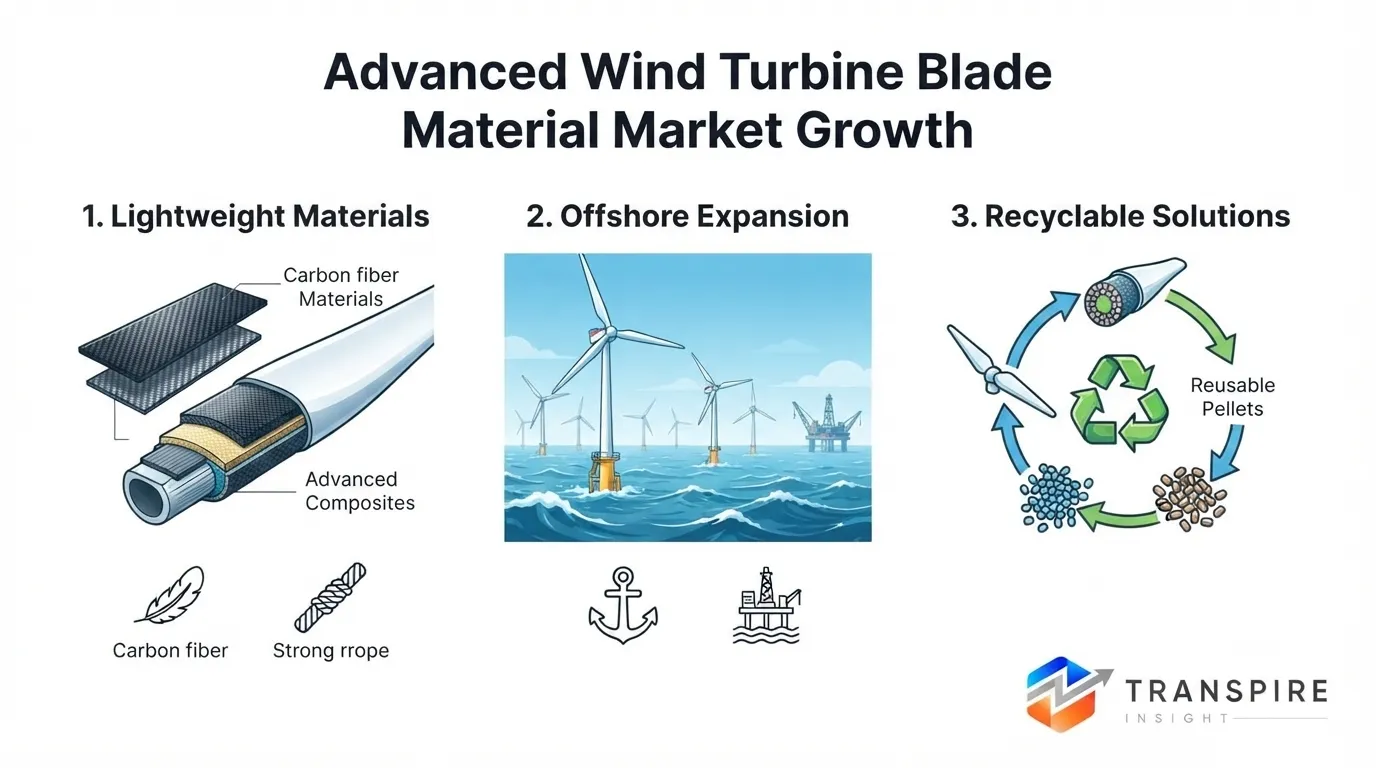
The wind industry is moving toward larger, lighter and more durable turbine blades, creating a major opportunity for advanced composites, carbon fiber, improved resins and next-generation manufacturing technologies.
The global advanced wind turbine blade material market is entering a new phase as wind-turbine manufacturers push toward larger rotor diameters, longer blades and improved energy capture.
Traditional blade materials remain important, but increasing turbine size is placing greater demands on stiffness, weight, fatigue resistance and durability. Offshore wind projects are particularly important because large turbines require blades capable of operating under demanding environmental conditions.
Market estimates vary considerably according to whether the scope includes only advanced materials or the broader blade-material ecosystem. Recent research places the global market around USD 11 billion in 2025, with the market potentially approaching USD 21 billion by 2035, representing growth of approximately 6.4% annually.
Larger turbines are changing material requirements
The commercial opportunity begins with turbine scale.
Modern turbines are becoming substantially larger than earlier generations. Longer blades can capture more wind energy, but their increasing size also creates structural challenges.
Every additional increase in blade length adds requirements for stiffness, fatigue performance and manufacturing precision. Excessive weight can increase loads on the turbine structure, drivetrain and tower.
This is why advanced materials are becoming strategically important.
Carbon fiber, glass fiber, advanced epoxy systems, thermoplastic composites and hybrid materials are being evaluated to balance performance and cost.
The market is therefore not simply about replacing conventional materials. It is about finding the right material combination for each turbine architecture and operating environment.
Market Size
The global advanced wind turbine blade material market is estimated at approximately USD 10.9 billion in 2025 and could reach nearly USD 20.9 billion by 2035, growing at around 6.5% CAGR through 2035. Current market studies report somewhat different figures because of differences in market definition.
Carbon fiber is gaining importance
Carbon fiber is one of the most important advanced materials in the sector because of its high strength-to-weight ratio.
For very large blades, reducing structural weight can provide important benefits. Carbon fiber can allow engineers to achieve required stiffness without adding the same mass associated with some traditional materials.
However, carbon fiber remains substantially more expensive than conventional glass fiber. This means its adoption depends on whether the performance advantages justify the additional cost.
As turbine manufacturers continue to move toward larger offshore platforms, the economics of carbon fiber may become increasingly favorable for selected blade sections.
Glass fiber remains the workhorse material
Despite the growth of advanced materials, glass fiber is expected to remain central to blade manufacturing.
Its comparatively low cost, established manufacturing ecosystem and reliable mechanical performance make it attractive for both onshore and offshore turbines.
The future market is therefore likely to be based on hybrid material architectures rather than a complete transition away from glass fiber.
Manufacturers can combine glass fiber and carbon fiber strategically, placing higher-performance materials where stiffness requirements are greatest while using more economical materials in other sections.
This approach can reduce total blade cost while still achieving advanced performance.
Resin systems are becoming increasingly important
Fiber selection is only one part of blade-material development. Resin systems determine how fibers are bound together and influence manufacturing speed, structural performance and recyclability.
Epoxy resins remain widely used because of their established performance, but manufacturers are increasingly interested in thermoplastic systems and other formulations.
Thermoplastic composites can potentially provide faster processing and improved recyclability. This is particularly important because end-of-life blade disposal has become a major sustainability issue for the wind industry.
As governments and developers place greater emphasis on circularity, material suppliers that can demonstrate recycling pathways may gain an important competitive advantage.
Offshore wind creates a major opportunity
Offshore wind is expected to become one of the strongest demand drivers for advanced blade materials.
Offshore turbines face high wind loads, saltwater exposure, fatigue and difficult maintenance conditions. Longer blades can increase energy output, but they also intensify structural demands.
This creates a premium market for materials capable of delivering high stiffness, durability and resistance to environmental degradation.
Offshore projects also make maintenance costs particularly important. A material that extends blade life or reduces inspection requirements can generate value beyond its initial purchase price.
Sustainable materials could become the next growth engine
Sustainability is increasingly influencing material selection.
Wind power is itself a renewable technology, but turbine blades have historically presented recycling challenges because of their composite construction.
This is encouraging research into recyclable thermoplastics, bio-based resins, improved composite separation and alternative reinforcement materials.
Bamboo and other bio-based materials have also attracted research attention, although their commercial adoption remains much smaller than established fiberglass and carbon-fiber systems.
Material companies that solve both performance and end-of-life challenges could gain a strong competitive position.
Manufacturing technology is evolving
Advanced blade materials are closely connected to manufacturing technology.
Prepreg systems, resin-infusion processes, automated fiber placement and emerging additive manufacturing approaches can improve consistency and reduce labor requirements.
Automation becomes increasingly important as blade dimensions grow. Large components are difficult to manufacture manually at high volumes, making digital process control and automated handling more attractive.
Manufacturers are also using simulation and digital engineering to optimize fiber orientation, structural loads and material utilization.
Key challenges
Cost remains the most significant challenge.
Carbon fiber and some advanced resin systems can be considerably more expensive than conventional materials. Turbine manufacturers therefore need clear evidence that performance gains justify additional material costs.
Supply-chain availability is another concern. Wind turbine demand can grow rapidly, creating pressure on fiber, resin and composite suppliers.
Blade recycling remains a long-term challenge. Although new materials may improve recyclability, commercial-scale recycling infrastructure is still developing.
Finally, the wind industry is highly sensitive to project economics. Interest rates, permitting, grid connection and supply-chain constraints can affect turbine installations and therefore material demand.
Competitive landscape
The competitive environment includes material suppliers, chemical companies, composite manufacturers and turbine OEMs.
Major participants compete through material performance, cost, production capacity, technical support and long-term supply agreements.
Top 10 Companies in Advanced Wind Turbine Blade Material Market
Headquarters: Stamford, Connecticut, USA
Hexcel is a major advanced-composites company supplying carbon fibers, reinforcement materials and composite technologies. Its expertise makes it an important supplier for applications requiring high strength and low weight.
Headquarters: Wiesbaden, Germany
SGL Carbon specializes in carbon-based materials and composite solutions. Its capabilities position the company to benefit from continued demand for lightweight, high-performance materials in large turbine blades.
Headquarters: Toledo, Ohio, USA
Owens Corning is a major supplier of glass fiber and related materials. Its scale and established manufacturing infrastructure make it an important participant in the wind-blade material ecosystem.
Headquarters: Tokyo, Japan
Teijin develops advanced fibers and composite materials used across transportation, industrial and energy applications. The company's focus on lightweight materials provides opportunities as turbine blade designs become more demanding.
Headquarters: Tokyo, Japan
Mitsubishi Chemical Group operates across advanced materials, polymers and composite technologies. Its broad materials portfolio supports opportunities in next-generation wind-turbine blade manufacturing.
Outlook: Could advanced materials unlock larger wind turbines?
The advanced wind turbine blade material market is expected to expand as turbine manufacturers pursue larger, lighter and more efficient designs.
Carbon fiber, hybrid composites, advanced resin systems and recyclable materials will each have a role in the next generation of blade technology.
The strongest opportunity may ultimately come from material systems that deliver several advantages simultaneously: lower weight, greater durability, faster manufacturing and improved end-of-life recyclability.
As offshore wind grows and turbine dimensions increase, advanced materials could become less of an optional upgrade and more of a fundamental requirement.


Send us a brief description of your challenge and we'll get back to you within 24 hours.

 inquiry@transpireinsight.com
 APAC:+91 7666513636
 Address


