
Oct 06, 2026
By Transpire Insight
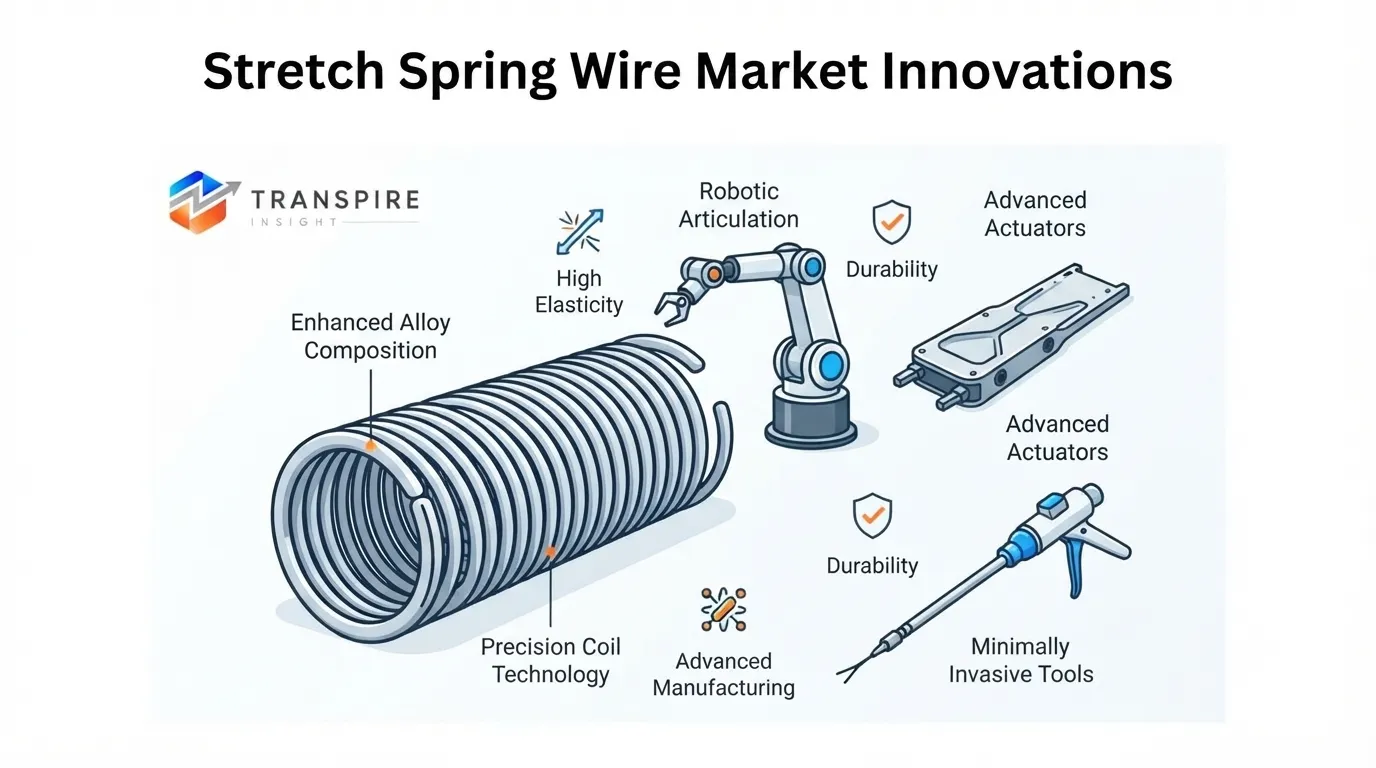
Stretch spring wire is becoming an increasingly important engineered material as manufacturers across automotive, aerospace, industrial machinery, electronics, medical devices, construction equipment, and consumer products demand components capable of delivering reliable force, flexibility, fatigue resistance, and long operating life. Extension springs and other spring mechanisms depend heavily on the quality and mechanical consistency of the wire from which they are manufactured.
The industry is moving beyond conventional spring-steel products toward higher-strength stainless steel, alloy steel, oil-tempered wire, music wire, shaped wire, and specialized coated materials. Lightweighting, vehicle electrification, industrial automation, precision medical equipment, and increasingly compact mechanical assemblies are encouraging manufacturers to develop spring wire with tighter dimensional tolerances, improved fatigue performance, corrosion resistance, and more consistent forming characteristics.
September 2026: The global Stretch Spring Wire Market was valued at approximately USD 1.793 billion in 2025 and is projected to reach around USD 2.708 billion by 2033, expanding at a CAGR of approximately 5.3% from 2026 to 2033. The market includes stainless steel spring wire, carbon steel spring wire, alloy spring wire, galvanized spring wire, oil-tempered spring wire, music wire, phosphor bronze spring wire, and other specialized materials used in automotive springs, industrial machinery, construction equipment, aerospace components, consumer appliances, electronics, and medical devices.
Market Size
The global Stretch Spring Wire Market is estimated at approximately USD 1.793 billion in 2025 and is expected to reach approximately USD 2.708 billion by 2033, registering a CAGR of about 5.3% during 2026–2033.
Stretch spring wire is used to manufacture springs that extend under load and return toward their original configuration when the load is released. Depending on material composition and processing, spring wire can provide tensile strength, elastic recovery, fatigue resistance, corrosion resistance, heat resistance, and dimensional stability.
The market serves a broad range of industrial applications. Automotive systems represent an important demand center, while aerospace, industrial machinery, construction equipment, oil and gas, mining, electronics, medical devices, consumer appliances, and other precision applications create additional opportunities. Industry research also identifies automotive and aerospace as important application areas for stretch spring wire.
Automotive Manufacturing Drives Demand
The automotive industry remains one of the most significant users of spring wire.
Springs are incorporated into braking systems, seating mechanisms, door systems, latches, steering assemblies, suspension systems, transmission components, engine systems, safety belts, and numerous other vehicle functions.
These components frequently experience repeated mechanical loads. Consequently, the wire used to manufacture them must maintain consistent mechanical properties throughout extended service.
Suzuki Garphyttan describes automotive spring wire applications including trunk opening systems, door mechanisms, safety systems, valve springs, fuel injection springs, retaining rings, seat-belt retractors, and transmission damper springs. The company highlights fatigue resistance, dimensional accuracy, and stable mechanical properties as important requirements for automotive spring wire.
As global vehicle production becomes more sophisticated, demand is shifting toward spring wire that can provide higher performance without adding unnecessary weight.
Vehicle Electrification Is Changing Spring-Wire Requirements
Electric vehicles are creating new engineering requirements throughout the automotive supply chain.
EV battery systems add substantial vehicle mass, increasing the importance of lightweight components.
Spring manufacturers are therefore exploring high-strength materials that can deliver the required force with reduced material volume.
Electrification also changes the operating environment of certain components. Higher electrical content, new thermal-management systems, compact packaging, and different vehicle architectures can require springs with specialized geometries and corrosion resistance.
Bekaert notes that electrification is increasing the importance of corrosion protection and longer component lifetimes for automotive spring applications. Its spring-wire portfolio includes specialized coatings designed to improve corrosion resistance.
The transition toward electric mobility therefore creates opportunities for advanced wire grades rather than simply increasing demand for conventional spring steel.
High-Fatigue Materials Are Becoming More Important
Fatigue performance is one of the most important characteristics of spring wire.
A spring may be compressed, extended, twisted, or otherwise loaded thousands or millions of times throughout its operating life.
Small surface imperfections can become initiation points for fatigue cracks under repeated stress.
Manufacturers are consequently investing in cleaner steel, controlled drawing processes, surface treatments, heat treatment, and non-destructive testing.
Suzuki Garphyttan offers high-fatigue steel wire materials and emphasizes controlled quality and testing for applications requiring demanding mechanical performance.
Usha Martin similarly uses continuous eddy-current inspection for selected spring wires to identify surface flaws along the wire length, supporting applications exposed to high dynamic stresses.
Oil-Tempered Spring Wire Supports High-Stress Applications
Oil-tempered wire is widely used in demanding spring applications.
The manufacturing process involves heat treatment that provides a combination of strength, toughness, and fatigue performance.
Applications include valve springs, clutch springs, suspension springs, and other components exposed to repeated mechanical loading.
Suzuki Garphyttan's OTEVA range includes oil-tempered wire developed for valve springs, transmission components, and crankshaft damper springs. The company highlights tensile strength, fatigue life, and coiling properties for these applications.
Usha Martin also offers oil-tempered silicon-chromium and silicon-chromium-vanadium spring wire grades for valve springs, clutch springs, and suspension springs.
The continuing demand for high-performance mechanical components supports the adoption of these specialized wire grades.
Aerospace Applications Require Precision and Reliability
Aerospace is another important application area for high-performance spring wire.
Aircraft and aerospace systems contain numerous spring components used in actuators, landing systems, engine-related mechanisms, seating systems, control assemblies, doors, valves, and other equipment.
Weight reduction is particularly important in aerospace engineering, while components must also tolerate vibration, temperature changes, repeated loads, and demanding environmental conditions.
This creates demand for materials that combine high strength with fatigue resistance and dimensional consistency.
Spring wire manufacturers can benefit from aerospace applications because these markets often require highly controlled materials and specialized specifications.
The qualification requirements can be demanding, but successful suppliers may develop long-term relationships with aerospace component manufacturers.
Industrial Automation Creates New Applications
The growth of industrial automation is expanding the range of machinery using precision springs.
Robotic arms, automated production equipment, conveyor systems, actuators, valves, tooling, grippers, and machine assemblies can all incorporate springs.
Automation equipment frequently performs repetitive movements continuously, increasing the importance of fatigue-resistant spring materials.
Standard spring wire may not always be appropriate for high-cycle applications.
Manufacturers are therefore developing wires with improved surface quality, dimensional consistency, tensile strength, and fatigue performance.
The trend toward smart factories and continuous production can increase demand for spring components capable of maintaining performance over extended operating cycles.
Electronics Requires Smaller Spring Components
Miniaturization is changing spring-wire requirements in electronics.
Electronic products increasingly contain smaller mechanisms, connectors, switches, actuators, hinges, battery contacts, and other components.
These applications can require very fine wire with extremely consistent diameter and surface quality.
Music wire, stainless steel wire, phosphor bronze, and other specialty materials can be selected according to electrical, mechanical, and corrosion requirements.
As consumer electronics become thinner and more compact, spring manufacturers are required to produce increasingly precise wire geometries.
Micro-drawing and controlled surface finishing are therefore becoming more important capabilities within the spring-wire supply chain.
Medical Devices Create Demand for Precision Wire
Medical equipment is another high-value application.
Springs are used in injection devices, inhalers, diagnostic equipment, surgical instruments, pumps, and other medical mechanisms.
Medical applications require high dimensional accuracy, consistent force characteristics, cleanliness, corrosion resistance, and reliable performance.
Bekaert specifically identifies medical applications including autoinjectors, inhalers, pen injectors, lancets, metering devices, pumps, and aerosol systems for its spring-wire products.
The expansion of self-administered drug delivery devices is creating additional opportunities for miniature spring components.
As pharmaceutical delivery becomes more device-oriented, spring-wire manufacturers capable of meeting stringent precision and quality requirements can access specialized medical applications.
Shaped Spring Wire Improves Design Flexibility
Round wire remains widely used, but shaped wire is gaining importance in applications where space is limited.
Square, rectangular, trapezoidal, half-round, and other profiles can provide different mechanical characteristics from conventional round wire.
Bekaert notes that shaped spring wire can provide higher stiffness and enable lighter or smaller spring designs compared with equivalent round-wire configurations.
This is particularly useful in automotive steering systems, compact mechanical assemblies, and other applications where available installation space is restricted.
Shaped wire can also improve material utilization and allow engineers to design springs around specific load requirements.
Corrosion Resistance Is Becoming a Key Differentiator
Corrosion can significantly reduce spring performance.
Surface deterioration can create defects that contribute to fatigue failure, especially when springs operate under repeated stress.
This is particularly relevant to automotive components exposed to road salt, moisture, temperature changes, and other environmental conditions.
Stainless steel provides inherent corrosion resistance, while carbon and alloy spring wires can be protected through coatings and surface treatments.
Bekaert offers spring wire with zinc-aluminum Bezinal coatings and other surface technologies designed to improve corrosion resistance. The company states that selected coatings can provide corrosion protection of at least 1,000 hours under ASTM B117 testing conditions.
The combination of high strength and corrosion protection is therefore becoming an important competitive factor.
Lightweighting Supports Advanced Alloy Development
Manufacturers across automotive, aerospace, industrial machinery, and consumer products are seeking to reduce component weight.
High-strength alloy spring wire can allow manufacturers to reduce wire diameter or material volume while maintaining the required spring force.
This can contribute to lower component weight and more compact assemblies.
Bekaert's shaped spring-wire technology specifically emphasizes the possibility of producing lighter and smaller springs with comparable spring loading to conventional round-wire designs.
The trend is particularly important for electric vehicles and aerospace systems, where every kilogram of weight can influence energy efficiency or payload performance.
Precision Manufacturing Is Improving Product Consistency
Spring manufacturers require wire with stable diameter, tensile strength, surface quality, and mechanical characteristics.
Variations in these parameters can affect the final spring's force, geometry, fatigue life, and manufacturing efficiency.
Modern wire production therefore relies on controlled drawing, heat treatment, annealing, oil tempering, induction hardening, surface finishing, and inspection.
Suzuki Garphyttan states that its products are subjected to testing and material analysis and provides different wire shapes, sizes, surface finishes, and material conditions for specific applications.
Such manufacturing control allows spring producers to automate forming operations and maintain more consistent production quality.
Raw Material Quality Remains Critical
Spring-wire performance begins with the quality of the steel rod or other raw material.
Chemical composition, cleanliness, inclusions, surface defects, and metallurgical structure can influence final spring performance.
High-performance spring applications require carefully controlled raw materials.
Usha Martin states that its spring wire production uses quality inspection and continuous surface testing for selected high-dynamic-stress products.
Leggett & Platt's drawn-wire operation similarly describes close coordination with steel-rod suppliers and testing of finished wire according to end-use requirements.
The emphasis on raw-material control is likely to increase as customers demand longer component lifetimes.
Automation Is Changing Spring Manufacturing
Spring production is increasingly automated.
CNC coiling machines, automated inspection, computer-controlled heat treatment, and advanced material-handling systems can improve production efficiency.
Automated manufacturing requires wire to have highly consistent properties.
A wire with inconsistent diameter or mechanical characteristics can cause production interruptions, tooling problems, or variation in the finished spring.
This creates a positive relationship between advanced spring-wire manufacturing and automation in downstream spring production.
Suppliers that can provide tight tolerances and stable forming characteristics can become important partners for high-volume spring manufacturers.
Sustainability Is Influencing Steel-Wire Production
Sustainability is becoming an increasingly relevant consideration in metal manufacturing.
Steel-wire producers are working to improve energy efficiency, reduce emissions, optimize material usage, and improve manufacturing processes.
Longer-lasting spring wire can also contribute to sustainability because components require less frequent replacement.
Suzuki Garphyttan states that it aims to reduce CO₂ emissions by 50% by 2030 and incorporates sustainability considerations into its manufacturing activities.
The broader steel industry is also investing in lower-emission production technologies.
For spring-wire customers, sustainability requirements are increasingly likely to become part of supplier selection alongside mechanical performance and price.
Regional Outlook
Asia Pacific
Asia Pacific represents the largest regional market for stretch spring wire, accounting for approximately 42% of global demand in the Transpire Insight market framework.
The region benefits from large automotive manufacturing bases, extensive electronics production, industrial machinery manufacturing, and expanding aerospace capabilities.
China, Japan, India, South Korea, and Southeast Asian economies all contribute to regional demand.
China has a large steel and manufacturing ecosystem, while Japan and South Korea have strong capabilities in high-performance materials and precision manufacturing.
India is also becoming increasingly important as automotive production, industrial equipment manufacturing, infrastructure investment, and domestic manufacturing capabilities expand.
The combination of large manufacturing volumes and growing demand for higher-performance components is expected to sustain regional consumption.
North America
North America represents approximately 23% of the global market in the Transpire Insight framework and is projected to expand at about 8.8% CAGR during the forecast period.
The region benefits from automotive manufacturing, aerospace production, industrial automation, medical-device manufacturing, and advanced engineering.
The United States has significant demand for specialized spring wire used in automotive systems, aerospace components, industrial equipment, and medical devices.
The increasing adoption of electric vehicles is also encouraging manufacturers to evaluate lightweight, corrosion-resistant, and fatigue-resistant materials.
Mexico provides additional opportunities through its growing automotive and manufacturing supply chain.
Europe
Europe accounts for approximately 27% of the market according to the Transpire Insight framework.
Germany, Italy, France, the United Kingdom, Sweden, and other European countries have established automotive and industrial manufacturing sectors.
The region has strong demand for high-quality spring wire because European manufacturers often require tight tolerances, advanced materials, and documented quality systems.
Automotive electrification, industrial automation, aerospace manufacturing, medical devices, and sustainability initiatives are expected to influence future demand.
European suppliers also have strong capabilities in specialty alloys, precision drawing, heat treatment, and surface engineering.
Latin America
Latin America represents a developing opportunity for spring-wire suppliers.
Brazil and Mexico have significant automotive manufacturing activity, while construction, appliances, industrial machinery, mining, and other sectors generate additional demand.
Mexico's integration with North American automotive supply chains provides opportunities for suppliers serving vehicle component manufacturers.
Brazil's industrial and automotive base creates demand for spring products used in vehicles, machinery, appliances, and other applications.
Future market development will depend on manufacturing investment, vehicle production, infrastructure activity, and raw-material availability.
Middle East and Africa
The Middle East and Africa represent a smaller but developing market.
Demand is connected to construction equipment, oil and gas machinery, automotive components, industrial equipment, mining, and infrastructure projects.
Spring wire used in demanding environments may require enhanced corrosion resistance and high mechanical strength.
Industrial diversification initiatives in Gulf economies are also supporting investments in advanced manufacturing.
South Africa provides opportunities through automotive, mining, industrial machinery, and engineering applications.
Competitive Landscape
The Stretch Spring Wire Market includes specialized spring-wire producers, steel manufacturers, wire-processing companies, and diversified industrial groups.
Competition is increasingly based on fatigue performance, tensile strength, dimensional accuracy, corrosion resistance, surface quality, customized shapes, material consistency, production capacity, and technical support.
The Transpire Insight market framework identifies NV Bekaert, Suzuki Garphyttan, KISWIRE, Tata Steel, Kobe Steel, Usha Martin, JSW Steel, Sandvik, Leggett & Platt, Sumitomo Electric, POSCO, JFE Steel, Bharat Wire Ropes, Shagang Group, and WireCo WorldGroup among the companies profiled in the market.
The market also includes regional spring-wire specialists and downstream spring manufacturers that produce finished components for automotive, industrial, aerospace, medical, and consumer applications.
Top 10 Companies in Stretch Spring Wire Market
1. NV Bekaert
Bekaert is a global steel-wire transformation and coating company with extensive experience in spring-wire applications.
Its spring-wire portfolio includes hard-drawn steel wire, stainless steel, alloyed materials, shaped wire, and coated products.
The company supplies wire for braking systems, door systems, seating, shock absorbers, valve springs, safety belts, retainers, and other automotive applications.
Bekaert also develops specialized shaped wire that can help manufacturers produce compact and lightweight springs.
2. Suzuki Garphyttan
Suzuki Garphyttan is a specialist supplier of advanced steel wire products and is part of Nippon Steel Corporation.
Its product range includes carbon steel, stainless steel, alloyed, oil-tempered, high-fatigue, cold-drawn, and other specialty wire products.
The company serves automotive, industrial, consumer, medical, and other applications.
Its OTEVA oil-tempered wire range is used in valve springs, clutch springs, and transmission-related applications requiring high fatigue performance.
3. KISWIRE
KISWIRE is a South Korean wire manufacturer with a broad portfolio of spring and specialty wire products.
Its product range includes hard-drawn steel wire, music wire, piano wire, silk wire, oil-tempered wire, and shaped wire.
The company's spring-wire products serve automotive, precision machinery, electronics, and other industrial applications.
Its oil-tempered wire is used for engine valve springs, clutch springs, die springs, and other components subjected to repeated stress.
4. Tata Steel
Tata Steel is a major integrated steel producer with a broad portfolio serving automotive, engineering, construction, and industrial customers.
Its position within the steel value chain provides access to raw materials and advanced steel grades used in engineered applications.
The company is included among the key companies profiled in the Transpire Insight Stretch Spring Wire Market framework.
Its presence across India and international markets gives it exposure to automotive and industrial spring-wire demand.
5. Kobe Steel
Kobe Steel has developed specialized capabilities in high-quality steel wire for spring applications.
Its Kobelco Spring Wire operation in Foshan, China manufactures and sells steel wires for high-grade springs. The facility was established to support high-quality spring-wire demand in the Chinese market.
The company combines steelmaking expertise with downstream wire-processing capabilities.
Its position in Japan and China gives it access to important automotive and industrial manufacturing markets.
6. Usha Martin
Usha Martin is an Indian manufacturer of steel wire and wire products with a dedicated spring-wire portfolio.
The company produces spring steel wire for demanding applications and supplies spring manufacturers serving the automotive industry.
Its product range includes oil-tempered silicon-chromium and silicon-chromium-vanadium grades designed for valve springs, clutch springs, and suspension springs.
Its continuous surface-inspection capabilities are particularly relevant to applications involving high dynamic stresses.
7. JSW Steel
JSW Steel is a major Indian steel producer serving automotive, industrial, construction, and engineering markets.
The company is included among the key companies profiled in the Transpire Insight stretch spring wire market framework.
Its large steel-production base and growing focus on value-added steel products provide a foundation for serving specialized wire and spring applications.
India's expanding automotive and industrial manufacturing sectors provide an important demand environment for the company's steel products.
8. Sandvik
Sandvik is a diversified engineering group with expertise in advanced materials, manufacturing technologies, and industrial products.
The company has a long history in high-performance metallic materials and precision applications.
Its capabilities in materials engineering are relevant to specialized spring-wire applications requiring high strength, corrosion resistance, and dimensional control.
Sandvik is included among the key market participants in the Transpire Insight competitive landscape.
9. Leggett & Platt
Leggett & Platt is a diversified manufacturer with deep expertise in steel wire and spring-based products.
Its Wire Group supplies drawn wire to customers across automotive, appliance, construction, furniture, consumer goods, and bedding markets.
The company also has extensive experience in steel coil spring products through its bedding business.
Its vertical involvement in wire, springs, and finished components gives the company exposure across multiple downstream markets.
10. Sumitomo Electric
Sumitomo Electric is a diversified Japanese technology and manufacturing company with activities spanning automotive, electronics, industrial materials, and other sectors.
Its inclusion in the stretch spring wire competitive landscape reflects its position within advanced wire and materials applications.
The company's broad automotive and materials technology capabilities provide opportunities in high-performance wire applications as vehicle architectures and industrial systems become increasingly sophisticated.
Market Challenges
The Stretch Spring Wire Market faces several challenges despite its expanding application base.
Raw-material price volatility can affect production costs because steel represents a major input for most spring-wire products.
Energy costs are also important because drawing, heat treatment, oil tempering, induction hardening, and other processing stages require significant energy.
Quality requirements create additional manufacturing complexity. Small surface defects or variations in mechanical properties can significantly affect spring fatigue performance.
Automotive production cycles can also influence demand. Spring-wire suppliers serving automotive OEMs and Tier 1 manufacturers may face volume fluctuations when vehicle production changes.
Electrification presents both an opportunity and a challenge. Some conventional engine-related spring applications may decline as internal-combustion powertrains are replaced, while new EV components create different requirements for spring materials.
Environmental regulations are also influencing production processes. Wire manufacturers must increasingly control emissions, energy consumption, waste, and coating-related environmental impacts.
Future Outlook
The global Stretch Spring Wire Market is projected to increase from approximately USD 1.793 billion in 2025 to USD 2.708 billion by 2033, representing a CAGR of approximately 5.3% during 2026–2033.
Future market development will be closely linked to the evolution of automotive engineering, industrial automation, aerospace manufacturing, medical devices, electronics, and specialized mechanical equipment.
Automotive manufacturers will continue to demand spring wire with improved fatigue performance, corrosion resistance, dimensional consistency, and lightweight characteristics.
Electric vehicles will encourage suppliers to develop materials suitable for new component architectures while reducing material consumption.
Industrial automation will increase the need for wires capable of supporting high-cycle spring applications in robots, actuators, machinery, and automated production systems.
Medical-device manufacturers will continue to create demand for small-diameter and highly precise wire products used in drug-delivery devices and diagnostic equipment.
Material innovation will remain central to the industry's development. High-carbon steel, stainless steel, silicon-chromium alloys, silicon-chromium-vanadium alloys, specialty stainless grades, and coated materials will each serve specific application requirements.
Shaped wire is also expected to gain importance as engineers attempt to make springs smaller, lighter, and more efficient.
Manufacturing technology will evolve alongside material technology. Improved drawing processes, automated inspection, digital process control, surface engineering, heat treatment, and advanced testing will support greater consistency.
Sustainability will become increasingly important as steel manufacturers and wire processors work to reduce energy consumption and carbon emissions while extending product lifetimes.
The market's future competitive environment will increasingly favor suppliers that can offer more than standard wire. Customers are seeking application-specific metallurgy, customized dimensions, specialized coatings, technical collaboration, reliable quality, and long-term supply capabilities.
As mechanical systems become smaller, lighter, more automated, and more demanding, the role of spring wire will continue to expand from a basic steel component into an engineered material designed around specific performance requirements. This transition is expected to create continuing opportunities for manufacturers with advanced metallurgy, precision processing, high-quality inspection, and application-development capabilities.


Send us a brief description of your challenge and we'll get back to you within 24 hours.

 [email protected]
 APAC:+91 7666513636
 Address


