
Oct 02, 2026
By Transpire Insight
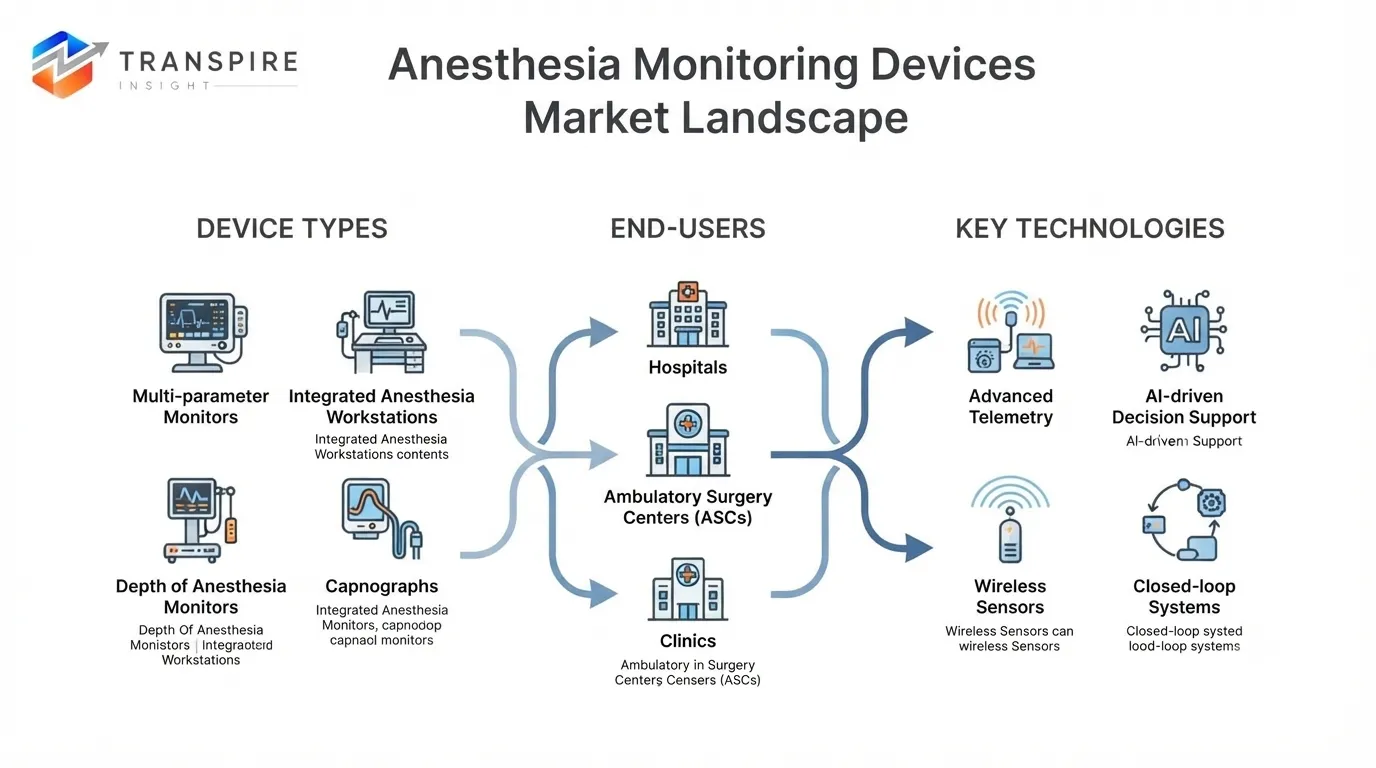
Anesthesia monitoring is becoming increasingly sophisticated as hospitals seek better visibility into patient physiology throughout surgical procedures. Modern monitoring systems combine multiple physiological measurements with integrated workstations, automated alerts and advanced analytics.
The expansion of surgical procedures, aging populations, chronic diseases and technological improvements in operating-room equipment is creating sustained demand for anesthesia monitoring devices.
September 2026: Anesthesia monitoring devices are used to continuously assess patients during procedures involving anesthesia.
These systems can monitor parameters including blood pressure, heart rate, oxygen saturation, respiratory rate, carbon dioxide levels and anesthetic gases.
Advanced systems can also incorporate electroencephalography-based measurements and other technologies designed to assess depth of anesthesia.
The objective is to provide clinicians with continuous information that supports safe anesthesia management.
Market Size
The global anesthesia monitoring devices market was estimated at approximately USD 2.7 billion in 2025 and is projected to reach around USD 6.9 billion by 2034, expanding at a CAGR of approximately 11.0% during 2026–2034.
Fortune Business Insight estimates the market at USD 2.57 billion in 2025 and projects USD 6.76 billion by 2034 at a CAGR of 11.36%.
Grand View Research estimates the 2025 market at USD 2.6 billion and forecasts approximately USD 6.0 billion by 2033.
North America represents the largest regional market in current estimates.
Growth in Surgical Procedures Drives Demand
The number of surgical procedures continues to support demand.
Hospitals perform surgeries across cardiology, orthopedics, oncology, ophthalmology and other specialties.
Many procedures require general or regional anesthesia.
Continuous physiological monitoring is therefore an essential part of modern operating-room infrastructure.
As hospitals expand surgical capacity, demand for anesthesia monitoring systems increases.
Aging Populations Increase the Need for Monitoring
Older patients are more likely to undergo procedures while also having chronic medical conditions.
This can increase the complexity of anesthesia management.
Continuous monitoring helps clinicians observe changes in cardiovascular and respiratory parameters.
The need for reliable monitoring is therefore particularly important in aging populations.
Integrated Anesthesia Workstations Gain Importance
Integrated anesthesia workstations combine anesthesia delivery and monitoring functions.
These systems can reduce equipment complexity within operating rooms.
Integrated workstations are becoming increasingly common because hospitals want connected equipment that supports efficient workflows.
Grand View Research estimates integrated anesthesia workstations represented more than 40% of market revenue in 2025.
Multi-Parameter Monitoring Remains Fundamental
Anesthesia monitors typically track several physiological variables simultaneously.
Blood pressure, oxygen saturation, ECG, respiratory rate and carbon dioxide are among the core parameters.
The ability to view multiple parameters on a single interface helps clinicians monitor patient status continuously.
Modern systems increasingly provide configurable displays and alarms.
Depth-of-Anesthesia Monitoring Creates Additional Opportunity
Depth-of-anesthesia technologies aim to provide information about the patient's level of consciousness during anesthesia.
EEG-based technologies can analyze brain activity.
These technologies may be particularly useful in certain procedures and patient populations.
Their increasing integration into advanced anesthesia workstations can support market growth.
Artificial Intelligence Could Improve Monitoring
AI is emerging in medical monitoring.
Algorithms can identify patterns across multiple physiological signals.
Instead of evaluating each parameter independently, future systems may combine several signals to identify potential deterioration.
AI could also help reduce alarm fatigue by prioritizing clinically relevant alerts.
However, medical AI systems require extensive validation.
Reliability, explainability and regulatory compliance will remain important.
Hospitals Represent the Largest End-User Segment
Hospitals perform a large proportion of surgical procedures.
They also have operating rooms, intensive-care departments and specialized surgical centers.
This makes hospitals the dominant customer group for anesthesia monitoring systems.
Hospitals increasingly seek integrated equipment that can connect to electronic health records and other clinical systems.
Ambulatory Surgery Centers Are Expanding
Ambulatory surgery centers are becoming increasingly important.
Patients can receive procedures without extended hospital stays.
These facilities require compact, efficient monitoring systems.
Manufacturers that develop cost-effective and easy-to-use devices can therefore address this growing customer segment.
Digital Connectivity Improves Workflow
Modern anesthesia monitoring systems increasingly support connectivity.
Patient data can potentially be transferred to hospital information systems.
Digital records improve documentation and can support postoperative analysis.
Connected devices can also assist equipment-management teams.
Patient Safety Remains the Central Driver
Unlike many medical-device categories, anesthesia monitoring has a direct relationship with intraoperative patient safety.
Reliable monitoring can help clinicians identify changes quickly.
This creates strong demand for accurate sensors and dependable equipment.
Hospitals are therefore unlikely to select equipment solely on purchase price.
Reliability, service support, interoperability and clinical functionality are important factors.
North America Leads the Market
North America is the leading regional market.
Fortune Business Insight estimates North America accounted for approximately 39% of the global market in 2025.
The region benefits from advanced healthcare infrastructure, high surgical volumes and strong medical-device adoption.
Europe Remains a Major Market
Europe has well-developed healthcare systems and established medical-device industries.
Hospitals are increasingly adopting integrated operating-room technologies.
The region also has strong demand for connected healthcare equipment.
Asia Pacific Offers High Growth Potential
Asia Pacific is expected to expand rapidly.
China, India, Japan and South Korea are investing in hospital infrastructure.
Growing healthcare access is increasing surgical capacity.
India represents a particularly important opportunity because of its large population and expanding private healthcare sector.
Competitive Landscape
The market includes global medical-device companies and specialized anesthesia-equipment manufacturers.
Major participants include Medtronic, GE HealthCare, Philips, Dräger, Nihon Kohden, Mindray, Masimo, Schiller, BD and Fukuda Denshi.
Top 10 Companies in Anesthesia Monitoring Devices Market
Headquarters: Chicago, Illinois, USA
GE HealthCare provides anesthesia machines, patient monitoring systems and other medical technologies.
Its broad hospital portfolio allows anesthesia monitoring equipment to be integrated into larger clinical workflows.
Headquarters: Galway, Ireland
Medtronic is a major medical-device company with products across multiple clinical areas.
Its healthcare technology portfolio provides exposure to monitoring and perioperative-care applications.
Headquarters: Lübeck, Germany
Dräger is a major provider of anesthesia workstations, ventilators and patient-monitoring technologies.
The company has specialized expertise in operating-room and critical-care environments.
Headquarters: Amsterdam, Netherlands
Philips provides patient monitoring and healthcare informatics technologies.
Its connected-monitoring ecosystem supports hospital workflows and perioperative care.
Headquarters: Tokyo, Japan
Nihon Kohden specializes in patient monitoring and medical electronic equipment.
Its technologies include monitoring systems designed for hospitals and critical-care environments.
Headquarters: Shenzhen, China
Mindray develops patient monitoring systems, anesthesia equipment and other medical devices.
Its broad portfolio supports hospitals across emerging and developed markets.
Headquarters: Irvine, California, USA
Masimo specializes in noninvasive monitoring technologies.
Its expertise in pulse oximetry and advanced physiological monitoring supports perioperative applications.
Headquarters: Baar, Switzerland
SCHILLER develops medical diagnostic and monitoring equipment.
Its portfolio includes patient monitoring technologies used in clinical environments.
Headquarters: Franklin Lakes, New Jersey, USA
BD provides medical devices and healthcare technologies.
Its broad clinical portfolio gives the company exposure to hospital and procedural-care markets.
Headquarters: Tokyo, Japan
Fukuda Denshi develops patient-monitoring and cardiovascular diagnostic technologies.
Its monitoring expertise supports applications across hospitals and clinical settings.
Outlook: Could Connected Monitoring Become the Next Stage of Anesthesia Care?
The anesthesia monitoring market is moving toward increasingly integrated and intelligent systems.
Future devices are likely to combine multiple physiological measurements with advanced analytics.
AI could help clinicians interpret large quantities of physiological data and identify abnormal patterns.
Connectivity will also become increasingly important.
Anesthesia devices may exchange information with electronic health records, operating-room systems and hospital analytics platforms.
Portable and compact systems could expand adoption in ambulatory surgical centers and emerging healthcare markets.
The increasing number of surgeries, aging populations and expansion of healthcare infrastructure provide a strong underlying demand base.
At the same time, manufacturers will need to demonstrate clinical reliability, cybersecurity and regulatory compliance.
The long-term opportunity is therefore not simply the replacement of conventional monitors.
It is the development of connected perioperative systems that provide clinicians with more comprehensive information throughout the surgical process.
As healthcare becomes increasingly data-driven, anesthesia monitoring devices are likely to remain an important component of modern operating-room technology.


Send us a brief description of your challenge and we'll get back to you within 24 hours.

 inquiry@transpireinsight.com
 APAC:+91 7666513636
 Address


