
Oct 10, 2026
By Transpire Insight
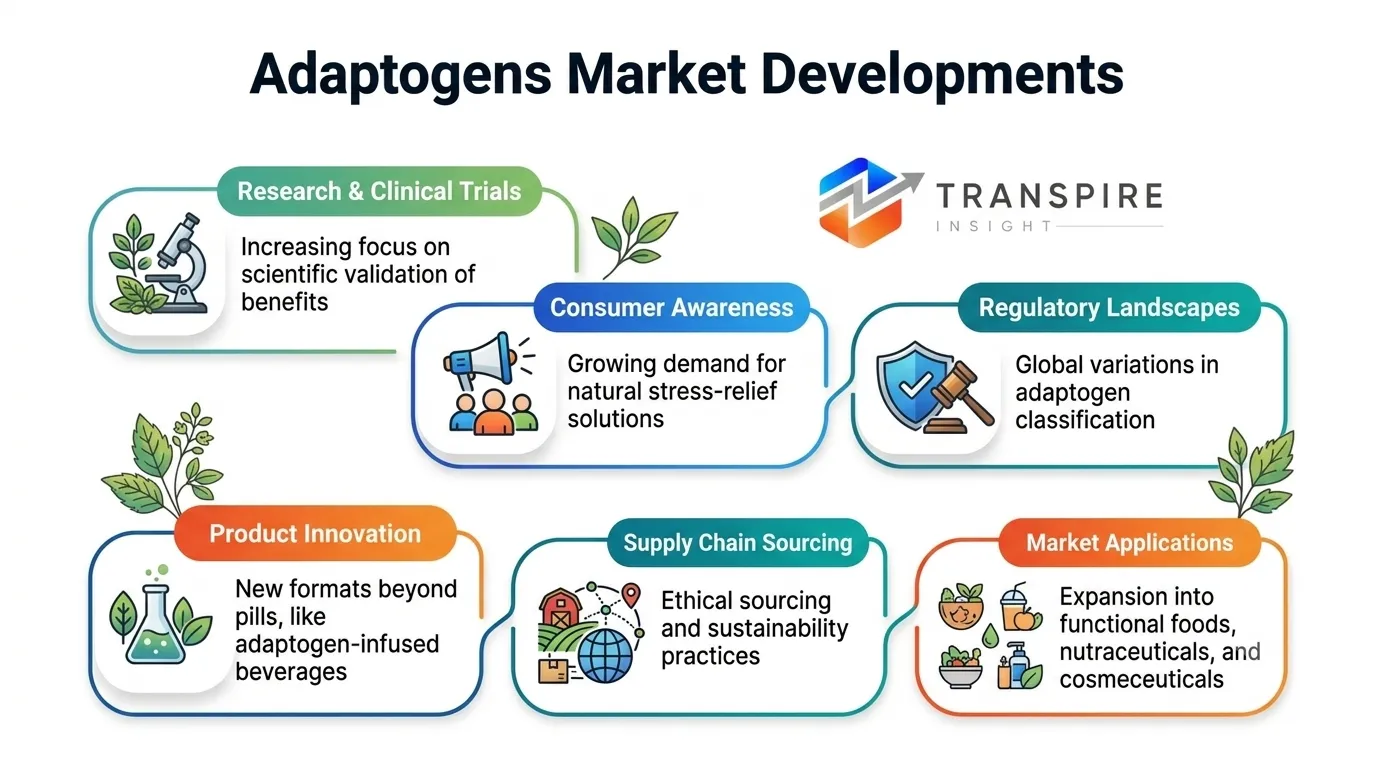
The global Adaptogens Market is expanding as consumers increasingly incorporate botanical ingredients into supplements, functional foods, beverages, sports nutrition, and wellness routines. At the same time, the market is becoming more sophisticated, with greater emphasis on standardized extracts, scientific validation, ingredient traceability, and regulatory compliance.
Adaptogens Market Overview
The Adaptogens Market includes botanical and functional ingredients commonly marketed for supporting the body's response to physical or psychological stress.
Major ingredients include ashwagandha, ginseng, rhodiola, holy basil, mushroom-based adaptogens, and other botanical ingredients.
Applications extend across:
Transpire Insights estimates that the global Adaptogens Market was valued at approximately USD 11.67 billion in 2025, reached approximately USD 12.51 billion in 2026, and is projected to reach approximately USD 20.63 billion by 2033, representing a CAGR of approximately 7.40% from 2026 to 2033.
Dietary supplements represent the largest application category in the current Transpire segmentation, while mushroom adaptogens represent one of the faster-growing ingredient areas.
Latest Global Market Developments
Regulators in Asia Pacific have increased attention to botanical safety, labeling, health claims, and traceability during 2026.
India's food regulator reiterated in April 2026 its position regarding the use of ashwagandha leaves in food products, while the issue subsequently became subject to legal proceedings. Australia also issued a July 2026 safety advisory concerning the rare risk of liver injury associated with ashwagandha supplementation.
As the market expands, manufacturers are increasingly investing in standardized extracts and clinical research to distinguish products from commodity botanical supplements.
Adaptogenic ingredients are increasingly incorporated into teas, coffees, ready-to-drink beverages, functional waters, and other convenient formats. Transpire separately projects the Adaptogenic Drinks Market to reach approximately USD 15.10 billion by 2033.
Functional mushrooms are increasingly positioned around wellness, cognition, energy, and immune-support applications, creating new product-development opportunities.
Digital wellness platforms and personalized nutrition services are creating opportunities for customized supplement recommendations and ingredient combinations.
Online retail allows emerging brands to reach consumers directly and educate them about botanical ingredients.
Consumers increasingly examine ingredient sourcing, extraction methods, additives, certifications, and formulation transparency.
Why Do Adaptogens Matter?
Adaptogens occupy an unusual position between traditional botanical knowledge and modern consumer wellness.
They are increasingly used in products designed around:
However, market growth is increasingly tied to quality and scientific credibility, rather than simply consumer awareness.
Key Factors Driving the Adaptogens Market
1. Preventive Wellness Culture
Consumers increasingly spend on products intended to support general wellness before health problems become acute.
2. Natural Ingredient Demand
Botanical ingredients continue to attract consumers seeking plant-derived alternatives within wellness categories.
3. Functional Beverage Expansion
Adaptogens are increasingly being incorporated into beverages, creating more convenient consumption occasions.
4. Sports Nutrition
Athletes and active consumers represent an expanding audience for botanical ingredients incorporated into performance and recovery products.
5. Scientific Research
Clinical evidence, standardized extraction, and transparent ingredient testing can improve confidence among consumers and professional buyers.
Five High-Potential Markets Shaping Global Adaptogens
1. United States
North America currently represents the largest regional market, supported by strong consumer awareness, established supplement distribution, and a mature wellness industry.
2. Germany
Germany represents an important European market because of its established herbal-health sector and consumer interest in natural products.
3. China
China provides a large opportunity through its traditional botanical-health ecosystem, expanding wellness industry, and growing functional-food market.
4. India
India has a strong cultural foundation for botanical ingredients and a large domestic herbal-products industry. However, manufacturers must closely monitor evolving regulatory requirements.
5. Japan
Japan provides opportunities for premium functional foods, beverages, healthy-aging products, and standardized botanical formulations.
Competitive Landscape
The market includes ingredient suppliers, herbal-product manufacturers, dietary supplement companies, functional-food brands, and specialty botanical companies.
Top 5 Companies in the Adaptogens Market
Himalaya has a long-established presence in herbal wellness products and operates across multiple international markets.
Organic India focuses on botanical wellness products and has significant exposure to tulsi, ashwagandha, and other herbal categories.
Gaia Herbs specializes in herbal supplements and botanical formulations with an emphasis on ingredient sourcing and formulation.
Nature's Way operates across the dietary supplement category and offers products containing a range of botanical ingredients.
Four Sigmatic has helped expand functional mushroom ingredients into beverages and convenient wellness formats.
Opportunities for Small Investors
Challenges & Restraints
Regulatory variation remains one of the market's biggest challenges.
Other constraints include:
The 2026 regulatory developments surrounding ashwagandha demonstrate why manufacturers need robust safety assessment, quality control, and jurisdiction-specific compliance strategies.
Conclusion
The Adaptogens Market is evolving from a traditional herbal-supplement category into a broader functional wellness ecosystem spanning supplements, beverages, food, sports nutrition, and personalized wellness.
Transpire Insights estimates the market could expand from USD 11.67 billion in 2025 to approximately USD 20.63 billion by 2033.
The next stage of market development will increasingly depend on standardization, scientific evidence, transparent sourcing, regulatory compliance, and innovative delivery formats.
For ingredient manufacturers, supplement brands, beverage companies, investors, and distributors, the largest opportunities are likely to come from combining established botanical knowledge with modern formulation, clinical research, and consumer-friendly product formats.


Send us a brief description of your challenge and we'll get back to you within 24 hours.

 inquiry@transpireinsight.com
 APAC:+91 7666513636
 Address


