
Oct 06, 2026
By Transpire Insight
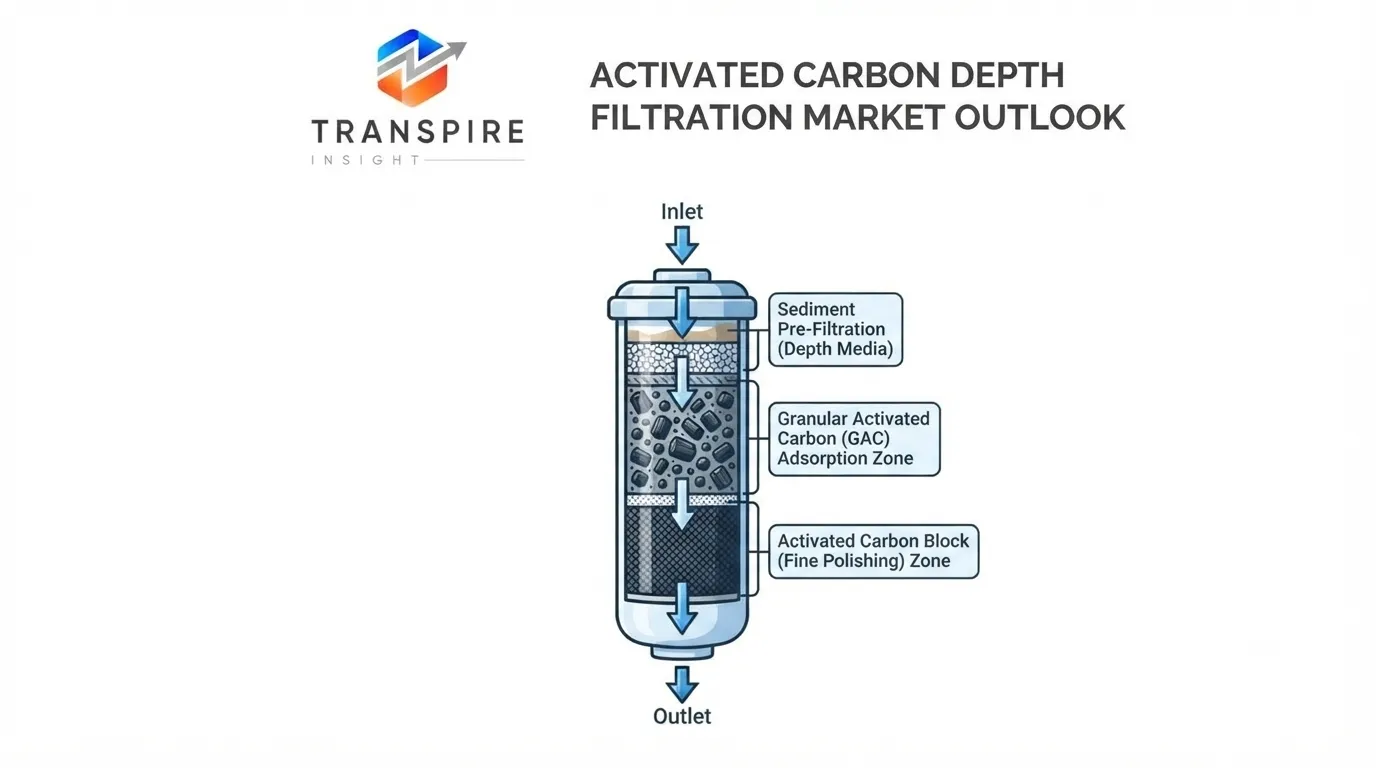
Activated carbon depth filtration is becoming an increasingly important purification technology as manufacturers across pharmaceuticals, biotechnology, food and beverages, chemicals, water treatment, and other process industries seek more efficient methods for removing particulates, color bodies, organic impurities, odors, and other contaminants. By combining the adsorption capability of activated carbon with the physical particle-retention characteristics of depth filtration, these systems can provide multifunctional treatment within a compact filtration step.
The technology is also evolving as industries move toward higher-purity manufacturing, tighter contamination control, single-use processing, automated filtration, and resource-efficient treatment systems. Manufacturers are developing carbon-loaded filter sheets, cartridges, capsules, modules, and hybrid media designed to improve adsorption capacity while maintaining filtration performance and simplifying installation, validation, and replacement.
September 2026: The global Activated Carbon Depth Filtration Market was valued at approximately USD 1.05 billion in 2025 and is projected to reach around USD 2.33 billion by 2033, expanding at a CAGR of approximately 10.51% from 2026 to 2033. The market includes powdered activated carbon filters, granular activated carbon filters, carbon block filters, hybrid carbon filters, high-flow filters, and other activated-carbon depth filtration formats used across pharmaceutical, food and beverage, water treatment, chemical processing, and related industries.
Market Size
The global Activated Carbon Depth Filtration Market is estimated at approximately USD 1.05 billion in 2025 and is expected to reach approximately USD 2.33 billion by 2033, registering a CAGR of about 10.51% during 2026–2033.
Activated carbon depth filtration combines two important purification mechanisms. First, the porous depth-filter structure physically retains suspended particles and contaminants throughout the thickness of the filtration media. Second, activated carbon provides adsorption sites capable of capturing dissolved organic compounds, color-causing substances, odors, and other impurities.
This combination makes the technology relevant to applications where conventional particulate filtration alone is insufficient.
The market covers carbon-containing depth filter sheets, cartridges, capsules, modules, carbon blocks, and hybrid filtration products. Demand is being supported by pharmaceutical manufacturing, biotechnology, food and beverage clarification, municipal and industrial water treatment, specialty chemicals, and other high-purity processing applications.
Multifunctional Filtration Drives Adoption
One of the strongest advantages of activated carbon depth filtration is its ability to perform multiple purification functions within one filtration stage.
Traditional filtration processes may require separate particulate filtration and adsorption steps. Activated carbon depth media can combine these functions, depending on the design and application.
The adsorption properties of activated carbon are particularly valuable for removing dissolved organic compounds, color, taste, odor, and trace contaminants.
This multifunctional capability can simplify process design and potentially reduce equipment requirements.
Industry research also identifies activated-carbon blends as one of the faster-growing media categories within the broader depth-filtration market. Mordor Intelligence projects activated-carbon blends to expand at a 10.06% CAGR through 2031.
Biopharmaceutical Manufacturing Creates New Opportunities
Biopharmaceutical manufacturing is an important growth area for advanced depth filtration.
Biological products such as monoclonal antibodies, vaccines, recombinant proteins, and other complex biologics require carefully controlled downstream processing.
Depth filtration is frequently used for clarification and removal of cells, cellular debris, process impurities, and other particulate materials before subsequent purification stages.
Activated carbon can add adsorption functionality to this process where the removal of specific organic impurities or color bodies is required.
The broader depth-filtration market is strongly connected to biopharmaceutical processing, with Mordor Intelligence identifying biopharmaceutical processing as its largest application segment in 2025.
The continued expansion of biologics manufacturing capacity is therefore creating opportunities for specialized filtration media capable of handling increasingly complex process streams.
Pharmaceutical Purification Requires High-Performance Media
Pharmaceutical manufacturers operate under strict quality and contamination-control requirements.
Filtration systems used during drug manufacturing must provide predictable performance, consistent media quality, and appropriate compatibility with pharmaceutical processes.
Activated carbon depth filtration can be used for applications involving decolorization, removal of unwanted organic compounds, purification of process fluids, and other specialized treatment requirements.
Eaton introduced its BECO CARBON ACF 03 activated carbon depth filter sheets at ACHEMA 2024. The product was developed for pharmaceutical, biopharmaceutical, and fine-chemical applications and is available in formats including flat sheets, stacked disc cartridges, and disposable capsules.
Product development of this type illustrates the shift toward more specialized activated-carbon filtration products rather than generic carbon media.
Food and Beverage Clarification Supports Demand
Food and beverage producers require filtration technologies that can improve product clarity, color, taste, stability, and consistency.
Activated carbon filtration can be used in selected beverage and food-processing applications where adsorption of unwanted compounds is required.
Breweries, wineries, spirits producers, ingredient manufacturers, and other processors may use specialized filtration technologies to manage color bodies, organic compounds, and other unwanted substances.
Activated-carbon depth filtration can be particularly useful when manufacturers want adsorption and particle removal to occur within the same filtration process.
The broader depth-filtration industry is experiencing increased adoption of specialty media in beverage processing, including activated-carbon blends.
Water Treatment Remains a Major Application
Water treatment is one of the most established applications for activated carbon.
Activated carbon is widely used to remove organic contaminants, taste and odor compounds, and other dissolved substances from water.
Combining activated carbon with depth filtration creates a system capable of addressing both particulate and adsorption-related purification requirements.
Municipal water treatment facilities, industrial wastewater plants, commercial water systems, and process-water applications can therefore contribute to market demand.
Growing attention to water quality and industrial water reuse is further increasing interest in advanced filtration technologies.
Activated carbon is also relevant to treatment challenges involving trace organic contaminants and other substances that cannot be effectively addressed through conventional particulate filtration alone.
Industrial Wastewater Treatment Expands the Addressable Market
Industrial facilities increasingly need to treat and reuse process water.
Manufacturing sectors including chemicals, pharmaceuticals, food processing, electronics, and specialty materials can generate wastewater containing suspended solids and dissolved organic contaminants.
Activated carbon depth filtration can support treatment processes by combining particle retention with adsorption.
This is particularly useful in facilities where water reuse and discharge requirements are becoming more stringent.
Industrial water recycling also creates opportunities for compact filtration technologies that can be integrated into multi-stage treatment systems.
The broader depth-filtration market is expected to benefit from expanding water and wastewater treatment applications, with Mordor Intelligence projecting water and wastewater treatment to grow at approximately 9.98% through 2031.
Carbon Media Innovation Is Improving Performance
Activated carbon is not a single uniform material.
Its performance depends on raw material, activation method, pore structure, particle size, surface chemistry, and other characteristics.
Coconut-shell carbon, coal-based carbon, wood-based carbon, and other feedstocks can produce materials with different adsorption properties.
Manufacturers are therefore developing specialized carbon media for particular contaminants and process requirements.
The development of hybrid carbon media is another important trend.
Hybrid systems can combine activated carbon with cellulose, synthetic fibers, filter aids, or other materials to balance adsorption capacity, mechanical strength, flow rate, and dirt-holding capability.
This allows filtration manufacturers to optimize products for different process conditions rather than relying on one universal carbon medium.
Cartridge and Capsule Formats Improve Process Flexibility
Filter format is an important consideration for industrial users.
Cartridge systems are widely used because they can be installed in standard filtration housings and replaced relatively easily.
Capsule systems provide another option for applications requiring enclosed, ready-to-use filtration assemblies.
The broader depth-filtration market continues to see significant demand for cartridge and capsule products. Mordor Intelligence estimates cartridges held approximately 38.27% of depth-filtration revenue in 2025, while capsules are projected to grow rapidly through 2031.
For pharmaceutical and biotechnology applications, disposable or single-use capsules can reduce cleaning and validation requirements.
Single-Use Processing Creates Opportunities
Single-use manufacturing is becoming increasingly important in biotechnology and pharmaceutical production.
Instead of relying entirely on permanent stainless-steel equipment, manufacturers can use disposable bags, tubing, filters, connectors, and other components.
This approach can reduce cleaning requirements and support faster production changeovers.
Activated carbon depth-filter capsules can potentially be integrated into single-use processing trains where adsorption or color removal is needed.
The adoption of modular single-use systems is especially relevant to smaller-scale biologics manufacturing, contract development and manufacturing organizations, and facilities producing multiple products.
Contract Manufacturing Supports Market Expansion
Contract development and manufacturing organizations are expanding their role in pharmaceutical and biotechnology production.
CDMOs often operate multiple production lines and need filtration systems that can accommodate different processes and product batches.
Flexible filter formats, modular assemblies, and scalable media can help these companies change production configurations efficiently.
Mordor Intelligence estimates that CDMOs will be among the faster-growing end-user categories in the broader depth-filtration market through 2031.
This trend supports demand for filtration products that can be scaled from laboratory and pilot applications to commercial manufacturing.
Automation Is Improving Filtration Operations
Filtration processes are becoming increasingly automated.
Automated filtration systems can monitor pressure, flow rate, temperature, and other operating parameters.
Digital monitoring can help operators identify when a filter is approaching its capacity and requires replacement.
Automation also supports more consistent process control.
In pharmaceutical environments, automated systems can help document process conditions and improve traceability.
Future activated carbon depth filtration systems are likely to increasingly incorporate sensors and digital monitoring technologies.
Regulatory Requirements Encourage Advanced Filtration
Pharmaceutical, food, beverage, and water-treatment industries operate under increasingly demanding quality requirements.
Filtration manufacturers therefore need to demonstrate product consistency, material compatibility, cleanliness, and appropriate performance.
For pharmaceutical applications, filter materials may need to satisfy requirements relating to extractables, biocompatibility, endotoxin levels, and other quality parameters.
Eaton's BECO CARBON ACF 03 product, for example, was developed with pharmaceutical and biopharmaceutical requirements in mind and was described as meeting specified endotoxin and biocompatibility requirements.
Regulatory complexity can raise development costs but also creates opportunities for established suppliers with validated products.
Sustainability Is Influencing Filtration Design
Sustainability is becoming an increasingly important consideration across industrial processing.
Manufacturers are seeking filtration technologies that consume less water, reduce chemical usage, minimize waste, and support process efficiency.
Activated carbon depth filtration can contribute to more efficient purification when adsorption and particle removal can be combined into fewer processing stages.
Longer-lasting media can also reduce replacement frequency.
At the same time, used activated carbon and filter media create waste-management considerations.
Future innovation will therefore focus not only on filtration efficiency but also on material recovery, carbon regeneration, lower-waste designs, and optimized filter lifetimes.
Regional Outlook
North America
North America represents a major market for activated carbon depth filtration.
The region has a highly developed pharmaceutical, biotechnology, food and beverage, chemical, and water-treatment industry.
The United States has substantial investment in biologics manufacturing and advanced pharmaceutical production.
The Transpire Insight market framework identifies North America as accounting for approximately 39% of the global activated carbon depth filtration market.
Demand is supported by stringent quality requirements, sophisticated industrial infrastructure, advanced filtration technologies, and investments in pharmaceutical and biotechnology manufacturing.
Water treatment is another important source of demand as utilities and industrial facilities address contaminants and aging treatment infrastructure.
Europe
Europe has a mature filtration industry supported by pharmaceutical manufacturing, food and beverage processing, specialty chemicals, and environmental applications.
Germany, France, Italy, the United Kingdom, Switzerland, and other European markets have strong pharmaceutical and industrial manufacturing capabilities.
European filtration users also place substantial emphasis on sustainability, waste reduction, product quality, and energy efficiency.
Companies such as Eaton, Merck, Sartorius, and Porvair Filtration Group have significant exposure to European filtration markets.
Asia Pacific
Asia Pacific is expected to remain one of the fastest-growing regions for activated carbon depth filtration.
Rapid industrialization, urbanization, pharmaceutical manufacturing expansion, food-processing growth, and water-treatment investment are supporting demand.
China and India are particularly important because of their large manufacturing bases and growing pharmaceutical industries.
Japan and South Korea also have advanced biotechnology, electronics, pharmaceutical, and chemical-processing sectors.
Research on the broader depth-filtration market identifies Asia Pacific as the fastest-growing major region, supported by expanding manufacturing and water-treatment infrastructure.
Latin America
Latin America offers opportunities through water treatment, food and beverage production, mining, pharmaceuticals, and industrial processing.
Brazil and Mexico are important industrial markets with established manufacturing and water-treatment requirements.
The region's need for improved wastewater management and industrial water reuse can support additional adoption of activated carbon filtration.
Middle East and Africa
Water scarcity is an important factor supporting advanced filtration adoption in the Middle East.
Desalination, wastewater reuse, industrial water treatment, and municipal water infrastructure create opportunities for activated carbon technologies.
Africa also presents long-term opportunities as cities and industrial facilities expand water-treatment infrastructure.
The demand for reliable purification technologies is expected to increase as industrialization and population growth place additional pressure on available water resources.
Competitive Landscape
The Activated Carbon Depth Filtration Market includes specialized activated-carbon manufacturers as well as global filtration and life-sciences companies.
Competition is increasingly based on adsorption performance, filter capacity, product consistency, regulatory compliance, scalability, customization, and lifecycle economics.
The Transpire Insight competitive framework identifies Pall Corporation, Sartorius, Eaton, Donaldson Company, 3M, Parker Hannifin, Kuraray, Calgon Carbon, Lenntech, Evoqua Water Technologies, Meissner Filtration, Merck Millipore, Porvair Filtration, Graver Technologies, and Omnipure among the key companies operating in the market.
The broader depth-filtration industry also includes Amazon Filters, Filtrox, ErtelAlsop, Synder Filtration, and other specialist suppliers.
Top 10 Companies in Activated Carbon Depth Filtration Market
1. Pall Corporation
Pall Corporation is a major filtration and separation technology company serving pharmaceutical, biotechnology, food and beverage, water, and industrial markets.
The company offers depth filtration products and systems for applications including clarification and downstream processing.
Its broad filtration portfolio allows Pall to combine depth filtration with other separation technologies.
The company's presence in high-purity processing makes it an important participant in advanced filtration applications. Pall products such as PDH4, V100, Bio20, and Bio10 are among depth filtration technologies referenced in pharmaceutical processing applications.
2. Sartorius AG
Sartorius is a major life-sciences technology company serving biopharmaceutical manufacturing and laboratory applications.
Its filtration portfolio includes depth filtration solutions used for cell clarification and downstream processing.
Sartorius has also expanded its single-use bioprocessing capabilities, supporting pharmaceutical manufacturers seeking flexible and scalable production systems.
Its expertise in bioprocessing positions the company strongly within the high-purity filtration segment.
3. Eaton Corporation
Eaton provides filtration products for industrial, food and beverage, pharmaceutical, biotechnology, and other applications.
The company has specifically developed activated carbon depth filter products.
Its BECO CARBON ACF 03 product combines activated carbon with depth filtration for applications including decolorization and removal of unwanted process compounds.
Eaton's expertise in filtration media and process filtration gives it exposure to several high-value end-use industries.
4. 3M Company
3M has a broad filtration portfolio covering healthcare, industrial, food and beverage, pharmaceutical, and other applications.
Its Zeta Plus family includes depth filtration products designed for liquid processing.
3M's filtration technologies combine depth media with different filter-aid and adsorption characteristics.
The company has long-standing expertise in engineered filtration materials and supplies products for demanding liquid-processing applications.
5. Donaldson Company
Donaldson is a global filtration company serving industrial, transportation, manufacturing, food and beverage, and other markets.
Its filtration portfolio includes liquid and air filtration technologies.
The company has expanded its service capabilities for food and beverage manufacturers and provides filtration products designed for demanding industrial environments.
Its broad industrial customer base provides opportunities as manufacturers upgrade filtration and process-water systems.
6. Parker Hannifin
Parker Hannifin provides filtration and separation technologies through its industrial and process filtration operations.
Its products cover liquid and gas filtration, process applications, and high-purity environments.
Parker's engineering capabilities allow it to develop filtration systems for different pressure, flow, contamination, and material-compatibility requirements.
The company serves pharmaceutical, chemical, food and beverage, industrial, and other applications.
7. Merck KGaA / MilliporeSigma
Merck is a major supplier of life-sciences and biopharmaceutical processing technologies.
Its MilliporeSigma portfolio includes depth filtration products for clarification and purification.
The company's filtration technologies are used throughout pharmaceutical and biotechnology manufacturing.
Its strong regulatory and bioprocessing expertise supports demand for filtration products requiring consistent performance and documented quality.
8. Meissner Filtration Products
Meissner Filtration Products specializes in filtration and single-use systems for biopharmaceutical manufacturing.
Its portfolio includes depth filtration products, cartridges, capsules, and other filtration assemblies.
The company focuses heavily on pharmaceutical and biotechnology applications where contamination control and process consistency are critical.
Its specialization in single-use processing provides opportunities as biopharmaceutical manufacturers increase modular production.
9. Porvair Filtration Group
Porvair Filtration Group develops filtration and separation technologies for aerospace, industrial, pharmaceutical, food and beverage, and other markets.
Its portfolio includes high-performance filter media and process filtration systems.
The company's expertise in engineered filtration enables it to address specialized applications where conventional filtration products may not provide sufficient performance.
Its international manufacturing and technical capabilities support a diverse customer base.
10. Graver Technologies
Graver Technologies is a filtration specialist providing liquid and gas filtration products.
The company serves industrial, pharmaceutical, food and beverage, and high-purity applications.
Its portfolio includes depth filter cartridges and other liquid-process filtration technologies.
Graver's ability to customize filtration solutions for specific process conditions helps it address applications requiring specialized particle retention and contaminant removal.
Market Challenges
The Activated Carbon Depth Filtration Market faces several technical and commercial challenges.
Filter-media cost can be significant for high-purity applications because manufacturers need carefully controlled activated carbon and other media.
Carbon variability is another consideration. Differences in pore structure, feedstock, activation, and surface chemistry can affect adsorption performance.
Filter replacement and waste disposal can also increase operating costs.
Validation requirements are particularly important in pharmaceutical and biotechnology manufacturing. New filtration products may require extensive testing before they can be introduced into validated production processes.
The broader depth-filtration market also faces high validation costs and compatibility requirements, particularly for pharmaceutical applications.
Process-specific optimization is another challenge. A filter designed for water treatment may not be suitable for pharmaceutical processing, while a high-purity bioprocess filter may be unnecessarily expensive for a conventional industrial application.
Manufacturers therefore need to balance adsorption capacity, flow rate, pressure drop, filter life, material compatibility, and total operating cost.
Future Outlook
The global Activated Carbon Depth Filtration Market is expected to maintain strong growth as pharmaceutical manufacturing, biotechnology, water treatment, food and beverage processing, and specialty chemical production increasingly demand multifunctional purification technologies.
The market is projected to expand from approximately USD 1.05 billion in 2025 to USD 2.33 billion by 2033, representing a CAGR of approximately 10.51% from 2026 to 2033.
Future product development is likely to concentrate on higher adsorption capacity, improved flow performance, longer filter life, lower pressure drop, optimized carbon loading, single-use formats, and application-specific media.
Biopharmaceutical manufacturing will remain a particularly important area because biologics require increasingly sophisticated clarification and purification processes.
Water treatment will provide another significant growth opportunity as utilities and industrial facilities invest in contaminant removal, water reuse, and advanced purification.
Food and beverage manufacturers are also expected to continue adopting activated-carbon filtration where color, odor, and organic impurity control are important to product quality.
Digitalization could further improve performance. Sensors and automated monitoring systems can help operators track pressure differential, flow conditions, filter loading, and replacement requirements.
Sustainability will increasingly influence product development, encouraging manufacturers to investigate carbon regeneration, recyclable components, longer-life media, reduced waste, and more efficient filtration processes.
The competitive landscape will favor suppliers capable of providing complete filtration solutions rather than individual filter elements. Companies that combine activated-carbon media expertise, depth filtration engineering, validated pharmaceutical products, scalable systems, and technical support will be positioned to participate across a wider range of applications.
As industries seek to reduce process complexity while achieving higher purification standards, activated carbon depth filtration is emerging as an important bridge between conventional particulate filtration and advanced adsorption-based treatment. Its ability to combine these functions within engineered filtration media gives the market significant potential across high-purity manufacturing, water treatment, food processing, and industrial purification.


Send us a brief description of your challenge and we'll get back to you within 24 hours.

 [email protected]
 APAC:+91 7666513636
 Address


