
Oct 10, 2026
By Transpire Insight
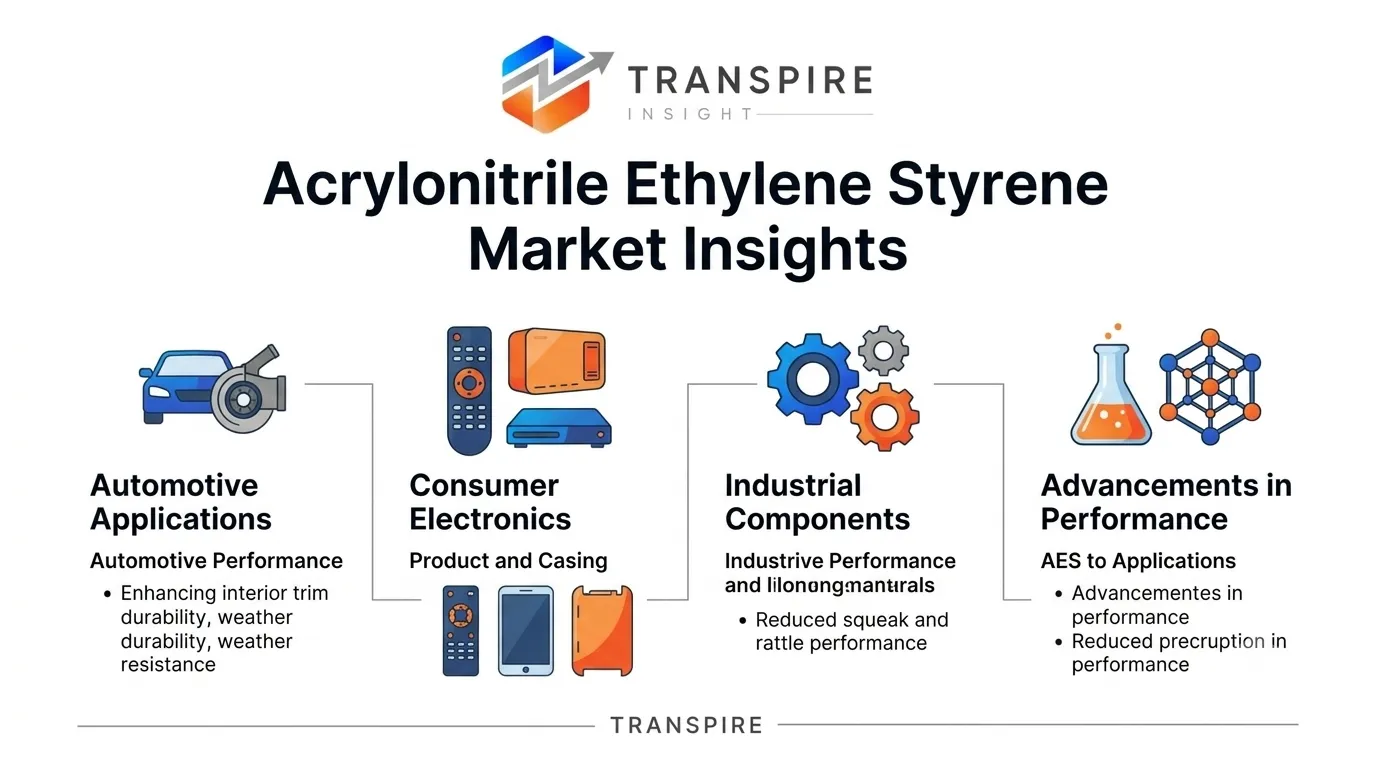
The Acrylonitrile Ethylene Styrene (AES) Market represents a specialized engineering-plastics opportunity driven by demand for weather-resistant, durable, and lightweight materials. Its positioning in exterior automotive components, outdoor applications, electrical products, and specialty molded parts creates opportunities where conventional plastics may face limitations from environmental exposure.
Acrylonitrile Ethylene Styrene Market Overview
Acrylonitrile Ethylene Styrene (AES) is an engineering thermoplastic designed to combine the processing characteristics of styrenic polymers with improved weatherability.
The material can be considered for applications requiring combinations of:
Potential applications include automotive exterior components, outdoor equipment, electrical housings, recreational products, construction components, and specialty molded products.
Transpire Insight estimates the global Acrylonitrile Ethylene Styrene Market at approximately USD 1.42 billion in 2025, rising to USD 1.49 billion in 2026 and reaching nearly USD 2.06 billion by 2033, representing a CAGR of approximately 4.76%.
| Market Indicator | Transpire Insight Estimate |
| Market Value (2025) | USD 1.42 Billion |
| Expected Market Value (2026) | USD 1.49 Billion |
| Estimated Market Value (2033) | USD 2.06 Billion |
| Forecast CAGR (2026–2033) | 4.76% |
| Leading Region in 2025 | Asia Pacific |
| Second-largest Region | North America |
| Fastest Growing Region | Asia Pacific |
The broader engineering-plastics environment remains strongly influenced by automotive, electronics, appliances, and specialty molding demand. For comparison, the much larger ABS market was estimated at USD 34.6 billion in 2026, illustrating the scale of the related styrenic-engineering-plastics ecosystem.
Latest Global Market Developments
Why Acrylonitrile Ethylene Styrene Matters?
AES occupies a specialized position in engineering plastics because outdoor durability can be an important material-selection requirement.
Potential benefits include:
Its commercial opportunity depends heavily on the ability of manufacturers to balance performance against material cost.
Key Factors Driving the Market
1. Automotive Exterior Applications
Automotive manufacturers increasingly use engineered plastics for components where lower weight and environmental resistance are important.
2. Outdoor Product Demand
Outdoor equipment, recreational products, electrical enclosures, and construction components can benefit from weather-resistant materials.
3. Lightweighting
Replacing heavier materials with engineering plastics can support component-weight reduction.
4. Advanced Polymer Formulation
Additives, stabilizers, impact modifiers, and processing technologies can improve the performance of specialty resin grades.
5. Growth of Electronics Manufacturing
Expansion of electronics and electrical equipment manufacturing creates demand for specialized polymer housings and components.
Five High-Potential Markets
1. China
China's large plastics-processing industry, automotive manufacturing base, and electronics production create substantial opportunities for engineering polymers.
2. Japan
Japan has sophisticated automotive, electronics, and specialty-material industries that support demand for advanced polymer grades.
3. South Korea
South Korea's electronics, automotive, and petrochemical industries provide a strong downstream base.
4. United States
The U.S. market benefits from automotive, electrical, consumer-product, and industrial manufacturing applications.
5. Germany
Germany's automotive and industrial manufacturing sectors provide opportunities for engineering plastics with high-performance characteristics.
Competitive Landscape
The AES market is more specialized than the broader ABS market, with competition influenced by resin formulation, weatherability, processing performance, application-specific specifications, and downstream technical support.
Top 5 Companies and Polymer Suppliers
Opportunities for Small Investors
Challenges & Restraints
The market faces feedstock-price volatility, competition from alternative engineering plastics, limited economies of scale in specialty grades, recycling challenges, formulation costs, and pressure from lower-cost materials.
Converters must also demonstrate that AES provides sufficient performance advantages to justify its cost relative to competing polymers.
Conclusion
The Acrylonitrile Ethylene Styrene Market is positioned within a specialized segment of engineering plastics where weatherability, durability, lightweighting, and processing performance are important.
The broader styrenics industry remains sensitive to feedstock availability and pricing. 2026 developments in Asian acrylonitrile supply illustrate how upstream conditions can influence downstream resin economics.
Long-term opportunities are likely to come from automotive exterior components, electronics, outdoor equipment, industrial products, and specialty applications where environmental durability creates a measurable advantage.
For resin manufacturers, compounders, molders, distributors, and automotive-component suppliers, the market offers opportunities through higher-performance formulations, application-specific grades, lightweight designs, and material-efficiency improvements.


Send us a brief description of your challenge and we'll get back to you within 24 hours.

 inquiry@transpireinsight.com
 APAC:+91 7666513636
 Address


