

United States Spouted Pouches Market Size & Forecast:
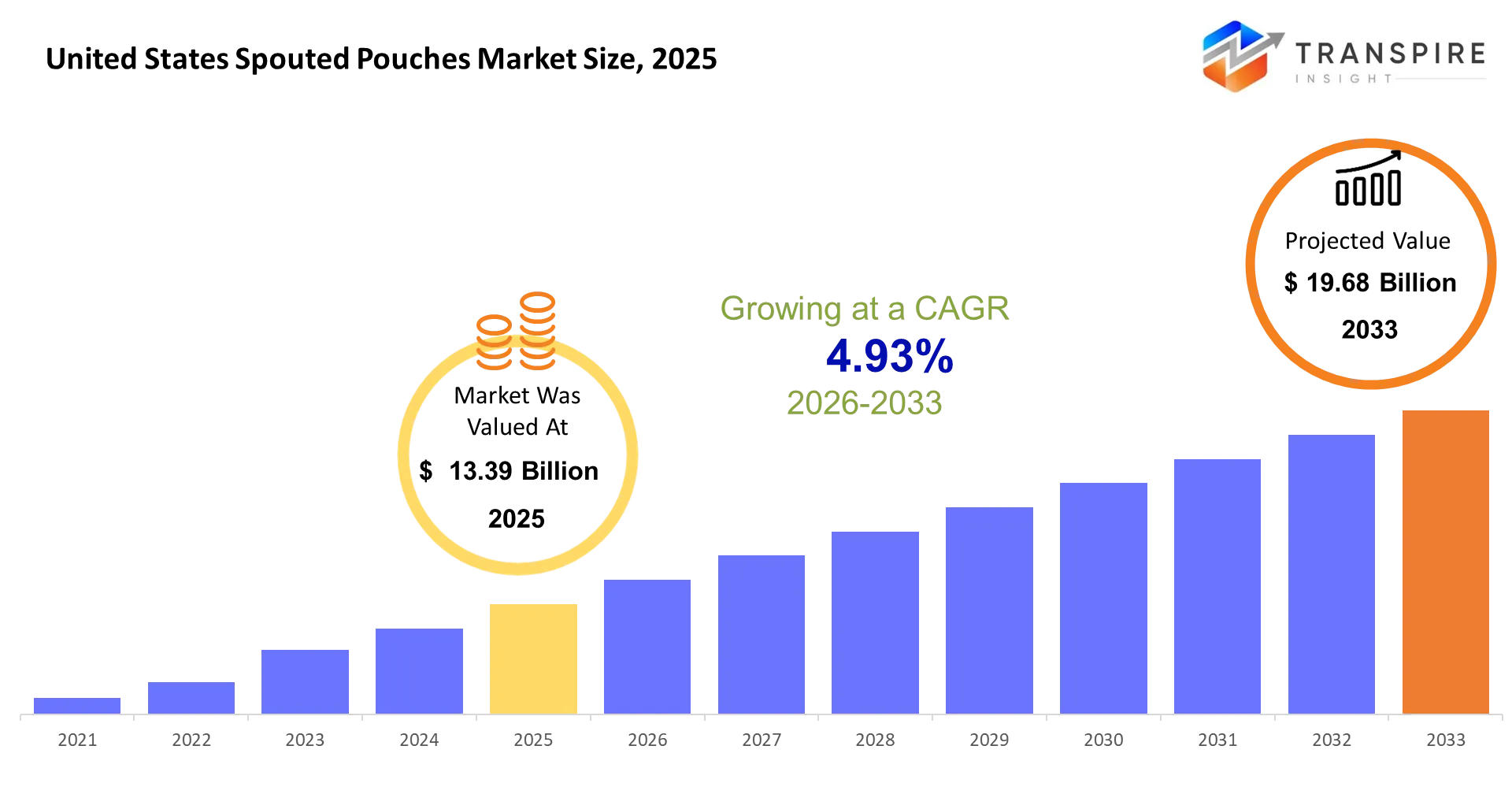
- United States Spouted Pouches Market Size 2025: USD 13.39 Billion
- United States Spouted Pouches Market Size 2033: USD 19.68 Billion
- United States Spouted Pouches Market CAGR: 4.93%
- United States Spouted Pouches Market Segments: By Material Type (Plastic, Aluminum Foil, Paper, Bioplastics, Laminates, Others); By Product Type (Stand-up Pouches, Flat Pouches, Retort Pouches, Recyclable Pouches, Others); By Closure Type (Screw Caps, Flip-top Caps, Child-resistant Caps, Push-pull Caps, Others); By Application (Food & Beverages, Personal Care, Household Products, Pharmaceuticals, Automotive Fluids, Others)
To learn more about this report,  Download Free Sample Report
United States Spouted Pouches Market Summary
The United States Spouted Pouches Market was valued at USD 13.39 Billion in 2025. It is forecast to reach USD 19.68 Billion by 2033. That is a CAGR of 4.93% over the period.
The US spouted pouches market basically supplies resealable, light-weight packaging that gets used for sauces, baby food, drinks, personal care, and household liquids, letting people dispense in a more controlled way while also reducing how much they rely on rigid bottles in both retail and e-commerce routes. In the last 3–5 years the market has kinda turned away from multi-layer plastic formats and moved toward recyclable mono-material structures, plus spout designs that are integrated in the package itself, as brands redo their packaging portfolio for more sustainability and efficiency.
A major spark here is the rollout of state-level plastic reduction rules, along with retailer-led packaging compliance demands, which have nudged converters to rethink their materials and bring down the overall environmental footprint. At the same time, after the pandemic, resin price swings and supply chain disruptions basically pressured manufacturers to use less material and to optimize shipping and transport, too. Because of all that, adoption has been speeding up, since spouted pouches reduce shipping mass, cut down on breakage incidents and boost filling performance, which helps with cost control and allows consumer goods producers to scale omnichannel distribution faster, basically without so much friction.
Key Market Insights
- In 2025 the West region sort of dominates the United States Spouted Pouches Market, taking in nearly 38% share because of a strong FMCG manufacturing presence and retail density.
- Meanwhile the South region feels like the quickest mover, projected to expand fast from 2026–2030, driven by more packaged food consumption , plus wider industrial expansion.
- The Midwest keeps a more steady appetite, backed by food processing hubs and established packaging supply chains across the United States Spouted Pouches Market, without much wild swing.
- When it comes to product form, stand-up spouted pouches lead the market, with roughly 42% share, mainly due to high retail visibility and easy usability.
- Flexible mono-material spouted pouches grab the second-largest slice, pushed by recyclability requirements and brand sustainability commitments.
- As for format, aseptic spouted pouch options are the fastest-growing segment through 2030, supported by demand for longer shelf life and lower refrigeration costs.
- Beverages pretty much dominate the application use with nearly 35% share, and it’s mostly pushed by ready to drink juices, energy drinks and functional hydration products, in general.
- FMCG manufacturers are leading the end-use demand, taking in more than 50% share, they do it through scale production plus branded packaging innovation that feels sort of more modern.
- Personal care brands are the fastest growing end-user group, mainly because of travel friendly packaging , and also premium product differentiation strategies that make it easier to stand out.
- Household cleaning product manufacturers are also seeing an uptick in adoption, for controlled dispensing and frankly reduced plastic usage requirements, too.
What are the Key Drivers, Restraints, and Opportunities in the United States Spouted Pouches Market?
The United States Spouted Pouches Market is being kinda shaped by a visible move toward cost efficient, kind of flexible packaging systems especially in high volume consumer goods. Driver, the main growth push comes from the quick shift away from rigid plastic bottles, toward lightweight spouted pouch formats, across food beverage and personal care. That shift really kicked off after the post pandemic logistics cost inflation, plus this ongoing resin price wobble, and brands started aiming to use less material and also move lighter loads. So adoption is rising, because manufacturers can trim per unit shipping expenses, while also getting better shelf efficiency, and that pretty directly supports stronger margin retention and quicker product turnover across retail channels.
The biggest obstacle is the lack of large scale recycling infrastructure for multi layer spouted pouch structures. This isn’t just a “nice to have” problem, it’s more of a structural constraint, because current waste management operations in the United States are still tuned for PET and HDPE streams, so those advanced pouch composites can be hard to process in a cost sensible way. Because of that, replacement cycles move slower in regulated retail spaces. In those places compliance uncertainty can delay procurement choices, and it ends up holding back broader revenue acceleration in the United States Spouted Pouches Market.
The next growth phase is starting to show up from mono-material spouted pouch innovation, kind of powered by advanced polymer extrusion tech stuff. Firms like Amcor are putting money into recyclable polyethylene based pouch systems that are meant to fit with the recovery streams already in use. There are pilot programs in California and bigger FMCG collaborations that suggest that once recyclability certification becomes broader, the use will speed up, especially in premium beverages and baby nutrition. That should unlock new revenue corridors, via sustainability aligned packaging upgrades.
What Has the Impact of Artificial Intelligence Been on the United States Spouted Pouches Market?
Artificial intelligence and advanced digital technologies are kind of reshaping the United States Spouted Pouches Market, because they are changing how packaging films, spouts, and filling lines get designed and then checked for quality across those high-speed manufacturing environments. In modern pouch-converting plants , AI vision inspection setups can spot tiny issues like seal inconsistencies, misaligned spouts, and barrier film irregularities without so much manual sampling. That in turn boosts production steadiness and helps manufacturers cut line stoppages, so first-pass yield improves. Because of that operational waste drops, and throughput looks better when dealing with big FMCG orders.
At the same time, machine learning models are being used more and more for predictive maintenance across extrusion, lamination, and filling equipment. These systems look at vibration, temperature, and throughput signals, then try to anticipate wear on key parts. The idea is to prevent unplanned downtime and also stretch the machine life cycle. So manufacturers often see higher uptime and more predictable production calendars, which then supports cost effectiveness in the United States Spouted Pouches Market.
Still, adoption is not smooth everywhere. The process is held back by high integration expenses and also by the lack of standardized defect datasets across different pouch materials, and different machinery types too. Smaller converters, in particular, tend to have trouble proving the ROI for AI infrastructure, unless they can be sure the scale benefits will actually arrive. Because of this, uniform uptake across the industry tends to slow down, even when the technology exists.
Key Market Trends
- Spouted pouch manufacturers sort of shifted from multilayer laminates in 2021–2025 to mono-material polyethylene structures, mainly to hit recyclability mandates and also satisfy retailer compliance rules.
- After 2022 there was this weird resin price volatility and converters started shaving material thickness by as much as 15 percent, which helped cost efficiency across United States Spouted Pouches Market production lines.
- Beverage brands, well they increased their use of flexible spouted formats after 2023 because supply chain disruptions showed bottlenecks in rigid bottle procurement and logistics systems.
- Since around 2022, e-commerce kept growing and demand kind of leaned toward leak-proof, lightweight packaging, and that reduced damage rates during last-mile delivery by nearly 20 percent in major FMCG categories, even with more shipments.
- Automation in filling and sealing lines also improved production uptime after 2023, and AI-based inspection reduced defect-related waste in those high speed manufacturing facilities.
- Baby food manufacturers between 2023 and 2025 were especially into spouted pouch usage, driven by portion control needs and this on-the-go consumption behavior change.
- Regulatory pressure from U.S. state-level plastic reduction policies since 2024 also pushed quicker conversion from rigid containers to flexible spouted packaging systems.
- Berry Global and other converters expanded North American capacity in 2025 to keep supply continuity steady, and to capture the rising FMCG packaging contracts , as if timing matters.
United States Spouted Pouches Market Segmentation
By Material Type :
Plastic material holds up well because it is easy to form, light in weight, and usually low cost, so it gets used a lot. Aluminum foil shows up when a strong, protective layer is needed, like moisture and oxygen control. Paper and bioplastics are getting more attention lately, since people are pushing eco needs, not just convenience. Laminates kind of help in a multi layer way, which improves shelf life for packaged liquid and semi liquid products.
Picking the right material depends on product safety, expected storage time, and transport realities. Plastic stays widely used in food and beverage packaging, mainly because it’s flexible. Bioplastics are seeing steady growth, partly due to rising environmental awareness. Laminates are often picked for premium packaging, where both durability and protection matter for sensitive contents.
By Product Type :
Stand up pouches seem to lead demand because they sit nicely on shelves and feel convenient for users. Flat pouches are commonly used when the amount is small, or for travel style packing. Retort pouches are built for heat processing, so they fit ready to eat meals. Recyclable pouches are also growing, since sustainability goals are spreading across packaging industries.
Product selection comes down to how it will be used and what storage conditions look like. Stand up pouches give strong branding space, and they are simpler to handle. Retort pouches help enable longer shelf life for processed foods. Recyclable choices are increasingly being used as companies move toward reduced waste packaging approaches.
By Closure Type :
Screw caps are pretty used for secure sealing , and also for repeated usage , you know. Flip-top caps help with quick access plus kind of controlled flow. Child-resistant caps matter a lot for safety in household products and in pharmaceutical ones too. Push-pull caps are for controlled dispensing , especially when the product is liquid-based like beverages or cleaning solutions.
Choosing the closure type really comes down to product safety and user convenience. Screw caps give strong sealing performance for transport. Flip-top caps make daily use easier, in practice. Child-resistant options are important in regulated industries, where safety standards have to stay intact, always.
By Application :
Food and beverages kind of dominate usage because people want portable packaging that feels easy to use. Personal care products often use spouted pouches for lotions and gels. Household products tend to rely on flexible packaging for cleaners and detergents. Pharmaceutical applications usually need packaging formats that are secure and contamination-free.
Automotive fluids use spouted pouches for controlled pouring , and storage safety too. Food remains the largest segment because consumption habits keep changing. Personal care and household segments keep growing, driven by convenience-based packaging demand among urban consumers. Pharmaceutical use stays focused on safety and hygiene standards.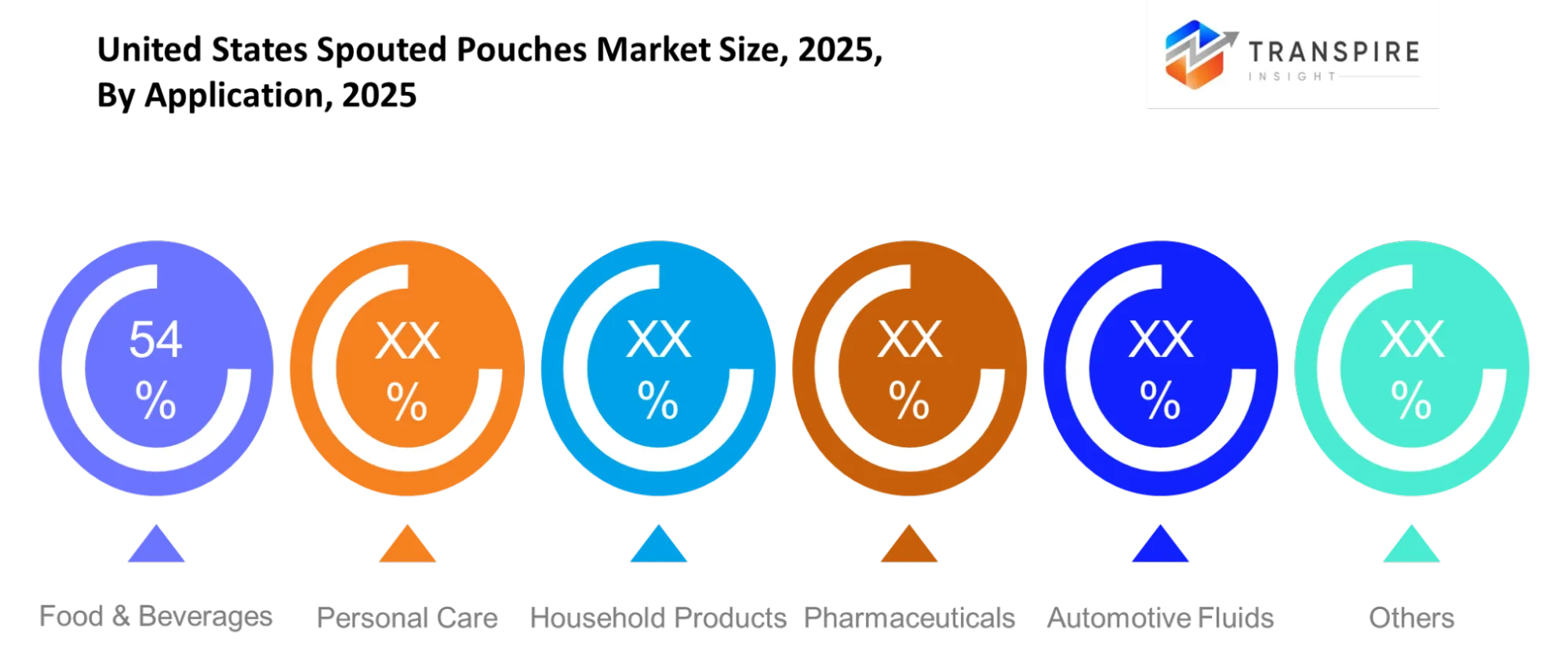
To learn more about this report, Download Free Sample Report
What are the Key Use Cases Driving the United States Spouted Pouches Market?
In the United States Spouted Pouches Market, beverages keep staying the big one, especially for ready to drink juices , sports drinks, and functional hydration liquids. A lot of brands lean on spouted formats because they cut down packaging weight, make it easier for carrying around, and they kinda match those on the go routines in retail and convenience locations. So demand stays pretty steady, and the volumes stay high.
Also there’s more growth in other things like baby food and sauces, where FMCG companies and packaged food groups are using spouted pouches for tighter portion control and less spoilage risk. At the same time, personal care players are increasingly adopting this type of package for shampoos and liquid soaps, mainly due to travel friendly requirements and because e-commerce penetration keeps rising, yes, even if the reasons are mixed.
More new use cases are starting to form around nutritional supplements and household cleaning concentrates, where controlled dispensing matters, and lower plastic usage is turning into a real buying signal. These categories are still ramping up , but they’re gaining ground as sustainability rules get stricter and brands keep revisiting their packaging playbooks across the United States Spouted Pouches Market ecosystem.
|
Report Metrics |
Details |
|
Market size value in 2025 |
USD 13.39 Billion |
|
Market size value in 2026 |
USD 14.05 Billion |
|
Revenue forecast in 2033 |
USD 19.68 Billion |
|
Growth rate |
CAGR of 4.93% from 2026 to 2033 |
|
Base year |
2025 |
|
Historical data |
2021 - 2024 |
|
Forecast period |
2026 - 2033 |
|
Report coverage |
Revenue forecast, competitive landscape, growth factors, and trends |
|
Geographic scope |
United States of America |
|
Key company profiled |
Amcor, Mondi Group, Sonoco Products, Berry Global, Smurfit Kappa, ProAmpac, Constantia Flexibles, Sealed Air, Coveris, Huhtamaki, Winpak, Glenroy, Uflex, Clondalkin Group, AptarGroup |
|
Customization scope |
Free report customization (country, regional & segment scope). Avail customized purchase options to meet your exact research needs. |
|
Report Segmentation |
By Material Type (Plastic, Aluminum Foil, Paper, Bioplastics, Laminates, Others); By Product Type (Stand-up Pouches, Flat Pouches, Retort Pouches, Recyclable Pouches, Others); By Closure Type (Screw Caps, Flip-top Caps, Child-resistant Caps, Push-pull Caps, Others); By Application (Food & Beverages, Personal Care, Household Products, Pharmaceuticals, Automotive Fluids, Others) |
Which Regions are Driving the United States Spouted Pouches Market Growth?
The West region kind of leads the United States spouted pouches market, mainly because it has a tight density of FMCG manufacturers, more advanced packaging converters and also pretty strong sustainability regulations in states like California. With strict single-use plastic limits in place, there’s been faster momentum toward recyclable spouted pouch formats for food, beverage, and personal care. Honestly, the region also does well thanks to a mature retail setup. Big supermarket chains dominate there, and e-commerce fulfillment centers too, and they basically prefer lighter packaging because it helps logistics move along more cleanly. So yeah, this whole connected manufacturing + distribution flow keeps the West in a dominant market position.
Meanwhile the Midwest region plays a steadier, stability-focused role in the United States spouted pouches market, backed by its food processing strength and agricultural output. In contrast to the West, growth there isn’t as much policy-led, it’s more anchored in long-term industrial consistency, along with established supplier relationships. A lot of major packaged food players depend on the Midwest for large-scale, cost-efficient production of sauces, dairy- based products and condiments. Also, steady capital spending on processing plants helps keep demand predictable for flexible packaging formats without sudden regulatory shocks. That combination turns the Midwest into a dependable revenue contributor, not really a place that drives major transformation.
The South region is showing the quickest growth momentum , mostly because of the rapid expansion in packaged food manufacturing and the steady increase in consumer demand across urbanizing states like Texas and Florida. Recently , there have been new investments tied to FMCG production facilities plus upgrades to logistics corridors. That combination has improved distribution efficiency, and in turn, it cuts supply chain lead times . At the same time, lower operational costs are also pulling in packaging converters, so they can broaden their capacity, a sort of quiet , steady momentum.
This shift is starting to create fresh demand clusters, especially for flexible spouted formats in beverages and household products. So for investors, the South looks like a high-growth entry point into the United States Spouted Pouches Market for the period 2026–2033.
Who are the Key Players in the United States Spouted Pouches Market and How Do They Compete?
The United States Spouted Pouches market shows a pretty moderately consolidated competitive scene, where a few large packaging converters take a noticeable share while mid-sized specialists push hard on customization and speed to market, sometimes it feels like they’re always chasing the next launch. The bigger incumbents tend to defend their spot by pouring money into material innovation and high-speed converting lines, whereas smaller players usually aim at niche formats for premium food, baby nutrition, and personal care goods. Overall competition is mostly steered by tech leadership in barrier films, spout integration efficiency, and also the ability to satisfy sustainability compliance requirements that come from major retailers.
Amcor keeps competing by leaning into technology innovation, with an emphasis on recyclable mono-material spouted pouch platforms that fit circular packaging mandates. Their edge is tied to advanced polymer engineering know-how, which helps deliver barrier protection without multilayer structures. That can reduce environmental compliance risk for FMCG clients. They also keep expanding via global R&D collaboration, plus long-term supply agreements with multinational food and beverage brands, and it’s not just one-off deals.
Berry Global plays more of a scale game, using large North American manufacturing capacity to roll out cost-efficient flexible packaging. What really stands out is its vertically integrated resin processing, paired with distribution networks that fit well across retail supply chains. ProAmpac, meanwhile, leans into customization-led specialization, providing short-run production flexibility for premium and private-label brands. It grows by acquiring regional converters, which strengthens its U.S. presence and keeps momentum going even when demand shifts.
Sealed Air is pushing ahead with sort of high-performance packaging systems, more durability and less leak risk for e-commerce shipments. At the same time they seem to be expanding, with automation-fueled packaging lines added and they’re also partnering with fulfillment operators. Huhtamaki is aiming for sustainable packaging leadership, so they’re investing in fiber-based approaches plus recyclable pouch innovations. They are also broadening their footprint through European to North American tech transfer and a bigger capacity ramp, which sounds like a clear plan.
Company List
- Amcor
- Mondi Group\
- Sonoco Products
- Berry Global
- Smurfit Kappa
- ProAmpac
- Constantia Flexibles
- Sealed Air
- Coveris
- Huhtamaki
- Winpak
- Glenroy
- Uflex
- Clondalkin Group
- AptarGroup
Recent Development News
In January 2025, Cheer Pack North America partnered with Once Upon a Farm and Amcor launched the first All-PE spouted pouch and cap in the plant-based snack category. The collaboration introduced a fully polyethylene-based recyclable spouted pouch system designed to improve recyclability and reduce environmental impact in infant and child nutrition packaging across the U.S. market.Source https://www.cheerpack.com/
In January 2025, Amcor plc and Cheer Pack North America announced a joint innovation launch of an All-PE spouted pouch and cap system for refrigerated food applications. The solution, developed for brands such as Once Upon a Farm, enhances recyclability by shifting to mono-material polyethylene structures, supporting circular packaging adoption in the U.S. spouted pouch segment. Source https://www.cheerpack.com/
What Strategic Insights Define the Future of the United States Spouted Pouches Market?
The United States Spouted Pouches Market is kind of moving, structurally, toward a high-compliance, material-efficient packaging ecosystem where recyclability and automation basically decide the real competitiveness later on. Over the next 5–7 years, growth will be driven not only by simple packaging substitution but also by putting circular design standards straight into FMCG procurement practices. This change is reinforced by retailer-led sustainability scoring systems, which are getting more and more influence on supplier choices and even contract allocation, across a lot of major consumer brands.
There’s also a less obvious risk, technology substitution from advanced rigid lightweight containers and paper-based aseptic cartons. These are improving shelf life performance and quietly shrinking the functional gap versus flexible pouches. If these alternatives manage to hit broader cost parity, they could compress the adoption momentum in premium beverage and nutrition categories. At the same time, recycling infrastructure that is uneven, stays a constraint that may make manufacturers exposed to regulatory penalties if compliance expectations tighten faster than processing capacity can expand.
But there’s an opportunity too, and it’s kind of more emerging now than people think. It’s about commercializing fully certified mono-material spouted systems that also include digital traceability features, so brands can verify recycled content at the SKU level. Companies that start early with scalable recyclable spout architectures and retailer-aligned sustainability verification setups will likely gain pricing leverage and longer-term contract stability in the United States Spouted Pouches Market.
United States Spouted Pouches Market Report Segmentation
By Material Type
- Plastic
- Aluminum Foil
- Paper
- Bioplastics
- Laminates
By Product Type
- Stand-up Pouches
- Flat Pouches
- Retort Pouches
- Recyclable Pouches
By Closure Type
- Screw Caps
- Flip-top Caps
- Child-resistant Caps
- Push-pull Caps
By Application
- Food & Beverages
- Personal Care
- Household Products
- Pharmaceuticals
- Automotive Fluids
Frequently Asked Questions
Find quick answers to common questions.
The United States Spouted Pouches Market size is USD 19.68 Billion in 2033.
Key Segments for the United States Spouted Pouches Market are By Material Type (Plastic, Aluminum Foil, Paper, Bioplastics, Laminates, Others); By Product Type (Stand-up Pouches, Flat Pouches, Retort Pouches, Recyclable Pouches, Others); By Closure Type (Screw Caps, Flip-top Caps, Child-resistant Caps, Push-pull Caps, Others); By Application (Food & Beverages, Personal Care, Household Products, Pharmaceuticals, Automotive Fluids, Others).
Major United States Spouted Pouches Market Players are Amcor, Mondi Group, Sonoco Products, Berry Global, Smurfit Kappa, ProAmpac, Constantia Flexibles, Sealed Air, Coveris, Huhtamaki, Winpak, Glenroy, Uflex, Clondalkin Group, AptarGroup.
The Current United States Spouted Pouches Market size is USD 13.39 Billion in 2025.
The United States Spouted Pouches Market CAGR is 4.93% from 2026 to 2033.
- Amcor
- Mondi Group\
- Sonoco Products
- Berry Global
- Smurfit Kappa
- ProAmpac
- Constantia Flexibles
- Sealed Air
- Coveris
- Huhtamaki
- Winpak
- Glenroy
- Uflex
- Clondalkin Group
- AptarGroup
Recently Published Reports
-
Apr 2026
Healthcare Polymer Packaging Market
Healthcare Polymer Packaging Market Size, Share & Analysis Report By Packaging Type (Syringes, IV Bottles and Pouches, Clamshells, Blisters, Bottles & Jars, Containers, Tubes, IV Parental Packaging, Others), By Type (Regulated, Non-regulated), By Polymer Type (LDPE (Low-Density Polyethylene), HDPE (High-Density Polyethylene), Homo-polymer (Homo), Random Copolymer (Random), Block Copolymer (Block), PET, Polystyrene, Polyvinyl Chloride, Polyamide/EVOH, Others), and Geography (North America, Europe, Asia-Pacific, Middle East and Africa, South and Central America), 2021 - 2031
-
Apr 2026
Hydrophilic Tape (Waterstop) Market
Hydrophilic Tape (Waterstop) Market Size, Share & Analysis Report By Type (Bentonite-Based Hydrophilic Tape, Rubber-Based Hydrophilic Tape), By Application (Residential Buildings, Commercial Buildings, Infrastructure Projects), and Geography (North America, Europe, Asia-Pacific, Middle East and Africa, South and Central America), 2021 - 2031
-
Apr 2026
Metalens Market
Metalens Market Size, Share & Analysis Report By Type (Visible Light Metalens, and Infrared Metalens), By Application (Consumer Electronics, Automotive Electronics, Industrial, Medical, and Others), and Geography (North America, Europe, Asia-Pacific, Middle East and Africa, South and Central America), 2021 - 2031
-
Apr 2026
PBT Resin Market
PBT Resin Market Size, Share & Analysis Report By Type (Reinforced PBT Resin, Unreinforced PBT Resin), By Processing Method (Injection Molding, Extrusion, Blow Molding, Others), By End-User (Automotive, Electrical & Electronics, Consumer Appliances, Industrial Machinery, Medical Devices, Packaging, Others), and Geography (North America, Europe, Asia-Pacific, Middle East and Africa, South and Central America), 2021 - 2031