

United States Recreational Vehicle Market Size & Forecast:
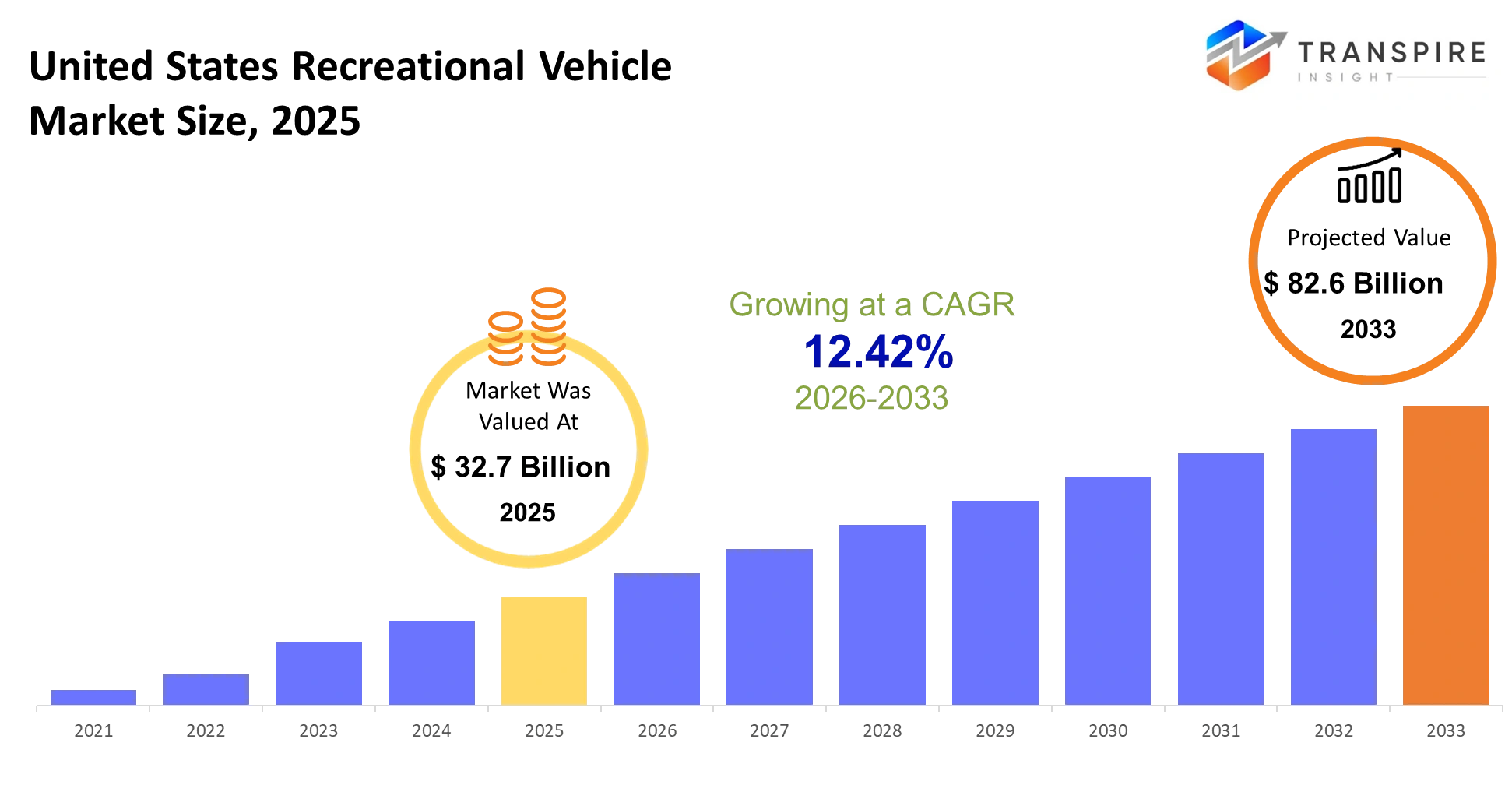
- United States Recreational Vehicle Market Size 2025: USD 32.7 Billion
- United States Recreational Vehicle Market Size 2033: USD 82.6 Billion
- United States Recreational Vehicle Market CAGR: 12.42%
- United States Recreational Vehicle Market Segments:By Type (Motorhomes, Travel Trailers, Fifth Wheel, Camper Vans, Pop-up Campers, Toy Haulers, Truck Campers), By Application (Leisure, Tourism, Camping, Rental, Adventure, Family Travel, Luxury), By Fuel (Diesel, Gasoline, Electric, Hybrid, LPG, Solar, Hydrogen), By End-User (Individuals, Rental Firms, Tour Operators, Govt, Families, Luxury Buyers, Adventurers), By Distribution (Dealers, Online, Direct Sales, Rentals, Auctions, OEM, Export).
To learn more about this report,  Download Free Sample Report
United States Recreational Vehicle Market Summary:
The United States recreational vehicle Market size is estimated at USD 32.7 Billion in 2025 and is anticipated to reach USD 82.6 Billion by 2033, growing at a CAGR of 12.42% from 2026 to 2033. The United States Recreational Vehicle Market keeps growing because travelers now prefer to travel through flexible travel methods which provide them with new experiences. RVs have become the preferred travel method for consumers because they provide better value for money and easier travel compared to regular travel methods. The demand for outdoor activities and national park visiting has increased because younger people and first-time buyers show rising interest in these activities.
The market undergoes transformation because manufacturers now implement advanced technologies which include smart capabilities and better fuel efficiency and sustainable product designs. The company develops new products from compact camper vans to luxury motorhomes which enable it to reach a broader customer market. The combination of rental platforms with peer-to-peer RV sharing services enables people to access recreational vehicles, which results in increased trial usage and higher rates of permanent ownership.
What Has the Impact of Artificial Intelligence Been on the United States Recreational Vehicle Market?
The United States Recreational Vehicle Market undergoes a significant transformation because artificial intelligence, which changes how businesses process information and adapt to changing customer preferences. The United States Recreational Vehicle Market uses AI technology to conduct market research which processes data instantaneously, enabling manufacturers and dealers to find useful business insights. The United States Recreational Vehicle Market businesses use machine learning models together with predictive analytics to create better demand forecasts, discover new travel patterns, and develop effective pricing methods. The data-driven method improves decision-making processes while it decreases uncertainty across all stages of the value chain.
Artificial intelligence deployment across United States Recreational Vehicle Market operations boosts production efficiency because it enables smart manufacturing automation in all production facilities. AI-powered systems streamline assembly processes which result in less downtime while improving quality control, which enables businesses to save costs and accelerate product delivery.
Artificial intelligence drives both innovation and tailored experiences, which enables businesses in the United States Recreational Vehicle Market to establish a strong market edge. Smart technologies provide customers with better satisfaction through their intelligent navigation systems and customized in-vehicle experiences.
Key Market Trends & Insights:
- The Midwest Recreational Vehicle Market leads the United States market because it currently holds 35% of the market share which will increase to 2025 through its strong manufacturing bases and customer requirements.
- The Western region displays the most rapid growth because its expansion rate will reach 8% CAGR between 2025 and 2030 due to increased outdoor tourism and national park travel.
- The motorhome market constitutes 45% of the market in 2025 because consumers seek high-end solutions that enable them to travel long distances.
- Towable RVs hold the second-largest market share which amounts to approximately 40% because they provide customers with budget-friendly options that require simple maintenance procedures.
- The camper van market capacity will expand through a 9% CAGR growth rate which will continue until 2030 because more people choose to travel with minimalist baggage.
- Leisure travel maintains its position as the leading segment in the United States Recreational Vehicle Market because it accounts for more than 60% of total market share which American families use to travel and experience road trip culture.
- The application of remote work and mobile living shows the highest growth rate because it expands at 10% CAGR while more people practice digital nomadism.
- The personal travel market shows strong growth because individual customers now control 70% of the market which operates in 2025.
- The rental and fleet operator market shows rapid growth because demand for their services increases at 8 to 10% CAGR which results from the popularity of peer-to-peer sharing systems.
United States Recreational Vehicle Market Segmentation
By Type
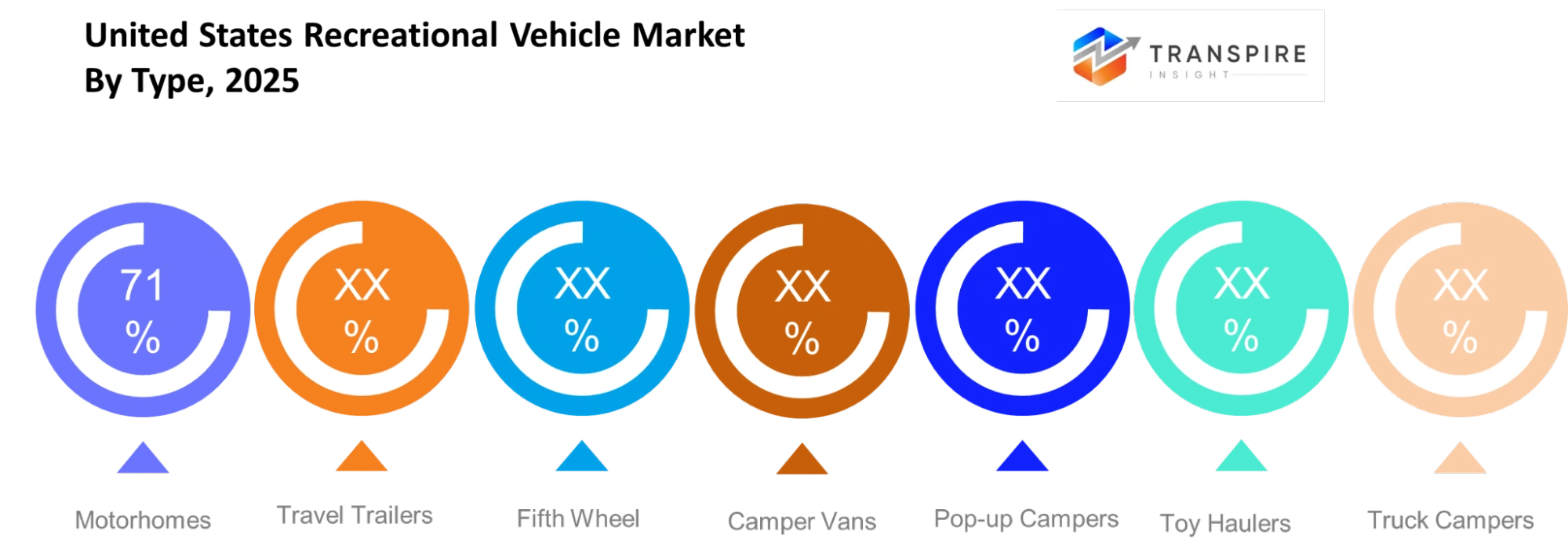
Motorhomes provide complete living space which contains kitchen facilities and restroom facilities and sleeping quarters. The travel trailers together with fifth wheel units deliver dual towing solutions which enable families to choose between different interior space options. The compact size of camper vans together with their straightforward operation has made them popular among users who need to travel short distances within cities.
Pop-up campers and truck campers serve budget-conscious buyers looking for lightweight and simple travel solutions. The design of toy haulers enables users who seek adventure to store their bikes and equipment while having a residential area. The different types of travel systems enable travelers to choose their preferred way of traveling which includes their comfort level and ability to move and their budget limits.
To learn more about this report, Download Free Sample Report
By Application
People mainly use the area for leisure activities and tourism which police support through their patrols of scenic routes and national parks. Camping remains a popular activity because travelers choose to experience nature through basic or semi-equipped setups. The rental system provides people with temporary vehicle access because it allows them to use vehicles without needing to buy them.
Adventure travel becomes more popular through off-road driving and outdoor sports which create a need for robust vehicles that can handle various driving conditions. Families prefer bigger cars because these vehicles provide extra security measures and comfortable seating. Luxury travel experiences permanent growth because premium interior designs and contemporary facilities enhance the overall travel experience.
By Fuel
People continue to use diesel and gasoline because these fuels are accessible and their distribution systems already exist which enables travel over long distances. The market shows rising demand for hybrid vehicles because these models provide superior fuel efficiency and lower emissions when compared to conventional vehicles. The electric vehicle market is expanding gradually because battery technology and charging station infrastructure have improved.
Off-grid travel support needs solar-powered systems which help reduce dependency on external power sources. The availability of LPG and hydrogen fuel options remains restricted yet these technologies have potential for future use because they produce environmentally friendly energy. People base their fuel selection on three factors which include expenses and travel distance and ecological impact.
By Installation
The demand from individual buyers seeking personal travel and flexible mobility options is a major part of the market. Families choose to travel in larger vehicles which provide them with better safety and comfort and storage space during their extended journeys. The rental businesses help the market expand by providing new customers who need short-duration travel options.
Recreational vehicles serve as the primary means of transportation that tour operators use to lead visitors through popular travel destinations. Buyers who seek luxury products concentrate on high-end models which include sophisticated functions and designer interiors. Adventurers choose to buy durable products which enable them to perform well in rough outdoor environments while they execute their different activities.
By End-User
The primary sales channel for dealers continues to operate through their physical location which enables customers to inspect products and obtain financing and receive service support after their purchase. Online platforms experience continuous growth because they enable users to compare products easily while making digital reservations and accessing a wider range of products. Direct sales from manufacturers help build customer trust and offer customized solutions.
The expansion of rental channels enables customers to access products with flexible usage rights while avoiding the expenses associated with ownership. Budget-conscious consumers are drawn to auctions because they provide access to used vehicles at reduced prices. OEM and export channels enable manufacturers to expand their market presence while their sales operations reach new territories to increase total sales.
What are the Main Challenges for the United States Recreational Vehicle Market Growth?
The United States recreational vehicle market experiences multiple technical and operational obstacles that interfere with its ability to achieve steady expansion. Product performance issues that include fuel efficiency and vehicle weight and maintenance complexity create obstacles which both manufacturers and consumers must overcome. Production cycles experience delays because of ongoing supply chain disruptions which particularly affect semiconductor and chassis parts.
The United States recreational vehicle market experiences growth obstacles because of manufacturing and commercialization barriers which create product development challenges. Production costs increase because of raw material price changes and labor costs which lead to lower profit margins across the entire value chain.
Companies face additional challenges because they must comply with safety and emission and quality standards which lead to product development delays. The need for product customization results in extended manufacturing processes which restrict production capabilities for both mass production and swift market entry.
The United States recreational vehicle market faces adoption challenges due to existing infrastructure and accessibility limitations. The limited number of RV parks and electric charging stations and maintenance facilities stop people from adopting the technology. The absence of skilled technicians who can operate advanced systems and smart technology results in decreased service efficiency.
Country Insights
The manufacturing clusters in the Midwest region combine with ongoing consumer demand to create a powerful economic advantage for the region. Indiana and other states produce large quantities of goods because they have access to skilled workers and extensive supplier networks. The region maintains its strong sales results because it operates reliable logistical and distribution networks.
Western parts of the country experience increasing economic development because outdoor recreational activities and national park visits attract more visitors. People want more products because they find scenic travel routes and road trips match their preferred way of life. The rental service industry will continue to expand because of better infrastructure development which will create new rental services that will support regional population growth.
The Southern region shows stable economic growth because its warm weather attracts visitors throughout the entire year. The increasing population together with rising disposable income will result in more people owning vehicles and renting them. States that focus on tourism generate continuous revenue growth through their sales activities.
Northeast regions reflect moderate growth due to seasonal travel patterns and space limitations. However, increasing interest in compact and fuel-efficient vehicles supports gradual demand improvement. Urban consumers show preference for flexible travel options which lead to more people using rental services.
Recent Development News
In March 2026, RV Industry Association (RVIA): The U.S. RV market is projected to continue steady recovery, with wholesale shipments expected to stay in the mid-300,000 unit range for 2026. Industry experts highlight improving economic conditions and stabilizing demand after post-pandemic fluctuations. Growth is expected to strengthen in the second half of 2026 as consumer confidence improves.
Source: https://www.rvia.org
In March 2026, US RV Shipments Drop Amid Weak Demand: The U.S. recreational vehicle market recorded a notable slowdown, with wholesale shipments falling 11.1% year-on-year in February 2026. This decline reflects continued pressure from high interest rates and cautious consumer spending on discretionary travel goods. Despite short-term weakness, the broader industry still shows signs of stabilisation compared to post-pandemic volatility.
Source: https://www.globenewswire.com
|
Report Metrics |
Details |
|
Market size value in 2025 |
USD 32.7 Billion |
|
Market size value in 2026 |
USD 36.4 Billion |
|
Revenue forecast in 2033 |
USD 82.6 Billion |
|
Growth rate |
CAGR of 12.42% from 2026 to 2033 |
|
Base year |
2025 |
|
Historical data |
2021 – 2024 |
|
Forecast period |
2026 – 2033 |
|
Report coverage |
Revenue forecast, competitive landscape, growth factors, and trends |
|
Country scope |
United States |
|
Key company profiled |
Thor Industries, Winnebago, Forest River, REV Group, Tiffin Motorhomes, Airstream, Newmar, Jayco, Coachmen, Pleasure-Way, Hymer, Gulf Stream, Nexus RV, Roadtrek, Entegra Coach |
|
Customization scope |
Free report customization (country, regional & segment scope). Avail customized purchase options to meet your exact research needs. |
|
Report Segmentation |
By Type (Motorhomes, Travel Trailers, Fifth Wheel, Camper Vans, Pop-up Campers, Toy Haulers, Truck Campers), By Application (Leisure, Tourism, Camping, Rental, Adventure, Family Travel, Luxury), By Fuel (Diesel, Gasoline, Electric, Hybrid, LPG, Solar, Hydrogen), By End-User (Individuals, Rental Firms, Tour Operators, Govt, Families, Luxury Buyers, Adventurers), By Distribution (Dealers, Online, Direct Sales, Rentals, Auctions, OEM, Export). |
How Can New Companies Establish a Strong Foothold in the United States Recreational Vehicle Market?
New companies starting their operations in the United States recreational vehicle market should concentrate on niche markets and neglected customer requirements to succeed. Emerging companies should establish their identity through specific product categories which include compact camper vans and eco-friendly models and affordable entry-level units.
New market players can establish competitive advantages through effective product positioning which matches existing market expansion and evolving travel patterns. The initial market presence of a business will become stronger through its development of a unique brand identity and design system which focuses on customer needs.
US recreational vehicle market entry requires companies to use innovation strategies as their primary approach to market entry. The startup sector can solve major industry problems which include high fuel expenses and complicated equipment maintenance through their development of smart technology products and energy-saving systems and connected devices.
The companies Pebble Mobility and Lightship create electric RV solutions which use software technology to demonstrate how companies can achieve product differentiation through their technological advancements. The industry preserves sustainability through these methods while implementing digital technologies across its core operations.
The United States recreational vehicle market expands through businesses which establish strategic partnerships and implement adaptable operational frameworks. The company will establish better distribution systems which decrease market entry obstacles through its partnerships with rental platforms and tourism operators and component suppliers.
The company can reach more customers through its direct-to-consumer sales model and subscription-based usage system. New market players can establish themselves as competitive businesses through their use of innovation and partnerships and their development of specific market solutions.
Key United States Recreational Vehicle Market Company Insights
Leading companies maintain their dominant market position because they operate their business through extensive product offerings and their established network of dealerships which serves important geographic areas. The brand will develop customer loyalty through its ongoing product enhancements which will deliver superior comfort and safety features and improved fuel efficiency. The company achieves steady market distribution and delivery performance through its strong production capacity and its ability to manage its supply chain operations.
The introduction of new products drives market competition because companies develop electric vehicles which include advanced technologies and lightweight construction materials. Companies dedicate resources to their research and development programs so they can enhance product performance while achieving lower costs during production. The business aims to attract first-time customers while maintaining its existing customer base in order to succeed against market competitors.
The business will achieve stronger market power through strategic partnerships and acquisitions which will enable it to operate in new markets. The company will establish better customer connections through its partnerships with rental services and tourism companies. The business will achieve greater sales efficiency through its development of online sales platforms and direct-to-consumer distribution systems.
Businesses use their pricing methods together with their product support services after purchase to create customer loyalty which helps them stay competitive in the market. Flexible payment options together with maintenance assistance and warranty services will help companies develop stronger relationships with their customers. The business will achieve sustained growth through its ability to deliver consistent service standards which create stable customer experiences.
Company List
- Thor Industries
- Winnebago
- Forest River
- REV Group
- Tiffin Motorhomes
- Airstream
- Newmar
- Jayco
- Coachmen
- Pleasure-Way
- Hymer
- Gulf Stream
- Nexus RV
- Roadtrek
- Entegra Coach
What are the Key Use-Cases Driving the Growth of the United States Recreational Vehicle Market?
The recreational vehicle market in the United States experiences growth because people want to travel for leisure and need transportation options that provide them with both freedom and tourism access. Families and retirees maintain frequent usage patterns of road trips and outdoor tourism and national park visits.Mobile living and remote work represent another important use case that develops the United States recreational vehicle market. Digital connectivity allows professionals to work from RVs which function as their mobile offices while they travel. People now demand vehicles that include smart technology and internet access and energy-saving features which provides manufacturers with opportunities to create new products.
The United States recreational vehicle market sees increased adoption through rental services and shared mobility offerings. First-time users can access RVs through peer-to-peer platforms and commercial rental fleets which provide affordable options that decrease ownership costs. The model increases utilization rates while bringing new customers into RV lifestyles which helps to sustain market growth over time.
Mobile healthcare units and emergency response vehicles and event-based deployments are now emerging as specialized applications. RV platforms demonstrate their versatility through multiple use cases which extend beyond tourism purposes. The ongoing process of innovation will lead to commercial and public service applications which can operate at scale to promote growth potential.
United States Recreational Vehicle Market Report Segmentation
By Type
- Motorhomes
- Travel Trailers
- Fifth Wheel
- Camper Vans
- Pop-up Campers
- Toy Haulers
- Truck Campers
By Application
- Leisure
- Tourism
- Camping,
- Rental
- Adventure
- Family Travel
- Luxury
By Fuel
- Diesel
- Gasoline
- Electric
- Hybrid
- LPG
- Solar
- Hydrogen
By End-User
- Individuals
- Rental Firms
- Tour Operators
- Govt
- Families
- Luxury Buyers
- Adventurers
By Distribution
- Dealers
- Online
- Direct Sales
- Rentals
- Auctions
- OEM
- Export
Frequently Asked Questions
Find quick answers to common questions.
The approximate United States Recreational Vehicle Market size for the market will be USD 82.6 Billion in 2033.
The key segments of the United States Recreational Vehicle Market are By Type (Motorhomes, Travel Trailers, Fifth Wheel, Camper Vans, Pop-up Campers, Toy Haulers, Truck Campers), By Application (Leisure, Tourism, Camping, Rental, Adventure, Family Travel, Luxury), By Fuel (Diesel, Gasoline, Electric, Hybrid, LPG, Solar, Hydrogen), By End-User (Individuals, Rental Firms, Tour Operators, Govt, Families, Luxury Buyers, Adventurers), By Distribution (Dealers, Online, Direct Sales, Rentals, Auctions, OEM, Export).
Major players in the United States Recreational Vehicle Market are Thor Industries, Winnebago, Forest River, REV Group, Tiffin Motorhomes, Airstream, Newmar, Jayco, Coachmen, Pleasure-Way, Hymer, Gulf Stream, Nexus RV, Roadtrek, Entegra Coach.
The current market size of the United States Recreational Vehicle Market is USD 32.7 Billion in 2025.
The United States Recreational Vehicle Market CAGR is 12.42%.
- Thor Industries
- Winnebago
- Forest River
- REV Group
- Tiffin Motorhomes
- Airstream
- Newmar
- Jayco
- Coachmen
- Pleasure-Way
- Hymer
- Gulf Stream
- Nexus RV
- Roadtrek
- Entegra Coach
About the Authors

Mayur Shinde
I am Mayur Shinde, a Senior Research Analyst at Transpire Insight, specializing in the Automotive & Transportation and Information & Communication Technology (ICT) Industry. My work focuses on analyzing emerging market trends, technological advancements, competitive landscapes, and industry developments to deliver accurate, data-driven insights. I am passionate about transforming complex market information into clear, actionable content that helps businesses, professionals, and decision-makers stay informed and make confident strategic decisions.

Chakradhar Khansole
Chakradhar serves as the Research Director at Transpire Insight, bringing over 8 years of experience in technology, innovation, and strategic market intelligence. He specializes in transforming complex market data into actionable business insights that enable organizations to make informed, growth-oriented decisions. Recognized for his strategic vision and analytical expertise, Chakradhar leads high-impact research initiatives, delivering comprehensive market assessments, competitive intelligence, and forward-looking industry analysis.
Recently Published Reports
-
Apr 2026
ATV & UTV Market
ATV & UTV Market Size, Share & Analysis Report By Type (ATV, and UTV), By Variants (Less Than 400 CC, 400 CC To 800 CC, and More Than 800 CC), and Geography (North America, Europe, Asia-Pacific, Middle East and Africa, South and Central America), 2021 - 2031
-
Apr 2026
Automotive Central Gateway Module Market
Automotive Central Gateway Module Market Size, Share & Analysis Report By Type (Ethernet Central Gateway Module, CAN Central Gateway Module, LIN Central Gateway Module, and FlexRay), By Application (Powertrain Control, Body Control, Infotainment System, Advanced Driver Assistance Systems (ADAS), and Others), By End User (Passenger Vehicles, and Commercial Vehicles), and Geography (North America, Europe, Asia-Pacific, Middle East and Africa, South and Central America), 2021 - 2031
-
Apr 2026
Automotive Engine Oil Filter Market
Automotive Engine Oil Filter Market Size, Share & Analysis Report By Filter Type (Fuel Filter, Engine Oil Filter, Hydraulic Oil Filter, and Others), By Filter Media (Cellulose, Synthetic, and Micro), By Sales Channel (OEMs, and Aftermarket), By Vehicle Type (Passenger Cars, Light Commercial Vehicles, Heavy Duty Trucks, Buses and Coaches, and Off-road Vehicles), and Geography (North America, Europe, Asia-Pacific, Middle East and Africa, South and Central America), 2021 - 2031
-
Apr 2026
Automotive Parts Aluminium Die Casting Market
Automotive Parts Aluminium Die Casting Market Size, Share & Analysis Report By Production Process (Pressure Die Casting, Vacuum Die Casting, Squeeze Die Casting, Gravity Die Casting), By Application (Body Parts, Engine Parts, Transmission Parts, Battery And Related Components, Other Application Types), and Geography (North America, Europe, Asia-Pacific, Middle East and Africa, South and Central America), 2021 - 2031
Our Clients



