

United States Nanorobots Market Size & Forecast:
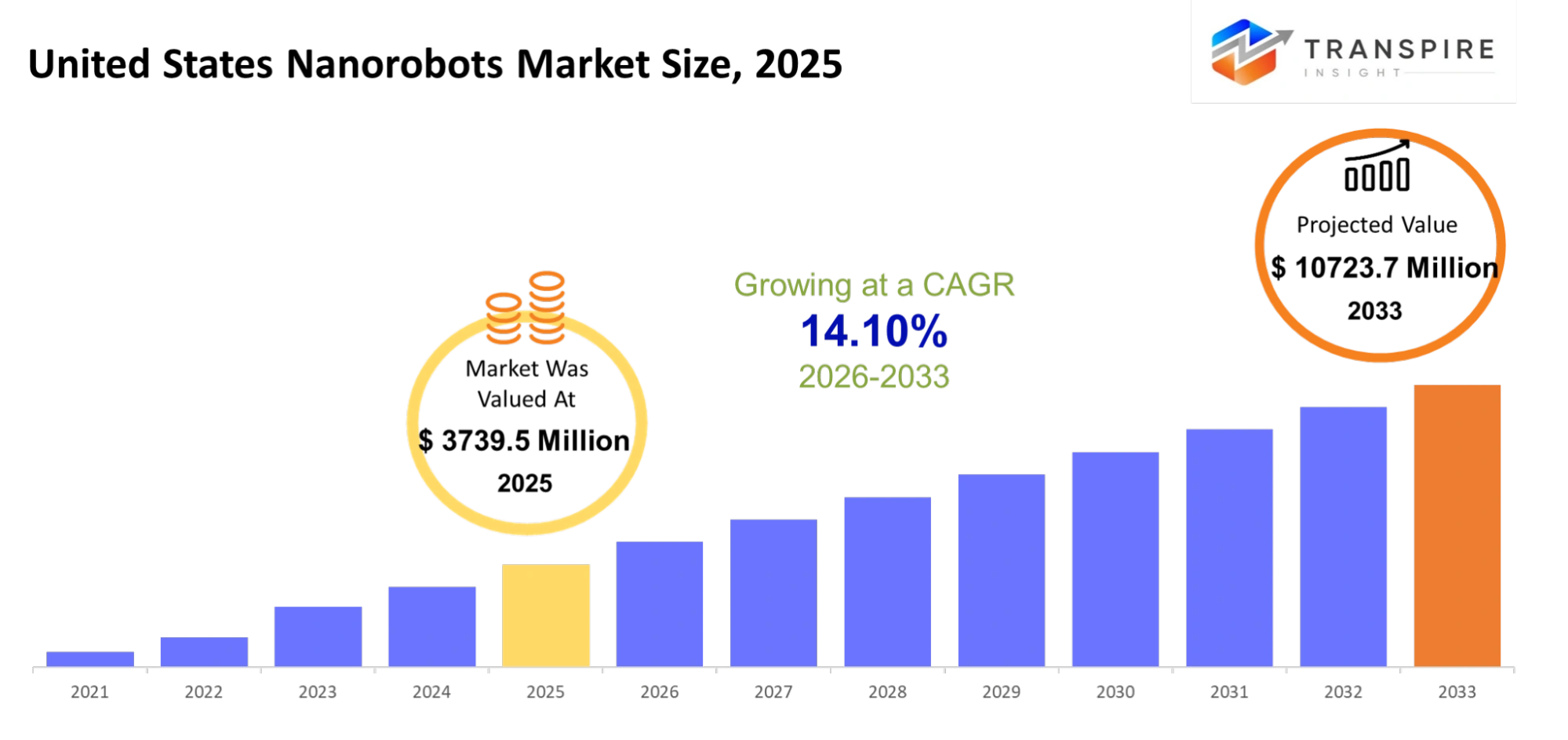
- United States Nanorobots Market Size 2025: USD 3739.5 Million
- United States Nanorobots Market Size 2033: USD 10723.7 Million
- United States Nanorobots Market CAGR: 14.10%
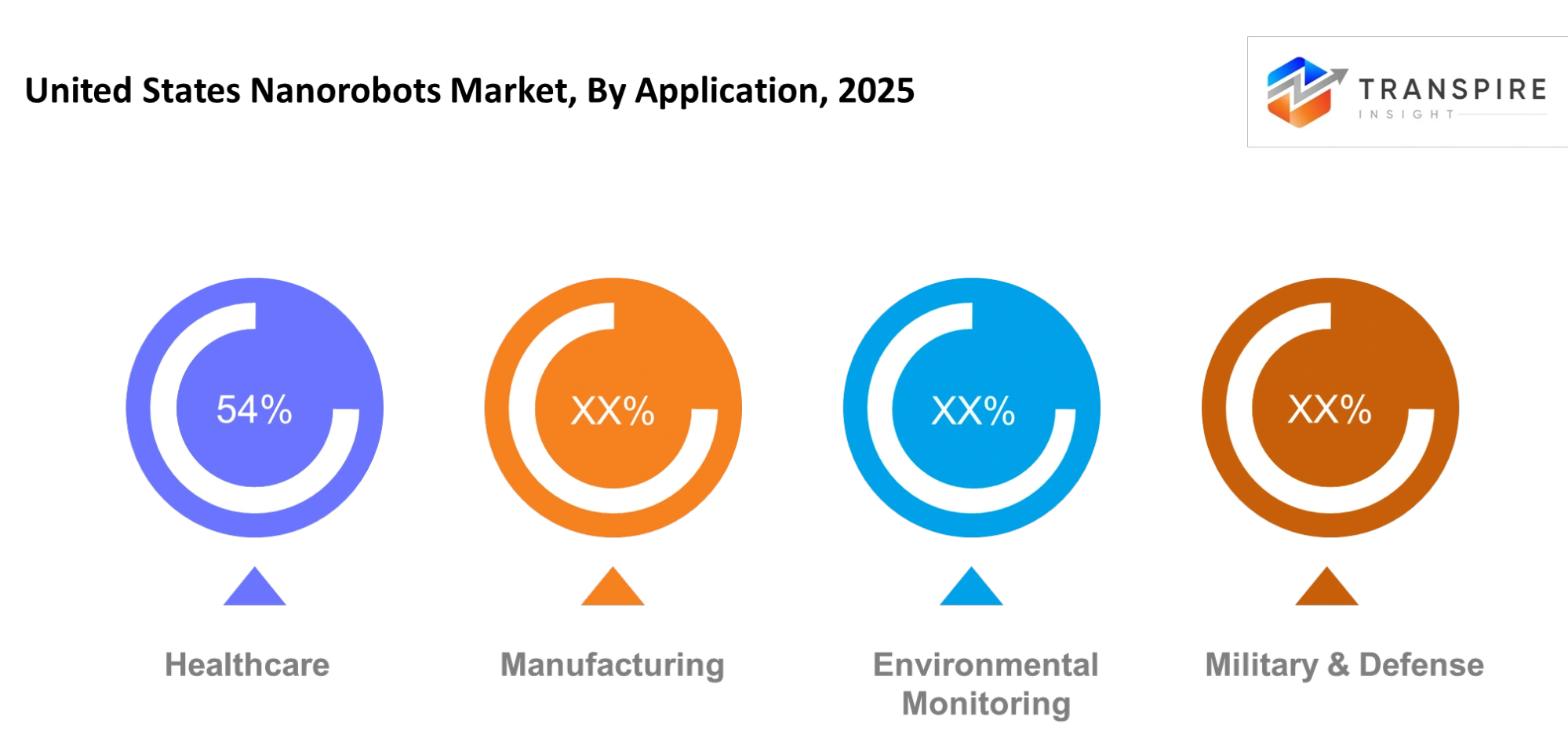
- United States Nanorobots Market Segments: By Type (Microbivore Nanorobots, Cellular Repair Nanorobots, Respirocyte Nanorobots), By Application (Healthcare, Manufacturing, Environmental Monitoring, Military & Defense).
To learn more about this report,  Download Free Sample Report
United States Nanorobots Market Summary:
The United States Nanorobot Market size is estimated at USD 3739.5 Million in 2025 and is anticipated to reach USD 10723.7 Million by 2033, growing at a CAGR of 14.10% from 2026 to 2033. The United States nanorobots market is slowly starting to develop because nanotechnology research and health care innovations are progressing. The tiny machines show potential for three medical applications, which include targeted drug delivery and minimally invasive surgeries and precision diagnostics. Research institutions and private companies are increasing their funding, which helps development progress while the market grows due to rising requirements for customised medical solutions. Although the field remains in its initial development stage, it demonstrates strong upcoming potential because of new technological advancements and its growing use in both medical and industrial applications.
Key Market Trends & Insights:
- Nanorobotics attracts strong interest from both governmental organisations and commercial funding sources. The increased financial support enables both emerging companies and established businesses to transition their new ideas into practical use.
- The development of nanorobots enables doctors to perform medical treatments with less invasive techniques. Their capacity to function at a small scale enables patients to heal faster while decreasing the dangers of surgical procedures.
- The demand for personalised medical treatments drives the growing popularity of nanorobots. The technologies provide customised treatment solutions which enhance patient outcomes and increase their contentment level.
- The integration of artificial intelligence with nanorobotics systems results in better operational accuracy and system control. Smart nanorobots possess the capability to carry out real-time decision-making processes within the human body, which enhances their operational efficiency.
- Regulatory requirements and safety issues exist as major obstacles which prevent development of the technology. Commercialization of products requires companies to demonstrate their materials possess biocompatibility while demonstrating the knowledge of their long-term effects.
United States Nanorobots Market Segmentation
By Type
- Microbivore Nanorobots: Microbivore nanorobots operate as artificial white blood cells which detect and destroy dangerous pathogens that exist in human blood. The system provides a modern infection treatment method which enables precise and rapid treatment operations while decreasing the need for antibiotics. The system helps solve current problems with antimicrobial resistance which exists in contemporary healthcare systems.
- Cellular Repair Nanorobots: The technology of cellular repair nanorobots works to restore or replace damaged human body cells. The advanced devices have the ability to perform tissue repairs through molecular processes which provide a potential solution for treating chronic diseases and injuries. The development of these technologies shows that the field of medicine is moving toward regenerative treatments which provide permanent solutions instead of temporary solutions.
- Respirocyte Nanorobots: Respirocyte nanorobots function as synthetic red blood cells which efficiently transport and distribute oxygen throughout the human body. The technology has the potential to transform emergency medicine and critical care by sustaining oxygen levels through traumatic events and respiratory failures which enhances patient outcomes during severe medical emergencies.
By Application
- Healthcare: The primary field for nanorobots in healthcare remains active because people need precise medical treatment and new medical procedures. Nanorobots transform patient treatment through their ability to deliver drugs directly to specific locations and perform diagnostic tests and surgical tasks, which result in less invasive treatments that provide better patient results and faster recovery times and lower total medical expenses.
- Manufacturing: Manufacturers investigate nanorobots for their ability to create products through microscopic assembly, which achieves better precision than current methods. The system enables better production results through decreased material waste while delivering superior product performance. The new technology provides essential support for sectors that need exact precision in their work, including electronics manufacturing and advanced materials development.
- Environmental Monitoring: Nanorobots function as effective instruments which scientists employ to examine and control environmental variables. The system detects pollutants and toxins and contaminants at microscopic levels, which allows for prompt environmental cleanup. The system operates to support sustainability initiatives which assist businesses and governmental entities in preserving healthy and secure natural environments.
- Military & Defense: The military and defence domain can utilise nanorobots for three main functions, which include conducting surveillance activities and identifying potential threats and delivering medical assistance to military personnel. Their advanced functions permit them to operate secretly while they use their small dimensions to reach critical situations and deliver better safety measures and strategic advantages and improved battlefield medical support.
To learn more about this report, Download Free Sample Report
Country Insights
The United States nanorobots market reflects a dynamic blend of innovation research excellence and growing commercial interest. The country benefits from a strong ecosystem of advanced laboratories and leading universities and technology-driven companies which are dedicated to researching nanorobotics applications in healthcare. The increasing focus on precision medicine together with early disease detection has created a need for specialised nanorobots which require advanced development.
Research capabilities receive strengthening through government funding initiatives while academic institutions and private firms create partnerships which result in faster development of real-world solutions. The presence of a well-established healthcare infrastructure enables faster adoption of new technologies which many other regions cannot match.
United States regulatory standards maintain strict requirements which help protect public safety through testing procedures that verify product reliability before authorisation for general distribution. The market remains in its developmental phase, yet the nation possesses the necessary conditions to become the future technological leader because of its ongoing research efforts and dedication to developing new technologies.
Recent Development News
U.S. Advances Targeted Cancer Nanorobot Therapy: Researchers in the U.S. are developing nanorobots that can release drugs only when cancer cells are detected. This breakthrough could significantly reduce chemotherapy side effects and improve treatment precision.
U.S. Pushes Innovation with Heavy Nanotech Investments: Government-backed initiatives continue to fuel nanorobotics research across universities and institutions. Increased funding is helping accelerate commercialisation efforts nationwide.
|
Report Metrics |
Details |
|
Market size value in 2025 |
USD 3739.5 Million |
|
Market size value in 2026 |
USD 4259.3 Million |
|
Revenue forecast in 2033 |
USD 10723.7 Million |
|
Growth rate |
CAGR of 14.10% from 2026 to 2033 |
|
Base year |
2025 |
|
Historical data |
2021 – 2024 |
|
Forecast period |
2026 – 2033 |
|
Report coverage |
Revenue forecast, competitive landscape, growth factors, and trends |
|
Country scope |
United States |
|
Key company profiled |
Oxford Instruments PLC, Bruker Corporation, Thermo Fisher Scientific Inc., Agilent Technologies Inc., JEOL Ltd., Nanonics Imaging Ltd., Kleindiek Nanotechnik GmbH, Ginkgo Bioworks Inc., Nanovery Ltd., Nanobots Medical Inc., Teledyne Technologies Inc., Park Systems Corp., Hitachi High-Tech Corporation, Zyvex Labs LLC, Klocke Nanotechnik GmbH. |
|
Customization scope |
Free report customization (country, regional & segment scope). Avail customized purchase options to meet your exact research needs. |
|
Report Segmentation |
By Type (Microbivore Nanorobots, Cellular Repair Nanorobots, Respirocyte Nanorobots), By Application (Healthcare, Manufacturing, Environmental Monitoring, Military & Defense). |
Key United States Nanorobots Company Insights
The United States nanorobot market exists because of new companies and research organisations and established technology firms which develop nanoscale technologies. The healthcare applications of organisations receive their main focus because they need precise solutions for targeted therapies and advanced diagnostic methods. Companies establish partnerships with universities and research institutes to speed up product development and achieve their market introduction goals. The industry players with testing operations receive support from increasing investment flows and strategic business partnerships which enable their progress towards operational capacity. The existing environment of business competition and collaboration will produce continuous technological advancements which will sustain market expansion over time.
Company List
- Oxford Instruments PLC
- Bruker Corporation
- Thermo Fisher Scientific Inc.
- Agilent Technologies Inc.
- JEOL Ltd.
- Nanonics Imaging Ltd.
- Kleindiek Nanotechnik GmbH
- Ginkgo Bioworks Inc.
- Nanovery Ltd.
- Nanobots Medical Inc.
- Teledyne Technologies Inc.
- Park Systems Corp.
- Hitachi High-Tech Corporation
- Zyvex Labs LLC
- Klocke Nanotechnik GmbH.
United States Nanorobots Market Report Segmentation
By Type
- Microbivore Nanorobots
- Cellular Repair Nanorobots
- Respirocyte Nanorobots
By Application
- Healthcare
- Manufacturing
- Environmental Monitoring
- Military & Defense
Frequently Asked Questions
Find quick answers to common questions.
The approximate United States Nanorobots Market size for the market will be USD 10723.7 Million in 2033.
The key segments of the United States Nanorobots Market are By Type (Microbivore Nanorobots, Cellular Repair Nanorobots, Respirocyte Nanorobots), By Application (Healthcare, Manufacturing, Environmental Monitoring, Military & Defense).
Major players in the United States Nanorobots Market are Oxford Instruments PLC, Bruker Corporation, Thermo Fisher Scientific Inc., Agilent Technologies Inc., JEOL Ltd., Nanonics Imaging Ltd., Kleindiek Nanotechnik GmbH, Ginkgo Bioworks Inc., Nanovery Ltd., Nanobots Medical Inc., Teledyne Technologies Inc., Park Systems Corp., Hitachi High-Tech Corporation, Zyvex Labs LLC, Klocke Nanotechnik GmbH.
The current market size of the United States Nanorobots Market is USD 3739.5 Million in 2025.
The United States Nanorobots Market CAGR is 14.10%.
- Oxford Instruments PLC
- Bruker Corporation
- Thermo Fisher Scientific Inc.
- Agilent Technologies Inc.
- JEOL Ltd.
- Nanonics Imaging Ltd.
- Kleindiek Nanotechnik GmbH
- Ginkgo Bioworks Inc.
- Nanovery Ltd.
- Nanobots Medical Inc.
- Teledyne Technologies Inc.
- Park Systems Corp.
- Hitachi High-Tech Corporation
- Zyvex Labs LLC
- Klocke Nanotechnik GmbH.
Recently Published Reports
-
Apr 2026
Fiber Optic Faceplates Market
Fiber Optic Faceplates Market Size, Share & Analysis Report By Type (< 300 mm2, 300-350 mm2, and > 350 mm2, By Application (Night Vision, Holographic Imaging, Medical, and Others), and Geography (North America, Europe, Asia-Pacific, Middle East and Africa, South and Central America), 2021 - 2031
-
Apr 2026
High Temperature Superconductors Market
High Temperature Superconductors Market Size, Share & Analysis Report By Type (1G HTS, and 2G HTS), By Application (Power Cable, Fault Current Limiter, and Transformer), and Geography (North America, Europe, Asia-Pacific, Middle East and Africa, South and Central America), 2021 - 2031
-
Apr 2026
Industrial Plugs and Socket Market
Industrial Plugs and Socket Market Size, Share & Analysis Report By Type (Industrial Plugs, Industrial Sockets), By Current (Up to 32 A, 32 to 125 A, Above 125 A), By Protection (Dustproof and Splash Proof, Waterproof, Explosion Proof), By End User (Heavy Industries, Oil and Gas, Chemicals and Pharmaceuticals, Power Generation, Others), and Geography (North America, Europe, Asia-Pacific, Middle East and Africa, South and Central America), 2021 - 2031
-
Apr 2026
InGaAs Avalanche Photodiodes Market
InGaAs Avalanche Photodiodes Market Size, Share & Analysis Report By Type (1100 - 1700 nm, and 1000 - 1600 nm), By Application (Missile Warning System, Muzzle Flash Detection, Wafer Defect Inspection, Laser Rangefinders, and Others), and Geography (North America, Europe, Asia-Pacific, Middle East and Africa, South and Central America), 2021 - 2031