

United States IPM Pheromones Market Size & Forecast
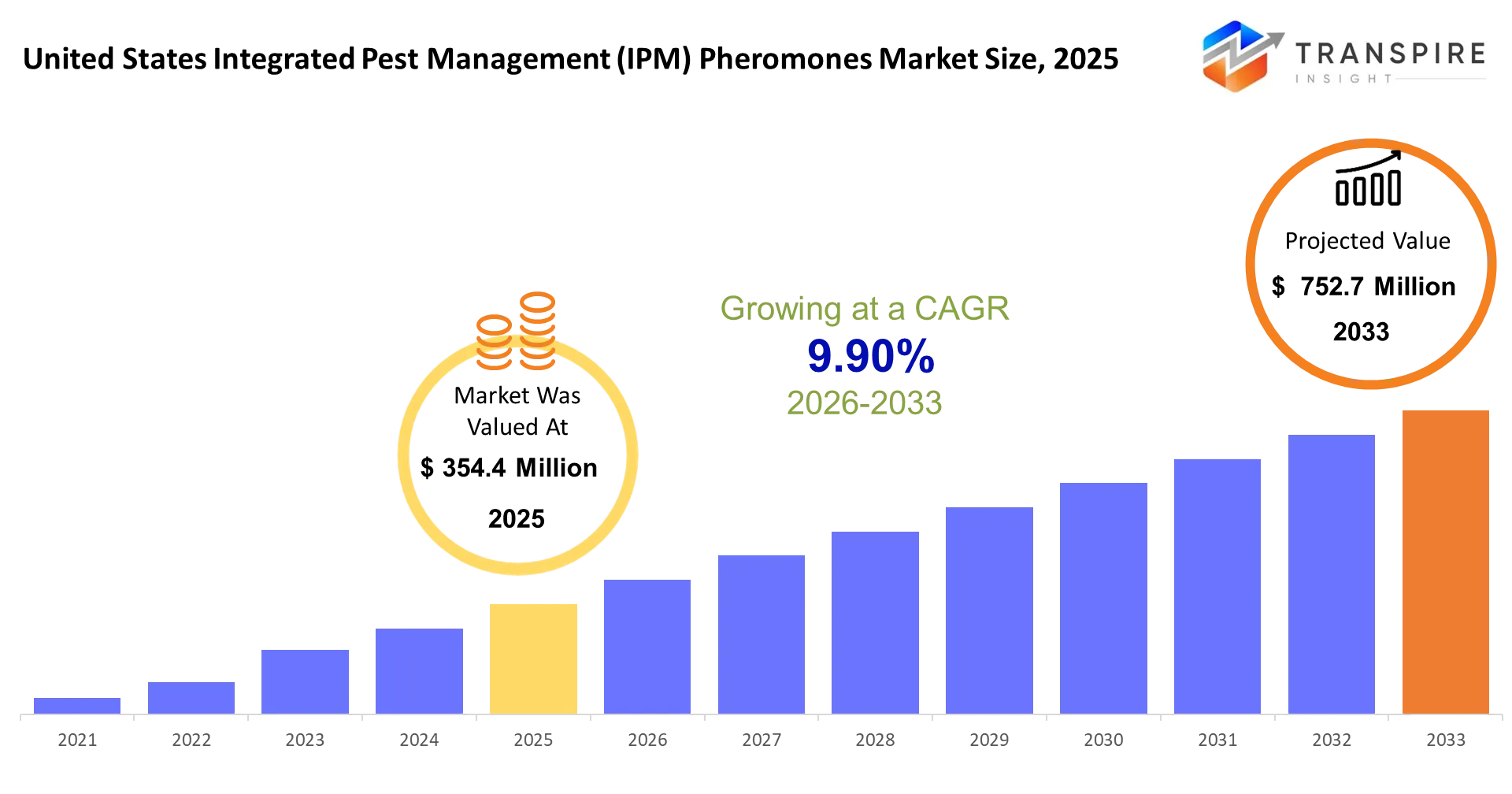
- United States IPM Pheromones Market Size 2025: USD 354.4 Million
- United States IPM Pheromones Market Size 2033: USD 752.7 Million
- United States IPM Pheromones Market CAGR: 9.90%
- United States IPM Pheromones Market Segments: By Type (Sex Pheromones, Aggregation Pheromones, Alarm Pheromones), By Application (Field Crops, Fruits & Vegetables, Stored Products)
To learn more about this report,  Download Free Sample Report
United States IPM Pheromones Market Summary
Pheromones are organic compounds that alter behavior and physiology in organisms of the same species. In integrated pest management, pheromones lure, disrupt, or incapacitate insects without chemical toxins. A farmer releases sex pheromones into field air, disrupting insect mating and reproduction. A warehouse manager suspends aggregation pheromone traps above stored grain, monitoring pest populations in real time. The United States IPM pheromones market converts biological insights into practical crop protection tools, eliminating the need for broad-spectrum insecticides that harm beneficial insects and leave residues on food.
The fundamental shift driving adoption is regulatory tightening around pesticide use combined with rising consumer demand for residue-free produce. The EPA has restricted over 30 active pesticide ingredients since 2010, and several states now mandate proof of integrated pest management before granting pesticide applicator licenses. Simultaneously, organic certification has grown from 2.7 million US acres in 2010 to over 6 million acres by 2024, all of which require alternatives to synthetic insecticides. Pheromones fill this gap. Their mechanism is species-specific, leaving no toxic residue on crops or in soil, and they integrate seamlessly with conventional farming practices because they reduce rather than eliminate chemical use.
The market size grew from USD 232.1 Million in 2020 to USD 354.4 Million in 2024, reflecting accelerating adoption across field crops, vegetable production, and post-harvest grain management. The growth trajectory accelerates further through 2033 as farmer awareness increases and pheromone products expand to manage secondary pest species beyond the current focus on lepidopterans (moths) and coleopterans (beetles). The installed base of pheromone-using farms, which are concentrated in California, Iowa, Illinois, and Indiana, now approaches 35,000 operations, creating a demonstration effect that pulls additional growers into the market each season.
Key United States IPM Pheromones Market Insights
- Sex Pheromones command 64% of United States IPM pheromones market revenue in 2024 because mating disruption is the most effective and cost-efficient mechanism for managing widespread lepidopteran pests including codling moth, Oriental fruit moth, and cotton bollworm.
- Field Crops account for 52% of United States pheromone application revenue in 2024, driven by corn, cotton, and soybean cultivation across the Corn Belt and Southeast, where chemical rotation requirements create demand for non-chemical alternatives.
- Fruits & Vegetables represent 38% of application revenue, concentrated in tree fruit, vine crops, and high-value vegetable production in California, Oregon, Washington, and Florida, where chemical restrictions are most severe.
- Aggregation Pheromones are the fastest-growing product type, expanding at a CAGR above 12% through 2033, as farmers adopt real-time pest monitoring in field and post-harvest environments using aggregation pheromone traps.
- Stored Products represent the emerging application segment, generating less than 10% of current revenue but expanding above 15% CAGR through 2033 as grain handlers and food processors implement pheromone-based monitoring in warehouse and grain elevator environments.
- Shin-Etsu Chemical Co. Ltd. and BASF SE together command approximately 35% of United States IPM pheromones market share through extensive distribution relationships with crop protection retailers and grain handling cooperatives.
- Suterra LLC, ISCA Technologies Inc., and Russell IPM Ltd. collectively hold approximately 25% of market revenue through specialization in specific pest complexes and crop types where their formulations deliver superior performance.
- Organic and certified sustainable farming operations account for only 18% of United States cropland but generate approximately 32% of IPM pheromone demand because certification requirements prohibit synthetic pesticide alternatives.
- Pheromone prices range from USD 45 to USD 95 per hectare applied annually for field crops, compared to USD 120 to USD 280 for equivalent chemical pest management, making pheromones cost-competitive at current market adoption rates.
- Digital monitoring platforms integrated with pheromone trap networks are expanding to cover approximately 8,000 farms as of 2024, up from 1,200 farms in 2020, creating data-driven pest management services that generate recurring software revenue.
What are the Key Drivers, Restraints, and Opportunities in the United States IPM Pheromones Market?
The primary driver is regulatory restriction of conventional pesticides. The EPA bans or restricts a category of insecticides approximately once every 18 to 24 months. Neonicotinoid restrictions in field crops, pyrethroids restrictions in coastal regions, and organophosphate phase-outs across vegetable production have collectively removed or narrowed access to over 40 pest management tools that were standard 15 years ago. Each restriction forces growers to adopt alternatives. Pheromones address this directly by delivering comparable or superior pest control without the regulatory burden that chemical alternatives face. Furthermore, state-level action in California, Washington, and Oregon extends restrictions beyond EPA timelines, expanding the addressable market to regions that might otherwise rely on chemical solutions.
Farmer awareness and adoption friction remain the most significant barriers. The average farmer in the United States received training on chemical pest management during their early career, often 20 to 40 years ago. Pheromone-based systems require different application timing, monitoring protocols, and decision frameworks. A farmer must identify the correct sex pheromone for each target pest species, understand that mating disruption requires full-field coverage rather than spot treatment, and monitor traps regularly to detect population shifts. This knowledge barrier, combined with switching costs and the upfront investment in monitoring equipment and traps, restrains adoption to the most progressive 15 to 20 percent of farmers. Expansion beyond this early-adopter cohort requires significant extension education investment from universities and government agencies.
The clearest forward opportunity is vertical integration of pheromone systems into precision agriculture platforms. Companies including John Deere, AGCO, and Climate FieldView are building decision-support systems that integrate weather data, pest forecasting models, and field management recommendations into a single interface. A pheromone-specific module within these platforms could enable automatic trap monitoring through cameras or IoT sensors, real-time pest population alerts, and integrated application timing linked to weather windows. The farmer sees a unified pest management dashboard rather than a standalone pheromone product. This vertical integration has already begun: Syngenta AG, which owns crop protection brands, launched early-stage integrations with precision ag platforms in 2023. First movers in this space will capture significant market share as precision agriculture adoption accelerates.
What Has the Impact of Artificial Intelligence Been on the United States IPM Pheromones Market?
Artificial intelligence is transforming pest monitoring from manual trap servicing to automated detection and prediction. Pheromone traps traditionally require weekly or bi-weekly field visits to count insects, a labor-intensive and imperfect process that misses population surges when traps are not checked. Computer vision systems mounted above or inside pheromone traps now photograph insects and use image recognition models to identify species, count individuals, and detect population anomalies in real time. Companies including PheromoneWorks and Agri-Plex have deployed this capability across approximately 500 farms in the United States. The detection accuracy exceeds 92 percent for target pest species, enabling farmers to make application decisions within hours rather than days.
Predictive pest population models, powered by machine learning, are beginning to move beyond linear regression toward non-linear forecasting. Historical field data, weather patterns, and phenology data are combined to predict population peaks two to four weeks in advance. This advance warning allows farmers to stage pheromone releases before populations rise, improving efficacy. Bayer CropScience and BASF have both invested in these predictive platforms, recognizing that information advantage creates product stickiness. The technical limitation is data scarcity: building reliable predictive models requires three to five seasons of field data for a specific geographic region and crop, which restricts deployment to high-value crops and established farming regions.
Key Market Trends
- California, Iowa, and Illinois account for approximately 48% of United States pheromone market revenue, driven by concentration of high-value tree fruit, wine grapes, corn, and soybean production in these regions.
- Organic crop acreage has grown 6.8% annually in the United States over the past decade, and organic farms use pheromones at rates 3.2 times higher than conventional farms, creating structural demand growth.
- Sex Pheromones for lepidopteran pest management hold 64% of market revenue in 2024, focused primarily on codling moth, Oriental fruit moth, and cotton bollworm, with newer applications emerging in cutworm and armyworm management.
- Aggregation Pheromones are the fastest-growing product type, above 12% CAGR through 2033, as post-harvest pest monitoring becomes mandatory under new grain handling standards in 12 states by 2025.
- Alarm Pheromones remain a niche segment at under 5% of market revenue, with applications limited to specific stored product pests and research-stage developments in field crop deployment.
- Field Crops account for 52% of application revenue, but growth rate is slower than Fruits & Vegetables at 8.5% CAGR versus 11.2% CAGR, reflecting saturation of early-adopter corn and cotton farmers.
- Fruits & Vegetables account for 38% of revenue and grow fastest due to chemical restrictions in California and persistent pest pressure in tree fruit and wine grape production.
- Stored Products represent less than 10% of current revenue but are the fastest-growing application segment, projected above 15% CAGR through 2033 as grain handlers implement post-harvest monitoring.
- Digital pheromone monitoring platforms grew from 1,200 equipped farms in 2020 to over 8,000 farms in 2024, creating recurring software revenue streams at USD 150 to USD 300 per farm annually.
- Pheromone product prices have declined 12 to 15 percent over the past five years as manufacturers achieve production scale and competition intensifies among established suppliers.
United States IPM Pheromones Market Segmentation
By Type
Sex Pheromones hold 64% of United States IPM pheromones market revenue in 2024. This product type works through mating disruption: synthetic sex pheromones are released into a field at concentrations that saturate insect olfactory receptors, preventing males from locating females. The mechanism is highly selective because each insect species responds to a unique pheromone blend. Sex Pheromones are most effective against lepidopteran pests including codling moth, Oriental fruit moth, and cotton bollworm. The technology has been commercially available since the 1980s, and over 40 million hectares of global agricultural production now use sex pheromones. The market for sex pheromones in the United States is mature, growing at approximately 8 percent annually, with revenue concentration in California, Oregon, Washington, and the cotton-producing Southeast.
Aggregation Pheromones are the fastest-growing product type, expanding above 12% CAGR through 2033. These pheromones attract multiple individuals of a pest species to a specific location, enabling farmers and grain handlers to monitor or control pest populations. Bark beetle pheromones are used extensively in forest management, and grain storage pheromones for stored product beetles are expanding rapidly in post-harvest environments. The growth catalyst is the shift toward real-time pest monitoring in grain elevators and commodity storage facilities. Aggregation pheromone traps hanging above grain bins or integrated into storage monitoring systems provide early warning of pest infestation without requiring invasive sampling. This monitoring capability is becoming standard practice in grain handling operations.
Alarm Pheromones remain a niche segment at under 5% of market revenue, with limited commercial applications. These pheromones are released when an insect is injured or threatened, signaling danger to nearby individuals. Research continues on alarm pheromone applications in stored products, but deployment remains experimental because the biological response is often unpredictable in field conditions.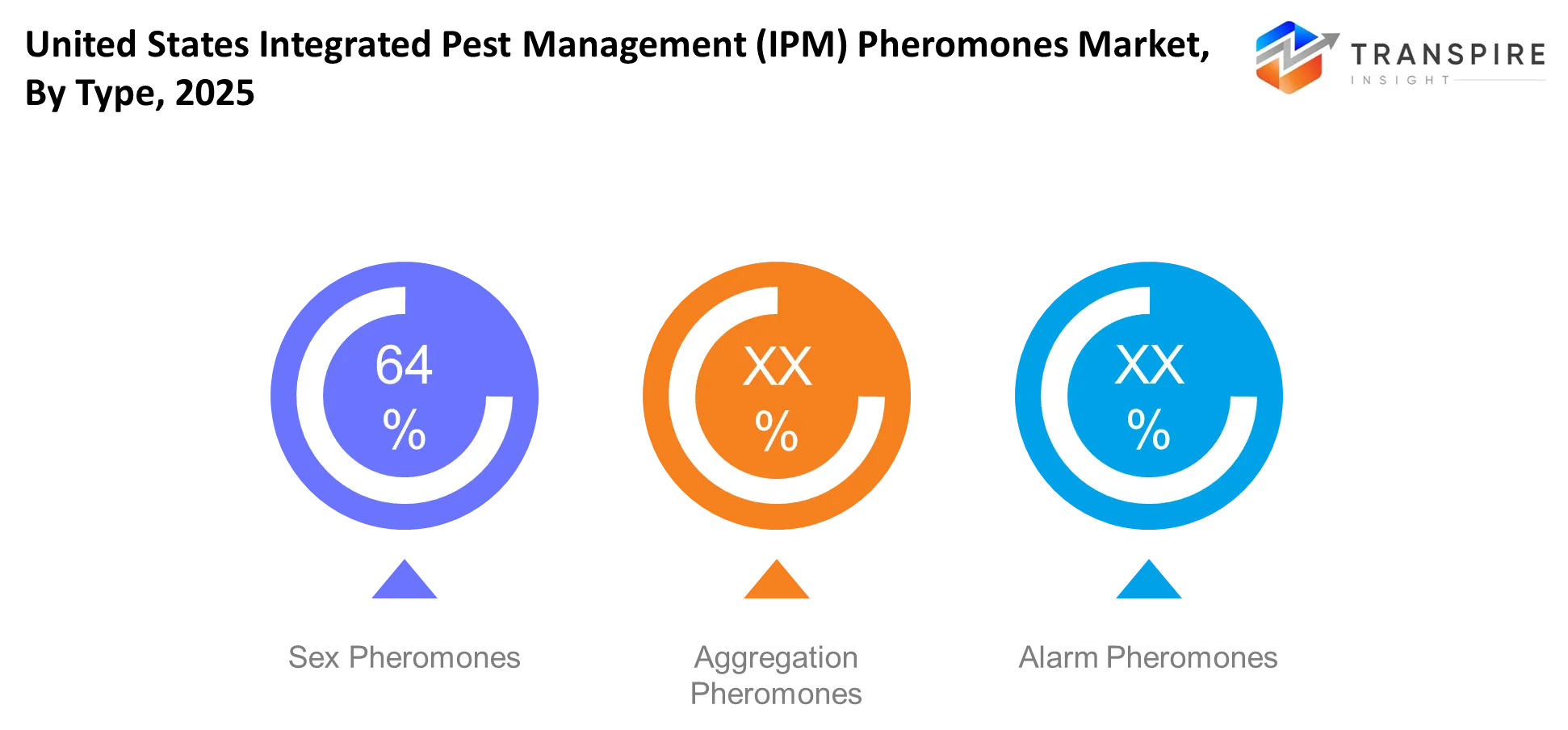
To learn more about this report, Download Free Sample Report
By Application
Field Crops account for 52% of United States IPM pheromones application revenue, dominated by corn, cotton, and soybean production across the Corn Belt, Mississippi Delta, and Great Plains regions. Sex pheromones for codling moth disruption in corn (though not primary use) and cotton bollworm management generate the largest revenues. The farmer economics are compelling: pheromone products cost approximately USD 45 to USD 75 per hectare annually, compared to USD 120 to USD 280 for chemical alternatives, while delivering comparable pest control. Adoption is concentrated among progressive farmers and certified sustainable operations, representing approximately 20 percent of corn and cotton acreage nationally.
Fruits & Vegetables account for 38% of application revenue, concentrated in California and the Pacific Northwest, where chemical restrictions are most severe. Tree fruit including apple, stone fruit, and pear production rely heavily on sex pheromone mating disruption, with over 80 percent of premium California apple and pear growers using pheromones. Wine grape production in California uses pheromones to manage grape moths, and high-value vegetable production including cucurbits and brassicas in Florida and California increasingly adopt pheromone-based monitoring. This segment grows faster than field crops at 11.2% CAGR because continued chemical restrictions in California provide persistent regulatory tailwinds.
Stored Products represent less than 10% of current market revenue but are the fastest-growing application segment, above 15% CAGR through 2033. Grain elevators, flour mills, and food processing facilities use aggregation pheromones to monitor stored product beetles and moths without opening bags or bins. The trigger for growth is new grain handling standards that mandate real-time pest monitoring in 12 states by 2025. These standards, combined with rising consumer awareness of pest-free grain supply, are driving adoption across commodity trading cooperatives and regional grain handlers.
What are the Key Use Cases Driving the United States IPM Pheromones Market?
The dominant use case is mating disruption in high-value tree fruit production. An apple grower in Washington or Oregon faces codling moth pressure that, if uncontrolled, can destroy 60 to 100 percent of fruit. Sex pheromones saturate the air with synthetic codling moth pheromones, making it impossible for males to locate females. The grower reduces chemical sprays by 75 to 85 percent, maintains yield, and markets fruit at premium prices because of low pesticide residue. Mating disruption has become the standard pest management strategy in California, Oregon, Washington, and Idaho, adopted by approximately 95 percent of premium apple and pear growers.
Real-time pest monitoring in stored grain using aggregation pheromone traps is the emerging use case with the highest growth trajectory. A grain elevator manager suspends Indianmeal moth and saw-toothed grain beetle pheromone traps throughout storage bins and uses them to detect infestation before significant crop loss occurs. Traditional monitoring relies on physical sampling, which is labor-intensive and misses early-stage population growth. Pheromone traps provide continuous monitoring and early detection that triggers targeted fumigation or temperature control before economic damage occurs. This use case is spreading through regional grain handling cooperatives as digital monitoring platforms make trap servicing more efficient.
Integrated pest management in organic vegetable production is an expanding use case driven by certification requirements that prohibit synthetic pesticides. An organic vegetable grower managing high-value crops including cucurbits, brassicas, and solanaceae faces pest pressure from multiple lepidopteran species. Pheromone mating disruption combined with biological controls and selective organic pesticides provides cost-effective pest management that maintains certification. This use case will grow as organic vegetable acreage expands and digital monitoring platforms reduce the labor cost of trap servicing.
Report Overview Table
|
Report Metrics |
Details |
|
Market size value in 2024 |
USD 354.4 Million |
|
Market size value in 2025 |
USD 388.8 Million |
|
Revenue forecast in 2033 |
USD 752.7 Million |
|
Growth rate |
CAGR of 9.90% from 2025 to 2033 |
|
Base year |
2024 |
|
Historical data |
2020 - 2023 |
|
Forecast period |
2025 - 2033 |
|
Report coverage |
Revenue forecast, competitive landscape, growth factors, and trends |
|
Regional scope |
United States: California, Oregon, Washington, Idaho, Colorado, Iowa, Illinois, Indiana, Texas, Florida, Georgia, North Carolina, South Carolina, and other states |
|
Key companies profiled |
Shin-Etsu Chemical Co. Ltd., BASF SE, Suterra LLC, ISCA Technologies Inc., Russell IPM Ltd., Koppert Biological Systems, Bedoukian Research Inc., Provivi Inc., Hercon Environmental, Pacific Biocontrol Corporation, BioControle, Pherobank BV, Trece Inc., Biobest Group NV, Syngenta AG |
|
Customization scope |
Free report customization (regional & segment scope). Avail customized purchase options to meet your exact research needs. |
|
Report Segmentation |
By Type (Sex Pheromones, Aggregation Pheromones, Alarm Pheromones), By Application (Field Crops, Fruits & Vegetables, Stored Products) |
Which United States Regions are Driving the IPM Pheromones Market Growth?
California dominates the United States IPM pheromones market, generating approximately 38% of national revenue. Wine grape production in Napa, Sonoma, and the Central Valley uses pheromones to manage grape moth and leafroller pests across approximately 280,000 acres. Tree fruit production, particularly apple and pear in the Sierra foothills and coast range, relies heavily on codling moth pheromones. Agricultural regulations in California are the most restrictive nationally: the Department of Pesticide Regulation has restricted or banned over 60 active ingredients in the past 15 years, creating structural demand for pheromone alternatives. Organic production, which accounts for over 16 percent of California crop value despite being only 2.8 percent of acreage nationally, drives adoption rates nearly 3 times the national average.
The Pacific Northwest, including Oregon, Washington, and Idaho, generates approximately 22% of United States pheromone market revenue. Apple production in Washington State, which represents approximately 65 percent of United States apple production, has nearly universalized pheromone adoption for codling moth management. Oregon wine grape production similarly relies on pheromones for multiple pest complexes. The drivers are comparable to California: high-value crops, significant organic acreage, and chemical restrictions that make pheromones the cost-competitive alternative. This region has achieved production maturity with adoption rates exceeding 85% among premium-market growers.
The Corn Belt, including Iowa, Illinois, Indiana, and Minnesota, generates approximately 18% of United States pheromone revenue, concentrated in corn and soybean production. Adoption rates are substantially lower than in high-value fruit and vegetable regions, approximately 15 to 20 percent of acreage, reflecting lower per-acre value and stronger grower attachment to conventional chemical pest management. However, growth is accelerating in this region as chemical restrictions tighten and precision agriculture platforms create infrastructure for adopting alternative pest management systems.
Who are the Key Players in the United States IPM Pheromones Market and How Do They Compete?
The United States IPM pheromones market is moderately consolidated at the top, with Shin-Etsu Chemical Co. Ltd. and BASF SE together commanding approximately 35% of market share. Shin-Etsu dominates sex pheromone formulation for tree fruit pests, supported by manufacturing scale and long-established relationships with crop protection retailers. BASF competes through full-spectrum product lines covering multiple pest types and crop applications, leveraging relationships from its broad pesticide portfolio. Below these two leaders, the market fragments across specialized competitors.
Suterra LLC, ISCA Technologies Inc., and Russell IPM Ltd. collectively hold approximately 25% of market revenue through vertical specialization. Suterra focuses on lepidopteran pest management and has built the largest installed base of pheromone-dispensing technologies including twist-ties and membrane formulations. ISCA Technologies specializes in aggregation pheromones and has developed proprietary blends for stored product beetles and bark beetles. Russell IPM, a United Kingdom-based company with significant United States market presence, leads in supplying traps and monitoring equipment to organic farmers and specialty crop operations. These mid-tier competitors compete on product specialization and service relationships rather than scale.
Syngenta AG entered the market through acquisition of a pheromone research company in 2019 and is building digital integration capabilities that position its products within precision agriculture platforms. Koppert Biological Systems and Biobest Group NV compete through bundled biological control services, offering pheromones alongside predatory insects and beneficial organisms as integrated pest management packages. This bundling strategy appeals to organic operations and premium market segments seeking comprehensive pest management solutions rather than point products.
United States IPM Pheromones Market Companies
- Shin-Etsu Chemical Co. Ltd.
- BASF SE
- Suterra LLC
- ISCA Technologies Inc.
- Russell IPM Ltd.
- Koppert Biological Systems
- Bedoukian Research Inc.
- Provivi Inc.
- Hercon Environmental
- Pacific Biocontrol Corporation
- BioControle
- Pherobank BV
- Trece Inc.
- Biobest Group NV
- Syngenta AG
Recent Developments
In March 2025, Syngenta AG announced a partnership with Climate FieldView to integrate pheromone monitoring and application recommendations into the FieldView decision-support platform. The integration enables farmers using FieldView to receive pest population alerts from pheromone traps and automated recommendations for pheromone release timing. This vertical integration positions Syngenta to expand market reach into precision agriculture-adopting farmers. https://www.syngenta.com
In November 2024, Provivi Inc. completed the expansion of its pheromone manufacturing facility in California to increase production capacity by 40%. The expansion supports growing demand for sex pheromones in organic tree fruit production and positions Provivi to compete more effectively on supply reliability and price. https://www.provivi.com
What Strategic Insights Define the Future of the United States IPM Pheromones Market?
Over the next five to seven years, the United States IPM pheromones market will shift from commodity product sales toward integrated pest management platforms that bundle pheromone products with digital monitoring, predictive pest forecasting, and biological control services. Growers increasingly expect a single interface for pest management rather than purchasing individual pheromone formulations. Companies that build vertical integration with precision agriculture platforms will capture disproportionate market share. Syngenta's partnership with Climate FieldView is the first of several similar integrations that will emerge by 2027.
The secondary shift is the expansion of aggregation pheromones beyond tree fruit and into grain and commodity storage as new handling standards make real-time pest monitoring mandatory. Post-harvest pheromone applications currently represent less than 10% of market revenue but will grow to approximately 18% of the market by 2033. This segment offers superior margins and recurring revenue opportunities because monitoring services can be bundled with trap subscriptions and software subscriptions, creating multi-year customer relationships rather than one-time product sales.
The primary risk for market growth is continued farmer adoption friction. The early-adopter base of 20% has largely transitioned to pheromones, but expanding adoption to the mainstream 60% of farmers requires significant education investment and simplified product offerings that reduce the knowledge barrier. Companies investing in farmer education, digital platforms that automate decision-making, and bundled service offerings will position themselves for market share expansion as adoption accelerates.
United States IPM Pheromones Market Report Segmentation
By Type
- Sex Pheromones
- Aggregation Pheromones
- Alarm Pheromones
By Application
- Field Crops
- Fruits & Vegetables
- Stored Products
Frequently Asked Questions
Find quick answers to common questions.
The United States IPM Pheromones Market size is expected to reach USD 752.7 Million by 2033.
The key segments are By Type (Sex Pheromones, Aggregation Pheromones, Alarm Pheromones) and By Application (Field Crops, Fruits & Vegetables, Stored Products).
Major Players include Shin-Etsu Chemical Co. Ltd., BASF SE, Suterra LLC, ISCA Technologies Inc., Russell IPM Ltd., Koppert Biological Systems, Bedoukian Research Inc., Provivi Inc., Hercon Environmental, Pacific Biocontrol Corporation, BioControle, Pherobank BV, Trece Inc., Biobest Group NV, and Syngenta AG.
The current United States IPM Pheromones Market size is USD 354.4 Million in 2025.
The United States IPM Pheromones Market CAGR is 9.90% from 2025 to 2033.
- Shin-Etsu Chemical Co. Ltd.
- BASF SE
- Suterra LLC
- ISCA Technologies Inc.
- Russell IPM Ltd.
- Koppert Biological Systems
- Bedoukian Research Inc.
- Provivi Inc.
- Hercon Environmental
- Pacific Biocontrol Corporation
- BioControle
- Pherobank BV
- Trece Inc.
- Biobest Group NV
- Syngenta AG
Recently Published Reports
-
Apr 2026
Healthcare Polymer Packaging Market
Healthcare Polymer Packaging Market Size, Share & Analysis Report By Packaging Type (Syringes, IV Bottles and Pouches, Clamshells, Blisters, Bottles & Jars, Containers, Tubes, IV Parental Packaging, Others), By Type (Regulated, Non-regulated), By Polymer Type (LDPE (Low-Density Polyethylene), HDPE (High-Density Polyethylene), Homo-polymer (Homo), Random Copolymer (Random), Block Copolymer (Block), PET, Polystyrene, Polyvinyl Chloride, Polyamide/EVOH, Others), and Geography (North America, Europe, Asia-Pacific, Middle East and Africa, South and Central America), 2021 - 2031
-
Apr 2026
Hydrophilic Tape (Waterstop) Market
Hydrophilic Tape (Waterstop) Market Size, Share & Analysis Report By Type (Bentonite-Based Hydrophilic Tape, Rubber-Based Hydrophilic Tape), By Application (Residential Buildings, Commercial Buildings, Infrastructure Projects), and Geography (North America, Europe, Asia-Pacific, Middle East and Africa, South and Central America), 2021 - 2031
-
Apr 2026
Metalens Market
Metalens Market Size, Share & Analysis Report By Type (Visible Light Metalens, and Infrared Metalens), By Application (Consumer Electronics, Automotive Electronics, Industrial, Medical, and Others), and Geography (North America, Europe, Asia-Pacific, Middle East and Africa, South and Central America), 2021 - 2031
-
Apr 2026
PBT Resin Market
PBT Resin Market Size, Share & Analysis Report By Type (Reinforced PBT Resin, Unreinforced PBT Resin), By Processing Method (Injection Molding, Extrusion, Blow Molding, Others), By End-User (Automotive, Electrical & Electronics, Consumer Appliances, Industrial Machinery, Medical Devices, Packaging, Others), and Geography (North America, Europe, Asia-Pacific, Middle East and Africa, South and Central America), 2021 - 2031