
United States High Intensity Discharge (HID) Light Market Size & Forecast:
- United States High Intensity Discharge (HID) Light Market Size 2025: USD 1.39 Billion
- United States High Intensity Discharge (HID) Light Market Size 2033: USD 2.295 Billion
- United States High Intensity Discharge (HID) Light Market CAGR: 6.47%
- United States High Intensity Discharge (HID) Light Market Segments: By Type (Metal Halide, High Pressure Sodium, Mercury Vapor, Xenon, Sodium Lamps, Others), By Application (Automotive, Industrial, Street Lighting, Stadium Lighting, Commercial, Others), By End-User (Automotive, Industrial, Govt, Commercial, Infrastructure, Others), By Wattage (Below 100W, 100–500W, Above 500W, High Intensity, Medium, Others).
To learn more about this report,  Download Free Sample Report
United States High Intensity Discharge (HID) Light Market Summary:
The United States High Intensity Discharge (HID) Light Market size is estimated at USD 1.39 Billion in 2025 and is anticipated to reach USD 2.295 Billion by 2033, growing at a CAGR of 6.47% from 2026 to 2033. The United States High Intensity Discharge (HID) Light Market basically supports operations where visibility , durability and wide-area illumination matter more than how small the fixture is. HID lighting is still used and kinda embedded in ports, warehouses, stadiums, highways, mining sites, and big heavy industrial facilities because it gives strong lumen output across large spaces with fewer units. In day-to-day practice, these setups help operators keep safety levels up, extend operating hours, and lower visibility risks in rough outdoor areas, or even high-ceiling environments where light tends to fade or scatter.
In the last 3–5 years, the market went through a more structural transition , as facility owners gradually moved their budget toward LED retrofits and also smart lighting controls. That change did not fully wipe out HID demand, but it did push manufacturers toward specialized industrial, and high-performance situations where HID still brings operational benefits. Then during the COVID-19 period, supply chain disruptions changed procurement habits too, so utilities and industrial operators started securing longer-life lighting stock, while also diversifying sourcing options. And as infrastructure modernization plus logistics expansion keeps rolling across the United States, replacement cycles and hybrid retrofit projects are sustaining revenue in legacy HID installations, while at the same time reshaping adoption priorities toward energy-efficient industrial lighting ecosystems, you know overall.
Key Market Insights
- In 2025, the Southern United States sort of dominated the United States High Intensity Discharge (HID) Light Market, sitting at nearly 34% market share, mostly because logistics keeps moving and industrial expansion just keeps happening.
- The Western U.S. is also showing the fastest growth through 2032, which is tied to smart infrastructure upgrades and the really big transportation projects that are rolling out across the region.
- Texas and California still stay among the high-revenue states, largely because ports, highways, warehouses, and stadiums all lean on durable high-intensity industrial lighting systems, for long runs and steady visibility.
- Meanwhile, Midwest manufacturing hubs are still generating a notable level of HID lighting demand, especially for automotive plants, steel processing facilities, and even mining operations where lighting reliability matters.
- Metal halide HID lights took more than 41% of the industry in 2025, not surprising really, since their color rendering performance is strong in industrial settings, even when conditions aren’t ideal.
- High-pressure sodium lamps stayed as the second-largest segment, since municipalities continue relying on cost-efficient roadway and street lighting infrastructure, year after year.
- For xenon HID lighting, projections point to it becoming the fastest-growing segment through 2032, helped by specialty automotive, and defense lighting use-cases where consistency is key.
- Retrofit-compatible HID systems gained some real traction too, because facilities were looking for lower replacement costs, without having to fully convert to LED infrastructure all at once.
- Outdoor industrial and roadway lighting basically led overall, with nearly 46% market share in 2025, because large-area illumination remains operationally critical for safety and day-to-day function.
- Warehouse and logistics applications are also showing emerging demand, especially as e-commerce fulfillment centers expand along the main U.S. distribution corridors, and add more lighting needs.
- Sports stadium lighting installations have been increasing steadily since 2022, due to broadcast-quality illumination requirements, plus a wave of infrastructure renovation projects, that keeps pushing upgrades forward.
What are the Key Drivers, Restraints, and Opportunities in the United States High Intensity Discharge (HID) Light Market?
Industrial infrastructure modernization is still the main thing pushing the United States High Intensity Discharge (HID) Light Market along. In the past five years, you can see operators at ports, along freight corridors, mining sites, and big warehouses doing more at night , mostly to get better asset utilization and to ease logistics bottlenecks. That change in how they run things boosted demand for high-lumen lighting solutions that can blanket wide outdoor spaces and high-ceiling areas without needing as many fixtures. On top of that, federal infrastructure funding plus state transportation upgrades sped up the replacement schedules for roadway, tunnel, and stadium lighting. When cities and industrial users worked on worn-out infrastructure , HID lighting suppliers often landed with big-volume procurement deals, maintenance arrangements, and revenue that comes from retrofit work, so it all kind of stacked together.
That said, the strongest structural hurdle is the fast price-to-performance gains coming from LED lighting systems. LED providers keep lowering lifecycle expenses while also delivering longer operating life, fewer maintenance touchpoints , and more capable digital controls. So this shift is a real long-horizon displacement risk for older HID setups, especially where commercial buildings and municipalities are involved. The issue feels structural because lighting upgrades are locked into multi-year capital planning, and they’re also influenced by utility efficiency requirements. Because of this, HID manufacturers often see replacement demand dampened and a slower spread of adoption when new construction projects are planned.
A big growth opportunity is showing up in heavy industry and hazardous operating settings where ultra-high-output lighting still counts more than tiny energy savings. Large mining operations, marine terminals, and defense infrastructure projects are still putting money into rugged lighting setups that can cope under dust, vibration, and extreme temperature conditions . Hybrid HID—smart control systems are also gaining momentum, mostly because they improve monitoring efficiency without forcing a full infrastructure swap, and it kinda keeps everything running in a steadier way.
What Has the Impact of Artificial Intelligence Been on the United States High Intensity Discharge (HID) Light Market?
Artificial intelligence and those newer digital technologies are kind of reshaping the United States High Intensity Discharge (HID) Light Market, mostly because they’re making operations more efficient, assets more dependable, and energy management less wasteful across industrial and transport infrastructure. A lot of facility operators now use AI driven lighting management platforms to basically automate when the lights run, watch ballast condition, and fine tune power draw in ports, warehouses, along highways, even in stadiums. What these setups do is lean on occupancy sensors, weather information, and traffic-flow analytics so they can shift illumination level in real time, so that less energy gets burned for no reason. They also tend to help with fixture lifespan, because the system isn’t just blasting full output all day, or every night.
On the maintenance side, machine learning models are giving predictive maintenance a stronger footing inside industrial lighting networks. Operators look at voltage swings, heat signatures and lamp degradation traits, to spot component trouble early before an outage actually shows up. In big logistics sites and transportation corridors, these predictive diagnostics have been linked to fewer unplanned downtime events, lower inspection costs, and better lighting uptime. Also there’s the workplace safety compliance angle, which gets easier when lighting performance is more stable and less surprising. Then there is smart control integration, which supports energy optimization programs that can cut electricity consumption by double digit percentages, especially in large area lighting applications.
That said, AI adoption still hits some real-world limits. A lot of older HID installations do not have compatible digital infrastructure, so integrating becomes expensive, and honestly technically complex. Industrial operators also run into trouble getting standardized performance data across aging lighting networks, and that restricts predictive model accuracy. Because of that, large scale rollouts of intelligent lighting control systems can move slower than expected, even when the potential benefits seem clear.
Key Market Trends
- Since 2021, municipalities have kind of sped up their LED transition programs, so new HID roadway installations drop off, but at the same time retrofit demand for older, legacy infrastructure networks keeps going.
- Industrial warehouses moved into more 24 hour operations, like after pandemic-era logistics disruptions, and this made them buy higher output HID fixtures more often, especially for those big- area illumination settings.
- Between 2022 and 2025, ports and marine terminals upgraded their night time cargo handling systems , mostly to improve operational safety, and also to cut turnaround delays which otherwise slow everything down.
- Some major players, like Signify and Acuity Brands, increased investment in smart lighting controls, that are compatible with existing HID infrastructure, rather than requiring a full swap right away.
- High pressure sodium lamp adoption has been falling steadily since about 2020, because energy efficiency mandates pushed utilities toward digitally controlled lighting alternatives instead.
- Mining and heavy industrial operators kept HID systems longer than some other segments, because high temperature environments still make long duration LED performance reliability a real challenge, in certain applications, you know.
- Since 2023, hybrid retrofit projects got more traction as facility owners delayed full lighting replacement, so they can manage capital expenditure while inflation driven construction cost increases were still hitting hard.
- Transportation agencies also raised tunnel and highway lighting modernization budgets, after federal infrastructure funding expanded across the United States in 2022.
- AI enabled predictive maintenance systems have shown up across lots of large industrial facilities, and they help operators reduce unplanned HID fixture failures, and even lower maintenance inspection frequency, with less “checking and rechecking” than before.
- Domestic sourcing strategies strengthened after global ballast and component shortages in 2021 exposed vulnerabilities in overseas lighting supply chains, so companies tried to keep more control locally , at least for critical parts.
United States High Intensity Discharge (HID) Light Market Segmentation
By Type
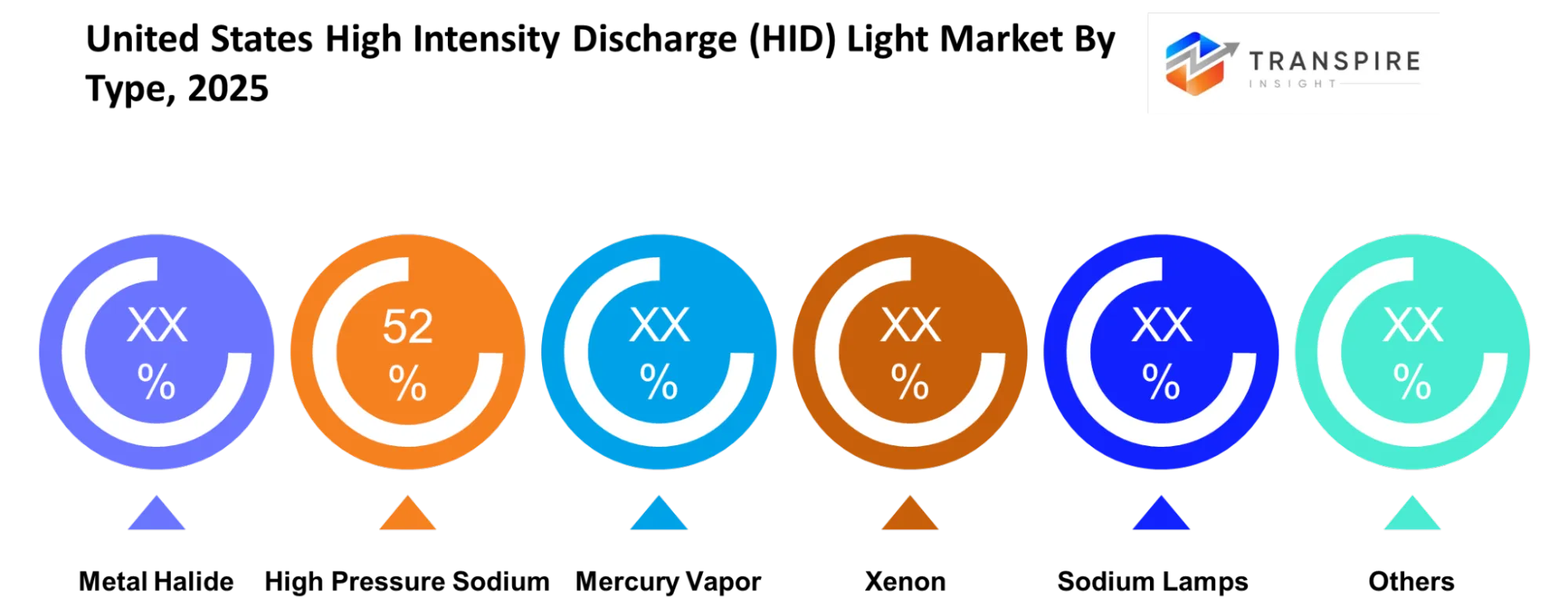
Metal halide lighting keeps that strongest spot in the type segment, more or less, because industrial operators and stadium facilities tend to care about very strong color rendering and also high lumen output. Meanwhile high pressure sodium lamps keep a big installed base across highways and municipal street lighting, mostly tied to lower running costs and really long operational life. Mercury vapor systems are still sliding in share, since environmental regulations plus efficiency standards nudge people away from new installations and that is not exactly subtle. Xenon lighting is growing pretty steadily in specialty automotive and defense use where precise illumination remains the point.
Even so, sodium lamps still back transportation infrastructure projects, those that need dependable large-area visibility, especially under tough outdoor conditions. Demand patterns are kinda shifting, more toward retrofit compatible products, so infrastructure life can be stretched out, rather than doing a full replacement. Manufacturers are responding with smart monitoring systems and longer-lasting ballast technologies, still leaning on the familiar HID platforms, for the most part. Looking ahead, the next investments probably will bunch up around specialized industrial and transportation applications where performance needs keep beating the standard energy transition pressures.
To learn more about this report, Download Free Sample Report
By Application
Industrial and street lighting applications kind of dominate the market because warehouses, ports , logistics corridors, and highways need durable illumination across wide operational areas. Stadium lighting is still a valuable part too , since sports venues keep upgrading for broadcast-quality visibility standards. Commercial applications are moving slower, mainly because retail and office facilities are increasingly shifting toward LED systems, with lower energy usage profiles and that sort of thing. Automotive keeps pulling demand as well, especially for xenon based lighting in premium and heavy duty vehicle categories , where drivers want high-intensity nighttime visibility.
Infrastructure modernization programs and transportation expansion projects keep reinforcing demand across public road networks and freight facilities, without much delay. Industrial operators also more and more care about lighting setups that can reduce maintenance frequency , particularly in hazardous or high ceiling environments where service is a pain. Looking ahead, growth across these application categories will hinge on hybrid retrofit strategies, balancing operational efficiency alongside cost management , at least in practice. Suppliers who can deliver digital controls and predictive maintenance functions should improve their competitive position across both infrastructure and industrial projects.
By End-User
Industrial end users keep hold of the leading market position, mostly because manufacturing plants, mining facilities, and logistics centers really need dependable high-output illumination for running things day after day. Government agencies are another big customer group too, they put money into highway lighting, tunnels, airports, and municipal infrastructure upgrades, so in practice that stays consistent. Commercial end users, meanwhile, have been slowly moving away from traditional HID systems. The energy efficiency directives push LED migration in retail spaces and office properties, so dependence drops over time, kind of naturally. Infrastructure operators still help keep procurement steady, ports, rail terminals, and freight corridors still want strong lighting coverage, even when the environmental conditions are harsh or just plain demanding.
Automotive end users still matter as well, especially for premium and specialty vehicle manufacturing where xenon lighting supports performance alongside safety requirements. Overall demand patterns now seem to lean more toward operational durability rather than plain energy savings. Buyers are increasingly looking at lighting systems by how often they have to be maintained, how well they stand up to the environment, and whether they actually match the current infrastructure , not just the shiny upfront specs. In the future, there should be more openings via long-term service pacts and retrofit programs aimed at older industrial locations and transit facilities.
By Wattage
That 100W to 500W wattage category kinda dominates what we’re seeing now, because industrial facilities, roadways, and warehouses need a sort of steadier illumination efficiency, and operational reliability as well. Once you get past 500W, those systems still show up in stadiums , ports , airports, and even mining environments where big-area visibility stays pretty must-have, you know, in practice. Under 100W products keep only a smaller portion, mainly because lower-intensity uses are leaning more and more toward compact LED alternatives.
Medium-intensity layouts still help with commercial infrastructure refreshes, where buyers try to keep power draw moderate, but don’t want to give up on illumination performance. High-intensity setups stay critical for outdoor industrial operations, especially when there’s dust , vibration, and harsh weather. Also the demand for higher wattage systems has been holding steady, even with energy transition policies, since a number of industrial sites still prefer long-range visibility and tough rugged durability.
Manufacturers are gradually redesigning ballast systems and thermal management technologies, trying to boost efficiency inside those higher-output categories. And for the future, procurement strategies will likely steer toward wattage configurations that go with smart controls, predictive diagnostics, and flexible retrofit integration across older infrastructure networks.
What are the Key Use Cases Driving the United States High Intensity Discharge (HID) Light Market?
Industrial and roadway lighting still, sort of, the main use case pushing HID adoption across the United States, mostly. Logistics hubs, ports, highways, and manufacturing plants depend on high-lumen illumination so they can keep running through the night and keep workplace safety intact over huge outdoor spaces.
Stadium lighting, plus freight infrastructure, is slowly getting more attention too. Municipalities and transportation operators are modernizing aging systems , and that’s opening the door for HID to make more sense there. Also, automakers keep leaning on xenon HID technology in premium and heavy-duty vehicle segments, since those categories need really solid nighttime visibility, along with long-distance beam performance that holds up.
More emerging use cases are showing up, like defense infrastructure , mining operations, and smart transportation corridors. In these places rugged high-intensity lighting still tends to beat compact substitutes when conditions get rough. Even hybrid HID setups , integrated with digital monitoring platforms are starting to draw interest from industrial facility operators, because they want predictive upkeep and energy optimization options, not just brighter output.
|
Report Metrics |
Details |
|
Market size value in 2025 |
USD 1.39 Billion |
|
Market size value in 2026 |
USD 1.48 Billion |
|
Revenue forecast in 2033 |
USD 2.295 Billion |
|
Growth rate |
CAGR of 6.47% from 2026 to 2033 |
|
Base year |
2025 |
|
Historical data |
2021 - 2024 |
|
Forecast period |
2026 - 2033 |
|
Report coverage |
Revenue forecast, competitive landscape, growth factors, and trends |
|
Geographic scope |
United States of America |
|
Key company profiled |
Philips, Osram, GE Lighting, Eaton, Acuity Brands, Cree, Hubbell, Panasonic, Toshiba, Schneider Electric, Havells, Syska, Bajaj Electricals, Zumtobel, Thorn Lighting |
|
Customization scope |
Free report customization (country, regional & segment scope). Avail customized purchase options to meet your exact research needs. |
|
Report Segmentation |
By Type (Metal Halide, High Pressure Sodium, Mercury Vapor, Xenon, Sodium Lamps, Others), By Application (Automotive, Industrial, Street Lighting, Stadium Lighting, Commercial, Others), By End-User (Automotive, Industrial, Govt, Commercial, Infrastructure, Others), By Wattage (Below 100W, 100–500W, Above 500W, High Intensity, Medium, Others) |
Which Regions are Driving the United States High Intensity Discharge (HID) Light Market Growth?
The Southern United States basically leads the market because the region, combines big scale logistics infrastructure, industrial manufacturing clusters and also expanding freight transportation networks. States like Texas, Georgia and Florida keep investing in highways, ports, warehouses, and energy facilities, and those places really need high output lighting systems so operations can keep going without interruption. On top of that, strong municipal infrastructure budgets, plus federal transportation funding, back up major replacement , and retrofit contracts across public roadway networks. In the end a pretty mature ecosystem of contractors, industrial operators, utility providers, and lighting manufacturers sustains long-term procurement activity, along with ongoing maintenance demand all over the region.
The Midwest counts as the second-largest regional contributor, but the growth trends feel different than in the South, because manufacturing stability tends to steer purchasing behavior rather than rapid infrastructure expansion. Automotive production centers, steel facilities, and heavy engineering plants keep steady demand for durable industrial lighting systems that can handle rough production conditions. Meanwhile utility modernization programs and municipal infrastructure upgrades have moved along in a gradual manner, so you end up with more predictable replacement cycles instead of sudden procurement spikes. With consistent capital investment from industrial operators, the Midwest gets a steady revenue base and less exposure to short term construction swings.
The Western United States is kind of emerging as the fastest-growing area, partly because transportation modernization is getting really aggressive and smart infrastructure is being deployed since 2022 or so. California, Arizona, and Nevada expanded their investments in ports, airports, logistics corridors, and high-capacity warehouse facilities after supply chain disruptions during the pandemic period. Also, rapid population growth plus higher freight activity has been adding more pressure on local municipalities to upgrade their roadway and tunnel lighting, with more efficient high-intensity solutions… at least that’s the direction things seem to be going. All this momentum, it creates strong chances for lighting manufacturers, retrofit specialists, and smart control providers aimed at infrastructure expansion projects between 2026 and 2033.
Who are the Key Players in the United States High Intensity Discharge (HID) Light Market and How Do They Compete?
The competitive landscape still looks fairly concentrated, like a small group of global lighting manufacturers is essentially driving a lot of the big industrial, infrastructure, and municipal work across the United States. Lately, rivalry is not as much about fixture pricing, but more about retrofit compatibility, the way digital control gets stitched in, and then how maintenance economics work out over time. Most established names keep defending their installed infrastructure setups through service agreements and smart lighting upgrades, sort of continuously , while smaller niche suppliers move toward specialized industrial uses and hazardous-environment applications. And procurement is leaning much harder on operational lifespan, energy-efficiency compliance, and predictive maintenance capabilities, especially for transportation and logistics infrastructure projects.
Signify mostly plays in the technology integration and infrastructure modernization arena, where connected lighting systems can turn into longer-term service revenue streams. The differentiation, as they frame it, is their intelligent lighting platforms that bring HID systems together with remote monitoring, plus energy management controls, for municipalities and industrial operators. Acuity Brands instead leans into building automation experience and maintains tight relationships with commercial infrastructure contractors across North America. Acuity has also pushed more sensor-enabled lighting deployments in warehouses and logistics sites, where operators tend to prioritize energy optimization, and yeah predictive maintenance too.
OSRAM keeps a solid standing in niche automotive as well as industrial uses thanks to high-performance xenon and a kind of precision-lighting know how. It kind of leverages engineering focus , plus that deep placement within automotive OEM supplier routes. GE Current on the other hand leans heavily on retrofit driven infrastructure programs , so municipalities can upgrade older lighting networks without doing an entire full system replacement, you know, just swaps where needed. Eaton also reinforces its competitive posture via integrated power-management and industrial lighting products aimed at hazardous settings, like mining and transport , and heavy manufacturing locations.
Company List
- Philips
- Osram
- GE Lighting
- Eaton
- Acuity Brands
- Cree
- Hubbell
- Panasonic
- Toshiba
- Schneider Electric
- Havells
- Syska
- Bajaj Electricals
- Zumtobel
- Thorn Lighting
Recent Development News
In April 2026, Schréder Expands U.S. Lighting Footprint via Acquisition of NLS Lighting: Schréder strengthened its North American lighting position by acquiring U.S.-based NLS Lighting, a manufacturer of specification-grade outdoor lighting systems. The move expands Schréder’s manufacturing and design capacity in the U.S. market, reinforcing its presence in commercial outdoor lighting segments that include HID replacement infrastructure.
Source: https://www.prnewswire.com
In May 2026, Hubbell Announces $3 Billion Acquisition of NSI Industries: Hubbell Inc. agreed to acquire NSI Industries to strengthen its electrical solutions portfolio, including components used in lighting and industrial power systems. The acquisition enhances Hubbell’s positioning in U.S. electrical infrastructure markets closely tied to commercial lighting modernization and HID replacement systems.
Source: https://www.globenewswire.com
What Strategic Insights Define the Future of the United States High Intensity Discharge (HID) Light Market?
United States High Intensity Discharge (HID) Light Market Report Segmentation
By Type
- Metal Halide
- High Pressure Sodium
- Mercury Vapor
- Xenon
- Sodium Lamps
- Others
By Application
- Automotive
- Industrial
- Street Lighting
- Stadium Lighting
- Commercial
- Others
By End-User
- Automotive
- Industrial
- Govt
- Commercial
- Infrastructure
- Others
By Wattage
- Below 100W
- 100–500W
- Above 500W
- High Intensity
- Medium
- Others
Frequently Asked Questions
Find quick answers to common questions.
The approximate United States High Intensity Discharge (HID) Light Market size for the market will be USD 2.295 Billion in 2033.
The key segments of the United States High Intensity Discharge (HID) Light Market are By Type (Metal Halide, High Pressure Sodium, Mercury Vapor, Xenon, Sodium Lamps, Others), By Application (Automotive, Industrial, Street Lighting, Stadium Lighting, Commercial, Others), By End-User (Automotive, Industrial, Govt, Commercial, Infrastructure, Others), By Wattage (Below 100W, 100–500W, Above 500W, High Intensity, Medium, Others).
Major players in the United States High Intensity Discharge (HID) Light Market are Philips, Osram, GE Lighting, Eaton, Acuity Brands, Cree, Hubbell, Panasonic, Toshiba, Schneider Electric, Havells, Syska, Bajaj Electricals, Zumtobel, Thorn Lighting.
The current market size of the United States High Intensity Discharge (HID) Light Market is USD 1.39 Billion in 2025.
The United States High Intensity Discharge (HID) Light Market CAGR is 6.47%.
- Philips
- Osram
- GE Lighting
- Eaton
- Acuity Brands
- Cree
- Hubbell
- Panasonic
- Toshiba
- Schneider Electric
- Havells
- Syska
- Bajaj Electricals
- Zumtobel
- Thorn Lighting
Recently Published Reports
-
Apr 2026
Bottled Water Market
Bottled Water Market Size, Share & Analysis Report By Product Type (Still Bottled Water, Carbonated Bottled Water, Functional Bottled Water, and Others), By Packaging (PET, Cans, and Others), By Sales Channel (Supermarkets/Hypermarkets, Convenience Stores/Drug Stores, Grocery Stores/Club Stores, Foodservice, and Others) and Geography (North America, Europe, Asia-Pacific, Middle East and Africa, South and Central America), 2021 - 2032
-
Apr 2026
Color Cosmetic Packaging Market
Color Cosmetic Packaging Market Size, Share & Analysis Report By Application (Mascara Packaging, Liquid Packaging, and Liquid Face), By Type (Tubes & Bottles, Pens & Markers, Compacts & Containers, and Droppers & Pumps), and Geography (North America, Europe, Asia-Pacific, Middle East and Africa, South and Central America), 2021 - 2031
-
Apr 2026
External Microphone For Camera Market
External Microphone For Camera Market Size, Share & Analysis Report By Type (Shotgun Microphone, Lavalier Microphone, and Others), By Application (Digital Camera, Professional Video Camera, and Others), and Geography (North America, Europe, Asia-Pacific, Middle East and Africa, South and Central America), 2021 - 2031
-
Apr 2026
Foot Orthotic Insoles Market
Foot Orthotic Insoles Market Size, Share & Analysis Report By Type (Pre-fabricated, and Custom-made), By Material (Thermoplastic, Composite Carbon Fiber, and Others), By Distribution Channel (Drug Stores, Hospitals & Clinics, and Others), and Geography (North America, Europe, Asia-Pacific, Middle East and Africa, South and Central America), 2021 - 2031