
United States High Fructose Corn Syrup Market Size & Forecast:
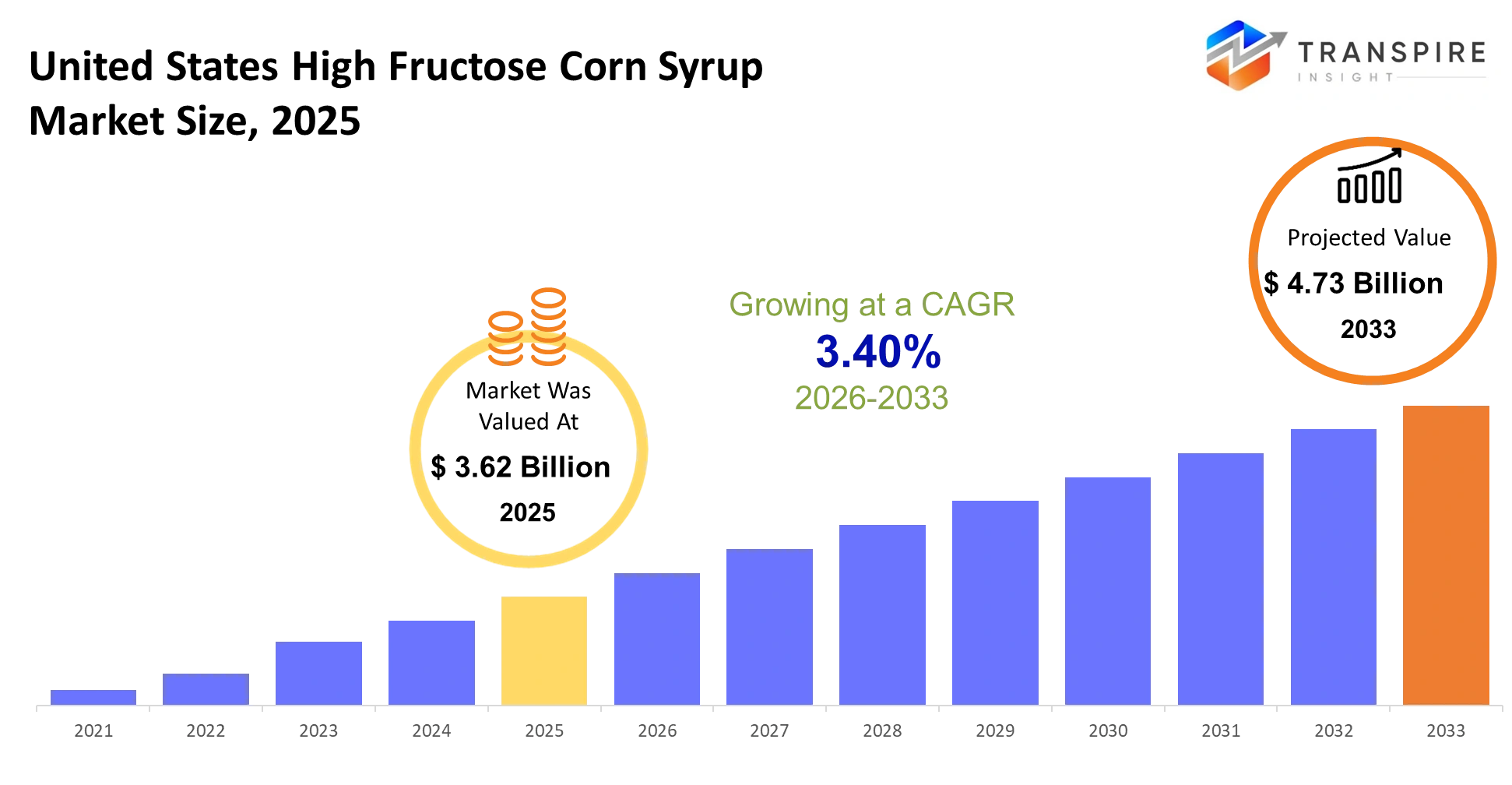
- United States High Fructose Corn Syrup Market Size 2025: USD 3.62 Billion
- United States High Fructose Corn Syrup Market Size 2033: USD 4.73 Billion
- United States High Fructose Corn Syrup Market CAGR: 3.40%
- United States High Fructose Corn Syrup Market Segments:By Type (HFCS-42, HFCS-55, HFCS-90), By Application (Beverages, Bakery Products, Dairy Products, Processed Foods).
To learn more about this report,  Download Free Sample Report
United States High Fructose Corn Syrup Market Summary:
The United States High Fructose Corn Syrup Market size is estimated at USD 3.62 Billion in 2025 and is anticipated to reach USD 4.73 Billion by 2033, growing at a CAGR of 3.40% from 2026 to 2033. The growth of the United States High Fructose Corn Syrup Market continues because the food and beverage industries use this sweetener throughout their products.
Food manufacturers use high fructose corn syrup (HFCS) as an economical sweetener which they apply to multiple products such as soft drinks and baked goods and processed foods. The manufacturers use the product which maintains its storage period product quality to improve product taste. The market develops through established food processing companies which operate their manufacturing facilities across the United States.
The United States High Fructose Corn Syrup Market undergoes transformation through two factors which include shifting consumer tastes and rising health awareness among people. The traditional applications of the product still receive strong demand but consumers now prefer products which feature clean labels and use different types of sweeteners.
The product maintains its market position because ongoing product development and current product usage patterns establish its presence in the market. The two market forces develop through the relationship between customer demand and their choice of health-oriented products.
What Has the Impact of Artificial Intelligence Been on the United States High Fructose Corn Syrup Market?
Artificial intelligence is changing the united states high fructose corn syrup market because it changes the ways that businesses assess market trends and adapt to new consumer behavior patterns. Businesses utilize machine learning and predictive analytics systems to analyze extensive data sets which enable them to detect market developments and determine optimal pricing methods and predict future demand with enhanced precision.
AI integration in united states high fructose corn syrup market research allows researchers to monitor consumption patterns in real time which helps manufacturers maintain production levels according to changing consumer tastes. The approach which uses data for decision-making helps organizations throughout their entire value chain to make better choices while decreasing operational risks.
Artificial intelligence technology develops operational efficiency within united states high fructose corn syrup market activities while it also enhances supply chain performance. Smart automation technologies streamline manufacturing processes which results in reduced operational costs and better product quality.
AI-powered systems enhance logistics operations through their ability to forecast supply interruptions while they handle inventory tasks. The united states high fructose corn syrup market is undergoing changes which make it more adaptable and competitive. Companies that implement AI-based innovations achieve competitive advantages through their ability to boost operational efficiency and create personalized products while decreasing their product development time from concept to market introduction.
Key Market Trends & Insights:
- The United States high fructose corn syrup market shows Midwest regional dominance because it holds almost 45 percent market share in 2024, which results from its capacity to produce and process corn.
- The Southern region shows the highest growth rate, which will exceed 4 percent annual growth rate between 2024 and 2030 because of beverage production facilities and their planned business development initiatives.
- The United States high fructose corn syrup market uses HFCS-55 as its primary component, which controls more than 60 percent of the market share in 2024.
- HFCS-42 stands as the second-largest market share product because it mainly serves processed food items and baked goods and dairy product needs.
- The specialty HFCS market segment shows the highest growth rate because companies create new products and tailor-make solutions which will become available by 2030.
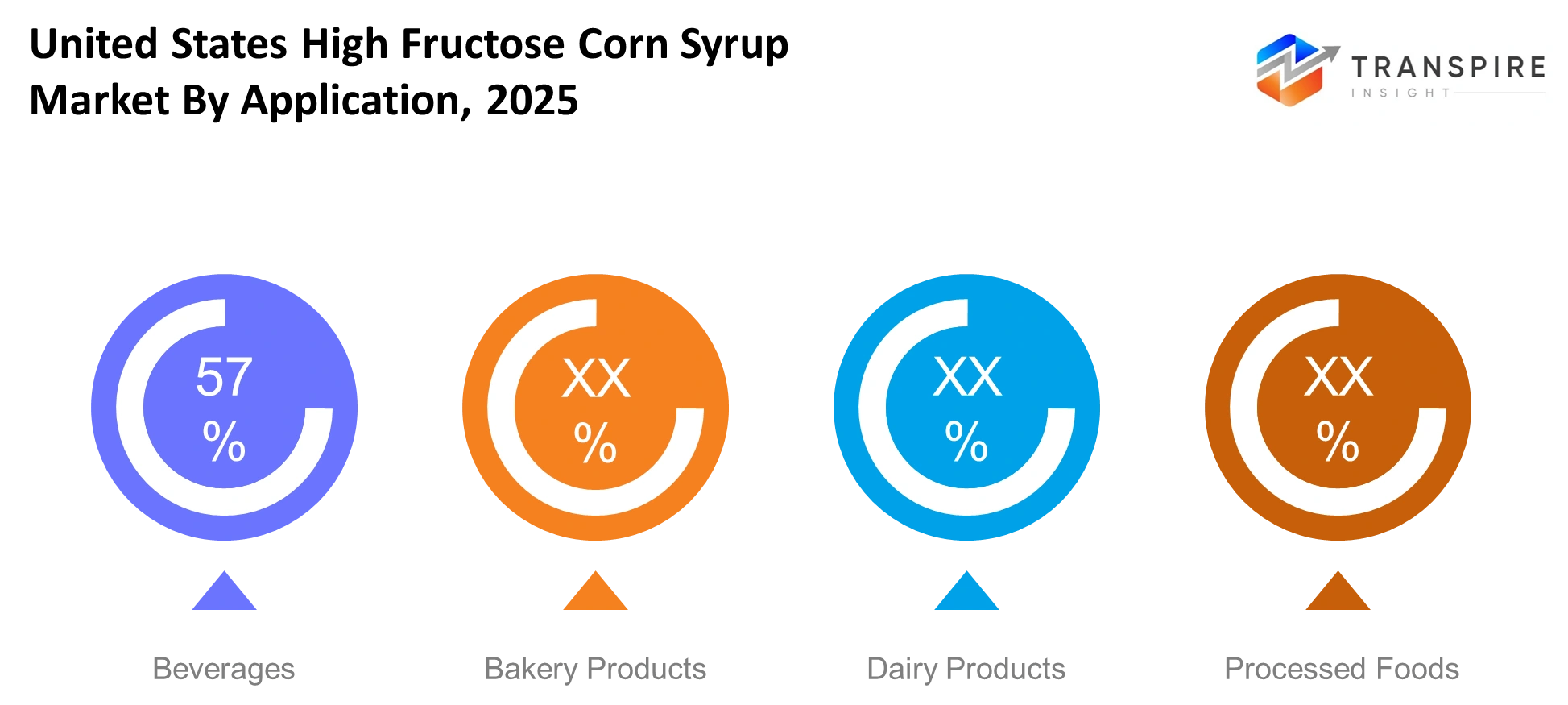
- The United States high fructose corn syrup market shows the highest usage of soft drinks which accounts for 50 percent of total 2024 market share.
- The processed food sector shows the highest growth rate because people now prefer to eat packaged foods which are becoming more accessible throughout the food industry.
- Food and beverage companies control more than 70 percent of the United States market, which creates the highest demand for high fructose corn syrup products.
- The consumption of food outside the home drives the expansion of quick-service restaurants and foodservice chains which represent the fastest growing end-user market segment.
United States High Fructose Corn Syrup Market Segmentation
By Type
HFCS-42 contains approximately 42 percent fructose which food manufacturers use to create sweet and stable processed foods and baked goods and dairy products. HFCS-55 contains about 55% fructose and is mainly used in soft drinks because of higher sweetness that matches sugar profiles. HFCS-90 contains the highest fructose concentration which food manufacturers use in small amounts to create specific sweetness levels through syrup blending. The different types of products accomplish their intended functions through their specific formulation requirements and essential product specifications.
The high demand for HFCS-55 will continue because people drink large amounts of carbonated beverages while HFCS-42 will support processed food production. HFCS-90 will experience limited but consistent demand in specialised products which need sweetening at elevated levels. Manufacturers will concentrate their efforts on enhancing operational productivity while upholding product standards throughout their entire product range. The selection of products will be based on three factors which include cost and application suitability and desired taste profile.
By Application
The beverage market stands as the biggest segment of the industry because consumers show strong demand for sweetened drinks which include both soft drinks and flavored beverages. High fructose corn syrup functions as a moisture-retaining ingredient which enhances the product's texture and extends its shelf life in bakery products. Dairy products contain flavored milk and yogurt and desserts which need balanced sweetness with uniform mouthfeel. Syrup serves as a flavoring agent in processed foods which include sauces and cereals and snacks while it ensures product quality remains intact.
The growing market for beverages will boost product demand while processed foods will see increased growth because of convenience needs and evolving consumer habits. The bakery and dairy industries will experience continuous demand which will increase at a slow pace because of ongoing product development. Manufacturers will adjust their ingredient usage to meet both consumer expectations and regulatory standards. The different ways products can be used will help them stay important in various food categories.
To learn more about this report, Download Free Sample Report
What are the Main Challenges for the United States High Fructose Corn Syrup Market Growth?
The market for high-fructose corn syrup in the USA is deficient in terms of numerous important functions that normally subjects it to constrained potential for growth. The production process depends on enzymatic conversion methods which need precise operational control to produce high-quality stable products.
Any change in the supply of raw corn or the conditions used for processing will affect both production efficiency and production costs. Supply chain interruptions combined with high transportation expenses create additional obstacles to business expansion especially during times when agricultural markets become unpredictable.
The united states high fructose corn syrup market encounters two primary barriers which hinder its growth through manufacturing and commercialization limitations. The production process requires food producers to follow stringent safety requirements and quality regulations which include Good Manufacturing Practices as their two main standards which make their business operations more difficult.
The increasing costs of energy and labor together with raw material expenses force businesses to decrease their profit margins while developing their pricing models. The market experiences slower growth and innovative development because companies face delays when they try to expand their production capacity and meet new regulatory requirements.
The united states high fructose corn syrup market faces adoption challenges because consumers increasingly prefer natural products which contain low sugar content. The health-conscious consumer group shows limited acceptance of the product which leads to decreased demand growth. The production process and distribution network will be affected by existing gaps which hinder the availability of skilled workers and necessary infrastructure. These market constraints prevent different new applications and regional markets from achieving wide-scale adoption.
Country Insights
The high fructose corn syrup market in the United States maintains consistent regional distribution because of its strong agricultural production capacity and its processing facilities. The Midwest region leads the market because of its high corn production capacity and its existing infrastructure. The Southern region keeps growing because of the increasing need for beverage manufacturing. The Western region has a moderate market share because it concentrates on different food processing business sectors.
The Midwest region will sustain its market dominance because it has raw material access combined with supply chain efficiency that leads to lower production expenses. The Southern region will achieve continuous growth because of its increasing industrial investments and the rising demand for packaged beverages. The Western region will create equal market demand because of its innovative developments and the growth of specialty food manufacturing.
The Northeast region will experience reduced growth rates because its operational expenses remain high while its capacity for large-scale production remains restricted. Nevertheless, urban consumption patterns and the demand for processed foods will ensure consistent market requirements. The market landscape will experience price variations and logistical changes and competitive strategy shifts because of the ongoing regional price differences.
Recent Development News
In February 2026, Ingredion Reaffirms High Fructose Corn Syrup as Core U.S. Sweetener Product in 2026 Filing: Ingredion Incorporated, a major U.S. producer of high fructose corn syrup and corn-based sweeteners, reaffirmed in its 2026 regulatory filings that HFCS remains a core part of its North American sweetener portfolio. The company highlighted its continued operations across U.S. corn-refining and sweetener businesses serving food and beverage manufacturers.
Source: https://ir.ingredionincorporated.com
In Febraury 2026, Ingredion Reports Continued Demand for Corn Sweeteners in U.S. Market: Ingredion’s February 2026 annual disclosures noted continued demand for corn sweeteners, including high fructose corn syrup, within the United States. The company emphasised that its extensive U.S. ingredient manufacturing network continues supporting food, beverage, and industrial sweetener customers nationwide.
Source: https://fortune.com
|
Report Metrics |
Details |
|
Market size value in 2025 |
USD 3.62 Billion |
|
Market size value in 2026 |
USD 3.743 Billion |
|
Revenue forecast in 2033 |
USD 4.73 Billion |
|
Growth rate |
CAGR of 3.40% from 2026 to 2033 |
|
Base year |
2025 |
|
Historical data |
2021 – 2024 |
|
Forecast period |
2026 – 2033 |
|
Report coverage |
Revenue forecast, competitive landscape, growth factors, and trends |
|
Country scope |
United States |
|
Key company profiled |
Archer Daniels Midland Company, Cargill Inc., Tate & Lyle PLC, Ingredion Incorporated, Roquette Frères, Grain Processing Corporation, Global Sweeteners Holdings Ltd., COFCO International, Daesang Corporation, Showa Sangyo Co. Ltd., Hungrana Ltd., Tereos Group, Gulshan Polyols Ltd., Bajaj Hindusthan Sugar Ltd., Samyang Corporation. |
|
Customization scope |
Free report customization (country, regional & segment scope). Avail customized purchase options to meet your exact research needs. |
|
Report Segmentation |
By Type (HFCS-42, HFCS-55, HFCS-90), By Application (Beverages, Bakery Products, Dairy Products, Processed Foods). |
How Can New Companies Establish a Strong Foothold in the United States High Fructose Corn Syrup Market?
New entrants aiming to establish their business presence in high fructose corn syrup market of the united states need to establish specific market segments which they will serve through unique value propositions. New companies can establish their market position by specializing in particular uses which include low-calorie beverages and specialty bakery products and clean-label formulations to keep themselves away from established industry competitors.
New market entrants can create products that meet modern consumer demands by using current industry trends which include decreased sugar consumption and clear product ingredient tracing.
Innovation and technology adoption function as essential components for companies that want to establish their presence in the United States high fructose corn syrup market. Companies can use advanced technologies such as intelligent automation and enzyme optimization and predictive analytics to enhance their production processes and control expenses.
Food manufacturers and regional distributors will help companies establish market presence while expanding their business operations through strategic partnerships. Startups like SweetTech Solutions and CornSweet Innovations are conducting research on advanced processing methods and personalized product development to solve performance issues and enhance product quality.
The identification and solution of major operational challenges which include price fluctuations and supply chain problems and product quality variation will enhance competitive advantages for businesses that operate in the United States high fructose corn syrup industry. Companies which establish operational systems through sustainable sourcing and digital supply chain management and adaptable manufacturing processes will achieve rapid demand-based operational adjustments. Companies that utilize innovative methods together with effective distribution systems will achieve sustained business development which will enable them to win market share from their competitors in the industry.
Key United States High Fructose Corn Syrup Market Company Insights
The high fructose corn syrup market in the United States experiences intense competition because large manufacturers possess established supply chains and cost benefits. Market leaders use production efficiency and consistent product quality and long-term contracts with beverage and food companies to create stable product demand which enables them to establish price control.
Companies that lead their industries will invest in new processing technologies and automation systems to achieve better profit margins while decreasing their operational expenses. The company will establish strategic partnerships with food and beverage producers to create better distribution networks which will help maintain continual product demand. The development of new formulas together with the company's commitment to meeting regulatory standards will enable the business to establish itself as a market leader in a competitive environment.
The new market entrants will start their operations through niche markets which include specialty syrups and specially designed products for particular uses. The market will experience greater competitive pressure because of both emerging sweeteners and changing consumer purchasing habits. Companies in the market will use product differentiation strategies together with cost management methods and expansion into new markets to achieve business growth while preserving their competitive edge.
Company List
- Archer Daniels Midland Company
- Cargill Inc.
- Tate & Lyle PLC
- Ingredion Incorporated
- Roquette Frères
- Grain Processing Corporation
- Global Sweeteners Holdings Ltd.
- COFCO International
- Daesang Corporation
- Showa Sangyo Co. Ltd.
- Hungrana Ltd.
- Tereos Group
- Gulshan Polyols Ltd.
- Bajaj Hindusthan Sugar Ltd.
- Samyang Corporation.
What are the Key Use-Cases Driving the Growth of the United States High Fructose Corn Syrup Market?
The United States high fructose corn syrup market exists because businesses in the beverage industry need a sweetener that provides both cost savings and stable performance throughout product use. High fructose corn syrup functions as the main sweetening ingredient in carbonated beverages and fruit drinks and energy drinks because it maintains consistent flavor while extending product shelf life. The beverage production industry shows strong demand which leads to continuous market expansion and product distribution throughout various regions.
The United States high fructose corn syrup market supports food processing operations through its applications in bakery products and dairy products and packaged food items. The product provides value to food manufacturers because it improves texture and moisture retention and flavor enhancement for products like bread and flavored yogurt and cereals. The practical uses of these solutions enable manufacturers to produce high-quality products while minimizing manufacturing expenses which drives market growth.
The United States high fructose corn syrup market serves its customers through both industrial applications and specialized product uses which include sauces and condiments and ready-to-eat meals. The rising demand for convenient food products results in increased use of ingredients that provide both operational stability and production scalability. The development of new product formulations and manufacturing methods enables businesses to create customized solutions which help them adapt to evolving market demands from customers.
The United States high fructose corn syrup market will experience future growth because companies will continue to develop new products and improve operational efficiency. Companies are developing new products through research into efficient combinations and environmentally friendly materials. The use cases will support sustained growth because demand continues through various industries while food production methods evolve.
United States High Fructose Corn Syrup Market Report Segmentation
By Type
- HFCS-42
- HFCS-55
- HFCS-90
By Application
- Beverages
- Bakery Products
- Dairy Products
- Processed Foods
Frequently Asked Questions
Find quick answers to common questions.
The approximate United States High Fructose Corn Syrup Market size for the market will be USD 4.73 Billion in 2033.
The key segments of the United States High Fructose Corn Syrup Market are By Type (HFCS-42, HFCS-55, HFCS-90), By Application (Beverages, Bakery Products, Dairy Products, Processed Foods).
Major players in the United States High Fructose Corn Syrup Market are Archer Daniels Midland Company, Cargill Inc., Tate & Lyle PLC, Ingredion Incorporated, Roquette Frères, Grain Processing Corporation, Global Sweeteners Holdings Ltd., COFCO International, Daesang Corporation, Showa Sangyo Co. Ltd., Hungrana Ltd., Tereos Group, Gulshan Polyols Ltd., Bajaj Hindusthan Sugar Ltd., Samyang Corporation.
The current market size of the United States High Fructose Corn Syrup Market is USD 3.62 Billion in 2025.
The United States High Fructose Corn Syrup Market CAGR is 3.40%.
- Archer Daniels Midland Company
- Cargill Inc.
- Tate & Lyle PLC
- Ingredion Incorporated
- Roquette Frères
- Grain Processing Corporation
- Global Sweeteners Holdings Ltd.
- COFCO International
- Daesang Corporation
- Showa Sangyo Co. Ltd.
- Hungrana Ltd.
- Tereos Group
- Gulshan Polyols Ltd.
- Bajaj Hindusthan Sugar Ltd.
- Samyang Corporation.
Recently Published Reports
-
Apr 2026
Baby Infant Formula Market
Baby Infant Formula Market Size, Share & Analysis Report By ype (Infant Milk, Follow On Milk, Specialty Baby Milk, Growing-Up Milk), By Ingredient (Carbohydrate, Fat, Protein, Minerals, Vitamins, and Others), By Product Form (Powder, Liquid, and Ready-to-feed), By Distribution Channels (Supermarket/Hypermarket, Specialty Store, Pharmacies, Online Retail, and Others), and Geography (North America, Europe, Asia-Pacific, Middle East and Africa, South and Central America), 2021 - 2031
-
Apr 2026
Edible Insects for Animal Feed Market
Edible Insects for Animal Feed Market Size, Share & Analysis Report By Type (Insect Powder, Insect Meal, Insect Bar, Insect Paste, Insect Oil, and Others), By Insect Type (Beetles, Cricket, Caterpillar, Hymenoptera, Orthoptera, Tree Bugs, and Others), By Application (Livestock, Pet Food, and Aquaculture), By Livestock Type (Poultry, Swine, and Others), and Geography (North America, Europe, Asia-Pacific, Middle East and Africa, South and Central America), 2021 - 2031
-
Apr 2026
Food Industry Disinfection and Bacterial Control Market
Food Industry Disinfection and Bacterial Control Market Size, Share & Analysis Report By Type (Chemical Disinfectants, Physical Disinfectants, and Biocides and Antimicrobials), By Application (Food Processing Equipment Surface Disinfection, Food Preparation Areas Surface Disinfection, Storage Areas Surface Disinfection, Anti-microbial Coatings Food Preservation, and Preservative Solutions Food Preservation), By End User (Meat and Poultry Processing, Dairy Processing, Seafood Processing, Bakery and Confectionery, Restaurants and Commercial Kitchens, and Food Service Providers), By Sales Channel (Online, Offline), and Geography (North America, Europe, Asia-Pacific, Middle East and Africa, South and Central America), 2021 - 2031
-
May 2026
Freeze Dried Food Market
Freeze Dried Food Market Size, Share & Analysis Report By Product Type (Fruits, Vegetables, Freeze-Dried Dairy Products, Freeze-Dried Meat and Seafood, Freeze-Dried Pet Food, and Prepared Meal), By Nature (Organic, and Conventional), By Form (Powdered, Granules, and Diced), By End Use (Breakfast Cereals, Dairy Products, Bakery & Confectionery, Nutritional Bars & Supplements, Powdered Beverages, Snacks, and Retail (Household)), and Geography (North America, Europe, Asia-Pacific, Middle East and Africa, South and Central America), 2021 - 2031