

United States Fructooligosaccharides Market Size & Forecast:
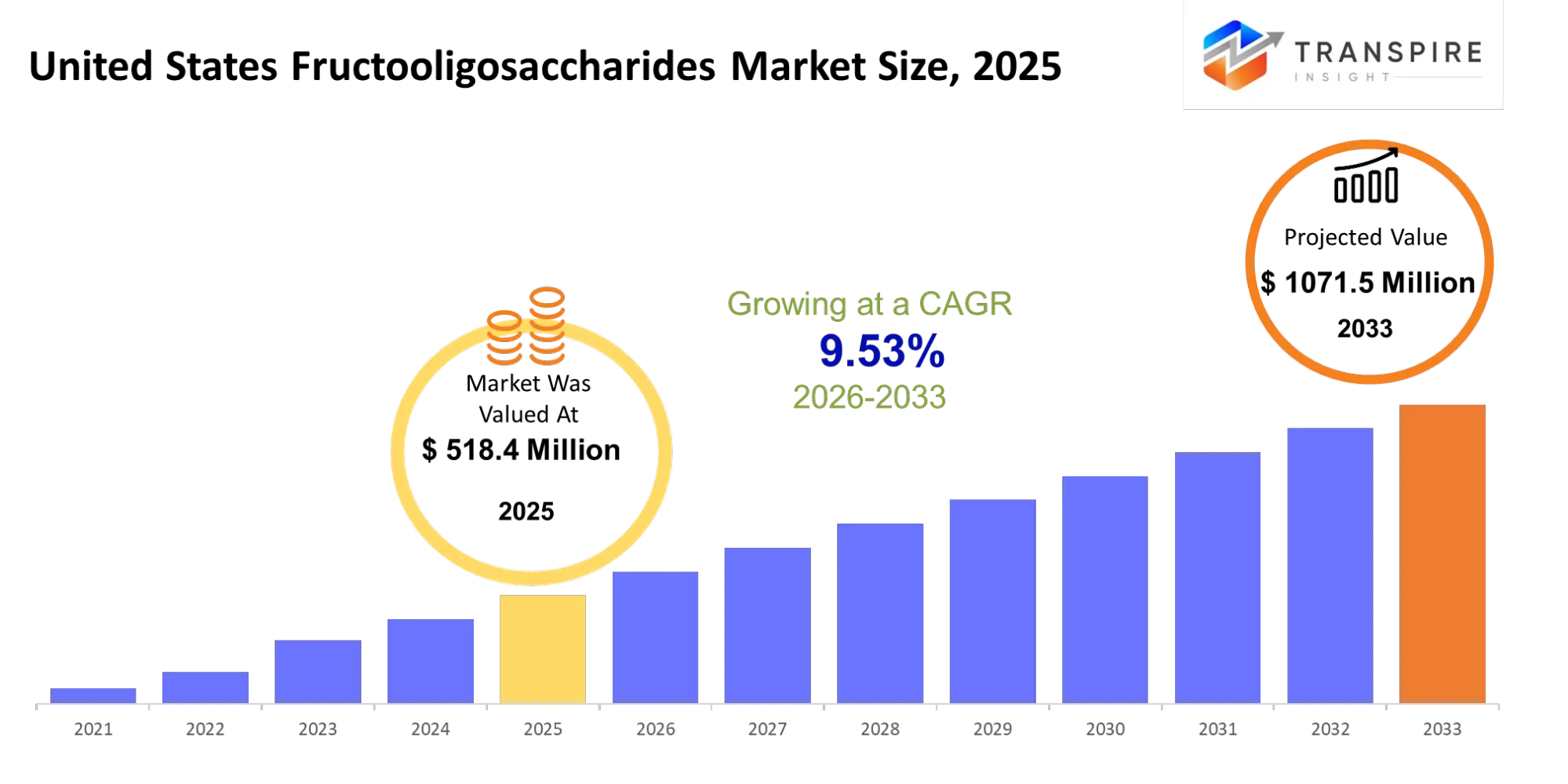
- United States Fructooligosaccharides Market Size 2025: USD 518.4 Million
- United States Fructooligosaccharides Market Size 2033: USD 1071.5 Million
- United States Fructooligosaccharides Market CAGR: 9.53%
- United States Fructooligosaccharides Market Segments: By Type (Short-chain FOS, Medium-chain FOS, Long-chain FOS, Organic FOS, Liquid FOS, Others); By Application (Food & Beverages, Infant Nutrition, Pharmaceuticals, Dietary Supplements, Animal Feed, Others); By End-User (Food Industry, Pharma, Nutrition Industry, Retail, Industrial, Others); By Form (Powder, Liquid, Syrup, Granules, Capsules, Others)
To learn more about this report,  Download Free Sample Report
United States Fructooligosaccharides Market Summary
The United States Fructooligosaccharides Market was valued at USD 518.4 Million in 2025. It is forecast to reach USD 1071.5 Million by 2033. That is a CAGR of 9.53% over the period.
Fructooligosaccharides, sort of play a practical role in the United States food and nutrition ecosystem, by helping manufacturers get gut-health functionality in products without messing up taste stability, or the sugar reduction targets too much. They’re used pretty often in dairy alternatives, nutritional supplements, infant nutrition and functional beverages where formulators really need ingredients that back digestive balance while also matching clean label product strategies. Over the last five years the market sort of shifted in a structural way, from small nutraceutical uses toward being mainstream in everyday packaged foods, as big consumer brands reformulated their portfolios around digestive wellness, and lower-calorie sweetening systems.
This change sped up hard during the post pandemic period, when supply chain disruptions showed up and preventive health became a bigger deal in public scrutiny, so food producers tried to localize sourcing and focus on functional ingredients with scientific backing. The end result is stronger commercial adoption, because manufacturers keep putting money into reformulation and product line expansion, since fructooligosaccharides bring both technical performance, and a market edge, which then feeds into broader shelf presence, plus higher procurement volumes for the ingredient.
Key Market Insights
- The Midwest kind of dominates the United States Fructooligosaccharides Market, holding nearly 38% market share in 2025, mostly because food processing and ingredient manufacturing clusters stay really concentrated.
- The West Coast is the fastest-moving regional market through 2032, it’s supported by clean-label product innovation that is pretty strong and also functional drink development, in other words.
- For the Northeast, markets show noticeable share expansion, fueled by premium nutrition product launches and the adoption of advanced food technology, too.
- Short-chain fructooligosaccharides really lead the way , capturing around 46% of the United States Fructooligosaccharides Market revenue in 2025, thanks to wide food-grade functionality.
- Liquid fructooligosaccharides are the fastest-growing segment through 2030, driven by rising demand in beverage and syrup uses.
- Functional food and beverage use cases make up something like over 41% of the total market pull, so yeah they end up as the main money-making group.
- Infant nutrition is still on the strong side of growth, with projections that go past 7% per year all the way through 2032.
- Dietary supplements keep gathering momentum too, mainly because personalized gut health approaches are becoming more common across adult wellness areas.
- Big food manufacturers in the U.S. still hold close to 52% of the Fructooligosaccharides Market, and they use that size for quicker product re-formulation pushes, not just small tweaks.
- Then, nutraceutical brands sit in the second-largest end-user segment, backed by a more premium digestive well-being stance.
What are the Key Drivers, Restraints, and Opportunities in the United States Fructooligosaccharides Market?
The most powerful force, driving the United States fructooligosaccharides market onward, is kind of that reformulation shift currently happening across packaged food and beverage manufacturing . The whole thing really picked up speed after the FDA updated Nutrition Facts labeling rules, and then brands felt pushed to trim added sugar levels while still keeping the taste and texture pretty much intact. Fructooligosaccharides ended up looking commercially interesting, not just because they add a gentle sweet note, but also because they back up fiber related statements. That two part benefit means manufacturers can satisfy tougher label expectations , without doing a huge product redesign every time. So naturally, food producers are boosting purchase volumes , especially in dairy alternatives, snack bars and functional beverages, which helps ingredient revenues climb and it expands everyday commercial use.
On the other hand the biggest structural roadblock is raw material and production cost volatility, mostly connected to chicory root extraction and the enzymatic processing capability. It’s not like those immediate logistics interruptions that come and go, this is more like the root problem is limited domestic output infrastructure , plus dependence on specialized processing technologies , which are basically centered with a small number of worldwide suppliers. To scale up, companies need major capital spending for facility upgrades, and they also need technical know-how that cannot be copied quickly. Because of that pricing stays higher versus conventional sweeteners and fibers , and mid sized manufacturers often hesitate, which slows down adoption in cost minded food categories.
Precision fermentation is probably the most straightforward next-stage growth chance. A few U.S. ingredient innovators are putting money into bio-based carbohydrate synthesis platforms, that can crank out highly customized prebiotic ingredients, at industrial scale and yeah. As these tools keep maturing—especially in the California and Massachusetts food-tech clusters—they might push costs downward and make wider adoption possible, for personalized nutrition as well as clinical diet uses.
What Has the Impact of Artificial Intelligence Been on the United States Fructooligosaccharides Market?
Artificial intelligence and advanced digital technologies are starting to reshape the United States fructooligosaccharides market, in a sort of indirect but noticeable way. They are improving production precision, keeping quality more consistent, and boosting supply chain responsiveness across ingredient manufacturing. In practice, AI driven process control systems are now being rolled out in enzymatic conversion and fermentation based production lines to automate temperature regulation, track substrate concentration more closely, and fine tune reaction timing. Because of that, there is less need for manual intervention , and manufacturers can maintain tighter purity requirements for prebiotic compounds used in functional foods as well as clinical nutrition uses.
At the same time, machine learning models are being applied to forecast equipment maintenance needs, and to nudge batch yields upward by looking at past production conditions. Things like enzyme activity, moisture levels, and raw material variability get analyzed, almost like a pattern search but with a lot more math. With this predictive angle, processors can cut unplanned downtime by something around 10 to 15 percent , while also improving throughput and reducing waste output. Then on the procurement and distribution side, digital forecasting tools help ingredient suppliers anticipate demand swings coming from food and beverage manufacturers, which in turn reduces inventory holding costs and supports better order completion rates.
The operational gains are kinda translating into stronger margins , mainly because energy consumption goes lower, raw material utilization is more efficient, and the formulation turnaround times for customers are getting faster. Still, right now the adoption is not moving as fast as it could , due to high integration costs, and also because there are limited training datasets that are specific to specialty carbohydrate processing. Many mid sized manufacturers, they still don’t have the historical operational data that would help them build very accurate predictive models so the broader implementation across the sector stays slower.
Key Market Trends
- Since 2022, big food manufacturers, like Ingredion Incorporated, have been adding prebiotic fiber integration by more than 20% across reshaped snack and beverage portfolios, kind of across the board.
- After the recent sugar disclosure requirements, FDA labeling pressure kinda kicked in and manufacturers pushed to swap out the usual bulking sweeteners for multifunctional fructooligosaccharides, during redesign cycles.
- Domestic sourcing strategies picked up momentum after 2021 disruptions, because U.S. processors started reducing reliance on European chicory-derived imports, to keep production schedules more stable and less wobbly.
- Between 2020 and 2025, fermentation based production investments rose pretty sharply as suppliers chased higher purity yields, plus they aimed to lower enzymatic processing costs along the way.
- Clinical nutrition brands shifted how they buy after 2023, moving away from generic fibers toward more targeted prebiotic compounds, with microbiome performance numbers that are actually documented and not just implied.
- Players such as Tate & Lyle and Beneo, accelerated partnerships with functional beverage developers to grab the growing ready-to-drink formulation demand before it cooled off.
- AI enabled process monitoring reduced batch inconsistencies by an estimated 10% to 15% since 2024, and that helped production efficiency across specialty carbohydrate facilities.
- Premium dairy alternative manufacturers increased fructooligosaccharide inclusion rates too, since plant based recipes needed better texture and digestive functionality, while avoiding synthetic additives.
- Regulatory scrutiny related to clean label substantiation has gotten more intense since 2023, so suppliers now invest more heavily in application specific clinical validation, not just generic evidence.
- Meanwhile mid-sized ingredient buyers are leaning more toward long-term supply contracts, reflecting a move from spot purchasing toward procurement stability, even with raw material volatility happening.
United States Fructooligosaccharides Market Segmentation
By Type :
Short-chain, medium-chain, and long-chain fructooligosaccharides are widely used, depending on digestion rate and sweetness level. Short-chain FOS helps with quick fermentation in the gut. Medium-chain FOS tends to give more balanced stability and performance. Long-chain FOS gives slower digestion which can feel more gradual, overall. These kinds of fructooligosaccharides support food formulation needs across several sectors, with steady demand growth seen in functional products.
Organic FOS and liquid FOS are getting more attention , largely because of clean-label expectations and the ease of blending in beverages. Organic versions help with a natural product story. Liquid formats work well for fast mixing in drink applications. Other options include tailored blends for industrial formulations. Segmenting by type also supports product diversification across nutrition and food manufacturing channels.
To learn more about this report, Download Free Sample Report
By Application :
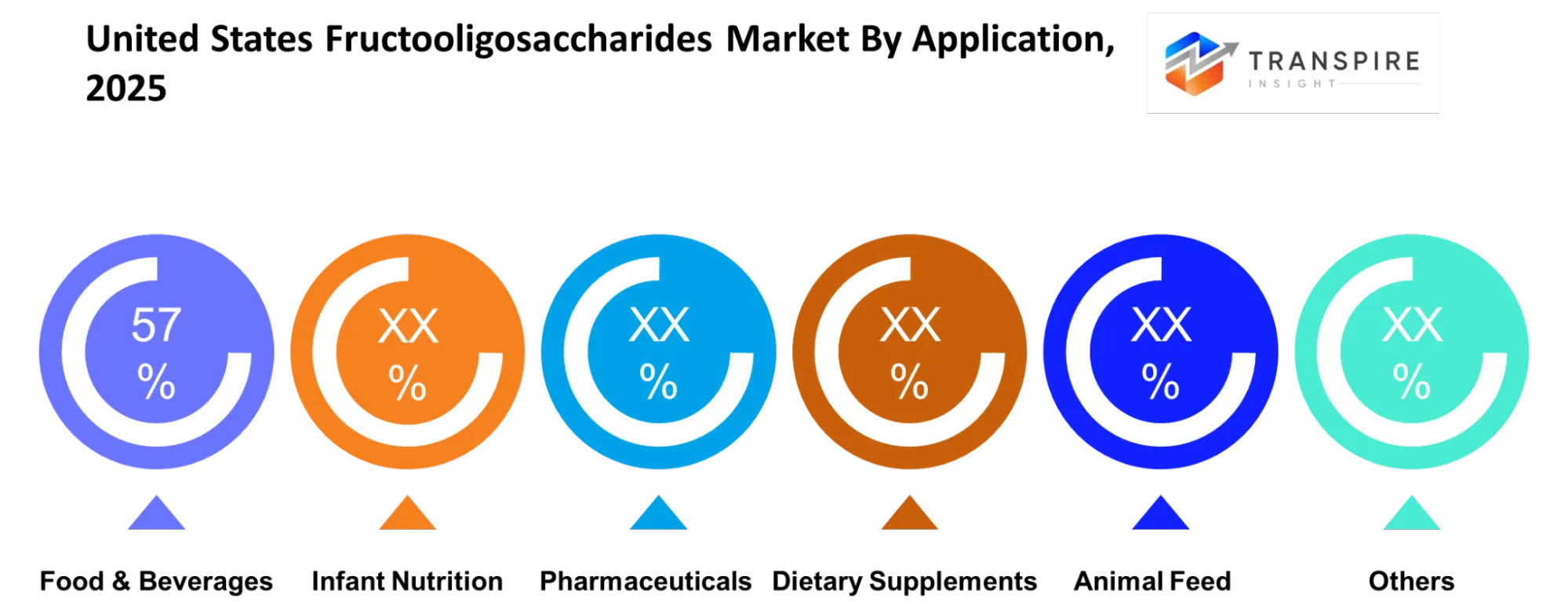
Food and beverages still lead as the main application area, because demand keeps rising for prebiotic ingredients in bakery, dairy, and drinks. Fructooligosaccharides support texture , while also promoting digestive well-being. Use in processed foods continues to climb as consumers focus more on functional nutrition and reduced sugar content.
Infant nutrition, pharmaceuticals, and dietary supplements are also expanding consistently , due to the gut health benefits. In infant formulas, FOS supports microbiome development. Pharmaceutical work focuses on digestive-support formulations. Dietary supplements use prebiotic qualities to strengthen routine wellness claims. Animal feed applications also aim to support gut balance in livestock. Beyond that, there are specialized industrial nutrition solutions for niche requirements.
By End-User :
In the food industry, end-users pretty much dominate usage, because there is strong integration of prebiotic ingredients into processed, and packaged foods. Manufacturers try to improve the health profiles of their products a bit more each year. Fructooligosaccharides help with sugar reduction strategies and also lift the fiber content across several food categories, so adoption stays high in large-scale production systems, even when supply schedules get tight.
On the pharma and nutrition side, demand is also significant. Pharmaceutical companies apply FOS in digestive health products, mainly for gut related support. The nutrition industry tends to lean on supplements and wellness formulations, while retail channels push packaged health products straight to consumers. Industrial users use FOS within bulk formulations for consistency. Other end-users include specialized manufacturing units that are more health-focused, and often keep stricter formulation rules.
By Form :
Powder form is still the most common, mostly due to easy storage, long shelf life, and solid compatibility with dry formulations. Powdered fructooligosaccharides get used in supplements, food blends, and general functional bases. Stability plus controlled dosing makes the powder kind a good fit for industrial production, and large scale manufacturing, across multiple sectors without much drama.
Liquid and syrup formats are typically used for beverages and ready-to-mix applications, largely because they dissolve quickly. Granules support a kind of controlled release in functional foods, so the effect can be more even. Capsules are often chosen in dietary supplements for precise dosage delivery, which helps with standardization. Each format kind of matches different processing needs, so the same fructooligosaccharides ingredient can be applied in food, pharma and nutrition markets with better flexibility.
What are the Key Use Cases Driving the United States Fructooligosaccharides Market?
The main use case behind adoption in the United States fructooligosaccharides market is functional food formulation, especially in nutritional bars, dairy alternatives, and fortified beverages. Food manufacturers lean on fructooligosaccharides because they bring fiber enrichment, a gentle sweetness, and also texture refinement in one go, so there is less need for several separate formulation additives, and honestly it makes planning easier.
Newer applications are showing up across infant nutrition, and also dietary supplement manufacturing, where prebiotic blends are used for digestive well-being positioning in more specialized ways. Clinical nutrition producers, plus nutraceutical brands, are starting to drop these ingredients into powders, gummies, and ready-to-mix formats, since health-minded consumers want gut microbiome support that feels targeted and backed by product efficacy you can point to in a report.
Right now, emerging use cases are taking shape in personalized nutrition platforms and medical food development. Digital wellness companies are beginning to weave custom prebiotic compositions into subscription based nutrition programs, while some pharmaceutical nutrition developers are assessing fructooligosaccharides for therapeutic dietary interventions tied to metabolic health and microbiome recovery. It’s still early stage, but the commercial promise seems real as precision nutrition technologies keep moving forward across the United States.
|
Report Metrics |
Details |
|
Market size value in 2025 |
USD 518.4 Million |
|
Market size value in 2026 |
USD 566.6 Million |
|
Revenue forecast in 2033 |
USD 1071.5 Million |
|
Growth rate |
CAGR of 9.53% from 2026 to 2033 |
|
Base year |
2025 |
|
Historical data |
2021 - 2024 |
|
Forecast period |
2026 - 2033 |
|
Report coverage |
Revenue forecast, competitive landscape, growth factors, and trends |
|
Geographic scope |
United States of America |
|
Key company profiled |
Beneo, Ingredion, Cosucra, Tate & Lyle, Cargill, ADM, FrieslandCampina, Meiji, Yakult, Baolingbao, Shandong Bailong, Quantum Hi-Tech, Roquette, Gushen, Sensus |
|
Customization scope |
Free report customization (country, regional & segment scope). Avail customized purchase options to meet your exact research needs. |
|
Report Segmentation |
By Type (Short-chain FOS, Medium-chain FOS, Long-chain FOS, Organic FOS, Liquid FOS, Others); By Application (Food & Beverages, Infant Nutrition, Pharmaceuticals, Dietary Supplements, Animal Feed, Others); By End-User (Food Industry, Pharma, Nutrition Industry, Retail, Industrial, Others); By Form (Powder, Liquid, Syrup, Granules, Capsules, Others) |
Which Regions are Driving the United States Fructooligosaccharides Market Growth?
The Midwest still shows up as the most important region in the United States fructooligosaccharides market, mainly because it mixes convenient agricultural feedstock access with a very mature food ingredient manufacturing scene. Places like Illinois, Iowa and Minnesota gain from solid corn-processing and carbohydrate conversion systems, which in turn supports efficient production of those specialty, kind of prebiotic-type additives. On top of that, the region has well-known formulation plus R&D circles that connect back to major food manufacturers. That setup helps shorten the time-to-market for prebiotic enriched products, so everything moves a little quicker. With this sort of all-in-one supply chain, from raw material pickup through large-scale processing, the Midwest ends up having a more stable structural advantage that keeps it in a leadership position.
The Northeast, meanwhile, comes in as the second most influential area, but its edge isn’t so much about manufacturing muscle. Instead, it leans more on market sophistication. Where the Midwest feels production first, this region leans on dense communities of premium food brands, nutraceutical creators, and clinical nutrition innovators. There is also strong consumer purchasing power and a fairly advanced functional wellness audience. That basically makes product uptake stay steadier, even when the economy is wobbling a bit. And because there is consistent funding for research collaborations between ingredient suppliers and life sciences institutions, the Northeast remains a dependable contributor to overall national fructooligosaccharide revenues.
The West Coast is showing the quickest growth momentum, kinda pushed along by rapid innovation in food technology and those personalized nutrition platforms. In the last three years venture capital investment in California based functional ingredient startups has, like, sped up development of fermentation-driven carbohydrate technologies. The regulatory spotlight is leaning hard on transparent labeling and plant based product reformulation, and that has pushed adoption among regional manufacturers even more. For investors and new entrants this is turning into a high potential growth corridor through 2033, because next generation applications move from pilot scale testing to full commercial production.
Who are the Key Players in the United States Fructooligosaccharides Market and How Do They Compete?
The competitive landscape for the United States fructooligosaccharides market is sort of moderately consolidated, in the sense that a small group of global ingredient manufacturers control big volume supply while more specialized innovators hang around via formulation know-how and application specific tailoring. Still, competition isn’t driven only by price, it’s more about production tech, steadier purity consistency, and the capability to help customers cycle through reformulation without too much delay. The established suppliers defend their positions through vertical integration and more robust domestic distribution, and the newer players are leaning on fermentation innovation to challenge the older chicory root extraction models. In practice, technical support , plus speed-to-market for custom ingredient solutions, has turned into a real deciding factor.
Beneo plays in this space with traceable chicory root sourcing and digestive health claims that are backed by clinical input, which tends to attract premium food and infant nutrition makers. Their edge is tied to scientific validation and formulation guidance, so customers can move faster when they launch clean-label products. Beyond that, the company keeps expanding through collaborations with U.S. beverage and dairy alternative developers who want functional fiber integration.
Ingredion Incorporated puts most of its attention on application-driven innovation, mixing fructooligosaccharides with texture systems that makes reformulation easier for big packaged food brands. It this bundled ingredient style cuts down on development time for customers, and also tends to keep them around longer. At the same time, Tate & Lyle uses a pretty wide North American manufacturing footprint, so orders can move faster, with more dependable supply security. Sensus stands apart by using high-purity prebiotic concentrates, and then they keep expanding via specific collaborations with personalized nutrition startups who are building next-generation microbiome, focused formulations.
Company List
- Beneo
- Ingredion
- Cosucra
- Tate & Lyle
- Cargill
- ADM
- FrieslandCampina
- Meiji
- Yakult
- Baolingbao
- Shandong Bailong
- Quantum Hi-Tech
- Roquette
- Gushen
- Sensus
Recent Development News
In April 2026, Laird Superfood announced the acquisition of Terrasoul Superfoods and secured an additional $60 million convertible preferred equity investment from Nexus Capital. The acquisition expands Laird Superfood’s presence in the functional superfoods and prebiotic-adjacent ingredients space, strengthening its portfolio in health-focused food ingredients that include fiber-rich formulations aligned with FOS demand trends in the U.S. functional nutrition market. Source https://www.nasdaq.com/
In February 2026, Refresco announced a definitive agreement to acquire SunOpta Inc. in an all-cash transaction valued at $6.50 per share. The acquisition expands Refresco’s North American food and beverage supply capabilities, enhancing its ability to integrate functional ingredients like fructooligosaccharides into beverage and nutrition manufacturing pipelines.
Source https://www.nasdaq.com/
What Strategic Insights Define the Future of the United States Fructooligosaccharides Market?
The United States fructooligosaccharides market is moving, structurally, toward a formulation-led ecosystem where functional ingredients get tucked into mainstream packaged food design rather than being treated like specialty additives. This sort of shift is pushed by ongoing reformulation pressure across food and beverage makers who now tend to favor multi-functional ingredients that do sweetness modulation, fiber enrichment, and label simplification… all within one input. Over the next five to seven years, that should end up consolidating demand around suppliers who can pair application science with scalable manufacturing, not just play the ingredient supply game.
A less obvious risk is the growing reliance on a tight set of enzymatic and chicory derived production pathways, which basically puts them closer to feedstock concentration issues and processing bottlenecks. So if there’s any disruption in agricultural inputs, or enzyme availability, supply can get tighter quickly and then compress margins even while end use demand stays stable.
There’s also an emerging opening, in a way. Precision fermentation platforms are being developed in U.S. biotech hubs, and the idea is that controlled microbial synthesis could reduce cost wobble and make it easier to create customized prebiotic structures for clinical nutrition. Firms that link up early with these platforms can probably lock in longer term differentiation.
Strategically, market players should put money into co development partnerships with food manufacturers, to secure formulation roles earlier in the product design cycle. That way recurring demand stays in place as the reformulation pipeline keeps expanding, and everyone doesn’t have to re-negotiate the same chemistry again and again.
United States Fructooligosaccharides Market Report Segmentation
By Type
- Short-chain FOS
- Medium-chain FOS
- Long-chain FOS
- Organic FOS
- Liquid FOS
By Application
- Food & Beverages
- Infant Nutrition
- Pharmaceuticals
- Dietary Supplements
- Animal Feed
By End-User
- Food Industry
- Pharma
- Nutrition Industry
- Retail
- Industrial
By Form
- Powder
- Liquid
- Syrup
- Granules
- Capsules
Frequently Asked Questions
Find quick answers to common questions.
The United States Fructooligosaccharides Market size is USD 1071.5 Million in 2033.
Key segments for the United States Fructooligosaccharides Market are By Type (Short-chain FOS, Medium-chain FOS, Long-chain FOS, Organic FOS, Liquid FOS, Others); By Application (Food & Beverages, Infant Nutrition, Pharmaceuticals, Dietary Supplements, Animal Feed, Others); By End-User (Food Industry, Pharma, Nutrition Industry, Retail, Industrial, Others); By Form (Powder, Liquid, Syrup, Granules, Capsules, Others).
Major United States Fructooligosaccharides Market players are Beneo, Ingredion, Cosucra, Tate & Lyle, Cargill, ADM, FrieslandCampina, Meiji, Yakult, Baolingbao, Shandong Bailong, Quantum Hi-Tech, Roquette, Gushen, Sensus.
The United States Fructooligosaccharides Market size is USD 518.4 Million in 2025.
The United States Fructooligosaccharides Market CAGR is 9.53% from 2026 to 2033.
- Beneo
- Ingredion
- Cosucra
- Tate & Lyle
- Cargill
- ADM
- FrieslandCampina
- Meiji
- Yakult
- Baolingbao
- Shandong Bailong
- Quantum Hi-Tech
- Roquette
- Gushen
- Sensus
Recently Published Reports
-
Apr 2026
Baby Infant Formula Market
Baby Infant Formula Market Size, Share & Analysis Report By ype (Infant Milk, Follow On Milk, Specialty Baby Milk, Growing-Up Milk), By Ingredient (Carbohydrate, Fat, Protein, Minerals, Vitamins, and Others), By Product Form (Powder, Liquid, and Ready-to-feed), By Distribution Channels (Supermarket/Hypermarket, Specialty Store, Pharmacies, Online Retail, and Others), and Geography (North America, Europe, Asia-Pacific, Middle East and Africa, South and Central America), 2021 - 2031
-
Apr 2026
Edible Insects for Animal Feed Market
Edible Insects for Animal Feed Market Size, Share & Analysis Report By Type (Insect Powder, Insect Meal, Insect Bar, Insect Paste, Insect Oil, and Others), By Insect Type (Beetles, Cricket, Caterpillar, Hymenoptera, Orthoptera, Tree Bugs, and Others), By Application (Livestock, Pet Food, and Aquaculture), By Livestock Type (Poultry, Swine, and Others), and Geography (North America, Europe, Asia-Pacific, Middle East and Africa, South and Central America), 2021 - 2031
-
Apr 2026
Food Industry Disinfection and Bacterial Control Market
Food Industry Disinfection and Bacterial Control Market Size, Share & Analysis Report By Type (Chemical Disinfectants, Physical Disinfectants, and Biocides and Antimicrobials), By Application (Food Processing Equipment Surface Disinfection, Food Preparation Areas Surface Disinfection, Storage Areas Surface Disinfection, Anti-microbial Coatings Food Preservation, and Preservative Solutions Food Preservation), By End User (Meat and Poultry Processing, Dairy Processing, Seafood Processing, Bakery and Confectionery, Restaurants and Commercial Kitchens, and Food Service Providers), By Sales Channel (Online, Offline), and Geography (North America, Europe, Asia-Pacific, Middle East and Africa, South and Central America), 2021 - 2031
-
Apr 2026
Freeze Dried Food Market
Freeze Dried Food Market Size, Share & Analysis Report By Product Type (Fruits, Vegetables, Freeze-Dried Dairy Products, Freeze-Dried Meat and Seafood, Freeze-Dried Pet Food, and Prepared Meal), By Nature (Organic, and Conventional), By Form (Powdered, Granules, and Diced), By End Use (Breakfast Cereals, Dairy Products, Bakery & Confectionery, Nutritional Bars & Supplements, Powdered Beverages, Snacks, and Retail (Household)), and Geography (North America, Europe, Asia-Pacific, Middle East and Africa, South and Central America), 2021 - 2031