

United States Duvet Covers Market Size & Forecast:
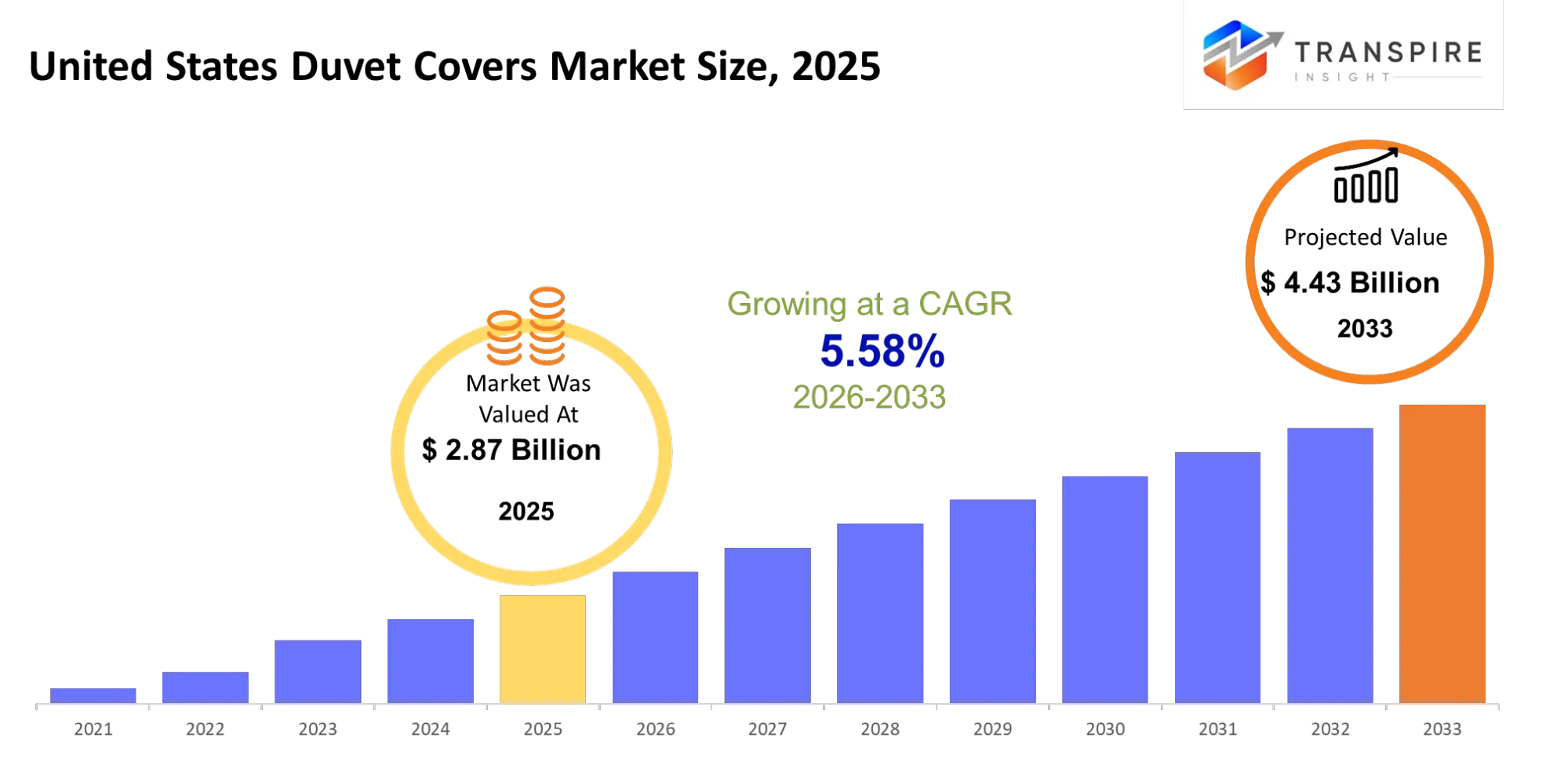
- United States Duvet Covers Market Size 2025: USD 2.87 Billion
- United States Duvet Covers Market Size 2033: USD 4.43 Billion
- United States Duvet Covers Market CAGR: 5.58%
- United States Duvet Covers Market Segments: By Type (Cotton, Linen, Silk, Polyester, Blended Fabrics, Others); By Application (Residential, Hospitality, Commercial, Luxury Bedding, Hotels, Others); By End-User (Households, Hotels, Retailers, Hospitality, Others); By Distribution (Online, Retail Stores, Specialty Stores, Supermarkets, Others)
To learn more about this report,  Download Free Sample Report
United States Duvet Covers Market Summary
The United States Duvet Covers Market was valued at USD 2.87 Billion in 2025. It is forecast to reach USD 4.43 Billion by 2033. That is a CAGR of 5.58% over the period.
The United States duvet covers market plays a kind of practical role in the home textiles ecosystem by shielding comforters from abrasion, spots, and seasonal wear, while letting households and hotel style operators refresh bedroom looks without swapping out the pricier bedding inserts. In a way, this has made duvet covers a cost effective approach for both everyday residential buyers and commercial accommodation providers, who want more flexibility in upkeep and quicker design changes . In the last three to five years, the whole market has been tilting in a more structural manner toward sustainable and performance focused fabrics. You can see organic cotton, linen blends, and antimicrobial treatments taking more retail space, as retailers react to sharper sourcing expectations and the growing consumer attention around textile staying power.
The pandemic era supply chain headaches were a big catalyst too, because they revealed how much the system relies on imported fabric processing. That pressure, in turn, pushed many brands to broaden suppliers and to firm up domestic inventory plans. This adjustment seems to have boosted product availability and helped cut replenishment time. So style rotations happen faster, with less delay. Meanwhile, as direct to consumer channels keep expanding and premium home furnishing purchases feel more deliberate , manufacturers are getting stronger margins through personalization and branded collections.
Key Market Insights
- The Northeast region sort of dominates the United States Duvet Covers Market , grabbing almost 34% market share in 2025. This is mainly because people are spending more on premium home decoration stuff and well, you know, nicer interiors.
- Meanwhile the Western United States shows the fastest growth all the way through 2032, backed by eco-minded shoppers and also strong e-commerce bedding sales, which feels kind of obvious but still true.
- The Southern states meanwhile are gaining share in a noticeable way , since new urban home construction is pushing demand for affordable yet mid-premium bedding products, for everyday households.
- Cotton duvet covers take the lead , with around 41% of the industry size in 2025. They’re picked for breathability and solid longevity, plus they match with basically any season bedding setups.
- Microfiber duvet covers end up holding the second-largest market share too. They do well thanks to their lower cost and the growing tendency to use them across rental housing segments, where budgets matter.
- Organic and linen-blend duvet covers are pretty much the fastest-growing slice , and they are projected to expand pretty quickly through 2032 because of sustainability trends.
- In the United States Duvet Covers Market, residential uses still lead, taking in almost 72% of the revenue share in 2025 as homeowners are really leaning into bedroom aesthetics, like that “done right” look.
- Meanwhile, hospitality applications are kind of popping up as the fastest-growing segment, pushed forward by boutique hotel renovations and investments aimed at a more premium guest experience.
- On the other side, household consumers hold the lead with nearly 68% market share, which ties back to ongoing replacement purchases and those seasonal décor refresh cycles that people do, without thinking too much.
- Also the commercial accommodation sector is moving fast through 2030 , backed by hotel expansion and an increase in short term rental inventory.
What are the Key Drivers, Restraints, and Opportunities in the United States Duvet Covers Market?
The strongest force driving the United States duvet covers market is kind of the rapid expansion of premium direct-to-consumer home textile retail. This shift really picked up after 2020, when digital-first bedding brands started putting more money into visualization tools, looser return rules, and data-led personalization. People who used to buy bedding only occasionally, through department stores, now show up for online product drops, limited edition collections, and subscription-like refresh cycles. That change has made replacement happen faster, and it also boosts the average order amounts, so revenue gets lifted across both premium and mid-tier sections, sort of right away.
Still, the market’s most stubborn structural obstacle is its reliance on imported cotton, mixed-fiber materials, and overseas textile finishing capacity. The United States doesn’t have enough large-scale domestic bedding manufacturing infrastructure to mirror Asian cost efficiencies. Because of that, producers get pulled into freight swings, tariff rule changes, and sourcing disruptions, and none of those can be handled quickly since building textile processing ecosystems takes years of capital investment, not weeks. The fallout is margin compression for brands, plus higher shelf prices, which delays replacement buying and keeps broader adoption slower in households that are more price sensitive.
The next growth phase will probably come from smart textile integration and the hospitality industry modernization, kind of, without too much fanfare. Temperature-regulating fabrics, antimicrobial treatments, and moisture-responsive weaves are shifting from niche R and D to real commercial rollout. Like, for instance, upscale hotel chains are starting to adopt performance bedding so they can stretch replacement cycles, while also lifting guest satisfaction metrics. Once these technologies scale, and manufacturing costs start normalizing , they may unlock more lucrative business-to-business contracts and essentially form a fresh premium tier inside the United States duvet covers market.
What Has the Impact of Artificial Intelligence Been on the United States Duvet Covers Market?
AI together with advanced digital technologies is kinda re-shaping the United States duvet covers market, mostly via supply chain automation, demand forecasting, and production optimization. It is not really the maritime-style uses mentioned in your earlier prompt, more like internal logistics stuff. In this area, manufacturers and retailers are rolling out AI-driven inventory systems to watch stock motion across warehouses, then automate replenishment rhythms, so they can cut down on excess stock that shows up around seasonal bedding demand changes. Also smart merchandising platforms look at browsing signals and purchase records, then nudge customers toward specific fabric types, color directions, and even bundle pairings. That tends to boost online conversions, and usually lifts average order values too.
Machine learning is making textile manufacturing more predictive as well. These models estimate demand swings by looking at home trends, hospitality occupancy levels, and general consumer buying behavior. With that info, producers can time fabric sourcing better, and line up production schedules with fewer surprises. A few major bedding suppliers say they are seeing directional improvements like reduced inventory holding expenses, quicker fulfillment turnaround, and fewer stockouts during the peak seasonal windows. On the operations side, automated quality inspection—using computer vision—can catch stitching irregularities and fabric flaws with more accuracy than manual checking. That usually means fewer returns, and smoother overall efficiency across the production floor.
A big limitation still stays the high integration cost, like for connecting older textile production equipment with AI-enabled analytics platforms. A lot of mid-sized manufacturers are still running split-up systems that spit out uneven data and so the model accuracy gets capped, which also slows the whole adoption. If there is no standardized digital setup, then the complete performance lift from predictive manufacturing and real-time retail optimization remains tricky to reach across the broader home textiles ecosystem .
Key Market Trends
- Since 2021, direct-to-consumer brands like Brooklinen and Parachute Home have sort of accelerated digital-first launches, which ends up reducing dependence on department-store bedding sales, or at least that’s the gist.
- Organic cotton and linen-blend collections expanded by more than 30% across premium retailers between 2022 and 2025, mostly as material traceability became a basic purchasing benchmark .
- U.S. bedding manufacturers shifted sourcing strategies after 2022 freight cost spikes , with many diversifying beyond single-country Asian supply chains to cut disruption exposure.
- AI-driven recommendation engines adopted by big players helped online bedding conversion rates rise about 12% to 18% since 2023, in practical terms, that means fewer browsing drop-offs.
- Consumer replacement cycles shortened, from roughly six years to under five years as seasonal design refreshes gained momentum through social commerce platforms, and people noticed.
- Hospitality buyers increased procurement of antimicrobial and temperature-regulating duvet covers after 2021, reflecting more operational focus on guest retention, plus reduced linen turnover that used to be a constant headache.
- Private-label bedding collections rolled out by retailers such as Target and Walmart intensified pricing pressure across mid-market manufacturers between 2022 and 2025, and it feels like margins got tighter.
- Textile waste regulations introduced in several U.S. states since 2023 pushed brands toward recyclable packaging, also closed-loop fabric recovery initiatives, which sounds greener but still costs money.
- Digital room-visualization tools came out as a competitive edge by 2024, helping retailers lower return rates, and improving buyer confidence for premium duvet cover purchases overall.
United States Duvet Covers Market Segmentation
By Type :
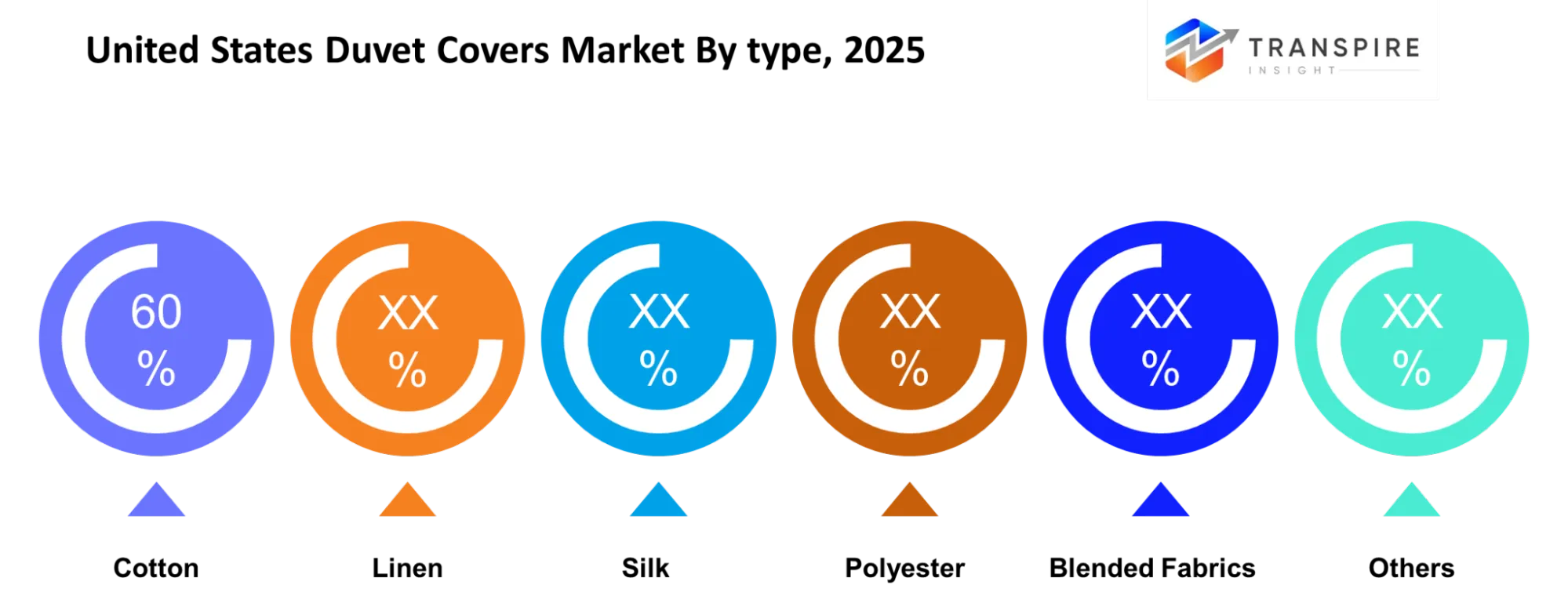
Cotton based duvet covers still hold pretty strong demand, mostly because they feel soft, breathe well, and they’re simply easy care. People also like linen options for durability, plus that natural texture kind of look, so it helps keep up premium demand. And silk, well, it stays tied to luxury bedding, not surprising there. Meanwhile polyester, or fabric blends, keep getting more interest because of cost efficiency, solid stain resistance, and how available they are through most retail channels.
\Material choice keeps steering purchasing habits across the whole bedding landscape. When blended fabrics grow, it tends to support affordability, while still offering decent comfort. Hospitality buyers often lean toward durability and wash resistance, and that factor supports polyester demand more directly. At the same time, luxury bedding segments keep backing silk and higher end natural materials, so expansion stays fairly balanced across price bands and real consumer preferences.
To learn more about this report, Download Free Sample Report
By Application :
Residential usage pushes demand too, since households replace bedding on a regular cycle and more people are focusing on home interior aesthetics. Hospitality, including hotels, keeps steady volume demand driven by occupancy rates and the repeated need for linen refreshes. For commercial use, things like serviced apartments and guest accommodations create consistent turnover, especially across urban centers where guest traffic stays active.
Luxury bedding applications are seeing a rising pull toward premium fabrics and customized designs. Hotel buyers, in particular, focus on durability hygiene standards and maintenance, which then shapes what fabric and stitching quality should be. For homes, adoption keeps moving forward with interior styling trends, while hospitality demand remains stable thanks to replacement policies and day to day operational requirements that facilities follow.
By End-User :
Households still feel like the main end user group , mostly because people are doing lifestyle upgrades and they care more about bedroom aesthetics lately. Hotels also bring a lot of demand because they keep doing linen replacement cycles , again and again, it’s kind of non stop in practice. Retailers matter too, they help move the items through distribution and they make it easier for customers to reach the products. And then the wider hospitality services thing, supports bulk procurement across lodgings and service establishments, so they kinda tie the whole system together.
What end users do and how much they buy, it’s not the same everywhere. It depends on how intensive the use is , and on how high the quality bar feels for them. Households tend to lean toward design variety plus affordability, while hotels push for durability and hygiene compliance, no shortcuts there. Retail channels offer broad product visibility, and hospitality operators keep procurement calendars consistent. Other groups show up as well, like institutional accommodations and rental housing segments, they have steady replacement needs, so they don’t really disappear.
By Distribution :
Online distribution channels keep growing, mainly because it’s convenient and you get a wide product selection, plus prices can be very competitive. Physical retail stores remain important because people like to check the texture or fit in person, and then buy right away. Specialty stores go more for premium and customized bedding solutions , and supermarkets stay strong with accessible, budget friendly options across mass consumer segments.
The overall distribution structure is shifting with changing consumer shopping behavior and product positioning. Online platforms help with broader reach and they also enable promotional pricing strategies, pretty easily. Retail outlets still matter for tactile product evaluation, even if online is trending. Specialty stores help premium segment visibility, while supermarkets keep essential bedding products available, so distribution ends up fairly balanced across both urban and semi-urban markets, you know, where demand is spread out.
What are the Key Use Cases Driving the United States Duvet Covers Market?
The main reason people are adopting duvet covers in the United States keeps coming back to residential bedroom furnishing, especially in middle and upper income homes where people upgrade master bedrooms and guest spaces. This group is where the biggest pull happens, because duvet covers are a pretty practical way to refresh the look of a room without having to swap out more expensive comforters.
Lately, more use is showing up in hospitality and short-term rental properties, and it seems to be getting momentum. Boutique hotels, serviced apartments, and higher end vacation rental operators are using duvet covers that can be swapped around, so they can keep linen routines simpler, enable quicker room turnover, and keep the room style in line with shifting guest expectations and brand standards.
At the same time, a few newer use cases are starting to form, like wellness-oriented residential developments and institutional accommodation settings. Senior living communities and luxury residential developers are leaning toward bedding solutions that help with temperature control plus antimicrobial features, mainly to improve comfort for residents. There’s also an interesting direction with smart textile integration, such as moisture responsive fabrics, and sensor enabled sleep performance tracking, which seems to have solid long term potential as connected home ecosystems mature, and people get more used to that kind of setup.
|
Report Metrics |
Details |
|
Market size value in 2025 |
USD 2.87 Billion |
|
Market size value in 2026 |
USD 3.03 Billion |
|
Revenue forecast in 2033 |
USD 4.43 Billion |
|
Growth rate |
CAGR of 5.58% from 2026 to 2033 |
|
Base year |
2025 |
|
Historical data |
2021 - 2024 |
|
Forecast period |
2026 - 2033 |
|
Report coverage |
Revenue forecast, competitive landscape, growth factors, and trends |
|
Geographic scope |
United States of America |
|
Key company profiled |
IKEA, Bed Bath & Beyond, West Elm, Pottery Barn, Target, Walmart, Amazon, Wayfair, Brooklinen, Parachute, Boll & Branch, Crane & Canopy, Casper, Saatva, Tempur Sealy |
|
Customization scope |
Free report customization (country, regional & segment scope). Avail customized purchase options to meet your exact research needs. |
|
Report Segmentation |
By Type (Cotton, Linen, Silk, Polyester, Blended Fabrics, Others); By Application (Residential, Hospitality, Commercial, Luxury Bedding, Hotels, Others); By End-User (Households, Hotels, Retailers, Hospitality, Others); By Distribution (Online, Retail Stores, Specialty Stores, Supermarkets, Others) |
Which Regions are Driving the United States Duvet Covers Market Growth?
The Northeast still feels like the main stronghold in the United States duvet covers market, mostly because you see a heavy concentration of high-income households, a pretty mature premium retail setup and, honestly, a design-minded buying mood that doesn’t fade. Major cities like New York and Boston keep spending up for home furnishing upgrades, especially via well-known omnichannel retailers and those specialty bedding brands that people kinda trust. On top of that, the region gets a kind of dense mix: interior design firms nearby, upscale residential developments in the area, and smaller boutique hospitality venues that, for their guests, treat bedding visuals as a priority. Add flagship showrooms to the mix, plus logistics that move efficiently, and you get quicker access to imported textile stocks, so the Northeast just keeps reinforcing that leadership spot.
Then the Midwest comes next, and it’s more steady than flashy, but its rhythm is a bit different from the Northeast because value-focused purchasing and repeat replacement cycles shape the demand more than the whole design-led side of things. Buyers here often lean toward long lasting durability, fabric practicality and cost reliability, instead of just jumping on every seasonal turn. Big format retailers along with wholesale distribution routes also make the sales lanes feel more predictable, so manufacturers can get steadier revenue visibility even when the wider retail climate wobbles a bit. After all, the Midwest becomes this dependable market where established brands keep long term customer commitment via reliable performance, not by leaning on premium novelty.
The Western United States is kinda emerging as the fastest-growing region, led by shifting consumer expectations related to sustainable textiles and technology enabled retail moments. Since 2023, more money going into regional fulfillment hubs and stronger take up of digital-first home furnishings platforms have sped up premium bedding sales. California, with its tighter textile sustainability rules and a very environmentally minded customer base has basically pushed brands to roll out traceable cotton, recycled packaging, and low impact dyeing processes. For new market entrants and investors, this area brings real upside through 2033 , because it tends to reward differentiated product innovation and it also supports swifter commercialization of the next generation bedding solutions.
Who are the Key Players in the United States Duvet Covers Market and How Do They Compete?
The competitive landscape in the United States duvet covers market still looks kind of moderately fragmented, like split between premium direct to consumer bedding brands and those older home furnishing retailers, plus large-scale mass market private label suppliers or something along those lines.Incumbents are basically defending their share by pushing faster product refresh cycles and more robust digital merchandising, while newer entrants keep disrupting things , by presenting highly curated collections and smoother online buying experiences. The main foundation for competition has slid away from price all by itself, toward fabric innovation, supply chain responsiveness, design exclusivity, and customer experience overall. So basically companies that can combine premium materials with efficient fulfillment plus personalization options , they usually end up winning stronger consumer loyalty.
Brooklinen shows up with digital-first convenience plus limited-edition product drops that bring urgency to younger urban buyers. Its bundled bedding packages and simplified online selection tools decrease purchase friction, and collaborations with lifestyle designers keep the brand feeling a bit more distinct. Parachute Home meanwhile has leaned into a minimalist aesthetic, with a lot of focus on certified organic materials, which attracts more affluent consumers who want transparent sourcing. The firm is also expanding via experiential retail showrooms that help grow brand trust, and in turn support higher-margin cross-category sales .
West Elm kinda differentiates itself by blending into wider home décor ecosystems, so you can do a coordinated bedroom look in a way that plain standalone bedding brands don’t really manage. Theres also partnerships with artisan textile suppliers which help it put out these exclusive collections, with a more local design appeal in the regions. Target moves more on private-label scale and pretty aggressive pricing, and it leans hard on extensive national distribution to snag middle income households. Meanwhile, The Company Store centers on durability-forward construction and this heritage driven trust, and it keeps expanding via upgraded e-commerce customization options, which tends to pull in repeat purchases for replacement bedding, over time.
Company List
- IKEA
- Bed Bath & Beyond
- West Elm
- Pottery Barn
- Target
- Walmart
- Amazon
- Wayfair
- Brooklinen
- Parachute
- Boll & Branch
- Crane & Canopy
- Casper
- Saatva
- Tempur Sealy
Recent Development News
In January 2026, Target Corporation collaborated with interior designer Jeremiah Brent to introduce the Jeremiah Brent Home bedding collection. The launch included duvet covers, comforter sets, and sheet sets positioned around premium yet accessible design aesthetics, reinforcing Target’s strategy of scaling designer-led home textiles in the U.S. mass retail bedding market. Source https://www.homesandgardens.com/
In March 2026, Wayfair partnered with Martha Stewart Living Omnimedia to launch a new spring bedding collection under the Martha Stewart brand. The rollout included duvet cover sets, reversible quilts, and sheet sets designed for seasonal home refreshes, reflecting strong consumer demand for affordable, design-led bedding in the U.S. e-commerce segment.
Source https://www.realsimple.com/
What Strategic Insights Define the Future of the United States Duvet Covers Market?
Over the next five to seven years , the United States duvet covers market is kind of structurally shifting toward a digitally integrated premium textile ecosystem, where the “new” product differences depend a lot less on surface looks and kind of more on how materials perform, how the supply chain can be shown end to end, and how much personalization is possible. This change is being pushed by tighter sustainability rules for textiles, by the steady move into direct-to-consumer buying, and also by the fact that shoppers are increasingly ready to pay extra for goods with clear durability plus wellness-leaning functions. So overall , the market probably favors brands that can keep design flexibility while also using data-enabled production responsiveness.
There’s a quieter risk though, and it sits with raw material concentration.In particular, there can be a heavy reliance on certified organic cotton, and also on specialty finishing providers, that are kind of clustered in a few global production hubs. If that kind of certification support becomes harder to reach or if the processing capacity gets disrupted, then premium brands that lean on these claims for pricing strength could see margins get squeezed, pretty fast.At the same time, an opportunity is forming in the Western United States via smart textile adoption, including temperature-adaptive bedding and sensor-enabled sleep setups, mainly for upscale homes and wellness-driven hospitality programs.
Market participants should really put emphasis on investing in nearshore manufacturing partnerships and digital product traceability systems, basically now rather than later. Firms that manage to keep sourcing flexible while also building verifiable material transparency should be in a better spot to win premium pricing, and to defend their share as expectations keep tightening.
United States Duvet Covers Market Report Segmentation
By Type
- Cotton
- Linen
- Silk
- Polyester
- Blended Fabrics
By Application
- Residential
- Hospitality
- Commercial
- Luxury Bedding
- Hotels
By End-User
- Households
- Hotels
- Retailers
- Hospitality
By Distribution
- Online
- Retail Stores
- Specialty Stores
- Supermarkets
Frequently Asked Questions
Find quick answers to common questions.
- IKEA
- Bed Bath & Beyond
- West Elm
- Pottery Barn
- Target
- Walmart
- Amazon
- Wayfair
- Brooklinen
- Parachute
- Boll & Branch
- Crane & Canopy
- Casper
- Saatva
- Tempur Sealy
Recently Published Reports
-
Apr 2026
Bottled Water Market
Bottled Water Market Size, Share & Analysis Report By Product Type (Still Bottled Water, Carbonated Bottled Water, Functional Bottled Water, and Others), By Packaging (PET, Cans, and Others), By Sales Channel (Supermarkets/Hypermarkets, Convenience Stores/Drug Stores, Grocery Stores/Club Stores, Foodservice, and Others) and Geography (North America, Europe, Asia-Pacific, Middle East and Africa, South and Central America), 2021 - 2032
-
Apr 2026
Color Cosmetic Packaging Market
Color Cosmetic Packaging Market Size, Share & Analysis Report By Application (Mascara Packaging, Liquid Packaging, and Liquid Face), By Type (Tubes & Bottles, Pens & Markers, Compacts & Containers, and Droppers & Pumps), and Geography (North America, Europe, Asia-Pacific, Middle East and Africa, South and Central America), 2021 - 2031
-
Apr 2026
External Microphone For Camera Market
External Microphone For Camera Market Size, Share & Analysis Report By Type (Shotgun Microphone, Lavalier Microphone, and Others), By Application (Digital Camera, Professional Video Camera, and Others), and Geography (North America, Europe, Asia-Pacific, Middle East and Africa, South and Central America), 2021 - 2031
-
Apr 2026
Foot Orthotic Insoles Market
Foot Orthotic Insoles Market Size, Share & Analysis Report By Type (Pre-fabricated, and Custom-made), By Material (Thermoplastic, Composite Carbon Fiber, and Others), By Distribution Channel (Drug Stores, Hospitals & Clinics, and Others), and Geography (North America, Europe, Asia-Pacific, Middle East and Africa, South and Central America), 2021 - 2031